2019 HONDA CLARITY FUEL CELL rear view mirror
[x] Cancel search: rear view mirrorPage 10 of 551
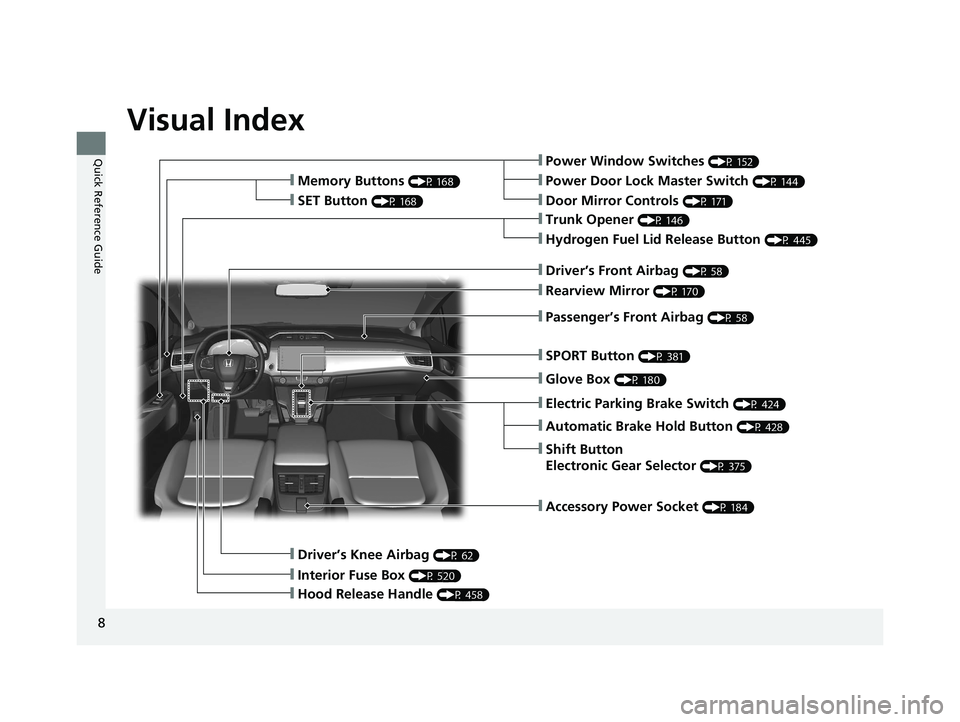
Visual Index
8
Quick Reference Guide❙Power Window Switches (P 152)
❙Trunk Opener (P 146)
❙Driver’s Knee Airbag (P 62)
❙Door Mirror Controls (P 171)
❙Power Door Lock Master Switch (P 144)
❙Hydrogen Fuel Lid Release Button (P 445)
❙Memory Buttons (P 168)
❙SET Button (P 168)
❙Interior Fuse Box (P 520)
❙Automatic Brake Hold Button (P 428)
❙Driver’s Front Airbag (P 58)
❙Passenger’s Front Airbag (P 58)
❙Rearview Mirror (P 170)
❙SPORT Button (P 381)
❙Glove Box (P 180)
❙Electric Parking Brake Switch (P 424)
❙Shift Button
Electronic Gear Selector
(P 375)
❙Accessory Power Socket (P 184)
❙Hood Release Handle (P 458)
19 CLARITY FCV CSS-31TRT6200.book 8 ページ 2019年1月17日 木曜日 午前11時54分
Page 12 of 551
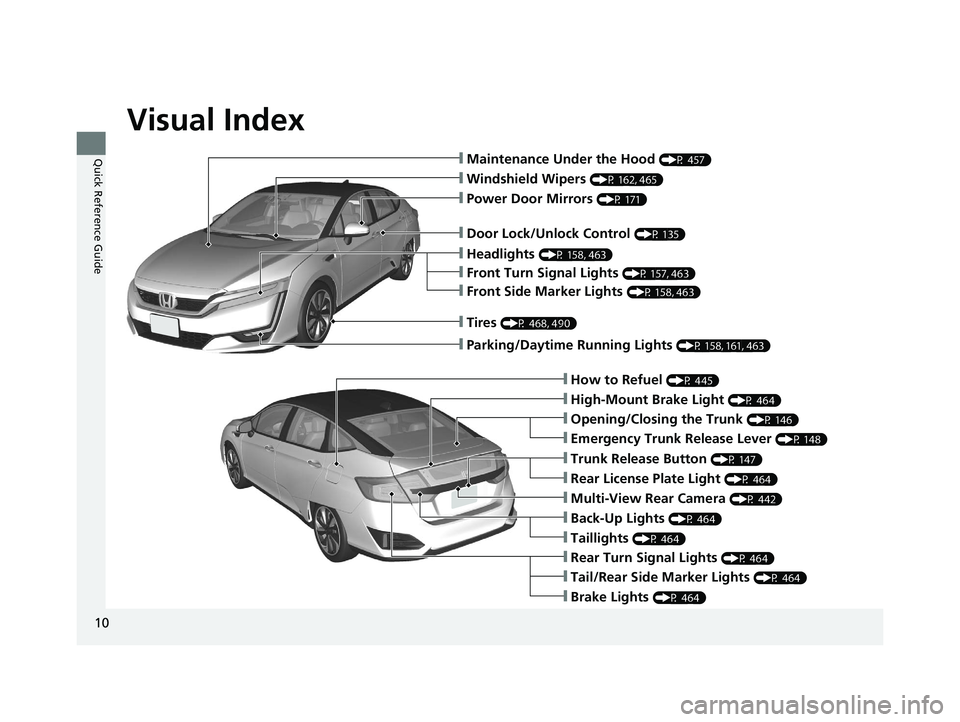
Visual Index
10
Quick Reference Guide❙Maintenance Under the Hood (P 457)
❙Windshield Wipers (P 162, 465)
❙Tires (P 468, 490)
❙Door Lock/Unlock Control (P 135)
❙Power Door Mirrors (P 171)
❙Headlights (P 158, 463)
❙Front Side Marker Lights (P 158, 463)
❙Front Turn Signal Lights (P 157, 463)
❙How to Refuel (P 445)
❙High-Mount Brake Light (P 464)
❙Emergency Trunk Release Lever (P 148)
❙Opening/Closing the Trunk (P 146)
❙Tail/Rear Side Marker Lights (P 464)
❙Brake Lights (P 464)
❙Rear Turn Signal Lights (P 464)
❙Back-Up Lights (P 464)
❙Taillights (P 464)
❙Trunk Release Button (P 147)
❙Rear License Plate Light (P 464)
❙Multi-View Rear Camera (P 442)
❙Parking/Daytime Running Lights (P 158, 161, 463)
19 CLARITY FCV CSS-31TRT6200.book 10 ページ 2019年1月17日 木曜日 午前11時54分
Page 38 of 551
36
Quick Reference Guide
Honda Sensing®
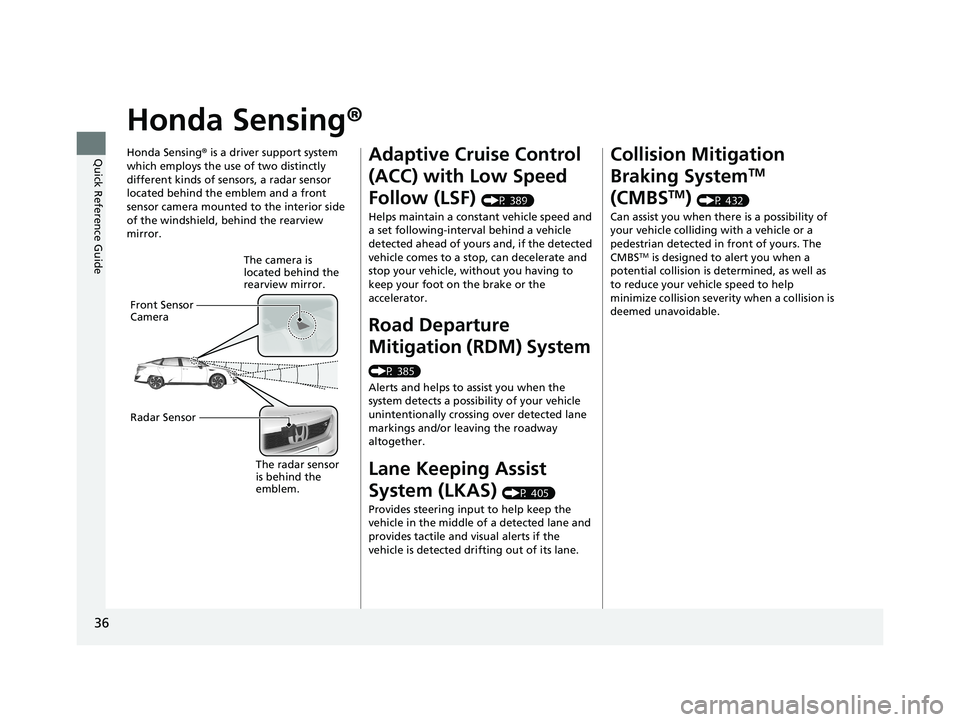
Honda Sensing® is a driver support system
which employs the use of two distinctly
different kinds of sensors, a radar sensor
located behind the emblem and a front
sensor camera mounted to the interior side
of the windshield, behind the rearview
mirror.
The camera is
located behind the
rearview mirror.
Front Sensor
Camera
Radar Sensor
The radar sensor
is behind the
emblem.
Adaptive Cruise Control
(ACC) with Low Speed
Follow (LSF)
(P 389)
Helps maintain a constant vehicle speed and
a set following-interval behind a vehicle
detected ahead of yours and, if the detected
vehicle comes to a stop, can decelerate and
stop your vehicle, wi thout you having to
keep your foot on the brake or the
accelerator.
Road Departure
Mitigation (RDM) System
(P 385)
Alerts and helps to assist you when the
system detects a possibility of your vehicle
unintentionally crossing over detected lane
markings and/or leaving the roadway
altogether.
Lane Keeping Assist
System (LKAS)
(P 405)
Provides steering input to help keep the
vehicle in the middle of a detected lane and
provides tactile and visual alerts if the
vehicle is detected drifting out of its lane.
Collision Mitigation
Braking System
TM
(CMBS
TM) (P 432)
Can assist you when there is a possibility of
your vehicle colliding with a vehicle or a
pedestrian detected in front of yours. The
CMBS
TM is designed to alert you when a
potential collision is determined, as well as
to reduce your vehicle speed to help
minimize collision severity when a collision is
deemed unavoidable.
19 CLARITY FCV CSS-31TRT6200.book 36 ページ 2019年1月17日 木曜日 午前11時 54分
Page 133 of 551
131
Controls
This chapter explains how to operate the various controls necessary for driving.
Clock.................................................. 132
Locking and Unlocking the Doors Key Types and Functions .................. 133
Low Smart Entry Remote Signal Strength .. 134Locking/Unlocking the Doors from the Outside .......................................... 135
Locking/Unlocking the Doors from the Inside ............................................. 142
Childproof Door Locks ..................... 144
Auto Door Locking/Unlocking .......... 145
Opening and Closing the Trunk ....... 146
Security System ................................ 149
Immobilizer System .......................... 149 Security System Alarm...................... 149
Opening and Closing the Windows ... 152
Operating the Switches Around the
Steering Wheel POWER Button................................. 154
Turn Signals ..................................... 157
Light Switches.................................. 158
Daytime Running Lights ................... 161
Wipers and Washers ........................ 162
Brightness Control ........................... 164
Rear Defogger Button ...................... 166
Driving Position Memory System ...... 167
Adjusting the Steering Wheel........... 169 Adjusting the Mirrors
....................... 170
Interior Rearview Mirror ................... 170
Power Door Mirrors ......................... 171
Adjusting the Seats .......................... 172
Front Seats ...................................... 172
Interior Lights/Interior Convenience
Items ................................................ 178
Interior Lights .................................. 178
Interior Convenience Items .............. 180
Climate Control System ................... 188
Using Automatic Climate Control .... 188
Automatic Climate Control Sensors ... 196
19 CLARITY FCV CSS-31TRT6200.book 131 ページ 2019年1月17日 木曜日 午前11 時54分
Page 172 of 551
170
Controls
Adjusting the Mirrors
Interior Rearview Mirror
Adjust the angle of the rearview mirror when you are sitting in the correct driving
position.
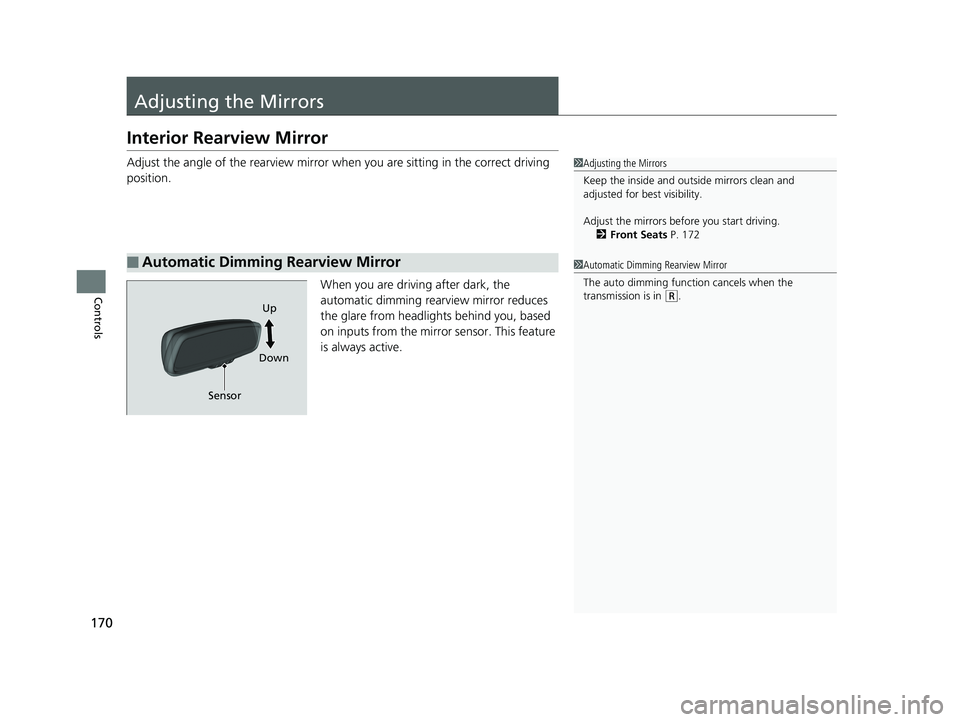
When you are driving after dark, the
automatic dimming rearview mirror reduces
the glare from headlights behind you, based
on inputs from the mirror sensor. This feature
is always active.
■Automatic Dimming Rearview Mirror
1Adjusting the Mirrors
Keep the inside and out side mirrors clean and
adjusted for best visibility.
Adjust the mirrors befo re you start driving.
2 Front Seats P. 172
1Automatic Dimming Rearview Mirror
The auto dimming function cancels when the
transmission is in
(R.
Sensor Up
Down
19 CLARITY FCV CSS-31TRT6200.book 170 ページ 2019年1月17日 木曜日 午前11 時54分
Page 385 of 551
383
uuWhen Driving uFront Sensor Camera
Continued
Driving
Front Sensor Camera
The camera, used in systems such as LKAS, RDM, ACC with LSF, and CMBSTM, is
designed to detect an object that tri ggers any of the systems to operate its
functions.
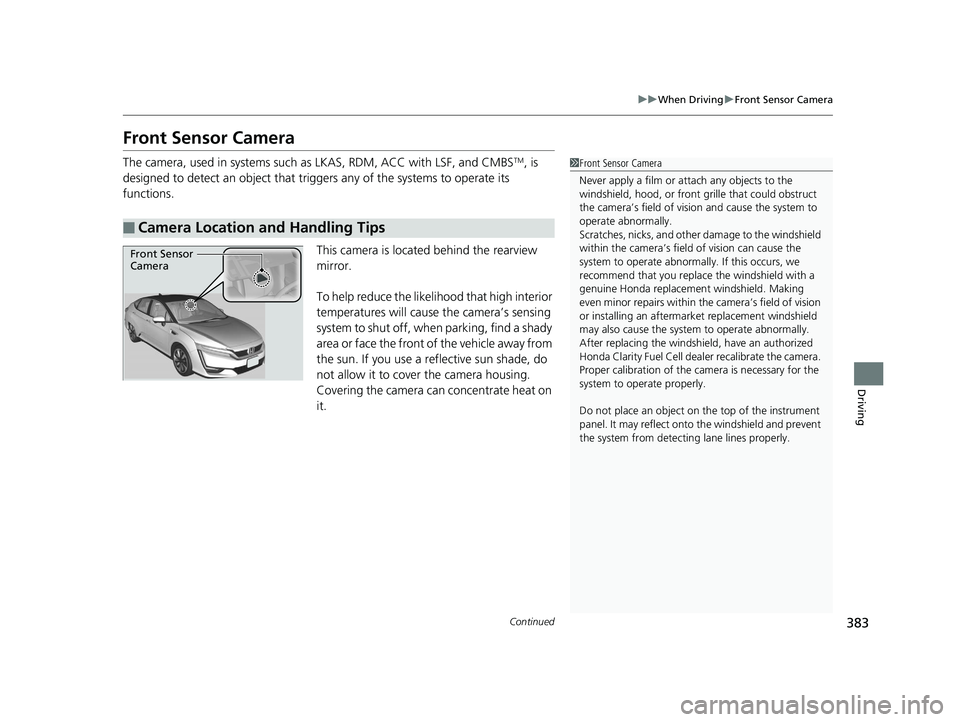
This camera is located behind the rearview
mirror.
To help reduce the likelihood that high interior
temperatures will cause the camera’s sensing
s y s t e m t o s h u t o f f , w h e n p a r k i n g , f i n d a s h a d y
area or face the front of the vehicle away from
the sun. If you use a reflective sun shade, do
not allow it to cover the camera housing.
Covering the camera can concentrate heat on
it.
■Camera Location and Handling Tips
1Front Sensor Camera
Never apply a film or attach any objects to the
windshield, hood, or front grille that could obstruct
the camera’s field of vision and cause the system to
operate abnormally.
Scratches, nicks, and othe r damage to the windshield
within the camera’s fiel d of vision can cause the
system to operate abnormall y. If this occurs, we
recommend that you replac e the windshield with a
genuine Honda replacem ent windshield. Making
even minor repairs within th e camera’s field of vision
or installing an aftermarket replacement windshield
may also cause the system to operate abnormally.
After replacing th e windshield, have an authorized
Honda Clarity Fuel Cell deal er recalibrate the camera.
Proper calibrat ion of the camera is necessary for the
system to ope rate properly.
Do not place an object on the top of the instrument
panel. It may reflect onto the windshield and prevent
the system from detecting lane lines properly.
Front Sensor
Camera
19 CLARITY FCV CSS-31TRT6200.book 383 ページ 2019年1月17日 木曜日 午前11 時54分
Page 387 of 551
385
uuWhen Driving uRoad Departure Mitigation (RDM) System
Continued
Driving
Road Departure Mitigation (RDM) System
Alerts and helps to assist you when the system detects a possibility of your vehicle
unintentionally crossing over detected lane markings and/or leaving the roadway
altogether.
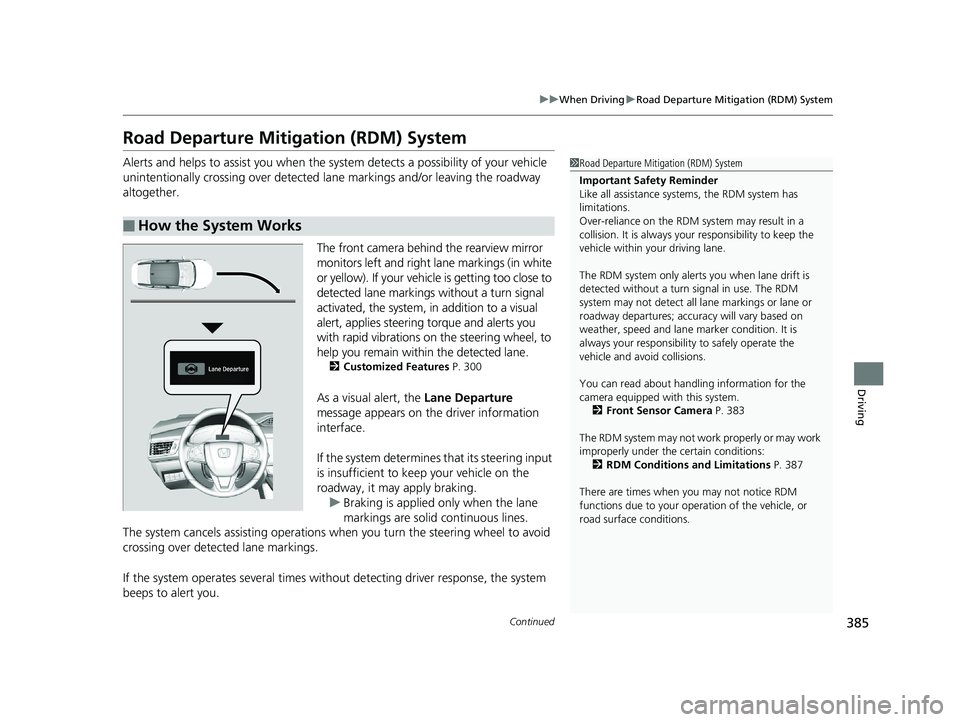
The front camera behind the rearview mirror
monitors left and right lane markings (in white
or yellow). If your vehicl e is getting too close to
detected lane markings without a turn signal
activated, the system, in addition to a visual
alert, applies steering torque and alerts you
with rapid vibrations on the steering wheel, to
help you remain within the detected lane.
2 Customized Features P. 300
As a visual alert, the Lane Departure
message appears on the driver information
interface.
If the system determines that its steering input
is insufficient to keep your vehicle on the
roadway, it may apply braking.
u Braking is applied only when the lane
markings are solid continuous lines.
The system cancels assisting operations wh en you turn the steering wheel to avoid
crossing over detected lane markings.
If the system operates several times with out detecting driver response, the system
beeps to alert you.
■How the System Works
1 Road Departure Mitigation (RDM) System
Important Safety Reminder
Like all assistance systems, the RDM system has
limitations.
Over-reliance on the RDM system may result in a
collision. It is always your responsibility to keep the
vehicle within your driving lane.
The RDM system only alerts you when lane drift is
detected without a turn signal in use. The RDM
system may not detect all la ne markings or lane or
roadway departures; accu racy will vary based on
weather, speed and lane marker condition. It is
always your responsibilit y to safely operate the
vehicle and avoid collisions.
You can read about handling information for the
camera equipped with this system.
2 Front Sensor Camera P. 383
The RDM system may not wo rk properly or may work
improperly under the certain conditions: 2 RDM Conditions and Limitations P. 387
There are times when you may not notice RDM
functions due to your opera tion of the vehicle, or
road surface conditions.
19 CLARITY FCV CSS-31TRT6200.book 385 ページ 2019年1月17日 木曜日 午前11 時54分
Page 391 of 551
389
uuWhen Driving uAdaptive Cruise Control (ACC) with Low Speed Follow (LSF)
Continued
Driving
Adaptive Cruise Control (ACC) with Low Speed
Follow (LSF)
Helps maintain a constant vehicle speed an d a set following-interval behind a vehicle
detected ahead of yours and, if the detect ed vehicle comes to a stop, can decelerate
and stop your ve hicle, without yo u having to keep your foot on the brake or the
accelerator.
When ACC with LSF slows your vehicle by applying the brakes, your vehicle's brake
lights will illuminate.
1 Adaptive Cruise Control (ACC) with Low Speed Follow (LSF)
Important Reminder
As with any system, there are limits to ACC with LSF.
Use the brake pedal whenever necessary, and always
keep a safe interval between your vehicle and other
vehicles.
Be careful not to severely impact the radar sensor
cover.
3WARNING
Improper use of ACC wi th LSF can lead to a
crash.
Use ACC with LSF only when driving on
expressways or freeways and in good
weather conditions.
3WARNING
ACC with LSF has limited braking capability
and may not stop your vehicle in time to
avoid a collision with a vehicle that quickly
stops in front of you.
Always be prepared to apply the brake
pedal if the conditions require.
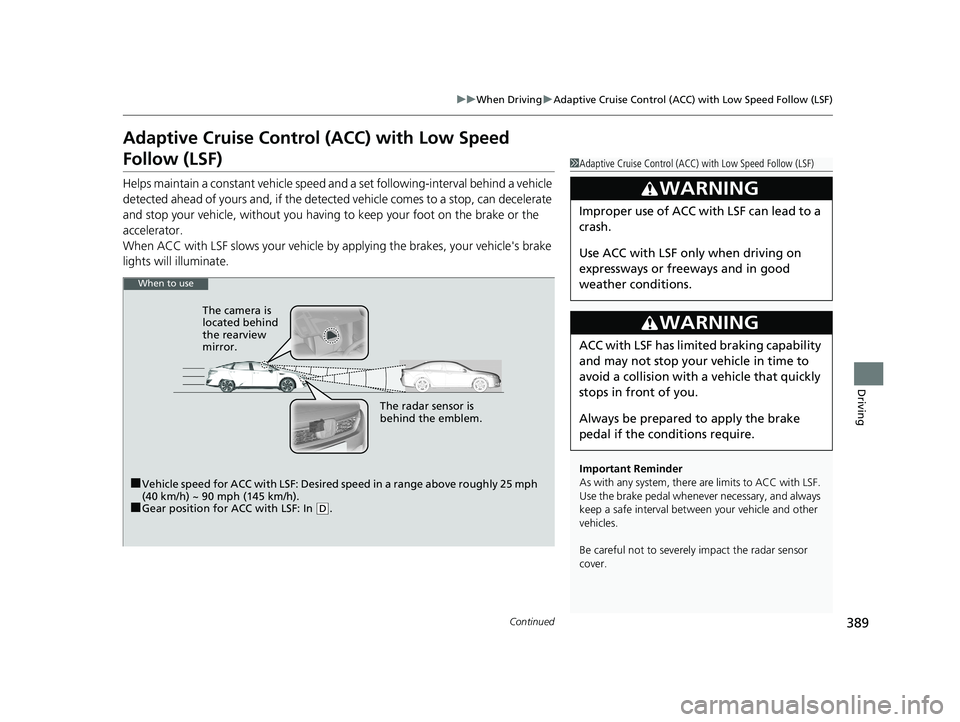
When to use
■Vehicle speed for ACC with LSF: Desired speed in a range above roughly 25 mph
(40 km/h) ~ 90 mph (145 km/h).
■Gear position for ACC with LSF: In ( D. The radar sensor is
behind the emblem.
The camera is
located behind
the rearview
mirror.
19 CLARITY FCV CSS-31TRT6200.book 389 ページ 2019年1月17日 木曜日 午前11
時54分