Page 624 of 727
622
uuMaintenance Under the Hood uChanging the Engine Oil and Oil Filter
Maintenance
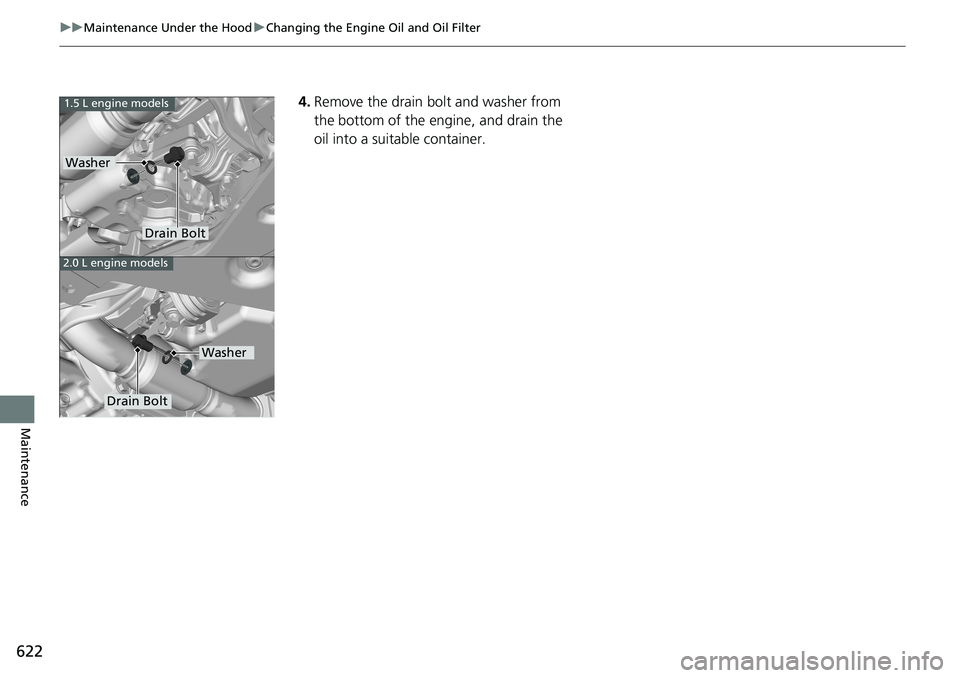
4. Remove the drain bolt and washer from
the bottom of the engine, and drain the
oil into a suitable container.1.5 L engine models
2.0 L engine models
Drain Bolt
Washer
Drain Bolt
Washer
Page 625 of 727
623
uuMaintenance Under the Hood uChanging the Engine Oil and Oil Filter
Continued
Maintenance
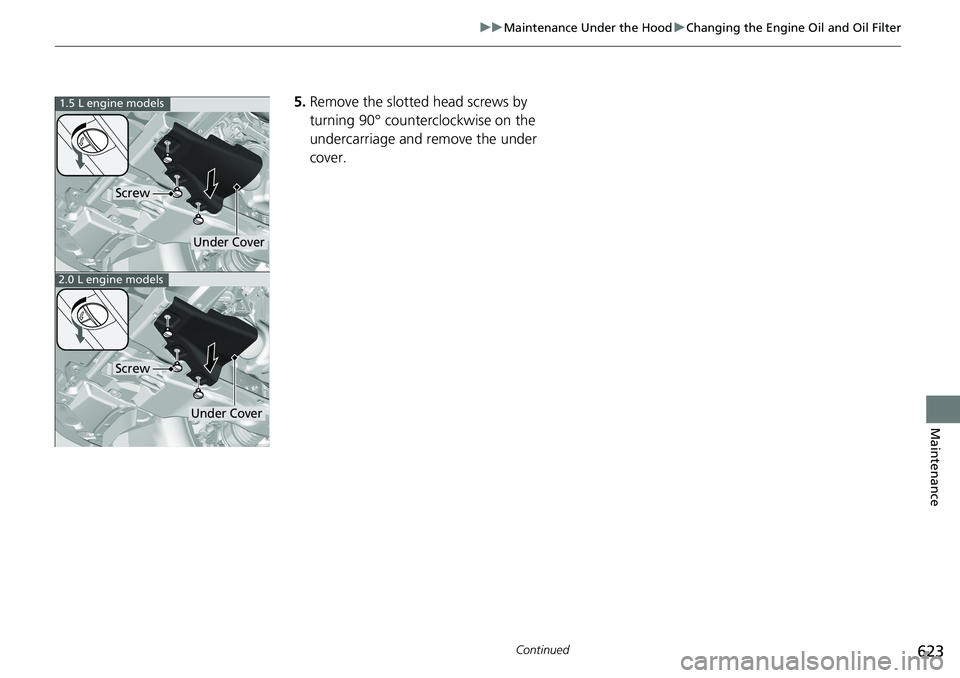
5. Remove the slotted head screws by
turning 90° counterc lockwise on the
undercarriage and remove the under
cover.1.5 L engine models
2.0 L engine models
Under Cover
Screw
Under Cover
Screw
Page 626 of 727

uuMaintenance Under the Hood uChanging the Engine Oil and Oil Filter
624
Maintenance
6. Remove the oil filter and dispose of the
remaining oil.
7. Check that the filter ga sket is not stuck to
the engine contact surface.
u If it is stuck, you must detach it.
8. Wipe away dirt and dust adhering to the
contact surface of the engine block, and
install a new oil filter.
u Apply a light coat of new engine oil to
the filter gasket.
9. Put a new washer on the drain bolt, then
reinstall the drain bolt.
u Tightening torque:
30 lbf∙ft (40 N∙m, 4.0 kgf∙m)
10. Pour the recommended engine oil into the
engine.
u Engine oil change capacity (including
filter):
3.7 US qt (3.5 L)
5.0 US qt (4.8 L)
11. Reinstall the engine oil fill cap securely and
start the engine.
12. Run the engine for a few minutes, and
then check that there is no leak from the
drain bolt or oil filter.
13. Stop the engine, wait for three minutes,
and then check the oil level on the dipstick.
u If necessary, add more engine oil.1Changing the Engine Oil and Oil Filter
You will need a special wrench to replace the oil
filter. You can buy this wrench from a dealer.
When installing the new oil filter, follow the
instructions supplied with the oil filter.
Reinstall the engine oil fill cap. Start the engine. The
low oil pressure indicator should go off within five
seconds. If it does not, turn off the engine, and check
your work.1.5 L engine models
2.0 L engine models
Oil Filter
Oil Filter1.5 L engine models
2.0 L engine models
Page 656 of 727
654
Maintenance
Climate Control System Maintenance
Air Conditioning
To ensure proper and safe operation, th e Society of Automotive Engineers (SAE
J2845) recommends that the refrigerant system only be serviced by trained and
certified technicians.
Never repair or replace the air conditioni ng evaporator (cooling coil) with one
removed from a used or salvaged vehicle.
New replacement mobile air conditioning evaporators must be certified (and
labeled) as meeting SAE Standard J2842.
Dust and Pollen Filter
The climate control system is equipped wi th a dust and pollen filter that collects
pollen, dust, and other debris in the air. The Maintenance MinderTM messages will let
you know when to replace the filter.
We recommend that you replace the dust and pollen filter sooner when using your
vehicle in areas with high concentrations of dust.
1Air Conditioning
NOTICE
Vented refrigerant is harmful to the environment.
To avoid refrigerant from venting, never replace the
evaporator with one re moved from a used or
salvaged vehicle.
Refrigerant in your vehicle’s air conditioning system is
flammable and can be igni ted during servicing if
proper procedures are not followed.
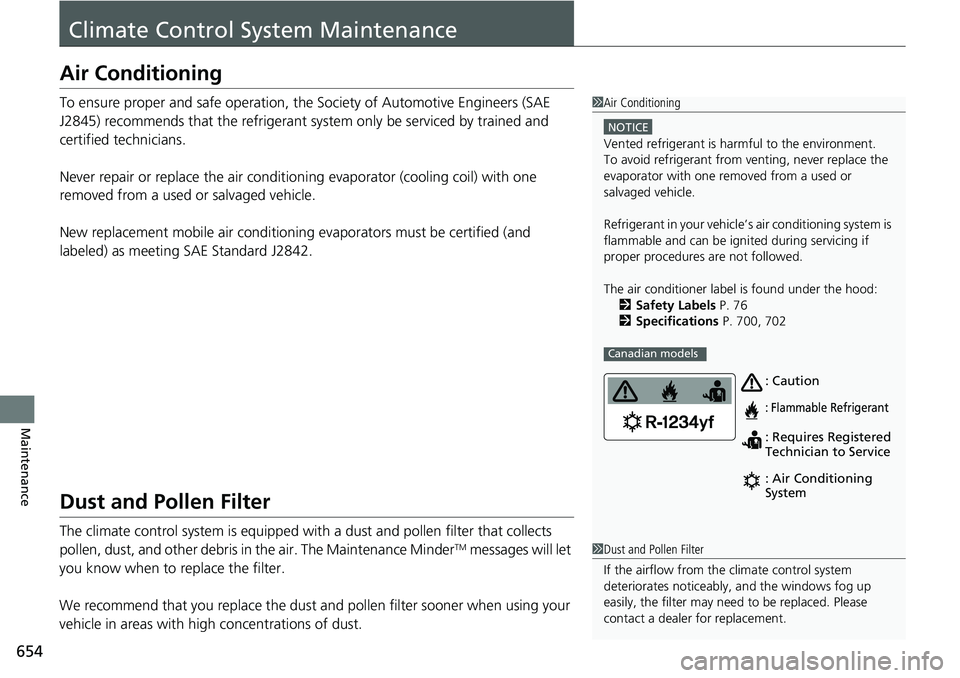
The air conditioner labe l is found under the hood:
2 Safety Labels P. 76
2 Specifications P. 700, 702
Canadian models
: Caution
: Flammable Refrigerant
: Requires Registered
Technician to Service
: Air Conditioning
System
1Dust and Pollen Filter
If the airflow from the climate control system
deteriorates noticeably, and the windows fog up
easily, the filter may need to be replaced. Please
contact a dealer for replacement.
Page 660 of 727
uuCleaning uExterior Care
658
Maintenance
A good coat of automotive body wax helps protect your vehicle’s paint from the
elements. Wax will wear off over time an d expose your vehicle’s paint to the
elements, so reapply as necessary.
If you get gasoline, oil, engine coolant, or battery fluid on resin coated parts, they
may be stained or the coating may peel. Prom ptly wipe it away using a soft cloth and
clean water.
Wipe using a glass cleaner.
Aluminum is susceptible to deteriorat ion caused by salt and other road
contaminants. When necessary, as early as possible use a sponge and mild detergent
to wipe away these contaminants. Do no t use a stiff brush or harsh chemicals
(including some commercial wheel cleaners). These can damage the protective finish
on aluminum alloy wheels, resulting in corrosion. Depending on the type of finish,
the wheels also may lose their luster or appear burnished. To avoid water stains,
wipe the wheels dry with a cloth while they are still wet.
■Applying Wax
■Maintaining the Bumpers and Other Resin Coated Parts
■Cleaning the Window
■Maintaining Aluminum Wheels
1 Applying Wax
NOTICE
Chemical solvents and strong cleaners can damage
the paint, metal, and plasti c on your vehicle. Wipe
away spills immediately.
1 Maintaining the Bumpers an d Other Resin Coated Parts
Ask a dealer about the corr ect coating material when
you want to repair the pa inted surface of the parts
made of resin.
Page 665 of 727
663
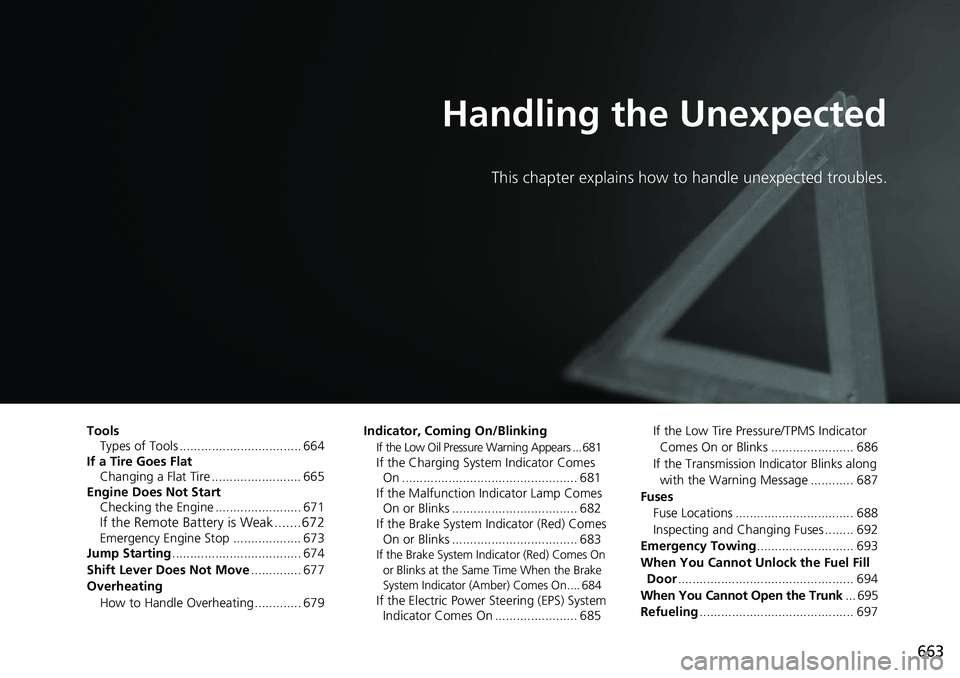
Handling the Unexpected
This chapter explains how to handle unexpected troubles.
ToolsTypes of Tools .................................. 664
If a Tire Goes Flat
Changing a Flat Tire ......................... 665
Engine Does Not Start Checking the Engine ........................ 671
If the Remote Battery is Weak ....... 672Emergency Engine Stop ................... 673
Jump Starting .................................... 674
Shift Lever Does Not Move .............. 677
Overheating How to Handle Overheating ............. 679 Indicator, Coming On/Blinking
If the Low Oil Pressure Warning Appears ... 681If the Charging System Indicator Comes
On ................................................. 681
If the Malfunction Indicator Lamp Comes On or Blinks ................................... 682
If the Brake System Indicator (Red) Comes
On or Blinks ................................... 683
If the Brake System Indicator (Red) Comes On
or Blinks at the Same Time When the Brake
System Indicator (Amber) Comes On.... 684
If the Electric Power Steering (EPS) System Indicator Comes On ....................... 685 If the Low Tire Pressure/TPMS Indicator
Comes On or Blinks ....................... 686
If the Transmission I ndicator Blinks along
with the Warning Message ............ 687
Fuses Fuse Locations ................................. 688
Inspecting and Changing Fuses ........ 692
Emergency Towing ........................... 693
When You Cannot Unlock the Fuel Fill Door ................................................. 694
When You Cannot Open the Trunk ... 695
Refueling ........................................... 697
Page 683 of 727

681
Handling the Unexpected
Indicator, Coming On/Blinking
If the Low Oil Pressure Warning Appears
■Reasons for the warning to appear
Appears when the engine oil pressure is low.
■What to do as soon as the warning
appears
1. Immediately park the vehicle in a safe place.
2. If necessary, turn the hazard warning lights
on.
■What to do after parking the vehicle
1. Stop the engine and let it sit for
approximately three minutes.
2. Open the hood and ch eck the oil level.
2Oil Check P. 618
3.Start the engine and check the low oil
pressure warning.
u The warning disappears: Start driving
again.
u The warning does not disappear:
Immediately stop the engine and contact
a dealer for repairs.
If the Charging System Indicator Comes On
■Reasons for the indicator to come on
Comes on when the battery is not being charged.
■What to do when th e indicator comes on
Stop in a safe place and have y our vehicle checked by a dealer
immediately.
1 If the Low Oil Pressure Warning Appears
NOTICE
Running the engine with low oil pressure can cause
serious mechanical damage almost immediately.
1If the Charging System Indicator Comes On
If you need to stop temporarily, do not turn off the
engine. Restarting the engi ne may rapidly discharge
the battery.
Page 702 of 727
700
Information
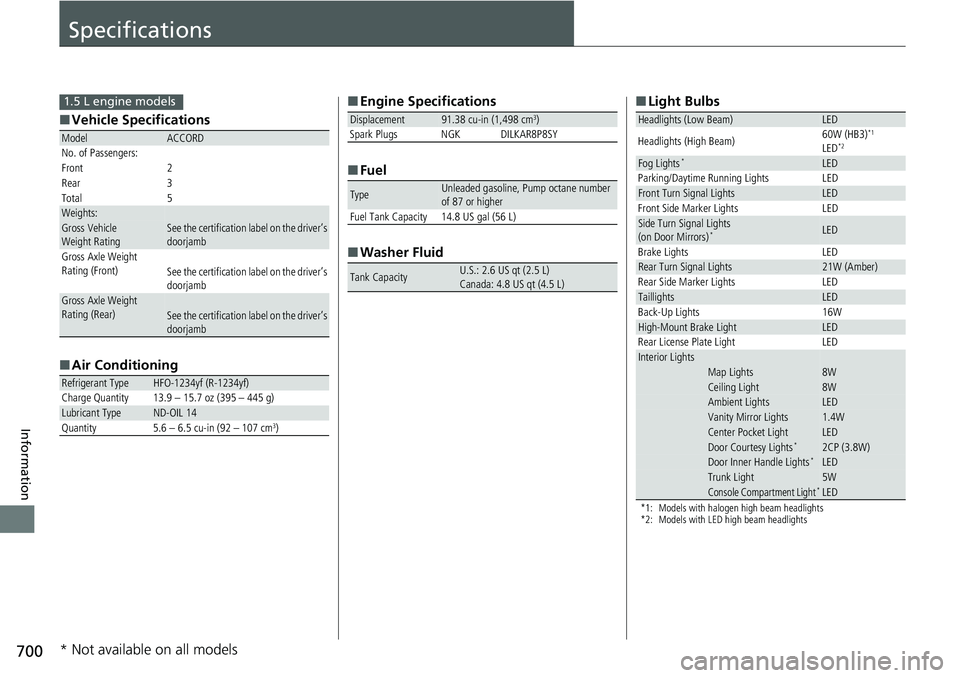
Specifications
■Vehicle Specifications
■ Air Conditioning
ModelACCORD
No. of Passengers:
Front 2
Rear 3
Total 5
Weights:Gross Vehicle
Weight Rating See the certification label on the driver’s
doorjamb
Gross Axle Weight
Rating (Front)See the certification label on the driver’s
doorjamb
Gross Axle Weight
Rating (Rear)See the certification label on the driver’s
doorjamb
Refrigerant TypeHFO-1234yf (R-1234yf)
Charge Quantity 13.9 – 15.7 oz (395 – 445 g)
Lubricant TypeND-OIL 14
Quantity 5.6 – 6.5 cu-in (92 – 107 cm3)
1.5 L engine models■ Engine Specifications
■ Fuel
■ Washer Fluid
Displacement91.38 cu-in (1,498 cm3)
Spark Plugs NGK DILKAR8P8SY
TypeUnleaded gasoline, Pump octane number
of 87 or higher
Fuel Tank Capacity 14.8 US gal (56 L)
Tank CapacityU.S.: 2.6 US qt (2.5 L)
Canada: 4.8 US qt (4.5 L)
■ Light Bulbs
*1: Models with halogen high beam headlights
*2: Models with LED high beam headlights
Headlights (Low Beam)LED
Headlights (High Beam) 60W (HB3)*1
LED*2
Fog Lights*LED
Parking/Daytime Running Lights LED
Front Turn Signal LightsLED
Front Side Marker Lights LED
Side Turn Signal Lights
(on Door Mirrors)*LED
Brake Lights LED
Rear Turn Signal Lights21W (Amber)
Rear Side Marker Lights LED
TaillightsLED
Back-Up Lights 16W
High-Mount Brake LightLED
Rear License Plate Light LED
Interior LightsMap Lights8WCeiling Light8WAmbient LightsLEDVanity Mirror Lights1.4WCenter Pocket LightLEDDoor Courtesy Lights*2CP (3.8W)Door Inner Handle Lights*LEDTrunk Light5WConsole Compartment Light*LED
* Not available on all models