2019 FORD RANGER oil pressure
[x] Cancel search: oil pressurePage 315 of 512
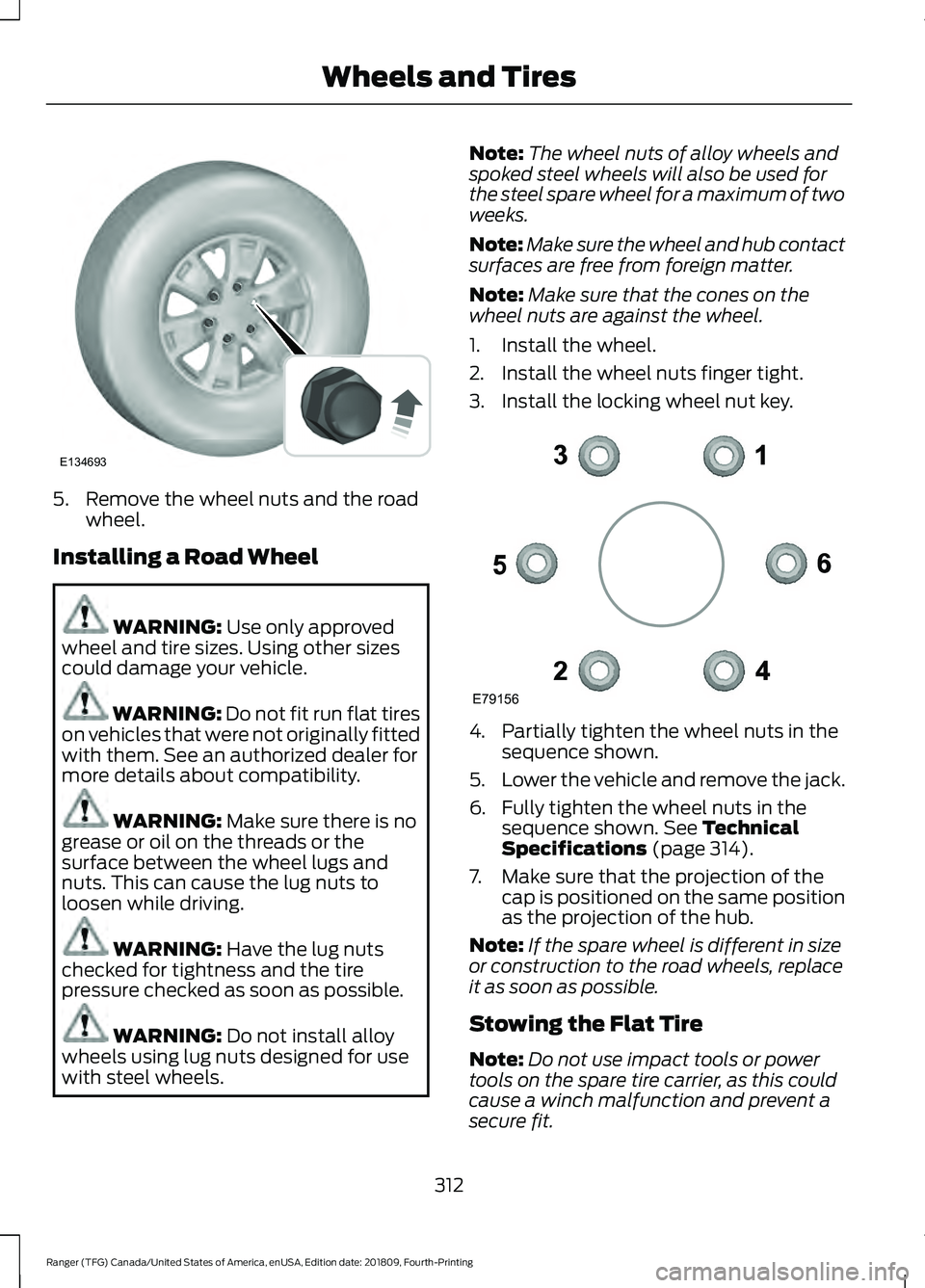
5. Remove the wheel nuts and the road
wheel.
Installing a Road Wheel WARNING: Use only approved
wheel and tire sizes. Using other sizes
could damage your vehicle. WARNING: Do not fit run flat tires
on vehicles that were not originally fitted
with them. See an authorized dealer for
more details about compatibility. WARNING:
Make sure there is no
grease or oil on the threads or the
surface between the wheel lugs and
nuts. This can cause the lug nuts to
loosen while driving. WARNING:
Have the lug nuts
checked for tightness and the tire
pressure checked as soon as possible. WARNING:
Do not install alloy
wheels using lug nuts designed for use
with steel wheels. Note:
The wheel nuts of alloy wheels and
spoked steel wheels will also be used for
the steel spare wheel for a maximum of two
weeks.
Note: Make sure the wheel and hub contact
surfaces are free from foreign matter.
Note: Make sure that the cones on the
wheel nuts are against the wheel.
1. Install the wheel.
2. Install the wheel nuts finger tight.
3. Install the locking wheel nut key. 4. Partially tighten the wheel nuts in the
sequence shown.
5. Lower the vehicle and remove the jack.
6. Fully tighten the wheel nuts in the sequence shown.
See Technical
Specifications (page 314).
7. Make sure that the projection of the cap is positioned on the same position
as the projection of the hub.
Note: If the spare wheel is different in size
or construction to the road wheels, replace
it as soon as possible.
Stowing the Flat Tire
Note: Do not use impact tools or power
tools on the spare tire carrier, as this could
cause a winch malfunction and prevent a
secure fit.
312
Ranger (TFG) Canada/United States of America, enUSA, Edition date: 201809, Fourth-Printing Wheels and TiresE134693 E79156
Page 323 of 512

CAPACITIES AND SPECIFICATIONS
Capacities
WARNING: The air conditioning refrigerant system contains refrigerant under
high pressure. Only qualified personnel should service the air conditioning refrigerant
system. Opening the air conditioning refrigerant system can cause personal injury. Capacity
Item
6.2 qt (5.9 L)
Engine oil (with oil filter).
11.6 qt (11 L)
Engine coolant.
Between MIN/MAX on brake fluid reservoir
Brake fluid.
2.11 pt (1.0 L)
Front axle fluid.
3.70 pt (1.75 L)
Rear axle fluid (standard axle).
3.04 pt (1.44 L)
Rear axle fluid (locking axle).
12.8 qt (12.1 L)1
Automatic transmission fluid.
23.7 fl oz (700 ml)
Power Transfer Unit (PTU) fluid (four-
wheel drive).
Fill as required
Windshield washer fluid.
18.8 gal (71.2 L)
Fuel tank.
1.49 lb (0.675 kg)
A/C refrigerant.
2.7 fl oz (80 ml)
A/C refrigerant compressor oil.
1 Approximate dry fill capacity. Actual amount could vary during fluid changes.
320
Ranger (TFG) Canada/United States of America, enUSA, Edition date: 201809, Fourth-Printing Capacities and Specifications
Page 441 of 512

When the oil change message appears in
the information display, it is time for an oil
change. Make sure you perform the oil
change within two weeks or 500 mi
(800 km) of the message appearing. Make
sure you reset the Intelligent Oil-Life
Monitor after each oil change. See
Oil
Change Indicator Reset (page 260).
If your information display resets
prematurely or becomes inoperative, you
should perform the oil change interval at
six months or
5,000 mi (8,000 km) from
your last oil change. Never exceed one year
or
10,000 mi (16,000 km) between oil
change intervals,
Your vehicle is very sophisticated and built
with multiple, complex, performance
systems. Every manufacturer develops
these systems using different
specifications and performance features.
That is why it is important to rely upon your
dealership to properly diagnose and repair
your vehicle.
We have recommended maintenance
intervals for various parts and component
systems based upon engineering testing.
We rely upon this testing to determine the
most appropriate mileage for replacement
of oils and fluids to protect your vehicle at
the lowest overall cost to you and
recommends against maintenance
schedules that deviate from the scheduled
maintenance information.
We strongly recommend the use of only
genuine Ford, Motorcraft or
Ford-authorized re-manufactured
replacement parts engineered for your
vehicle. Additives and Chemicals
This owner's manual and the our
Workshop Manual list the recommended
additives and chemicals for your vehicle.
We do not recommend using chemicals or
additives not approved by us as part of
your vehicle
’s normal maintenance. Please
consult your warranty information.
Oils, Fluids and Flushing
In many cases, fluid discoloration is a
normal operating characteristic and, by
itself, does not necessarily indicate a
concern or that the fluid needs to be
changed. However, a qualified expert, such
as the factory-trained technicians at your
dealership, should inspect discolored fluids
that also show signs of overheating or
foreign material contamination
immediately.
Make sure to change your vehicle ’s oils and
fluids at the specified intervals or in
conjunction with a repair. Flushing is a
viable way to change fluid for many vehicle
sub-systems during scheduled
maintenance. It is critical that systems are
flushed only with new fluid that is the same
as that required to fill and operate the
system or using a Ford-approved flushing
chemical.
Owner Checks and Services
Make sure you perform the following basic
maintenance checks and inspections every
month or at six-month intervals. Check Every Month
Engine oil level.
Function of all interior and exterior lights.
Tires (including spare) for wear and proper pressure.
438
Ranger (TFG) Canada/United States of America, enUSA, Edition date: 201809, Fourth-Printing Scheduled Maintenance
Page 443 of 512

Multi-Point Inspection
Suspension components for leaks ordamage
Exhaust system
Steering and linkage
Exterior lamps operation
Tires (including spare) for wear and properpressure2
Fluid levels 1
; fill if necessary
Windshield for cracks, chips or pits
For oil and fluid leaks
Washer spray and wiper operation
Half-shaft dust boots
1 Brake, coolant recovery reservoir, automatic transmission and window washer
2 If your vehicle is equipped with a temporary mobility kit, check the tire sealant expiration
Use By date on the canister. Replace as needed.
Be sure to ask your dealership service
advisor or technician about the multi-point
vehicle inspection. It is a comprehensive
way to perform a thorough inspection of
your vehicle. Your checklist gives you
immediate feedback on the overall
condition of your vehicle.
440
Ranger (TFG) Canada/United States of America, enUSA, Edition date: 201809, Fourth-Printing Scheduled Maintenance
Page 511 of 512

Using Snow Chains.....................................297
Vehicles with Stability Control..................... 298
Using Stability Control
................................170
AdvanceTrac ™ with Roll Stability Control ™
(RSC™)............................................................. 170
Using SYNC™ With Your Media Player.............................................................347
Audio Voice Commands.................................. 347
Media Sources..................................................... 347
Using SYNC™ With Your Phone............342 Accessing Features through the Phone
Menu.................................................................. 343
Pairing a Phone...................................................342
Phone Controls................................................... 343
Phone Voice Commands................................ 343
Using Traction Control...............................168 Switching the System Off .............................. 168
System Indicator Lights and Messages.......................................................... 168
Using Voice Recognition...........................340 Audio Voice Commands................................. 370
Climate Voice Commands............................... 371
Initiating a Voice Session............................... 340
Mobile App Voice Commands...................... 374
Navigation Voice Commands........................ 373
Phone Voice Commands................................. 371
SiriusXM Traffic and Travel Link Voice Commands...................................................... 374
System Interaction and Feedback...............341
Voice Settings Commands............................. 375
Using Voice Recognition - Vehicles Without: SYNC..........................................338
Voice Pass Through.......................................... 338
Utilizing the Mediation/Arbitration Program (Canada Only).........................237
V
Vehicle Care
...................................................273
General Information.......................................... 273
Vehicle Certification Label........................318
Vehicle Identification Number.................318
Vehicle Storage.............................................278 Battery.................................................................... 279
Body........................................................................\
278
Brakes..................................................................... 279
Cooling system................................................... 279
Engine..................................................................... 279Fuel system..........................................................
279
General.................................................................. 278
Miscellaneous..................................................... 279
Removing Vehicle From Storage.................. 279
Tires........................................................................\
. 279
Ventilation See: Climate Control........................................... 111
VIN See: Vehicle Identification Number.............318
Voice Control
....................................................67
W
Warning Lamps and Indicators................86 Adaptive Cruise Control Indicator.................86
Anti-Lock Braking System................................ 86
Automatic Headlamp High Beam Indicator............................................................. 86
Auto-Start-Stop Indicator................................ 86
Battery..................................................................... 86
Blind Spot Monitor.............................................. 86
Brake System Warning Lamp.......................... 86
Cruise Control Indicator..................................... 87
Direction Indicator................................................ 87
Door Ajar Warning Lamp................................... 87
Electronic Locking Differential........................ 87
Engine Coolant Temperature Warning Lamp.................................................................... 87
Fasten Seatbelt Warning Lamp...................... 87
Four-Wheel Drive Indicators............................ 87
Front Airbag............................................................ 87
Front Fog Lamp Indicator.................................. 87
Headlamp High Beam Indicator..................... 87
Hood Ajar Warning Lamp................................. 88
Low Beam Malfunction..................................... 88
Low Fuel Level Warning Lamp....................... 88
Low Tire Pressure Warning Lamp.................. 88
Low Washer Fluid Level Warning Lamp
................................................................... 88
Oil Pressure Warning Lamp............................. 88
Parking Lamps...................................................... 88
Powertrain Malfunction/Reduced Power/Electronic Throttle Control...........88
Service Engine Soon........................................... 88
Stability Control and Traction Control Indicator............................................................. 89
Stability Control and Traction Control Off Warning Lamp................................................. 89
508
Ranger (TFG) Canada/United States of America, enUSA, Edition date: 201809, Fourth-Printing Index