2019 FORD POLICE INTERCEPTOR brakes
[x] Cancel search: brakesPage 147 of 370

TOWING A TRAILER
WARNING: Towing trailers
beyond the maximum
recommended gross trailer
weight exceeds the limit of your
vehicle and could result in engine
damage, transmission damage,
structural damage, loss of
vehicle control, vehicle rollover
and personal injury. WARNING:
Do not exceed
the GVWR or the GAWR
specified on the certification
label.
Note: See
Recommended
Towing Weights (page 145).
Your vehicle may have electrical
items, such as fuses or relays,
related to towing. See
Fuses
(page 164).
Your vehicle's load capacity
designation is by weight, not by
volume, so you cannot necessarily
use all available space when
loading a vehicle or trailer.
Towing a trailer places an extra
load on your vehicle's engine,
transmission, axle, brakes, tires
and suspension. Inspect these
components periodically during,
and after, any towing operation. Load Placement
To help minimize how trailer
movement affects your vehicle
when driving:
•
Load the heaviest items closest
to the trailer floor.
• Load the heaviest items
centered between the left and
right side trailer tires.
• Load the heaviest items above
the trailer axles or just slightly
forward toward the trailer
tongue. Do not allow the final
trailer tongue weight to go
above or below 10-15% of the
loaded trailer weight.
• Select a ball mount with the
correct rise or drop and load
capacity. When both the
loaded vehicle and trailer are
connected, the trailer frame
should be level, or slightly
angled down toward your
vehicle, when viewed from the
side.
When driving with a trailer or
payload, a slight takeoff vibration
or shudder may be present due to
the increased payload weight.
Additional information regarding
proper trailer loading and setting
your vehicle up for towing is
located in another chapter of this
manual. See
Load Limit (page
138).
You can also find information in
the
RV & Trailer Towing Guide
available at your authorized
dealer, or online.
144
Police Interceptor (CPH) Police, Canada/United States of America, enUSA, Edition date: 201806, First-Printing Towing
Page 148 of 370
RV & Trailer Towing Guide Online
http://www.fleet.ford.com/towing-guides/
Website
RECOMMENDED TOWING
WEIGHTS
Note: Do not tow a trailer during
patrol or pursuit situations.
Note: Do not exceed the trailer
weight for your vehicle
configuration listed in the chart
below.
Note: Take into consideration
trailer frontal area. Do not exceed
12 ft² (1.11 m²).
Note: For high altitude operation,
reduce the gross combined weight
by 2% per 1,000 ft (300 m)
starting at the 1,000 ft (300 m)
elevation point. Note:
Certain states require
electric trailer brakes for trailers
over a specified weight. Check
state regulations for this specified
weight. The maximum trailer
weights listed may be limited to
this specified weight, as the
vehicle ’s electrical system may not
include the wiring connector
needed to activate electric trailer
brakes.
Your vehicle may tow a trailer
provided the maximum trailer
weight is less than or equal to the
maximum trailer weight listed for
your vehicle configuration on the
following chart. Maximum trailer weight
Engine
1,000 lb (454 kg)
3.5L TiVCT front-wheel drive
1,000 lb (454 kg)
3.5L GTDI all-wheel drive
1,000 lb (454 kg)
3.7L TiVCT all-wheel drive
145
Police Interceptor (CPH) Police, Canada/United States of America, enUSA, Edition date: 201806, First-Printing Towing
Page 149 of 370
ESSENTIAL TOWING CHECKS
Follow these guidelines for safe towing:
•
Do not tow a trailer until you drive your
vehicle at least 1,000 mi (1,600 km).
• Consult your local motor vehicle laws
for towing a trailer.
• See the instructions included with
towing accessories for the proper
installation and adjustment
specifications.
• Service your vehicle more frequently if
you tow a trailer. See your scheduled
maintenance information.
• If you use a rental trailer, follow the
instructions the rental agency gives
you.
You can find information on load
specification terms found on the tire label
and Safety Compliance label as well as
instructions on calculating your vehicle's
load in the Load Carrying chapter. See
Load Limit
(page 138).
Remember to account for the trailer
tongue weight as part of your vehicle load
when calculating the total vehicle weight.
Hitches
Do not use a hitch that either clamps onto
the bumper or attaches to the axle.
Distribute the trailer load so 10-15% of the
total trailer weight is on the tongue.
Safety Chains
Note: Never attach safety chains to the
bumper.
Always connect the safety chains to the
hook retainers of your vehicle hitch.
To connect the trailer ’s safety chains, cross
them under the trailer tongue and allow
enough slack for turning tight corners. Do
not allow the chains to drag on the ground. Trailer Brakes WARNING:
Do not connect a
trailer's hydraulic brake system directly
to your vehicle's brake system. Your
vehicle may not have enough braking
power and your chances of having a
collision greatly increase.
Electric brakes and manual, automatic or
surge-type trailer brakes are safe if you
install them properly and adjust them to
the manufacturer's specifications. The
trailer brakes must meet local and federal
regulations.
The rating for the tow vehicle's braking
system operation is at the gross vehicle
weight rating, not the gross combined
weight rating.
Separate functioning brake systems
are required for safe control of towed
vehicles and trailers weighing more
than 1500 pounds (680 kilograms)
when loaded.
Trailer Lamps WARNING:
Never connect any
trailer lamp wiring to the vehicle's tail
lamp wiring; this may damage the
electrical system resulting in fire. Contact
your authorized dealer as soon as
possible for assistance in proper trailer
tow wiring installation. Additional
electrical equipment may be required.
Trailer lamps are required on most towed
vehicles. Make sure all running lights, brake
lights, turn signals and hazard lights are
working.
146
Police Interceptor (CPH) Police, Canada/United States of America, enUSA, Edition date: 201806, First-Printing Towing
Page 150 of 370
Before Towing a Trailer
Practice turning, stopping and backing up
to get the feel of your vehicle-trailer
combination before starting on a trip.
When turning, make wider turns so the
trailer wheels clear curbs and other
obstacles.
When Towing a Trailer
•
Do not drive faster than 70 mph
(113 km/h) during the first 500 mi
(800 km).
• Do not make full-throttle starts.
• Check your hitch, electrical connections
and trailer wheel lug nuts thoroughly
after you have traveled 50 mi (80 km).
• When stopped in congested or heavy
traffic during hot weather, place the
gearshift in position P to aid engine and
transmission cooling and to help A/C
performance.
• Turn off the speed control with heavy
loads or in hilly terrain. The speed
control may turn off automatically
when you are towing on long, steep
grades.
• Shift to a lower gear when driving down
a long or steep hill. Do not apply the
brakes continuously, as they may
overheat and become less effective.
• If your transmission is equipped with a
Grade Assist or Tow/Haul feature, use
this feature when towing. This provides
engine braking and helps eliminate
excessive transmission shifting for
optimum fuel economy and
transmission cooling.
• Allow more distance for stopping with
a trailer attached. Anticipate stops and
brake gradually.
• Avoid parking on a grade. However, if
you must park on a grade:
1. Turn the steering wheel to point your vehicle tires away from traffic flow. 2. Set your vehicle parking brake.
3. Place the automatic transmission in
park (P).
4. Place wheel chocks in front and back of the trailer wheels. Chocks are not
included with your vehicle.
Launching or Retrieving a Boat or
Personal Watercraft (PWC)
Note: Disconnect the wiring to the trailer
before backing the trailer into the water.
Note: Reconnect the wiring to the trailer
after
removing the trailer from the water.
When backing down a ramp during boat
launching or retrieval:
• Do not allow the static water level to
rise above the bottom edge of the rear
bumper.
• Do not allow waves to break higher
than
6 in (15 cm) above the bottom
edge of the rear bumper.
Exceeding these limits may allow water to
enter vehicle components:
• Causing internal damage to the
components.
• Affecting drivability, emissions, and
reliability.
Replace the rear axle lubricant anytime
the rear axle has been submerged in water.
Water may have contaminated the rear
axle lubricant, which is not normally
checked or changed unless a leak is
suspected or other axle repair is required.
147
Police Interceptor (CPH) Police, Canada/United States of America, enUSA, Edition date: 201806, First-Printing Towing
Page 153 of 370
•
Transmissions give their best fuel
economy when operated in the top
cruise gear and with steady pressure
on the gas pedal.
• Four-wheel-drive operation (if
equipped) is less fuel efficient than
two-wheel-drive operation.
• Close the windows for high-speed
driving.
DRIVING THROUGH WATER WARNING: Do not drive through
flowing or deep water as you may lose
control of your vehicle.
Note: Driving through standing water can
cause vehicle damage.
Note: Engine damage can occur if water
enters the air filter.
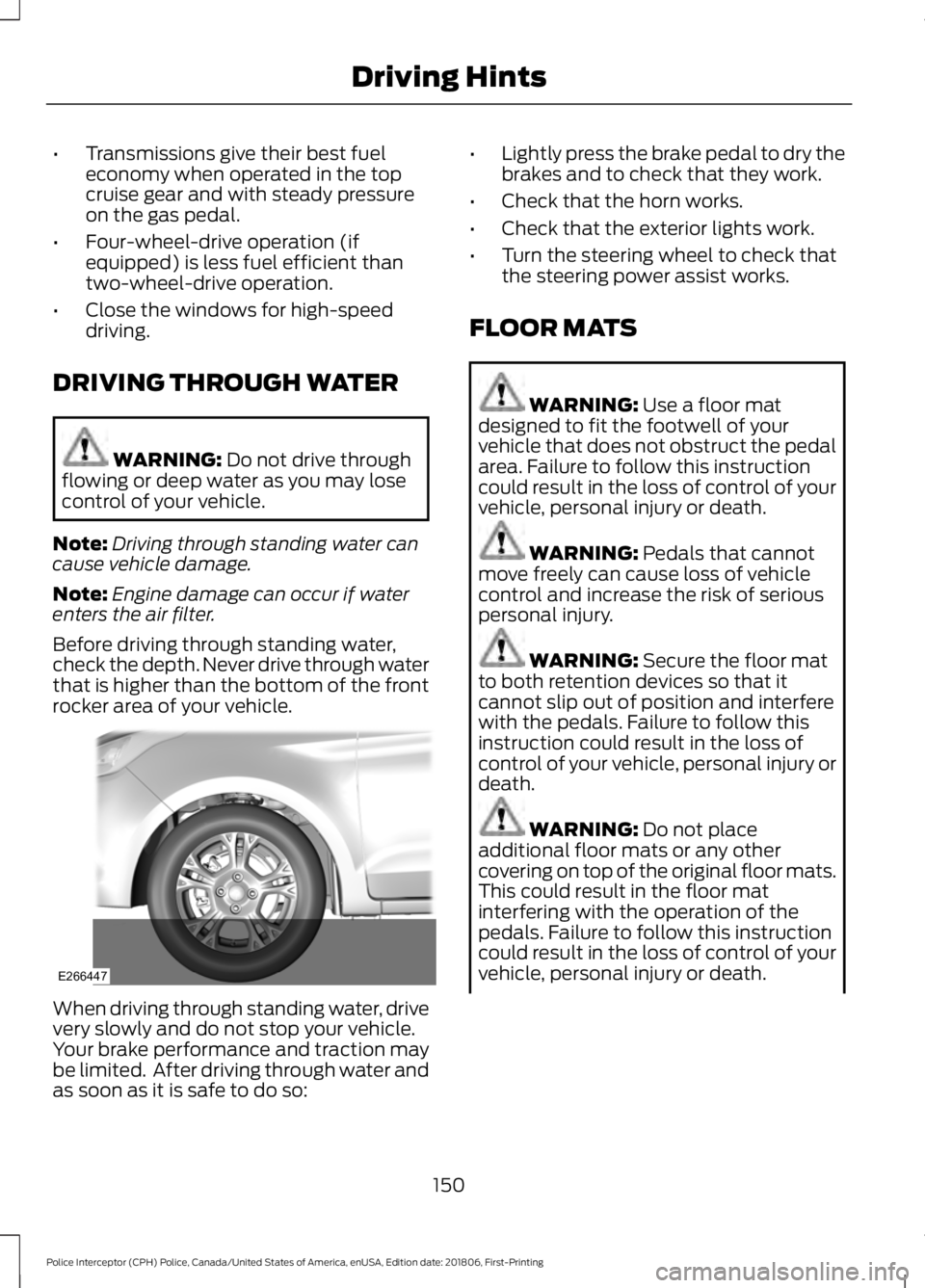
Before driving through standing water,
check the depth. Never drive through water
that is higher than the bottom of the front
rocker area of your vehicle. When driving through standing water, drive
very slowly and do not stop your vehicle.
Your brake performance and traction may
be limited. After driving through water and
as soon as it is safe to do so: •
Lightly press the brake pedal to dry the
brakes and to check that they work.
• Check that the horn works.
• Check that the exterior lights work.
• Turn the steering wheel to check that
the steering power assist works.
FLOOR MATS WARNING:
Use a floor mat
designed to fit the footwell of your
vehicle that does not obstruct the pedal
area. Failure to follow this instruction
could result in the loss of control of your
vehicle, personal injury or death. WARNING:
Pedals that cannot
move freely can cause loss of vehicle
control and increase the risk of serious
personal injury. WARNING:
Secure the floor mat
to both retention devices so that it
cannot slip out of position and interfere
with the pedals. Failure to follow this
instruction could result in the loss of
control of your vehicle, personal injury or
death. WARNING:
Do not place
additional floor mats or any other
covering on top of the original floor mats.
This could result in the floor mat
interfering with the operation of the
pedals. Failure to follow this instruction
could result in the loss of control of your
vehicle, personal injury or death.
150
Police Interceptor (CPH) Police, Canada/United States of America, enUSA, Edition date: 201806, First-Printing Driving HintsE266447
Page 205 of 370
•
Cover interior trim to prevent fading.
• Keep all rubber parts free from oil and
solvents.
Engine
• Change the engine oil and filter prior to
storage because used engine oil
contains contaminates which may
cause engine damage.
• Start the engine every 15 days for a
minimum of 15 minutes. Run at fast idle
with the climate controls set to defrost
until the engine reaches normal
operating temperature.
• With your foot on the brake, shift
through all the gears while the engine
is running.
• We recommend that you change the
engine oil before you use your vehicle
again.
Fuel system
• Fill the fuel tank with high-quality fuel
until the first automatic shutoff of the
fuel pump nozzle.
Cooling system
• Protect against freezing temperatures.
• When removing your vehicle from
storage, check coolant fluid level.
Confirm that there are no cooling
system leaks and that fluid is at the
recommended level.
Battery
• Check and recharge as necessary. Keep
connections clean.
• If storing your vehicle for more than 30
days without recharging the battery,
we recommend that you disconnect
the battery cables to maintain battery
charge for quick starting. Note:
It is necessary to reset memory
features if battery cables are disconnected.
Brakes
• Make sure the brakes and parking brake
release fully.
Tires
• Maintain recommended air pressure.
Miscellaneous
• Make sure all linkages, cables, levers
and pins under your vehicle are covered
with grease to prevent rust.
• Move vehicles at least 25 ft (7.5 m)
every 15 days to lubricate working parts
and prevent corrosion.
Removing Vehicle From Storage
When your vehicle is ready to come out of
storage, do the following:
• Wash your vehicle to remove any dirt
or grease film build-up on window
surfaces.
• Check windshield wipers for any
deterioration.
• Check under the hood for any foreign
material that may have collected
during storage such as mice or squirrel
nests.
• Check the exhaust for any foreign
material that may have collected
during storage.
• Check tire pressures and set tire
inflation per the Tire Label.
• Check brake pedal operation. Drive
your vehicle
15 ft (4.5 m) back and
forth to remove rust build-up.
202
Police Interceptor (CPH) Police, Canada/United States of America, enUSA, Edition date: 201806, First-Printing Vehicle Care
Page 362 of 370

A
A/C
See: Climate Control........................................... 83
About This Manual...........................................7
ABS See: Brakes........................................................... 120
ABS driving hints See: Hints on Driving With Anti-Lock
Brakes.................................................................. 121
Accessories See: Replacement Parts
Recommendation............................................ 12
Adjusting the Headlamps..........................192 Horizontal Aim Adjustment............................ 193
Vertical Aim Adjustment.................................. 192
Adjusting the Pedals
.....................................59
Adjusting the Steering Wheel....................57
Airbag Disposal..............................................50
Air Conditioning See: Climate Control........................................... 83
Air Filter See: Changing the Engine Air Filter.............194
Alarm See: Anti-Theft Alarm........................................ 56
All-Wheel Drive
..............................................113
Anti-Theft Alarm............................................56
Alarm System........................................................ 56
Arming the Alarm................................................. 56
Disarming the Alarm........................................... 56
Triggering the Alarm........................................... 56
Appendices.....................................................319
At a Glance........................................................16
Audible Warnings and Indicators..............73 Headlamps On Warning Chime...................... 73
Key in Ignition Warning Chime......................... 73
Parking Brake On Warning Chime.................. 73
Audio Control
...................................................57
Auxiliary Steering Wheel Controls.................57
Audio Input Jack...........................................255
Audio System
................................................249
General Information......................................... 249
Audio Unit......................................................250 Accessing the Auxiliary Media
Sources............................................................. 250
Accessing the Clock Settings......................... 251
Accessing the Menu........................................... 251
Accessing the Phone Features...................... 251Accessing the Sound Settings.......................
251
Adjusting the Volume........................................ 251
Changing Radio Stations................................. 251
Ejecting the CD................................................... 252
Listening to a CD................................................ 252
Listening to Satellite Radio............................ 252
Listening to the Radio...................................... 252
Menu Structure................................................... 252
Muting the Audio................................................ 252
Playing or Pausing Media................................ 252
Switching the Audio Unit On and Off.........252
Using Seek, Fast Forward and Reverse.............................................................. 252
Using the Display Control............................... 252
Using the Number Block................................. 252
Autolamps........................................................62 Windshield Wiper Activated
Headlamps........................................................ 62
Automatic Transmission............................110 Automatic Transmission Adaptive
Learning.............................................................. 112
Brake-Shift Interlock.......................................... 110
If Your Vehicle Gets Stuck In Mud or Snow.................................................................... 112
Understanding the Positions of Your Automatic Transmission............................. 110
Automatic Transmission Fluid Check - 3.5L Duratec/3.5L Ecoboost™/
3.7L..................................................................185
6F50/6F55 Transmission............................... 185
Adjusting Automatic Transmission Fluid Levels.................................................................. 187
Checking the fluid level.................................... 187
Moving the Air Filter Assembly (Accessing the Dipstick).................................................... 186
Reinstalling The Air Filter Assembly...........188
Auxiliary Power Points.................................90 12 Volt DC Power Point...................................... 90
Locations................................................................ 90
AWD See: All-Wheel Drive........................................... 113
B
Battery See: Changing the 12V Battery...................... 189
Blind Spot Information System...............132 Switching the System Off and On................133
359
Police Interceptor (CPH) Police, Canada/United States of America, enUSA, Edition date: 201806, First-Printing Index
Page 363 of 370

System Errors.......................................................
133
System Limitations............................................ 133
Using the System................................................ 132
BLIS See: Blind Spot Information System...........132
Bonnet Lock See: Opening and Closing the Hood............175
Booster Seats..................................................25 Types of Booster Seats...................................... 26
Brake Fluid Check........................................188
Brakes...............................................................120 General Information.......................................... 120
Breaking-In......................................................149
Bulb Specification Chart...........................247
C
Cabin Air Filter.................................................85
Capacities and Specifications - 3.5L Duratec.........................................................235
Alternative Engine Oil for Extremely Cold Climates........................................................... 238
Specifications...................................................... 235
Capacities and Specifications - 3.5L Ecoboost™.................................................238
Alternative Engine Oil for Extreme Cold Climates........................................................... 242
Specifications..................................................... 239
Capacities and Specifications - 3.7L.................................................................243
Alternative Engine Oil for Extremely Cold Climates........................................................... 246
Specifications..................................................... 244
Capacities and Specifications................228
Car Wash See: Cleaning the Exterior............................... 196
Catalytic Converter......................................107 On-Board Diagnostics (OBD-II)................... 108
Readiness for Inspection and Maintenance (I/M) Testing................................................... 108
Center Console
................................................91
Console Mounting Plates................................... 91
Universal Top Tray................................................ 91
Changing a Bulb
............................................193
Front Fog Lamp................................................... 193
High-Intensity Discharge Headlamps.........193
LED Lamps............................................................ 194
License Plate Lamp........................................... 194Changing a Fuse............................................173
Fuses........................................................................\
173
Changing a Road Wheel............................222 Dissimilar Spare Wheel and Tire Assembly
Information...................................................... 222
Tire Change Procedure.................................... 223
Changing the 12V Battery..........................189 Battery Management System......................... 191
Changing the Engine Air Filter.................194
Changing the Wiper Blades......................192
Checking the Wiper Blades.......................191
Child Restraint and Seatbelt Maintenance.................................................35
Child Restraint Positioning
..........................27
Child Safety.......................................................18
General Information............................................. 18
Cleaning Leather Seats.............................200
Cleaning Products.......................................196 Materials................................................................ 196
Cleaning the Engine
....................................198
Cleaning the Exterior...................................196 Cleaning the Headlamps................................. 197
Exterior Chrome Parts....................................... 197
Exterior Plastic Parts......................................... 197
Stripes or Graphics............................................. 197
Underbody............................................................. 197
Under Hood........................................................... 197
Cleaning the Instrument Panel and Instrument Cluster Lens.........................199
Cleaning the Interior....................................199 Mirrors..................................................................... 199
Cleaning the Wheels...................................201
Cleaning the Windows and Wiper Blades............................................................198
Climate Control
..............................................83
Coolant Check See: Engine Coolant Check............................. 181
Crash Sensors and Airbag Indicator
........45
Airbags and Police Equipment....................... 46
Cross Traffic Alert.........................................134 False Alerts........................................................... 136
Switching the System Off and On...............136
System Errors....................................................... 136
System Lights, Messages and Audible Alerts.................................................................. 135
System Limitations............................................ 136
Using the System................................................ 134
360
Police Interceptor (CPH) Police, Canada/United States of America, enUSA, Edition date: 201806, First-Printing Index