2019 FORD GT tires
[x] Cancel search: tiresPage 199 of 321

Changing Tires With a Tire
Pressure Monitoring System
Note:
Each road tire is equipped with a tire
pressure sensor located inside the wheel
and tire assembly cavity. The pressure
sensor is attached to the valve stem. The
pressure sensor is covered by the tire and is
not visible unless the tire is removed. Take
care when changing the tire to avoid
damaging the sensor
You should always have your tires serviced
by an authorized dealer.
Check the tire pressure periodically (at
least monthly) using an accurate tire
gauge. See Inflating Your Tires in this
chapter. Understanding Your Tire Pressure
Monitoring System The tire pressure monitoring system
measures pressure in your road tires and
sends the tire pressure readings to your
vehicle. You can view the tire pressure
readings through the information display.
See General Information (page 69). The
low tire pressure warning light turns on if
the tire pressure is significantly low. Once
the light is illuminated, your tires are
under-inflated and need to be inflated to
the manufacturer
’s recommended tire
pressure. Even if the light turns on and a
short time later turns off, your tire pressure
still needs to be checked.
When You Believe Your System is Not
Operating Properly
The main function of the tire pressure
monitoring system is to warn you when
your tires need air. It can also warn you in
the event the system is no longer capable
of functioning as intended. See the
following chart for information concerning
your tire pressure monitoring system:
196
Ford GT (CGX) Canada/United States of America, enUSA, Edition date: 201810, First-Printing Wheels and TiresE142549 E250820
Page 200 of 321

Customer action required
Possible cause
Low tire pressure
warning light
Make sure tires are at the proper pres-
sure. See Inflating your tires in this
chapter. After inflating your tires to the
manufacturer’s recommended pressure
as shown on the Tire Label (located on
the edge of driver ’s door or the B-Pillar),
the vehicle must be driven for at least
two minutes over 20 mph (32 km/h)
before the light turns off.
Tire(s) under-inflated
Solid warning light
If the tires are properly inflated and the
light remains on, contact your authorized
dealer as soon as possible.
TPMS malfunction
If the tires are properly inflated and the
light remains on, contact your authorized
dealer as soon as possible.
TPMS malfunction
Flashing warning
light
When Inflating Your Tires
Note: Do not use the tire pressure display
screen as a tire pressure gauge, this can
result in over or under inflation of a tire.
When putting air into your tires (such as at
a gas station or in your garage), the tire
pressure monitoring system may not
respond immediately to the air added to
your tires.
It may take up to two minutes of driving
over 20 mph (32 km/h) for the light to turn
off after you have filled your tires to the
recommended inflation pressure.
How Temperature Affects Your Tire
Pressure
The tire pressure monitoring system
monitors tire pressure in each pneumatic
tire. When driving in a normal manner, a
typical passenger tire inflation pressure
may increase about
2 –4 psi (14– 28 kPa)
from a cold start situation. If the vehicle is
stationary overnight with the outside temperature significantly lower than the
daytime temperature, the tire pressure may
decrease about 3 psi (21 kPa) for a drop of
30°F (17°C) in ambient temperature. This
lower pressure value may be detected by
the tire pressure monitoring system as
being significantly lower than the
recommended inflation pressure and
activate the system warning light for low
tire pressure. If the low tire pressure
warning light is on, visually check each tire
to verify that no tire is flat. If one or more
tires are flat, repair as necessary. Check
the air pressure in the road tires. If any tire
is under-inflated, carefully drive the vehicle
to the nearest location where air can be
added to the tires. Inflate all the tires to
the recommended inflation pressure.
197
Ford GT (CGX) Canada/United States of America, enUSA, Edition date: 201810, First-Printing Wheels and Tires
Page 201 of 321

CHANGING A ROAD WHEEL
Important Information for Lifting
or Jacking
A vehicle jack is not included with your
vehicle. If you are on the road and need to
change a wheel, it is recommended that
you contact the Ford GT Concierge to
obtain roadside assistance. See Special
Notices (page 10). Front lift points
A
Middle lift points
B
Rear lift points
C
To avoid damage to your vehicle, use a low
profile hydraulic jack when removing a road
wheel. Only place the jack on one of the
alloy lifting posts when lifting your vehicle.
Do not lift your vehicle on the carbon fiber
panels.
Note: It is recommended that an interface
be used between the alloy lifting point and
the vehicle jack (for example, a hockey puck
or dense rubber pad). DRIVING AT HIGH SPEED
Tire Pressure - Speeds Greater
Than
165 mph (265 km/h) WARNING:
Always re-inflate tires
to recommended tire pressures before
the vehicle is operated on-road. The
recommended pressure is located on the
tire label or safety certification label,
located on the B-pillar, inside the driver's
door.
Note: When driving over
165 mph
(265 km/h), be sure to check and adjust
your tire pressures accordingly.
Note: If you are not sure about the proper
tire inflation pressures, contact an
authorized dealer or service center. Your tires may require additional inflation
pressure for operation at speeds greater
than
165 mph (265 km/h). If this label is
present on your vehicle, you must adjust
the tire pressure accordingly.
198
Ford GT (CGX) Canada/United States of America, enUSA, Edition date: 201810, First-Printing Wheels and TiresE228623 E247515
Page 202 of 321
TECHNICAL SPECIFICATIONS
Wheel Lug Nut Torque Specifications
WARNING: When you install a wheel, always remove any corrosion, dirt or foreign
materials present on the mounting surfaces of the wheel or the surface of the wheel
hub, brake drum or brake disc that contacts the wheel. Make sure to secure any fasteners
that attach the rotor to the hub so they do not interfere with the mounting surfaces of
the wheel. Installing wheels without correct metal-to-metal contact at the wheel
mounting surfaces can cause the wheel nuts to loosen and the wheel to come off while
your vehicle is in motion, resulting in loss of vehicle control, personal injury or death. Ib-ft (Nm)
*
Bolt size
150 lb.ft (204 Nm)
M14 X 1.5
* Torque specifications are for nut and bolt threads free of dirt and rust. Use only Ford
recommended replacement fasteners.
Retighten the lug nuts to the specified torque within 100 miles (160 kilometers) after any
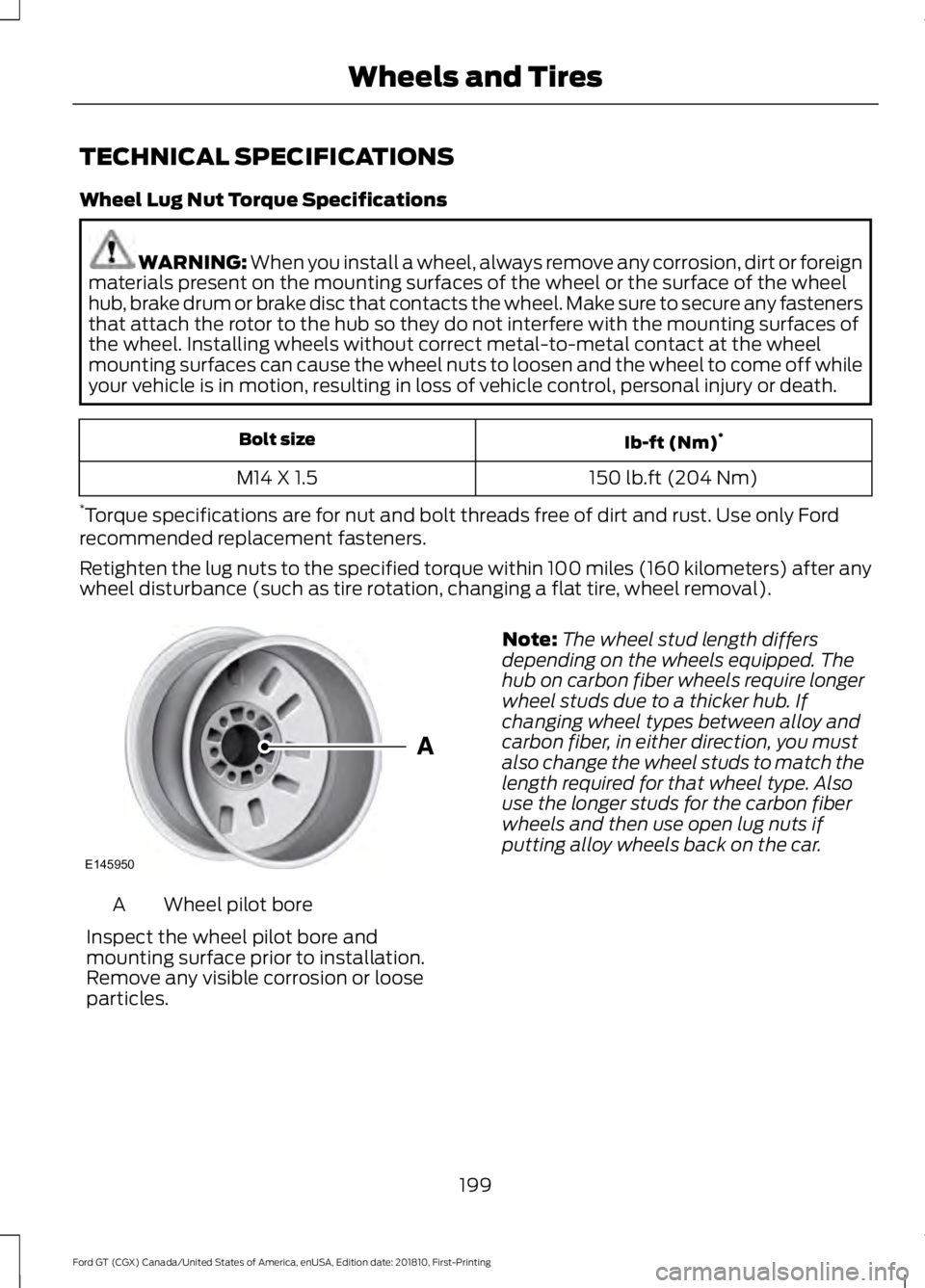
wheel disturbance (such as tire rotation, changing a flat tire, wheel removal). Wheel pilot bore
A
Inspect the wheel pilot bore and
mounting surface prior to installation.
Remove any visible corrosion or loose
particles. Note:
The wheel stud length differs
depending on the wheels equipped. The
hub on carbon fiber wheels require longer
wheel studs due to a thicker hub. If
changing wheel types between alloy and
carbon fiber, in either direction, you must
also change the wheel studs to match the
length required for that wheel type. Also
use the longer studs for the carbon fiber
wheels and then use open lug nuts if
putting alloy wheels back on the car.
199
Ford GT (CGX) Canada/United States of America, enUSA, Edition date: 201810, First-Printing Wheels and TiresE145950
Page 275 of 321

Oils and Fluids
In many cases, fluid discoloration is a
normal operating characteristic and, by
itself, does not necessarily indicate a
concern or that the fluid needs to be
changed. However, a qualified expert, such
as the factory-trained technicians at your
dealership, should inspect discolored fluids
that also show signs of overheating or
foreign material contamination
immediately.
Make sure to change your vehicle
’s oils and
fluids at the specified intervals or in
conjunction with a repair.
NORMAL SCHEDULED MAINTENANCE
Normal Maintenance Intervals Annually or Every 5,000 mi (8,000 km)
Change oil and filter.
Inspect tires and check tire pressures.
Inspect the brake pads, rotors, hoses, brake cooling duct hoses and check parking brake
function. Check brake fluid level.
Inspect the engine cooling system strength and hoses. Check coolant level.
Inspect the exhaust system and heat shields.
Inspect the accessory drive belts.
Inspect the steering linkage, ball joints, suspension and tie-rod ends.
Inspect the wiper blades. Check washer fluid level.
Inspect hinges and latches. Lubricate if needed.
Inspect vehicle battery and state of charge.
Check the hydraulic fluid level.
Check operation of all lights.
Check operation of warning indicators inside the instrument cluster.
Check for any fluid leaks.
272
Ford GT (CGX) Canada/United States of America, enUSA, Edition date: 201810, First-Printing Scheduled Maintenance
Page 277 of 321

Before Operating Your Vehicle at High
Speeds:
•
Verify your tires have the correct
pressures See Technical
Specifications (page 199).
• Inspect wheels and tires for wear and
damage. Replace any damaged wheels
and tires.
• Check and set lug nut torque. See
Technical Specifications (page 199).
• Verify fluid levels for oil, coolant, brake,
and hydraulic fluid. See Maintenance
(page
150).
• Change the oil and filter prior to use on
the track. After Operating Your vehicle at High
Speeds and Track Day Driving, Do the
Following:
•
Set tire pressures to specification.
• Check and set lug nut torque. See
Technical Specifications (page 199).
• Check all fluid levels.
• If you drive your car for an extended
period of time at high speed or on the
track for an extended time, change the
oil and filter.
SCHEDULED MAINTENANCE RECORD 274
Ford GT (CGX) Canada/United States of America, enUSA, Edition date: 201810, First-Printing Scheduled MaintenanceE146852
Repair Order #:Distance:
Engine hours (optional): Multi-point inspection (recommended): Signature:
Dealer stamp
Page 320 of 321

Tire Inflation When Punctured
See: Tire Sealant and Inflator Kit.................. 176
Tire Pressure Monitoring System...........194 Changing Tires With a Tire Pressure
Monitoring System........................................ 196
Understanding Your Tire Pressure Monitoring System ....................................... 196
Tire Repair Kit See: Tire Sealant and Inflator Kit.................. 176
Tire Sealant and Inflator Kit......................176 First Stage: Inflating the Tire with Sealing
Compound and Air........................................ 178
General Information........................................... 177
Second Stage: Checking Tire Pressure............................................................ 180
Tips for Use of the Kit........................................ 177
What to Do After the Tire has Been Sealed............................................................... 180
What to do When a Tire Is Punctured.........178
Tires See: Wheels and Tires....................................... 176
Towing a Trailer.............................................126
Towing Points.................................................132
Installing the Recovery Hook.......................... 132
Recovery Hook Location................................... 132
Towing the Vehicle on Four Wheels...........................................................126
Emergency Towing............................................. 126
Towing..............................................................126
Track Use
.........................................................165
Operating at High Speeds and on Track
Days.................................................................... 165
Road Course Vehicle Preparation................166
Transmission Code Designation............204
Transmission.................................................100
Transporting the Vehicle.............................131 Getting the Transmission in Neutral............132
U
Under Hood Overview.................................152
Under Seat Storage.......................................85
Unique Features
..............................................15
USB Port.........................................................208
Using Cruise Control.....................................114 Switching Cruise Control Off........................... 114
Switching Cruise Control On........................... 114
Using Launch Control..................................167 Using Snow Chains
......................................194
Using Stability Control................................110 AdvanceTrac ™ Electronic Stability Control
........................................................................\
....... 110
Stability Control.................................................... 111
Using Summer Tires....................................194
Using Voice Recognition
...........................220
Audio Voice Commands................................. 220
Climate Voice Commands............................... 221
Mobile App Voice Commands...................... 224
Navigation Voice Commands........................ 223
Phone Voice Commands................................ 222
SiriusXM Traffic and Travel Link Voice Commands...................................................... 225
Voice Settings Commands............................. 225
Utilizing the Mediation/Arbitration Program (Canada Only)
.........................135
V
Vehicle Care
...................................................168
General Information.......................................... 168
Vehicle Certification Label.......................204
Vehicle Dimensions
....................................202
Vehicle Identification Number................203
Vehicle Storage..............................................173 Battery..................................................................... 174
Body........................................................................\
. 174
Brakes...................................................................... 174
Cooling system..................................................... 174
Engine...................................................................... 174
Fuel system........................................................... 174
General.................................................................... 174
Miscellaneous ....................................................... 175
Removing Vehicle From Storage................... 175
Tires........................................................................\
.. 175
Ventilation See: Climate Control........................................... 79
VIN See: Vehicle Identification Number............203
Voice Control
....................................................52
W
Warning Lamps and Indicators................64 Anti-Lock Braking System................................ 64
Battery...................................................................... 65
Brake System......................................................... 65
317
Ford GT (CGX) Canada/United States of America, enUSA, Edition date: 201810, First-Printing Index
Page 321 of 321

Carbon Ceramic Brakes.....................................
65
Cruise Control........................................................ 65
Damper Comfort Mode..................................... 65
Direction Indicator............................................... 65
Door Ajar.................................................................. 65
Electric Park Brake............................................... 65
Engine Coolant Temperature.......................... 65
Engine Oil................................................................ 65
Fasten Seatbelt.................................................... 66
Front Airbag........................................................... 66
Front Lift Mode Active........................................ 66
Frost Warning Lamp........................................... 66
Hatch Ajar............................................................... 66
High Beam.............................................................. 66
Hood Ajar................................................................ 66
Hydraulic System Fault..................................... 66
Launch Control..................................................... 66
Low Beam Malfunction Warning Lamp.................................................................... 66
Low Fuel Level...................................................... 66
Low Tire Pressure Warning.............................. 66
Parking Lamps....................................................... 67
Powertrain Fault.................................................... 67
Rear Fog Lamp...................................................... 67
Ride Height System Fault.................................. 67
Service Engine Soon............................................ 67
Stability Control.................................................... 67
Stability Control Off............................................ 67
Transmission Fault............................................... 67
Washer Fluid Check.....................................159
Washers See: Cleaning the Exterior............................... 168
Waxing..............................................................170
Wheel Nuts See: Changing a Road Wheel........................ 198
Wheels and Tires
..........................................176
Technical Specifications................................. 199
Windows and Mirrors...................................60
Windshield Washers.....................................56
Windshield Wipers
........................................56
Wiper and Washer Control.........................53
Wiper Blades See: Checking the Wiper Blades................... 162
Wipers and Washers
.....................................56
318
Ford GT (CGX) Canada/United States of America, enUSA, Edition date: 201810, First-Printing Index