2019 FORD GT check oil
[x] Cancel search: check oilPage 156 of 321

ENGINE OIL DIPSTICK
MINA
MAX
B
ENGINE OIL CHECK
Note: Use a thick cloth to protect your hand
when removing the oil tank cap and dipstick.
To check the engine oil level consistently
and accurately, do the following:
1. Make sure the parking brake is on. Make
sure the transmission is in park (P) or
neutral (N).
2. Run the engine until it reaches normal operating temperature (Coolant
temperature of 190°F (87.7°C) or
higher).
3. Turn the engine off and wait two to three minutes.
4. Make sure that your vehicle is on level ground.
5. Open the rear hatch. See
Opening
and Closing the Hood (page 150).
6. Unscrew the oil tank cap to remove the
dipstick and wipe it with a clean,
lint-free cloth. See
Under Hood
Overview (page 152). 7. Replace the cap and dipstick and
remove it again to check the oil level.
See
Engine Oil Dipstick (page 153).
8. Make sure that the oil level is between
the minimum and the maximum marks.
If the oil level is at the minimum mark,
add oil immediately. See
Capacities
and Specifications (page 200).
9. If the oil level is correct, replace the cap
and dipstick and make sure it is fully
tightened.
Note: Do not remove the dipstick when the
engine is running.
Note: If the oil level is between the
maximum and minimum marks, the oil level
is acceptable. Do not add oil.
Note: The oil consumption of new engines
reaches its normal level after approximately
3,000 mi (5,000 km)
.
Note: High performance vehicles tend to
be driven in such a way the engine
experiences high speed and high load. As a
result, some oil consumption could occur
between oil changes. We recommend that
you check the oil level on a regular basis.
Adding Engine Oil WARNING:
Do not remove the
filler cap when the engine is running. WARNING:
Do not add engine oil
when the engine is hot. Hot engine oil
can burn you badly.
Note: Use a thick cloth to protect your hand
when removing the oil tank cap and dipstick.
Do not use supplemental engine oil
additives because they are unnecessary
and could lead to engine damage that may
not be covered by the vehicle Warranty.
To top up the engine oil level do the
following:
153
Ford GT (CGX) Canada/United States of America, enUSA, Edition date: 201810, First-Printing MaintenanceE230019
Page 157 of 321

1. Unscrew the oil tank cap.
2.
Add engine oil by pouring oil that meets
Ford specifications into the oil tank.
See Capacities and Specifications
(page 200). You may have to use a
funnel to pour the engine oil into the
opening.
3. Recheck the oil level.
4. If the oil level is correct, replace the cap
and the dipstick and make sure it is
fully tightened.
Note: Do not add oil further than the
maximum mark. Oil levels above the
maximum mark may cause engine damage.
Note: Make sure you install the oil tank cap
and dipstick correctly.
Note: Soak up any spillage with an
absorbent cloth immediately.
ENGINE COOLANT CHECK WARNING:
Never remove the
coolant reservoir cap when the engine is
running or hot. WARNING:
Do not put coolant in
the windshield washer reservoir. If
sprayed on the windshield, coolant could
make it difficult to see through the
windshield. WARNING:
To reduce the risk of
personal injury, make sure the engine is
cool before unscrewing the coolant
pressure relief cap. The cooling system
is under pressure. Steam and hot liquid
can come out forcefully when you loosen
the cap slightly. WARNING:
Do not add coolant
further than the MAX mark. Check the concentration and level of the
coolant only when the engine is cold at the
intervals listed in the scheduled
maintenance information. See Scheduled
Maintenance
(page 271).
Note: Make sure that the coolant level is
between the
MIN and MAXmarks on the
coolant reservoir when the engine is cold.
Note: Coolant expands when it is hot. The
level may extend beyond the
MAX mark.
The coolant reservoir is behind an access
panel on the left side of the of the engine
compartment. The cold MIN / MAX are
located on the front inboard corner of the
coolant reservoir. MAX is located just
below where the black top meets the
translucent reservoir lower. MIN is located
3/4 inch (20 mm) below the black top. Maintain coolant concentration within
48% to 50%, which equates to a freeze
point between -30°F (-34°C) and -34°F
(-37°C). Coolant concentration should be
checked using a refractometer. We do not
recommend the use of hydrometers or
coolant test strips for measuring coolant
concentration.
154
Ford GT (CGX) Canada/United States of America, enUSA, Edition date: 201810, First-Printing MaintenanceE244128
Page 168 of 321

Operating at High Speeds and on
Track Days
Your vehicle is capable of sustained high
speeds and track day driving. Follow the
guidelines for breaking in the tires and
powertrain before operating your vehicle
at high speeds or on a track. See
Breaking-In (page 127).
Note: Obey all traffic laws and only operate
your vehicle at locations designed to do so
safely.
Note: For a detailed description of what
your vehicle's New Limited Warranty covers,
see the Ford GT Warranty Guide provided
to you along with your owner's manual.
Before operating your vehicle at high
speeds, follow these guidelines:
Overall Vehicle Preparation:
• Inspect wheels and tires for wear and
damage. Replace any damaged wheels
or tires.
• Torque the wheel lug nuts to the proper
specification:
150 lb.ft (204 Nm).
• Inspect all aerodynamic grilles and
cooling system components for
damage. Make sure there is no debris
or non-factory installed protective
films or equipment that could obstruct
airflow.
• Verify your tires have the correct tire
pressure. See the section that follows
for tire pressure specifications.
• Do not operate your vehicle at high
speeds while carrying cargo. Brake System Preparation:
•
Your vehicle has carbon ceramic brake
rotors that require extra care and
inspection methods including
measuring their weight and reviewing
the surface condition.
• Inspect the brake system for wear or
damage. Replace worn or below
specification brake pads, rotors or
cooling hoses. Make sure that the cross
drilling holes in the rotors are open and
free of debris.
• Prior to track use, replace the brake
fluid with fresh Motorcraft/Ford DOT
4 LV High Performance Brake Fluid or
other DOT compliant fluid with a dry
boiling point greater than
500°F
(260°C) from a sealed container. Do
not use silicone or DOT 5 brake fluids.
Powertrain Preparation:
• Make sure the engine oil, coolant,
transmission fluids and hydraulic
system fluid have received proper
maintenance, are clean and are at the
appropriate capacity.
• Allow the powertrain to warm up and
reach normal operating temperature.
Your vehicle has electronic controls to
reduce power or limit engine RPM to
reduce powertrain temperatures if
required.
• Regularly check the engine oil level
during the event. Maintain the engine
oil level at or near the max mark on the
engine oil dipstick.
See Engine Oil
Check (page 153).
Note: To obtain service, please contact the
Ford GT Concierge and they will advise you
of the nearest Certified Ford GT Service
Dealership.
See About This Manual (page
5).
165
Ford GT (CGX) Canada/United States of America, enUSA, Edition date: 201810, First-Printing Track Use
Page 177 of 321

We engineer and test all motor vehicles
and their components for reliable, regular
driving. Under various conditions,
long-term storage may lead to degraded
engine performance or failure unless you
use specific precautions to preserve engine
components.
General
Note:
Do not park your vehicle in facilities
that use parking platforms or elevators that
lift your vehicle. The vehicle Warranty may
not cover damage caused to your vehicle as
a result of using this type of equipment.
• Store all vehicles inside a garage or
building in a dry, ventilated place.
• Protect from sunlight, if possible. Use
a soft, breathable vehicle cover.
Body
• Wash your vehicle thoroughly to
remove dirt, grease, oil, tar or mud from
exterior surfaces, rear-wheel housing
and the underside of front fenders.
• Lubricate all hood, door and luggage
compartment hinges and latches with
a light grade oil.
• Cover interior trim to prevent fading.
• Keep all rubber parts free from oil and
solvents.
Engine
• Change the engine oil and filter prior to
storage because used engine oil
contains contaminates which may
cause engine damage.
• Start the engine every 15 days for a
minimum of 15 minutes. Run at fast
idle with the climate controls set to
defrost until the engine reaches normal
operating temperature. •
With your foot on the brake, shift
through all the gears while the engine
is running.
• If your vehicle is stored for more than
a few months, we recommend that you
change the engine oil before you use
your vehicle again.
Fuel system
• Fill the fuel tank with high-quality fuel
until the first automatic shutoff of the
fuel pump nozzle and add
commercially available fuel stabilizer.
Run the engine for a minimum of one
minute to ensure that treated fuel has
circulated through the system.
Cooling system
• Protect against freezing temperatures.
• When removing your vehicle from
storage, check coolant fluid level.
Confirm that there are no cooling
system leaks and that fluid is at the
recommended level.
Battery
• Connect your vehicle to the battery
charger/maintainer provided with your
vehicle whenever you store your vehicle
for more than 2 weeks.
• Connect the wires as shown in the
illustration. See Changing the 12V
Battery (page 160).
Brakes
• Make sure the brakes and parking brake
release fully.
174
Ford GT (CGX) Canada/United States of America, enUSA, Edition date: 201810, First-Printing Vehicle Care
Page 178 of 321

Tires
•
To minimize flat spots on the tires,
inflate all four tires to the
recommended cold pressures listed on
the Safety Compliance Certification
label or Tire Label. When the vehicle is
taken out of storage, reset the tire
pressures as necessary to the
recommended levels listed on the
Safety Compliance Certification label
or Tire Label affixed to your vehicle.
Note: If you store your vehicle in a location
with low ambient temperatures, follow the
instructions for care of summer tires. See
Using Summer Tires (page 194).
Miscellaneous
• Move vehicles at least
25 ft (7.5 m)
every 15 days to lubricate working parts
and prevent flat spots in the tires.
Removing Vehicle From Storage
When your vehicle is ready to come out of
storage, do the following:
• Wash your vehicle to remove any dirt
or grease film build-up on window
surfaces.
• Check windshield wipers for any
deterioration.
• Check under the hood and engine cover
for any foreign material that may have
collected during storage such as mice
or squirrel nests.
• Check the exhaust for any foreign
material that may have collected
during storage.
• Check tire pressures and set tire
inflation per the Tire Label. •
Check brake pedal operation. Drive
your vehicle
15 ft (4.5 m) back and
forth with the brake lightly applied.
• Check fluid levels (including coolant,
oil and gas) to make sure there are no
leaks, and fluids are at recommended
levels.
See an authorized dealer if you have any
concerns or issues.
175
Ford GT (CGX) Canada/United States of America, enUSA, Edition date: 201810, First-Printing Vehicle Care
Page 275 of 321

Oils and Fluids
In many cases, fluid discoloration is a
normal operating characteristic and, by
itself, does not necessarily indicate a
concern or that the fluid needs to be
changed. However, a qualified expert, such
as the factory-trained technicians at your
dealership, should inspect discolored fluids
that also show signs of overheating or
foreign material contamination
immediately.
Make sure to change your vehicle
’s oils and
fluids at the specified intervals or in
conjunction with a repair.
NORMAL SCHEDULED MAINTENANCE
Normal Maintenance Intervals Annually or Every 5,000 mi (8,000 km)
Change oil and filter.
Inspect tires and check tire pressures.
Inspect the brake pads, rotors, hoses, brake cooling duct hoses and check parking brake
function. Check brake fluid level.
Inspect the engine cooling system strength and hoses. Check coolant level.
Inspect the exhaust system and heat shields.
Inspect the accessory drive belts.
Inspect the steering linkage, ball joints, suspension and tie-rod ends.
Inspect the wiper blades. Check washer fluid level.
Inspect hinges and latches. Lubricate if needed.
Inspect vehicle battery and state of charge.
Check the hydraulic fluid level.
Check operation of all lights.
Check operation of warning indicators inside the instrument cluster.
Check for any fluid leaks.
272
Ford GT (CGX) Canada/United States of America, enUSA, Edition date: 201810, First-Printing Scheduled Maintenance
Page 277 of 321

Before Operating Your Vehicle at High
Speeds:
•
Verify your tires have the correct
pressures See Technical
Specifications (page 199).
• Inspect wheels and tires for wear and
damage. Replace any damaged wheels
and tires.
• Check and set lug nut torque. See
Technical Specifications (page 199).
• Verify fluid levels for oil, coolant, brake,
and hydraulic fluid. See Maintenance
(page
150).
• Change the oil and filter prior to use on
the track. After Operating Your vehicle at High
Speeds and Track Day Driving, Do the
Following:
•
Set tire pressures to specification.
• Check and set lug nut torque. See
Technical Specifications (page 199).
• Check all fluid levels.
• If you drive your car for an extended
period of time at high speed or on the
track for an extended time, change the
oil and filter.
SCHEDULED MAINTENANCE RECORD 274
Ford GT (CGX) Canada/United States of America, enUSA, Edition date: 201810, First-Printing Scheduled MaintenanceE146852
Repair Order #:Distance:
Engine hours (optional): Multi-point inspection (recommended): Signature:
Dealer stamp
Page 315 of 321
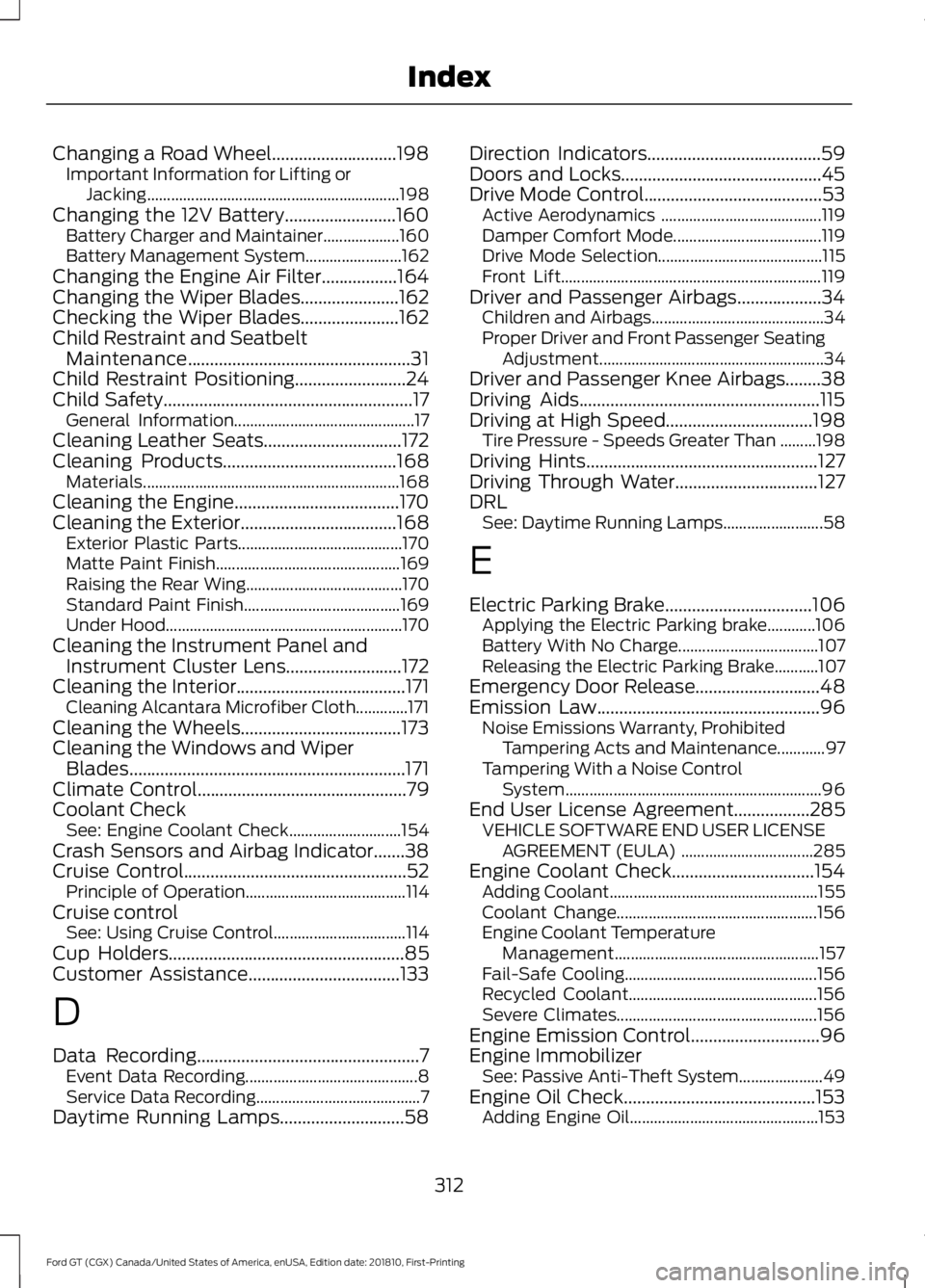
Changing a Road Wheel............................198
Important Information for Lifting or
Jacking............................................................... 198
Changing the 12V Battery.........................160 Battery Charger and Maintainer................... 160
Battery Management System........................ 162
Changing the Engine Air Filter.................164
Changing the Wiper Blades......................162
Checking the Wiper Blades......................162
Child Restraint and Seatbelt Maintenance..................................................31
Child Restraint Positioning.........................24
Child Safety
........................................................17
General Information............................................. 17
Cleaning Leather Seats...............................172
Cleaning Products
.......................................168
Materials................................................................ 168
Cleaning the Engine.....................................170
Cleaning the Exterior
...................................168
Exterior Plastic Parts......................................... 170
Matte Paint Finish.............................................. 169
Raising the Rear Wing....................................... 170
Standard Paint Finish....................................... 169
Under Hood........................................................... 170
Cleaning the Instrument Panel and Instrument Cluster Lens..........................172
Cleaning the Interior......................................171 Cleaning Alcantara Microfiber Cloth.............171
Cleaning the Wheels....................................173
Cleaning the Windows and Wiper Blades..............................................................171
Climate Control
...............................................79
Coolant Check See: Engine Coolant Check............................ 154
Crash Sensors and Airbag Indicator.......38
Cruise Control..................................................52 Principle of Operation........................................ 114
Cruise control See: Using Cruise Control................................. 114
Cup Holders
.....................................................85
Customer Assistance..................................133
D
Data Recording
..................................................7
Event Data Recording........................................... 8
Service Data Recording......................................... 7
Daytime Running Lamps............................58 Direction Indicators
.......................................59
Doors and Locks.............................................45
Drive Mode Control........................................53 Active Aerodynamics ........................................ 119
Damper Comfort Mode..................................... 119
Drive Mode Selection......................................... 115
Front Lift................................................................. 119
Driver and Passenger Airbags...................34 Children and Airbags........................................... 34
Proper Driver and Front Passenger Seating Adjustment........................................................ 34
Driver and Passenger Knee Airbags........38
Driving Aids......................................................115
Driving at High Speed.................................198 Tire Pressure - Speeds Greater Than .........198
Driving Hints
....................................................127
Driving Through Water................................127
DRL See: Daytime Running Lamps......................... 58
E
Electric Parking Brake
.................................106
Applying the Electric Parking brake............106
Battery With No Charge................................... 107
Releasing the Electric Parking Brake...........107
Emergency Door Release............................48
Emission Law..................................................96 Noise Emissions Warranty, Prohibited
Tampering Acts and Maintenance............97
Tampering With a Noise Control System................................................................ 96
End User License Agreement.................285 VEHICLE SOFTWARE END USER LICENSE
AGREEMENT (EULA) ................................. 285
Engine Coolant Check................................154 Adding Coolant.................................................... 155
Coolant Change.................................................. 156
Engine Coolant Temperature Management................................................... 157
Fail-Safe Cooling................................................ 156
Recycled Coolant............................................... 156
Severe Climates.................................................. 156
Engine Emission Control.............................96
Engine Immobilizer See: Passive Anti-Theft System..................... 49
Engine Oil Check...........................................153 Adding Engine Oil............................................... 153
312
Ford GT (CGX) Canada/United States of America, enUSA, Edition date: 201810, First-Printing Index