2019 FORD F-550 transmission oil change
[x] Cancel search: transmission oil changePage 7 of 666

Lane Keeping System
...............................250
Blind Spot Information System .............
253
Cross Traffic Alert .......................................
258
Steering ..........................................................
260
Pre-Collision Assist ....................................
262
Load Carrying
Load Limit .....................................................
266
Bed Ramps ....................................................
270
Towing
Towing a Trailer ............................................
273
Trailer Reversing Aids .................................
275
Trailer Sway Control ..................................
282
Recommended Towing Weights ..........
283
Essential Towing Checks .........................
287
Towing the Vehicle on Four Wheels .....
296
Driving Hints
Breaking-In ...................................................
299
Economical Driving ....................................
299
Driving Through Water .............................
300
Floor Mats .....................................................
300
Snow Plowing ...............................................
301
Roadside Emergencies
Roadside Assistance ................................
304
Hazard Flashers ..........................................
305
Fire Extinguisher .........................................
305
Warning Triangle .........................................
305
Fuel Shutoff .................................................
305
Jump Starting the Vehicle .......................
306
Post-Crash Alert System .........................
308
Transporting the Vehicle .........................
308
Towing Points ..............................................
309
Customer Assistance
Getting the Services You Need ................
311
In California (U.S. Only) .............................
312The Better Business Bureau (BBB) Auto
Line Program (U.S. Only) ......................
313
Utilizing the Mediation/Arbitration Program (Canada Only) .......................
314
Getting Assistance Outside the U.S. and Canada ........................................................
314
Ordering Additional Owner's Literature ........................................................................\
.
316
Reporting Safety Defects (U.S. Only) ........................................................................\
.
316
Reporting Safety Defects (Canada Only) ........................................................................\
.
316
Fuses
Fuse Specification Chart ..........................
318
Changing a Fuse ..........................................
327
Maintenance
General Information ..................................
329
Opening and Closing the Hood .............
329
Under Hood Overview - 6.2L ..................
330
Under Hood Overview - 6.7L Diesel ......
331
Under Hood Overview - 6.8L ..................
333
Engine Oil Dipstick - 6.2L/6.8L ..............
334
Engine Oil Dipstick - 6.7L Diesel ............
334
Engine Oil Check - 6.2L/6.8L .................
334
Engine Oil Check - 6.7L Diesel ...............
335
Changing the Engine Oil and Oil Filter ........................................................................\
336
Changing the Crankcase Vent Filter Element ......................................................
337
Oil Change Indicator Reset .....................
338
Engine Coolant Check - 6.2L/6.8L .......
339
Engine Coolant Check - 6.7L Diesel ......
343
Automatic Transmission Fluid Check ........................................................................\
346
Transfer Case Fluid Check ......................
349
Brake Fluid Check .......................................
350
Power Steering Fluid Check ...................
350
Washer Fluid Check ....................................
351
Draining the Fuel Filter Water Trap - 6.7L Diesel ............................................................
351
4
Super Duty (TFE) Canada/United States of America, enUSA, Edition date: 201804, Fourth-Printing Table of Contents
Page 305 of 666

•
The tire air pressures recommended
for general driving are on the vehicle ’s
Safety Certification Label. The
maximum cold inflation pressure for
the tire and associated load rating is
on the tire sidewall. Tire air pressure
may require re-adjustment within these
pressure limits to accommodate the
additional weight of the snowplow
installation.
• Federal and some local regulations
require additional exterior lamps for
snowplow-equipped vehicles. Consult
your authorized dealer for additional
information.
Operating the Vehicle with the
Snowplow Attached
Note: Do not use your vehicle for snow
removal until you have driven at least
500 mi (800 km).
Ford recommends vehicle speed does not
exceed
45 mph (72 km/h) when
snowplowing.
The attached snowplow blade restricts
airflow to the radiator, and may cause the
engine to run at a higher temperature:
Attention to engine temperature is
especially important when outside
temperatures are above freezing. Angle
the blade to maximize airflow to the
radiator and monitor engine temperature
to determine whether a left or right angle
provides the best performance.
Follow the severe duty schedule in your
Scheduled Maintenance information for
engine oil and transmission fluid change
intervals. Snowplowing with your Airbag
Equipped Vehicle WARNING:
Do not attempt to
service, repair, or modify the airbag
supplemental restraint system (SRS) or
its fuses. Contact an authorized dealer. WARNING:
Additional equipment
for example snowplow equipment may
affect the performance of the airbag
sensors increasing the risk of injury.
Please refer to the Body Builders Layout
Book for instructions about the
appropriate installation of additional
equipment. WARNING:
All occupants of the
vehicle, including the driver, should
always properly wear their seatbelt, even
when provided with an airbag
supplemental restraint system (SRS).
Your vehicle is equipped with a driver and
passenger airbag supplemental restraint
system. The supplemental restraint system
will activate in certain frontal and offset
frontal collisions when the vehicle sustains
sufficient frontal deceleration.
Careless or high speed driving while
plowing snow that results in sufficient
vehicle decelerations can deploy the
airbags. Such driving also increases the risk
of accidents.
Never remove or defeat the tripping
mechanisms designed into the snow
removal equipment by its manufacturer.
Doing so may cause damage to the vehicle
and the snow removal equipment as well
as possible airbag deployment.
302
Super Duty (TFE) Canada/United States of America, enUSA, Edition date: 201804, Fourth-Printing Driving Hints
Page 434 of 666
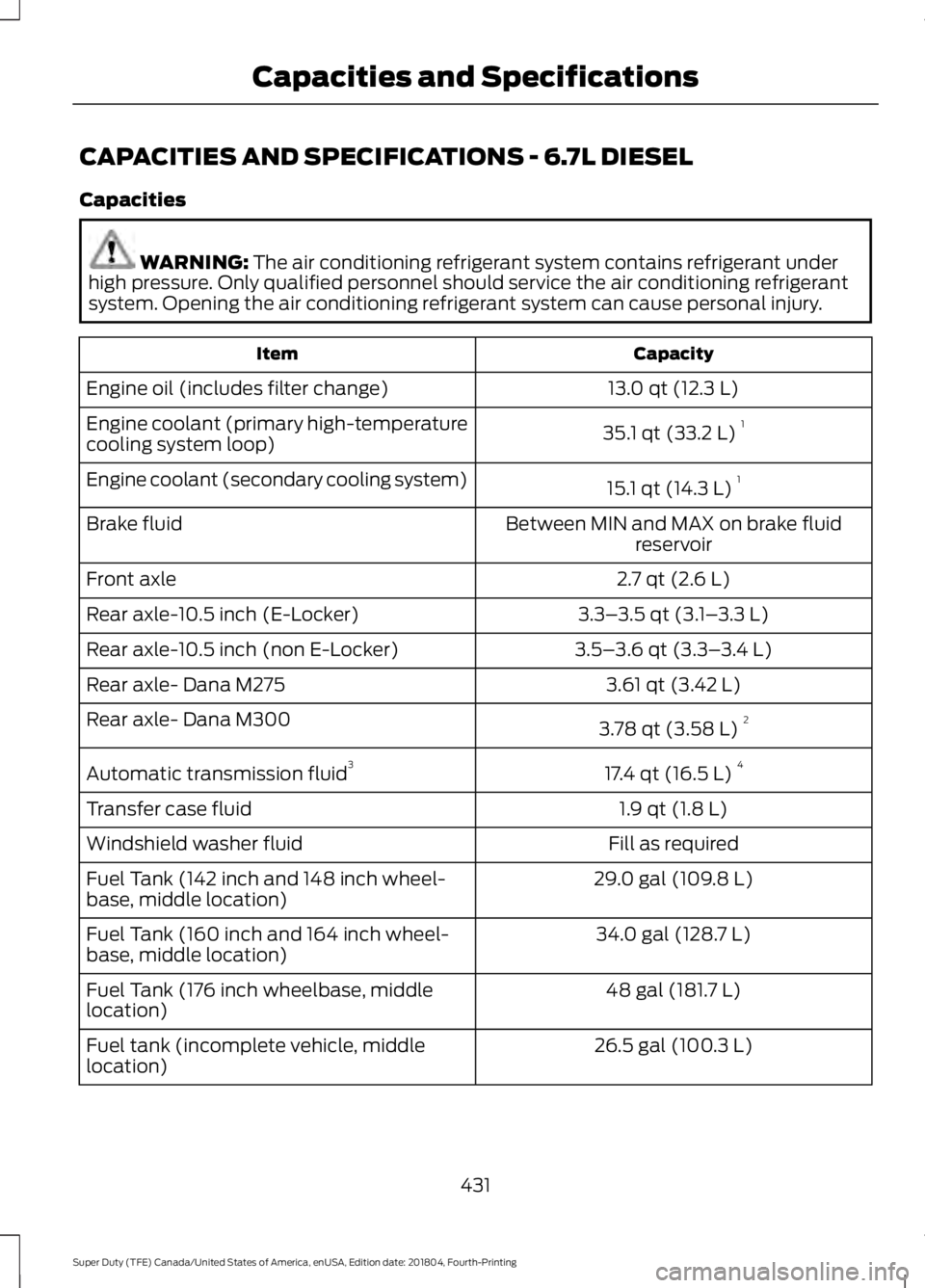
CAPACITIES AND SPECIFICATIONS - 6.7L DIESEL
Capacities
WARNING: The air conditioning refrigerant system contains refrigerant under
high pressure. Only qualified personnel should service the air conditioning refrigerant
system. Opening the air conditioning refrigerant system can cause personal injury. Capacity
Item
13.0 qt (12.3 L)
Engine oil (includes filter change)
35.1 qt (33.2 L)1
Engine coolant (primary high-temperature
cooling system loop)
15.1 qt (14.3 L)1
Engine coolant (secondary cooling system)
Between MIN and MAX on brake fluidreservoir
Brake fluid
2.7 qt (2.6 L)
Front axle
3.3–3.5 qt (3.1– 3.3 L)
Rear axle-10.5 inch (E-Locker)
3.5–3.6 qt (3.3– 3.4 L)
Rear axle-10.5 inch (non E-Locker)
3.61 qt (3.42 L)
Rear axle- Dana M275
3.78 qt (3.58 L)2
Rear axle- Dana M300
17.4 qt (16.5 L)4
Automatic transmission fluid 3
1.9 qt (1.8 L)
Transfer case fluid
Fill as required
Windshield washer fluid
29.0 gal (109.8 L)
Fuel Tank (142 inch and 148 inch wheel-
base, middle location)
34.0 gal (128.7 L)
Fuel Tank (160 inch and 164 inch wheel-
base, middle location)
48 gal (181.7 L)
Fuel Tank (176 inch wheelbase, middle
location)
26.5 gal (100.3 L)
Fuel tank (incomplete vehicle, middle
location)
431
Super Duty (TFE) Canada/United States of America, enUSA, Edition date: 201804, Fourth-Printing Capacities and Specifications
Page 440 of 666
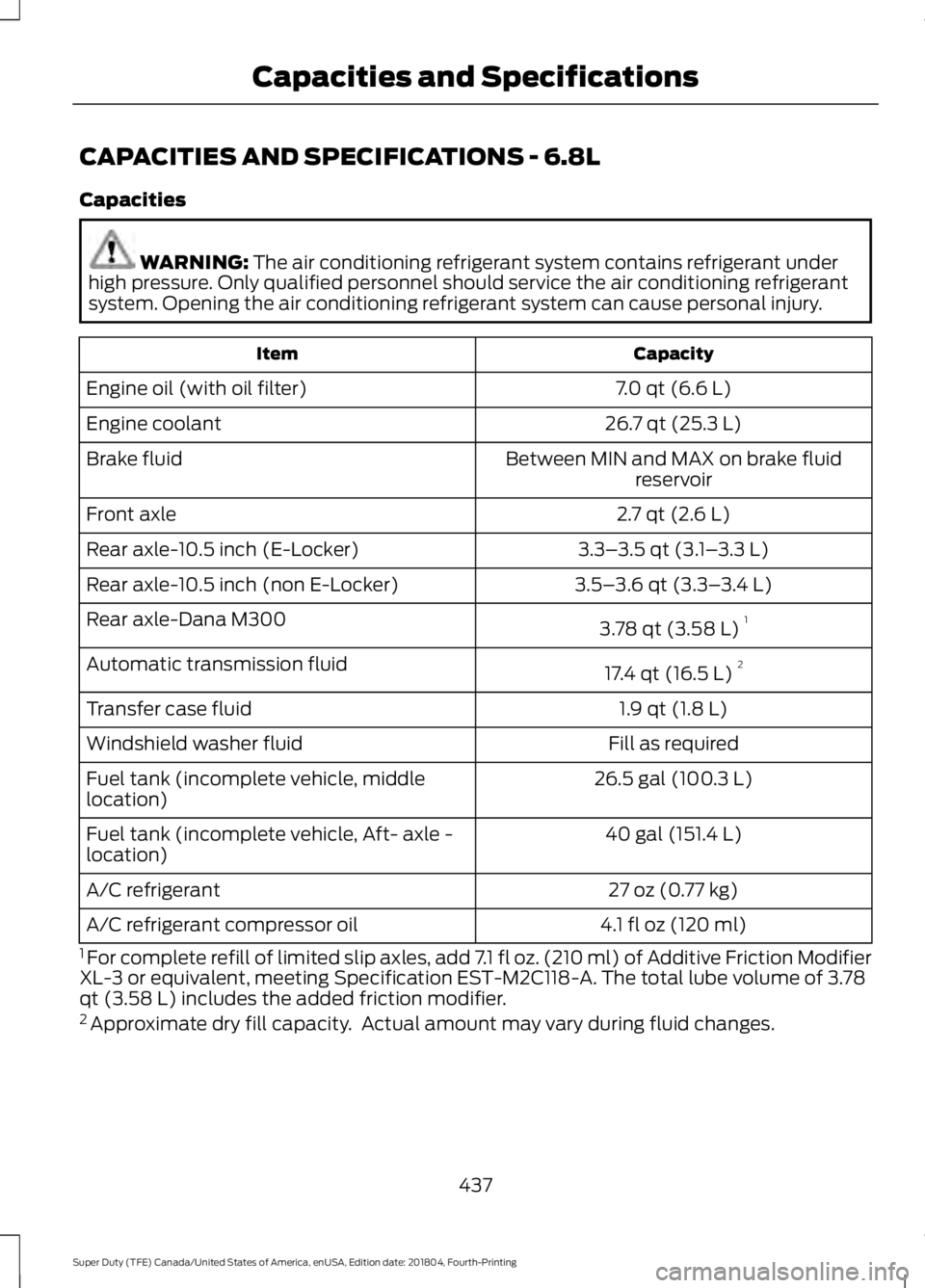
CAPACITIES AND SPECIFICATIONS - 6.8L
Capacities
WARNING: The air conditioning refrigerant system contains refrigerant under
high pressure. Only qualified personnel should service the air conditioning refrigerant
system. Opening the air conditioning refrigerant system can cause personal injury. Capacity
Item
7.0 qt (6.6 L)
Engine oil (with oil filter)
26.7 qt (25.3 L)
Engine coolant
Between MIN and MAX on brake fluidreservoir
Brake fluid
2.7 qt (2.6 L)
Front axle
3.3–3.5 qt (3.1– 3.3 L)
Rear axle-10.5 inch (E-Locker)
3.5–3.6 qt (3.3– 3.4 L)
Rear axle-10.5 inch (non E-Locker)
3.78 qt (3.58 L)1
Rear axle-Dana M300
17.4 qt (16.5 L)2
Automatic transmission fluid
1.9 qt (1.8 L)
Transfer case fluid
Fill as required
Windshield washer fluid
26.5 gal (100.3 L)
Fuel tank (incomplete vehicle, middle
location)
40 gal (151.4 L)
Fuel tank (incomplete vehicle, Aft- axle -
location)
27 oz (0.77 kg)
A/C refrigerant
4.1 fl oz (120 ml)
A/C refrigerant compressor oil
1 For complete refill of limited slip axles, add 7.1 fl oz. (210 ml) of Additive Friction Modifier
XL-3 or equivalent, meeting Specification EST-M2C118-A. The total lube volume of 3.78
qt (3.58 L) includes the added friction modifier.
2 Approximate dry fill capacity. Actual amount may vary during fluid changes.
437
Super Duty (TFE) Canada/United States of America, enUSA, Edition date: 201804, Fourth-Printing Capacities and Specifications
Page 587 of 666

NORMAL SCHEDULED MAINTENANCE
Gasoline Engine
Normal Maintenance Intervals
7,500 mi (12,000 km) or Six Months Whichever Comes First
Change engine oil and filter.
Rotate tires, inspect tire wear and measure tread depth. 1
Inspect wheels and related components for abnormal noise, wear, looseness or drag.
Perform multi-point inspection recommended.
1 For vehicles with dual rear wheels, rotate the front wheels when specified. Only rotate
the dual rear wheels if you see unusual wear. 15,000 mi (24,000 km) or 12 Months Whichever Comes First
Inspect automatic transmission fluid level. Consult dealer for requirements.
Inspect brake pads, shoes, rotors, drums, brake linings, hoses and parking brake.
Inspect engine coolant concentration, freeze-point protection, level and hoses.
Inspect exhaust system and heat shields.
Inspect front axle and U-joints. Lubricate if equipped with grease fittings. Four-wheel
drive vehicles.
Inspect steering linkage, ball joints, suspension, tie-rod ends, driveshaft and U-joints.
Lubricate if equipped with grease fittings. Other Maintenance Items
Replace cabin air filter.
Every 15,000 mi
(24,000 km)
Replace engine air filter.
Every
30,000 mi
(48,000 km)
Replace front wheel bearing grease and grease seal if non-
sealed bearings are used.
Every
60,000 mi
(96,000 km)
Replace spark plugs.
Every
97,000 mi
(156,000 km)
584
Super Duty (TFE) Canada/United States of America, enUSA, Edition date: 201804, Fourth-Printing Scheduled Maintenance
Page 588 of 666
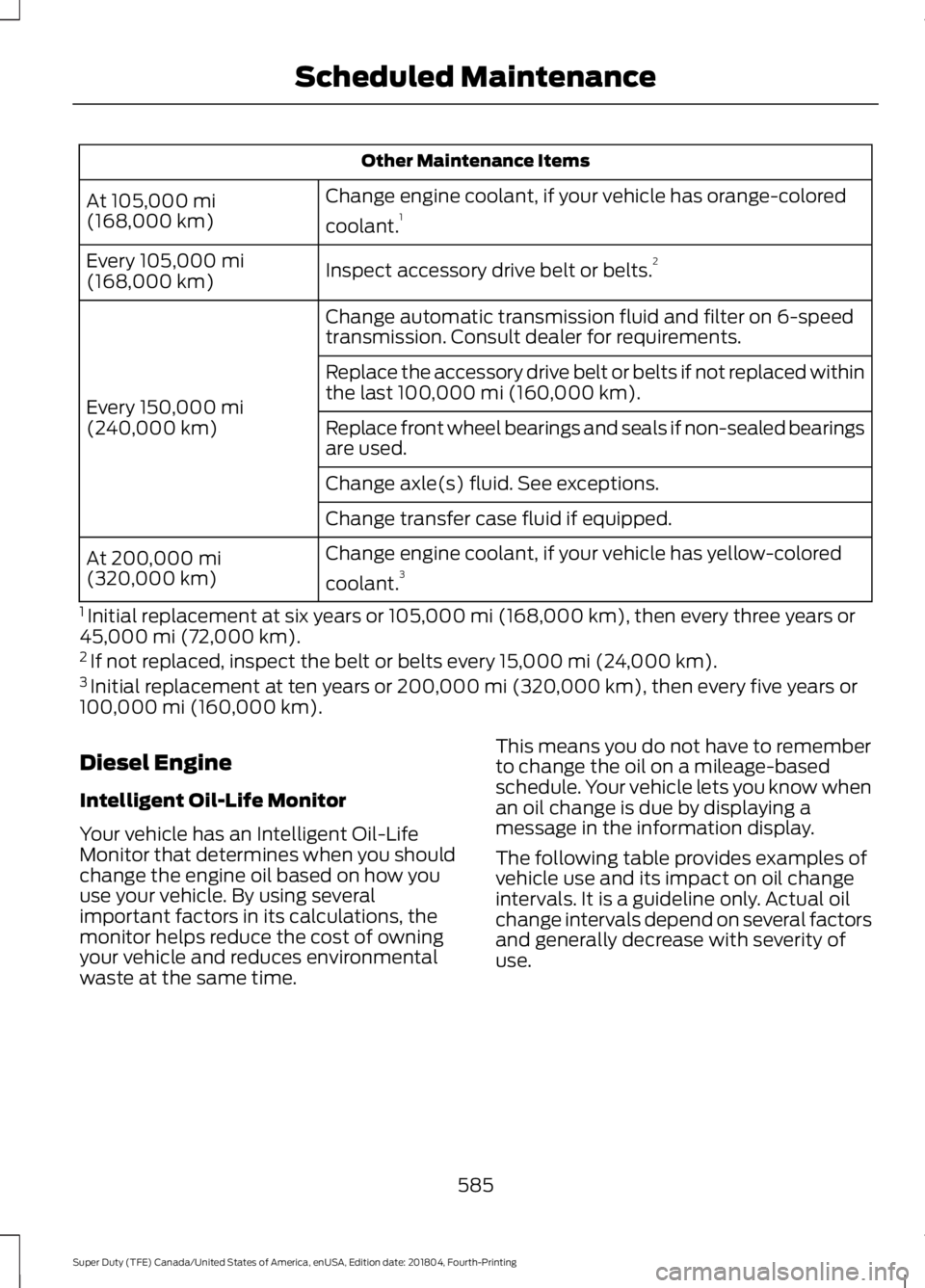
Other Maintenance Items
Change engine coolant, if your vehicle has orange-colored
coolant. 1
At 105,000 mi
(168,000 km)
Inspect accessory drive belt or belts. 2
Every
105,000 mi
(168,000 km)
Change automatic transmission fluid and filter on 6-speed
transmission. Consult dealer for requirements.
Every
150,000 mi
(240,000 km) Replace the accessory drive belt or belts if not replaced within
the last 100,000 mi (160,000 km).
Replace front wheel bearings and seals if non-sealed bearings
are used.
Change axle(s) fluid. See exceptions.
Change transfer case fluid if equipped.
Change engine coolant, if your vehicle has yellow-colored
coolant. 3
At
200,000 mi
(320,000 km)
1 Initial replacement at six years or
105,000 mi (168,000 km), then every three years or
45,000 mi (72,000 km).
2 If not replaced, inspect the belt or belts every
15,000 mi (24,000 km).
3 Initial replacement at ten years or 200,000 mi (320,000 km), then every five years or
100,000 mi (160,000 km).
Diesel Engine
Intelligent Oil-Life Monitor
Your vehicle has an Intelligent Oil-Life
Monitor that determines when you should
change the engine oil based on how you
use your vehicle. By using several
important factors in its calculations, the
monitor helps reduce the cost of owning
your vehicle and reduces environmental
waste at the same time. This means you do not have to remember
to change the oil on a mileage-based
schedule. Your vehicle lets you know when
an oil change is due by displaying a
message in the information display.
The following table provides examples of
vehicle use and its impact on oil change
intervals. It is a guideline only. Actual oil
change intervals depend on several factors
and generally decrease with severity of
use.
585
Super Duty (TFE) Canada/United States of America, enUSA, Edition date: 201804, Fourth-Printing Scheduled Maintenance
Page 589 of 666
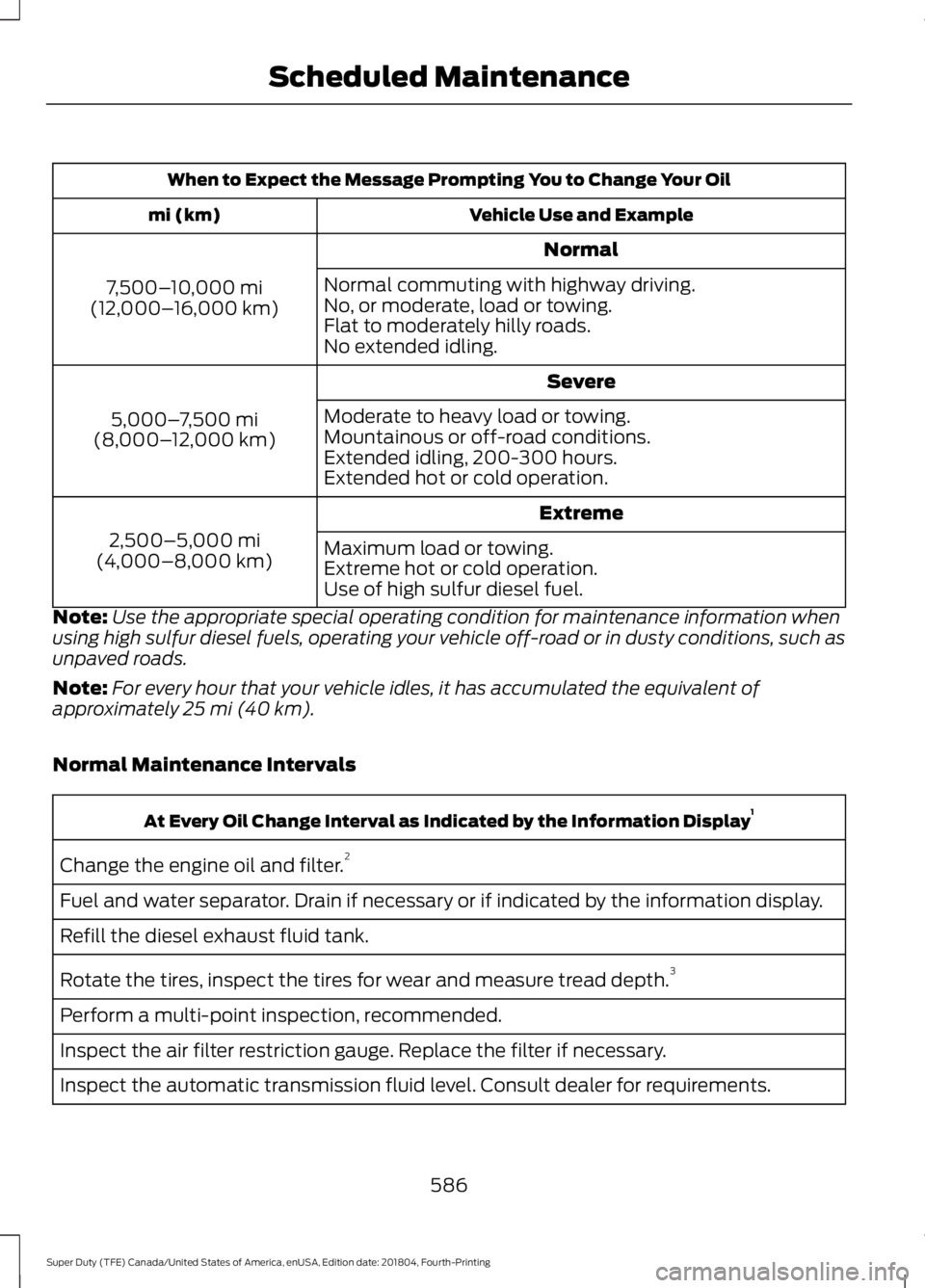
When to Expect the Message Prompting You to Change Your Oil
Vehicle Use and Example
mi (km)
Normal
7,500– 10,000 mi
(12,000– 16,000 km) Normal commuting with highway driving.
No, or moderate, load or towing.
Flat to moderately hilly roads.
No extended idling.
Severe
5,000– 7,500 mi
(8,000– 12,000 km) Moderate to heavy load or towing.
Mountainous or off-road conditions.
Extended idling, 200-300 hours.
Extended hot or cold operation.
Extreme
2,500–5,000 mi
(4,000–8,000 km) Maximum load or towing.
Extreme hot or cold operation.
Use of high sulfur diesel fuel.
Note: Use the appropriate special operating condition for maintenance information when
using high sulfur diesel fuels, operating your vehicle off-road or in dusty conditions, such as
unpaved roads.
Note: For every hour that your vehicle idles, it has accumulated the equivalent of
approximately 25 mi (40 km).
Normal Maintenance Intervals At Every Oil Change Interval as Indicated by the Information Display
1
Change the engine oil and filter. 2
Fuel and water separator. Drain if necessary or if indicated by the information display.
Refill the diesel exhaust fluid tank.
Rotate the tires, inspect the tires for wear and measure tread depth. 3
Perform a multi-point inspection, recommended.
Inspect the air filter restriction gauge. Replace the filter if necessary.
Inspect the automatic transmission fluid level. Consult dealer for requirements.
586
Super Duty (TFE) Canada/United States of America, enUSA, Edition date: 201804, Fourth-Printing Scheduled Maintenance
Page 590 of 666
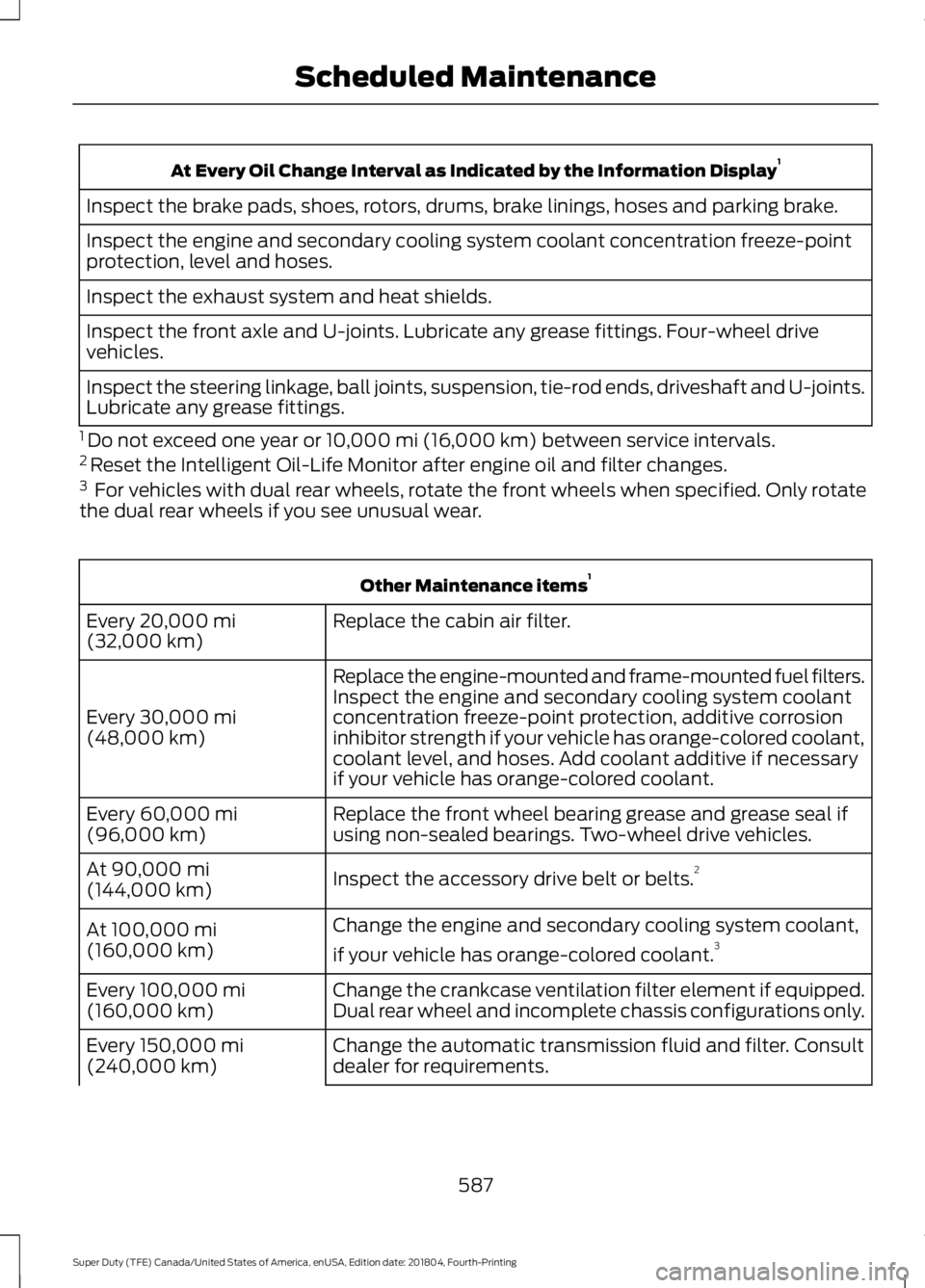
At Every Oil Change Interval as Indicated by the Information Display
1
Inspect the brake pads, shoes, rotors, drums, brake linings, hoses and parking brake.
Inspect the engine and secondary cooling system coolant concentration freeze-point
protection, level and hoses.
Inspect the exhaust system and heat shields.
Inspect the front axle and U-joints. Lubricate any grease fittings. Four-wheel drive
vehicles.
Inspect the steering linkage, ball joints, suspension, tie-rod ends, driveshaft and U-joints.
Lubricate any grease fittings.
1 Do not exceed one year or 10,000 mi (16,000 km) between service intervals.
2 Reset the Intelligent Oil-Life Monitor after engine oil and filter changes.
3 For vehicles with dual rear wheels, rotate the front wheels when specified. Only rotate
the dual rear wheels if you see unusual wear. Other Maintenance items
1
Replace the cabin air filter.
Every
20,000 mi
(32,000 km)
Replace the engine-mounted and frame-mounted fuel filters.
Every
30,000 mi
(48,000 km) Inspect the engine and secondary cooling system coolant
concentration freeze-point protection, additive corrosion
inhibitor strength if your vehicle has orange-colored coolant,
coolant level, and hoses. Add coolant additive if necessary
if your vehicle has orange-colored coolant.
Replace the front wheel bearing grease and grease seal if
using non-sealed bearings. Two-wheel drive vehicles.
Every
60,000 mi
(96,000 km)
Inspect the accessory drive belt or belts. 2
At
90,000 mi
(144,000 km)
Change the engine and secondary cooling system coolant,
if your vehicle has orange-colored coolant. 3
At
100,000 mi
(160,000 km)
Change the crankcase ventilation filter element if equipped.
Dual rear wheel and incomplete chassis configurations only.
Every
100,000 mi
(160,000 km)
Change the automatic transmission fluid and filter. Consult
dealer for requirements.
Every
150,000 mi
(240,000 km)
587
Super Duty (TFE) Canada/United States of America, enUSA, Edition date: 201804, Fourth-Printing Scheduled Maintenance