2019 FORD F-53 weight
[x] Cancel search: weightPage 52 of 176

- 1200 = - 240 pounds. No, you donot have enough cargo capacityto carry that much weight. Inmetric units, the calculation wouldbe: 635 kilograms - (2 x 99kilograms) - (12 x 45 kilograms) =635 - 198 - 540 = -103 kilograms.You will need to reduce the loadweight by at least 240 pounds(104 kilograms). If you removethree 100-pound (45-kilogram)cement bags, then the loadcalculation would be:1400 - (2 x220) - (9 x 100) = 1400 - 440 -900 = 60 pounds. Now you havethe load capacity to transport thecement and your friend home. Inmetric units, the calculation wouldbe: 635 kilograms - (2 x 99kilograms) - (9 x 45 kilograms) =635 - 198 - 405 = 32 kilograms.
The above calculations alsoassume that the loads arepositioned in your vehicle in amanner that does not overloadthe front or the rear gross axleweight rating specified for yourvehicle on the Safety ComplianceCertification label.
Special Loading Instructionsfor Owners of Pick-up Trucksand Utility-type Vehicles
WARNING: When loadingthe roof racks, we recommendyou evenly distribute the load,as well as maintain a low centerof gravity. Loaded vehicles, with
higher centers of gravity, may
handle differently than unloadedvehicles. Take extra precautions,such as slower speeds andincreased stopping distance,when driving a heavily loadedvehicle.
49
Motorhome (TY3) Canada/United States of America, enUSA, Edition date: 201803, Third-Printing-Load Carrying
Page 53 of 176

TOWING A TRAILER
WARNING: Towing trailersbeyond the maximumrecommended gross trailerweight exceeds the limit of yourvehicle and could result in enginedamage, transmission damage,structural damage, loss ofvehicle control, vehicle rolloverand personal injury.
WARNING: Do not exceedthe GVWR or the GAWRspecified on the certificationlabel.
Note: See RecommendedTowing Weights (page 51).
Your vehicle may have electricalitems, such as fuses or relays,related to towing. See Fuses(page 71).
Your vehicle's load capacitydesignation is by weight, not byvolume, so you cannot necessarilyuse all available space whenloading a vehicle or trailer.
Towing a trailer places an extraload on your vehicle's engine,transmission, axle, brakes, tiresand suspension. Inspect thesecomponents periodically during,and after, any towing operation.
Load Placement
To help minimize how trailermovement affects your vehiclewhen driving:
•Load the heaviest items closestto the trailer floor.
•Load the heaviest itemscentered between the left andright side trailer tires.
•Load the heaviest items abovethe trailer axles or just slightlyforward toward the trailertongue. Do not allow the finaltrailer tongue weight to goabove or below 10-15% of theloaded trailer weight.
•Select a ball mount with thecorrect rise or drop and loadcapacity. When both theloaded vehicle and trailer areconnected, the trailer frameshould be level, or slightlyangled down toward yourvehicle, when viewed from theside.
When driving with a trailer orpayload, a slight takeoff vibrationor shudder may be present due tothe increased payload weight.Additional information regardingproper trailer loading and settingyour vehicle up for towing islocated in another chapter of thismanual. See Load Limit (page45).
You can also find information inthe RV & Trailer Towing Guideavailable at your authorizeddealer, or online.
50
Motorhome (TY3) Canada/United States of America, enUSA, Edition date: 201803, Third-Printing-Towing
Page 54 of 176
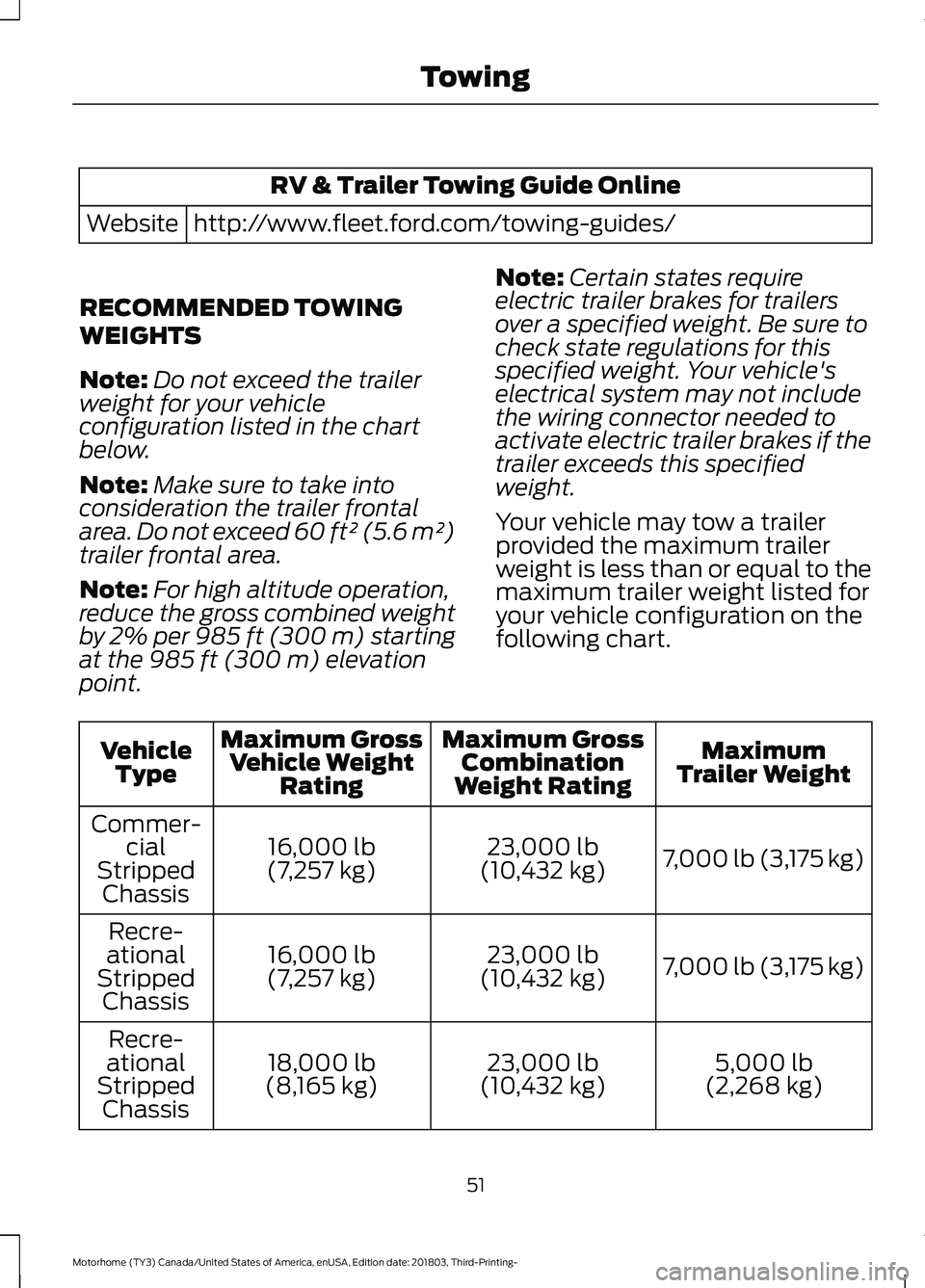
RV & Trailer Towing Guide Online
http://www.fleet.ford.com/towing-guides/Website
RECOMMENDED TOWING
WEIGHTS
Note:Do not exceed the trailerweight for your vehicleconfiguration listed in the chartbelow.
Note:Make sure to take intoconsideration the trailer frontalarea. Do not exceed 60 ft² (5.6 m²)trailer frontal area.
Note:For high altitude operation,reduce the gross combined weightby 2% per 985 ft (300 m) startingat the 985 ft (300 m) elevationpoint.
Note:Certain states requireelectric trailer brakes for trailersover a specified weight. Be sure tocheck state regulations for thisspecified weight. Your vehicle'selectrical system may not includethe wiring connector needed toactivate electric trailer brakes if thetrailer exceeds this specifiedweight.
Your vehicle may tow a trailerprovided the maximum trailerweight is less than or equal to themaximum trailer weight listed foryour vehicle configuration on thefollowing chart.
MaximumTrailer Weight
Maximum GrossCombinationWeight Rating
Maximum GrossVehicle WeightRating
VehicleType
7,000 lb (3,175 kg)23,000 lb(10,432 kg)16,000 lb(7,257 kg)
Commer-cialStrippedChassis
7,000 lb (3,175 kg)23,000 lb(10,432 kg)16,000 lb(7,257 kg)
Recre-ationalStrippedChassis
5,000 lb(2,268 kg)23,000 lb(10,432 kg)18,000 lb(8,165 kg)
Recre-ationalStrippedChassis
51
Motorhome (TY3) Canada/United States of America, enUSA, Edition date: 201803, Third-Printing-Towing
Page 55 of 176
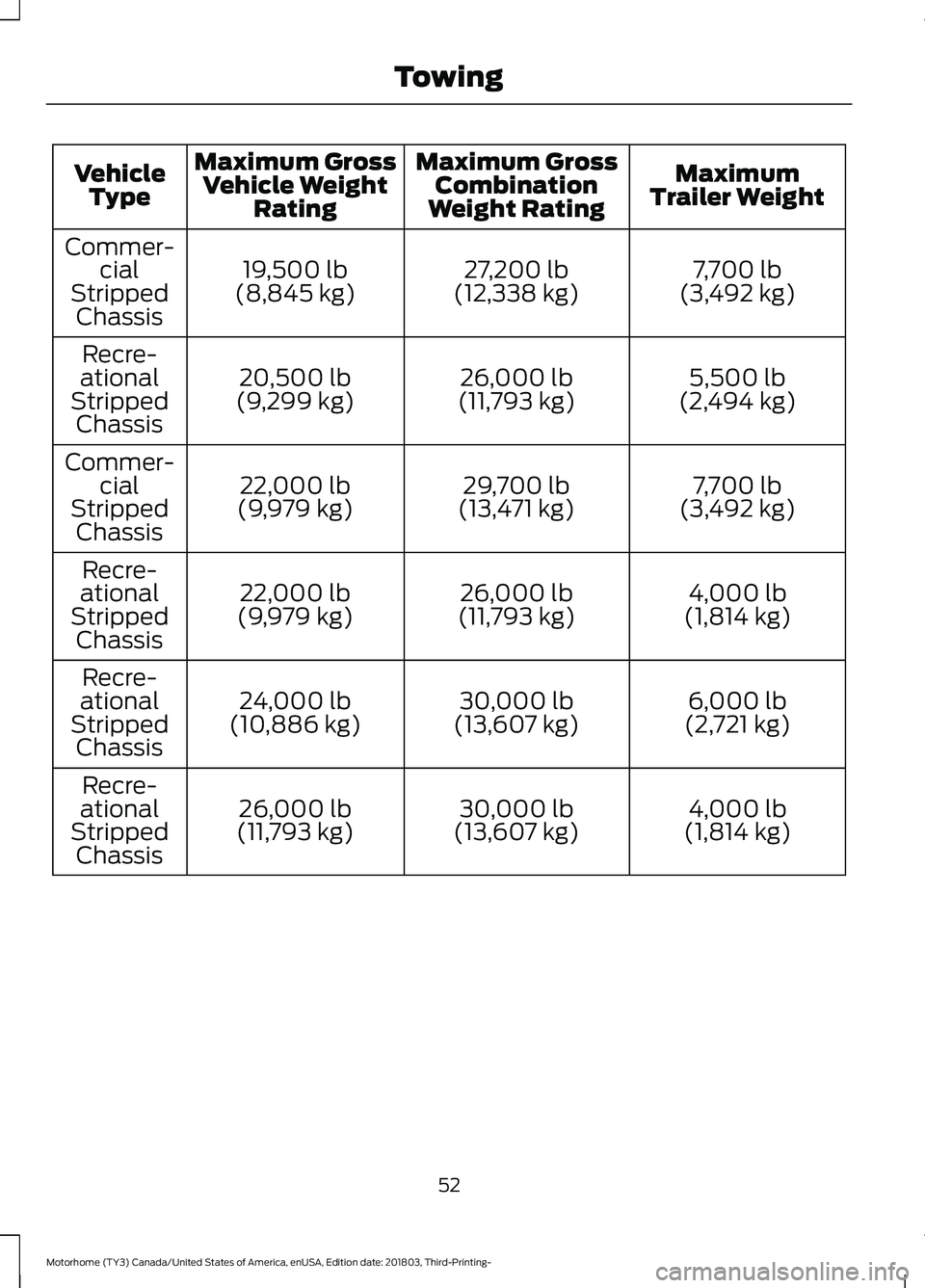
MaximumTrailer Weight
Maximum GrossCombinationWeight Rating
Maximum GrossVehicle WeightRating
VehicleType
7,700 lb(3,492 kg)27,200 lb(12,338 kg)19,500 lb(8,845 kg)
Commer-cialStrippedChassis
5,500 lb(2,494 kg)26,000 lb(11,793 kg)20,500 lb(9,299 kg)
Recre-ationalStrippedChassis
7,700 lb(3,492 kg)29,700 lb(13,471 kg)22,000 lb(9,979 kg)
Commer-cialStrippedChassis
4,000 lb(1,814 kg)26,000 lb(11,793 kg)22,000 lb(9,979 kg)
Recre-ationalStrippedChassis
6,000 lb(2,721 kg)30,000 lb(13,607 kg)24,000 lb(10,886 kg)
Recre-ationalStrippedChassis
4,000 lb(1,814 kg)30,000 lb(13,607 kg)26,000 lb(11,793 kg)
Recre-ationalStrippedChassis
52
Motorhome (TY3) Canada/United States of America, enUSA, Edition date: 201803, Third-Printing-Towing
Page 56 of 176

ESSENTIAL TOWING CHECKS
Follow these guidelines for safe towing:
•Do not tow a trailer until you drive yourvehicle at least 1,000 mi (1,600 km).
•Consult your local motor vehicle lawsfor towing a trailer.
•See the instructions included withtowing accessories for the properinstallation and adjustmentspecifications.
•Service your vehicle more frequently ifyou tow a trailer. See ScheduledMaintenance (page 145).
•If you use a rental trailer, follow theinstructions the rental agency givesyou.
Another chapter of this manual containsload specification terms found on the tirelabel and Safety Compliance label andinstructions on calculating your vehicle'sload. See Load Limit (page 45).
Remember to account for the trailertongue weight as part of your vehicle loadwhen calculating the total vehicle weight.
Hitches
Do not use a hitch that either clamps ontothe bumper or attaches to the axle.
Distribute the trailer load so 10-15% of thetotal trailer weight is on the tongue.
Weight-Distributing Hitches
WARNING: Do not adjust thespring bars so that your vehicle's rearbumper is higher than before attachingthe trailer. Doing so will defeat thefunction of the weight-distributing hitch,which may cause unpredictablehandling, and could result in seriouspersonal injury.
When hooking-up a trailer using aweight-distributing hitch, always use thefollowing procedure:
1.Park the loaded vehicle, without thetrailer, on a level surface.
2.Measure the height to the top of yourvehicle’s front wheel opening on thefender. This is H1.
3.Securely attach the loaded trailer toyour vehicle without theweight-distributing bars connected.
4.Measure the height to the top of yourvehicle’s front wheel opening on thefender a second time. This is H2.
5.Install and adjust the tension in theweight-distributing bars so that theheight of your vehicle’s front wheelopening on the fender is approximatelyhalfway between H1 and H2.
6.Check that the trailer is level or slightlynose down toward your vehicle. If not,adjust the ball height accordingly andrepeat Steps 1-6.
7.Lock the bar tension adjuster in place.
8.Check that the trailer tongue securelyattaches and locks onto the hitch.
9.Install safety chains, lighting and trailerbrake controls as required by law or thetrailer manufacturer.
Safety Chains
Note:Never attach safety chains to thebumper.
Always connect the safety chains to thehook retainers of your vehicle hitch.
To connect the safety chains, cross themunder the trailer tongue and allow enoughslack for turning tight corners. Do not allowthe chains to drag on the ground.
53
Motorhome (TY3) Canada/United States of America, enUSA, Edition date: 201803, Third-Printing-Towing
Page 57 of 176

Trailer Brakes
WARNING: Do not connect atrailer's hydraulic brake system directlyto your vehicle's brake system. Yourvehicle may not have enough brakingpower and your chances of having acollision greatly increase.
Electric brakes and manual, automatic orsurge-type trailer brakes are safe if youinstall them properly and adjust them tothe manufacturer's specifications. Thetrailer brakes must meet local and federalregulations.
The rating for the tow vehicle's brakingsystem operation is at the gross vehicleweight rating, not the gross combinedweight rating.
Separate functioning brake systemsare required for safe control of towedvehicles and trailers weighing morethan 1500 lb (680 kg) when loaded.
Trailer Lamps
WARNING: Never connect anytrailer lamp wiring to the vehicle's taillamp wiring; this may damage theelectrical system resulting in fire. Contactyour authorized dealer as soon aspossible for assistance in proper trailertow wiring installation. Additionalelectrical equipment may be required.
Trailer lamps are required on most towedvehicles. Make sure all running lights, brakelights, direction indicators and hazard lightsare working.
Before Towing a Trailer
Practice turning, stopping and backing upto get the feel of your vehicle-trailercombination before starting on a trip.When turning, make wider turns so thetrailer wheels clear curbs and otherobstacles.
When Towing a Trailer
•Do not drive faster than 70 mph(113 km/h) during the first 500 mi(800 km).
•Do not make full-throttle starts.
•Check your hitch, electrical connectionsand trailer wheel lug nuts thoroughlyafter you have traveled 50 mi (80 km).
•When stopped in congested or heavytraffic during hot weather, place thegearshift in park (P) to aid engine andtransmission cooling and to help airconditioning performance.
•Switch off the speed control withheavy loads or in hilly terrain. Thespeed control may turn offautomatically when you are towing onlong, steep grades.
•Shift to a lower gear when driving downa long or steep hill. Do not apply thebrakes continuously, as they mayoverheat and become less effective.
•If your transmission is equipped with aGrade Assist or Tow/Haul feature, usethis feature when towing. This providesengine braking and helps eliminateexcessive transmission shifting foroptimum fuel economy andtransmission cooling.
•Allow more distance for stopping witha trailer attached. Anticipate stops andbrake gradually.
•Avoid parking on a grade. However, ifyou must park on a grade:
1.Turn the steering wheel to point yourvehicle tires away from traffic flow.
54
Motorhome (TY3) Canada/United States of America, enUSA, Edition date: 201803, Third-Printing-Towing
Page 60 of 176

•Warm up your vehicle on coldmornings.
•Use the air conditioner or frontdefroster.
•Use the speed control in hilly terrain.
•Rest your foot on the brake pedal whiledriving.
•Drive a heavily loaded vehicle or tow atrailer.
•Carry unnecessary weight(approximately 1 mpg [0.4 km/L] islost for every 400 lb [180 kilogram] ofweight carried).
•Driving with the wheels out ofalignment.
Conditions
•Heavily loading a vehicle or towing atrailer may reduce fuel economy at anyspeed.
•Adding certain accessories to yourvehicle (for example bug deflectors,rollbars, light bars, running boards, skiracks or luggage racks) may reducefuel economy.
•To maximize the fuel economy, drivewith the tonneau cover installed (ifequipped).
•Using fuel blended with alcohol maylower fuel economy.
•Fuel economy may decrease with lowertemperatures during the first 5–10 mi(12–16 km) of driving.
•Driving on flat terrain offers improvedfuel economy as compared to drivingon hilly terrain.
•Transmissions give their best fueleconomy when operated in the topcruise gear and with steady pressureon the gas pedal.
•Four-wheel-drive operation (ifequipped) is less fuel efficient thantwo-wheel-drive operation.
•Close the windows for high-speeddriving.
DRIVING THROUGH WATER
WARNING: Do not drive throughflowing or deep water as you may losecontrol of your vehicle.
Note:Driving through standing water cancause vehicle damage.
Note:Engine damage can occur if waterenters the air filter.
Before driving through standing water,check the depth. Never drive through waterthat is higher than the bottom of the wheelhubs.
When driving through standing water, drivevery slowly and do not stop your vehicle.Your brake performance and traction maybe limited. After driving through water andas soon as it is safe to do so:
•Lightly press the brake pedal to dry thebrakes and to check that they work.
•Check that the horn works.
57
Motorhome (TY3) Canada/United States of America, enUSA, Edition date: 201803, Third-Printing-Driving HintsE176913
Page 106 of 176
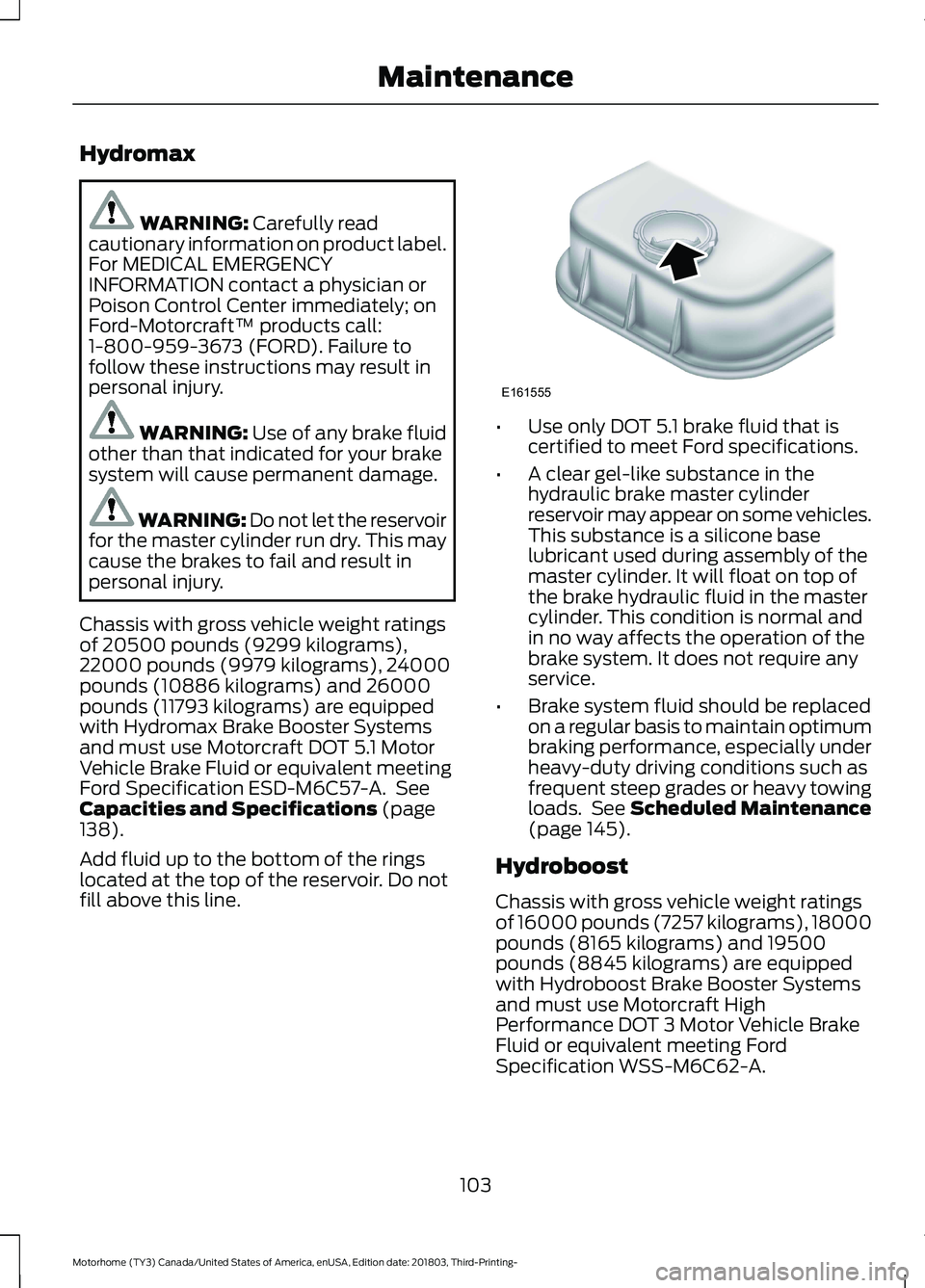
Hydromax
WARNING: Carefully readcautionary information on product label.For MEDICAL EMERGENCYINFORMATION contact a physician orPoison Control Center immediately; onFord-Motorcraft™ products call:1-800-959-3673 (FORD). Failure tofollow these instructions may result inpersonal injury.
WARNING: Use of any brake fluidother than that indicated for your brakesystem will cause permanent damage.
WARNING: Do not let the reservoirfor the master cylinder run dry. This maycause the brakes to fail and result inpersonal injury.
Chassis with gross vehicle weight ratingsof 20500 pounds (9299 kilograms),22000 pounds (9979 kilograms), 24000pounds (10886 kilograms) and 26000pounds (11793 kilograms) are equippedwith Hydromax Brake Booster Systemsand must use Motorcraft DOT 5.1 MotorVehicle Brake Fluid or equivalent meetingFord Specification ESD-M6C57-A. SeeCapacities and Specifications (page138).
Add fluid up to the bottom of the ringslocated at the top of the reservoir. Do notfill above this line.
•Use only DOT 5.1 brake fluid that iscertified to meet Ford specifications.
•A clear gel-like substance in thehydraulic brake master cylinderreservoir may appear on some vehicles.This substance is a silicone baselubricant used during assembly of themaster cylinder. It will float on top ofthe brake hydraulic fluid in the mastercylinder. This condition is normal andin no way affects the operation of thebrake system. It does not require anyservice.
•Brake system fluid should be replacedon a regular basis to maintain optimumbraking performance, especially underheavy-duty driving conditions such asfrequent steep grades or heavy towingloads. See Scheduled Maintenance(page 145).
Hydroboost
Chassis with gross vehicle weight ratingsof 16000 pounds (7257 kilograms), 18000pounds (8165 kilograms) and 19500pounds (8845 kilograms) are equippedwith Hydroboost Brake Booster Systemsand must use Motorcraft HighPerformance DOT 3 Motor Vehicle BrakeFluid or equivalent meeting FordSpecification WSS-M6C62-A.
103
Motorhome (TY3) Canada/United States of America, enUSA, Edition date: 201803, Third-Printing-MaintenanceE161555