Page 344 of 644
Protected Component
Fuse Rating
Fuse Number
Radio amplifier.
20A 1
22
Alt A sensor.
10A 1
23
Trailer brake control module.
30A 2
24
Body control module 1.
50A 2
25
Electric fan (Gas).
50A 2
26
Driver seat motors/memory module.
30A 2
27
Heated seat.
15A 1
28
4x4 solenoid.
10A 1
29
Trailer tow battery charge.
25A 2
30
Not used.
—
31
A/C clutch.
10A 1
32
Not used.
—
33
Vehicle power 5 (Diesel).
10A 1
34
Vehicle power 4 (Gas).
20A 1
35
Vehicle power 4 (Diesel).
15A 1
Vehicle power 3.
10A 1
36
Vehicle power 2 (Gas).
25A 1
37
Vehicle power 2 (Diesel).
15A 1
Vehicle power 1 (Gas).
25A 1
38
Vehicle power 1 (Diesel).
20A 1
Not used.
—
39
341
F-150 (TFC) Canada/United States of America, enUSA, Edition date: 201808, Third-Printing- Fuses
Page 353 of 644
GENERAL INFORMATION
Have your vehicle serviced regularly to help
maintain its roadworthiness and resale
value. There is a large network of
authorized dealers that are there to help
you with their professional servicing
expertise. We believe that their specially
trained technicians are best qualified to
service your vehicle properly and expertly.
They are supported by a wide range of
highly specialized tools developed
specifically for servicing your vehicle.
If your vehicle requires professional service,
an authorized dealer can provide the
necessary parts and service. Check your
warranty information to find out which
parts and services are covered.
Use only recommended fuels, lubricants,
fluids and service parts conforming to
specifications. Motorcraft® parts are
designed and built to provide the best
performance in your vehicle.
Precautions
•
Do not work on a hot engine.
• Make sure that nothing gets caught in
moving parts.
• Do not work on a vehicle with the
engine running in an enclosed space,
unless you are sure you have enough
ventilation.
• Keep all open flames and other burning
material (such as cigarettes) away
from the battery and all fuel related
parts.
Working with the Engine Off
1. Set the parking brake and shift the transmission to park (P).
2. Switch off the engine.
3. Block the wheels. Working with the Engine On WARNING: To reduce the risk of
vehicle damage and personal burn
injuries, do not start your engine with the
air cleaner removed and do not remove
it while the engine is running.
1. Set the parking brake and shift the transmission to park (P).
2. Block the wheels.
OPENING AND CLOSING THE
HOOD
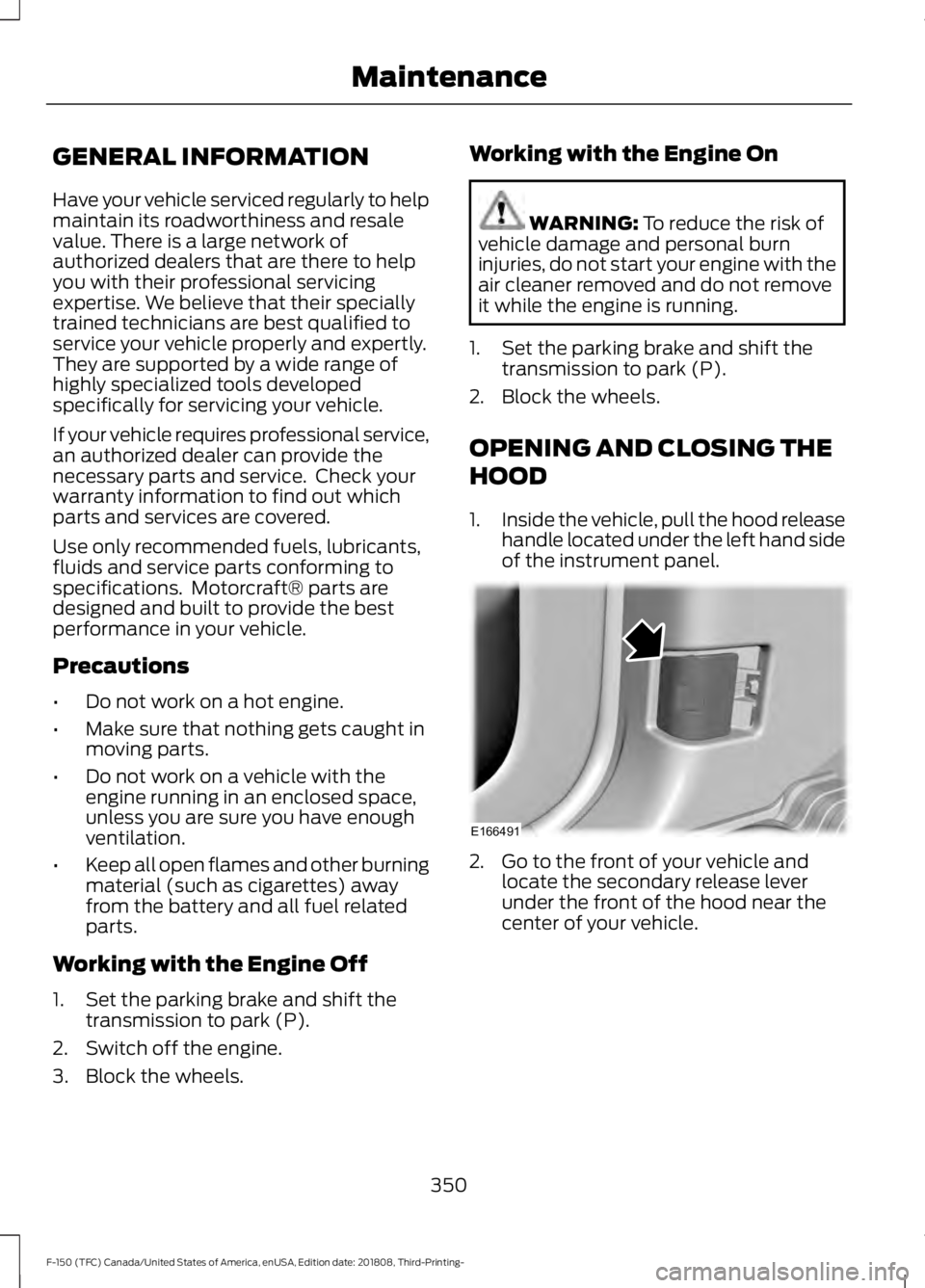
1. Inside the vehicle, pull the hood release
handle located under the left hand side
of the instrument panel. 2. Go to the front of your vehicle and
locate the secondary release lever
under the front of the hood near the
center of your vehicle.
350
F-150 (TFC) Canada/United States of America, enUSA, Edition date: 201808, Third-Printing- MaintenanceE166491
Page 354 of 644
3. Raise the hood until the lift cylinders
hold it open.
4. To close, lower the hood and make sure that it is closed properly and fully
latched.
UNDER HOOD OVERVIEW - 2.7L ECOBOOST™ Windshield washer fluid reservoir. See Washer Fluid Check (page 365).
A.
Power distribution box. See
Fuses (page 339).
B.
Battery.
See Changing the 12V Battery (page 366).
C.
Engine oil filler cap.
See Engine Oil Check (page 356).
D.
Engine oil dipstick.
See Engine Oil Dipstick (page 356).
E.
351
F-150 (TFC) Canada/United States of America, enUSA, Edition date: 201808, Third-Printing- MaintenanceE190266 E249452
Page 355 of 644
Brake fluid reservoir. See Brake Fluid Check (page 364).
F.
Air filter assembly. See
Changing the Engine Air Filter (page 374).
G.
Engine coolant reservoir.
See Engine Coolant Check (page 359).
H.
UNDER HOOD OVERVIEW - 3.0L DIESEL Power distribution box. See
Fuses (page 339).
A.
Engine oil filler cap. See
Engine Oil Check (page 356).
B.
Engine oil dipstick. See
Engine Oil Dipstick (page 356).
C.
Brake fluid reservoir. See
Brake Fluid Check (page 364).
D.
Air filter assembly. See
Changing the Engine Air Filter (page 374).
E.
Engine coolant reservoir. See
Engine Coolant Check (page 359).
F.
Battery. See
Changing the 12V Battery (page 366).
G.
Windshield washer fluid reservoir. See
Washer Fluid Check (page 365).
H.
352
F-150 (TFC) Canada/United States of America, enUSA, Edition date: 201808, Third-Printing- MaintenanceE247635
Page 356 of 644
UNDER HOOD OVERVIEW - 3.3L
Power distribution box. See Fuses (page 339).
A.
Engine oil filler cap. See
Engine Oil Check (page 356).
B.
Engine oil dipstick. See
Engine Oil Dipstick (page 356).
C.
Brake fluid reservoir. See
Brake Fluid Check (page 364).
D.
Air filter assembly. See
Changing the Engine Air Filter (page 374).
E.
Engine coolant reservoir. See
Engine Coolant Check (page 359).
F.
Battery. See
Changing the 12V Battery (page 366).
G.
Windshield washer fluid reservoir. See
Washer Fluid Check (page 365).
H.
353
F-150 (TFC) Canada/United States of America, enUSA, Edition date: 201808, Third-Printing- MaintenanceE247636
Page 357 of 644
UNDER HOOD OVERVIEW - 3.5L ECOBOOST™
Windshield washer fluid reservoir. See Washer Fluid Check (page 365).
A.
Power distribution box.
See Changing a Fuse (page 348).
B.
Battery.
See Changing the 12V Battery (page 366).
C.
Engine oil filler cap.
See Engine Oil Check (page 356).
D.
Engine oil dipstick.
See Engine Oil Dipstick (page 356).
E.
Brake fluid reservoir. See
Brake Fluid Check (page 364).
F.
Air filter.
See Changing the Engine Air Filter (page 374).
G.
Engine coolant reservoir. See
Engine Coolant Check (page 359).
H.
354
F-150 (TFC) Canada/United States of America, enUSA, Edition date: 201808, Third-Printing- MaintenanceE258054
Page 358 of 644
UNDER HOOD OVERVIEW - 5.0L
Windshield washer fluid reservoir. See Washer Fluid Check (page 365).
A.
Battery. See
Changing the 12V Battery (page 366).
B.
Engine oil filler cap. See
Engine Oil Check (page 356).
C.
Engine oil dipstick. See
Engine Oil Dipstick (page 356).
D.
Brake fluid reservoir. See
Brake Fluid Check (page 364).
E.
Air filter assembly. See
Changing the Engine Air Filter (page 374).
F.
Engine coolant reservoir. See
Engine Coolant Check (page 359).
G.
355
F-150 (TFC) Canada/United States of America, enUSA, Edition date: 201808, Third-Printing- MaintenanceE251845
Page 369 of 644

FUEL FILTER - GASOLINE
Your vehicle is equipped with a lifetime
fuel filter that is integrated with the fuel
tank. Regular maintenance or replacement
is not needed.
CHANGING THE 12V BATTERY
WARNING: Batteries normally
produce explosive gases which can
cause personal injury. Therefore, do not
allow flames, sparks or lighted
substances to come near the battery.
When working near the battery, always
shield your face and protect your eyes.
Always provide correct ventilation. WARNING:
When lifting a
plastic-cased battery, excessive pressure
on the end walls could cause acid to flow
through the vent caps, resulting in
personal injury and damage to the
vehicle or battery. Lift the battery with a
battery carrier or with your hands on
opposite corners. WARNING:
Keep batteries out of
reach of children. Batteries contain
sulfuric acid. Avoid contact with skin,
eyes or clothing. Shield your eyes when
working near the battery to protect
against possible splashing of acid
solution. In case of acid contact with skin
or eyes, flush immediately with water for
a minimum of 15 minutes and get prompt
medical attention. If acid is swallowed,
call a physician immediately. WARNING:
Battery posts,
terminals and related accessories
contain lead and lead compounds,
chemicals known to the State of
California to cause cancer and
reproductive harm. Wash your hands
after handling
. WARNING: This vehicle may have
more than one battery. Removing the
battery cables from only one battery
does not disconnect your vehicle
electrical system. Make sure you
disconnect the battery cables from all
batteries when disconnecting power.
Failure to do so may cause serious
personal injury or property damage.
Your vehicle is fitted with a Motorcraft
maintenance-free battery which normally
does not require additional water.
When a battery replacement is required,
you must use a recommended
replacement battery that matches the
electrical requirements of the vehicle.
Note: After cleaning or replacing the
battery, make sure you reinstall the battery
vent tube, battery cover or shield.
For longer, trouble-free operation, keep the
top of the battery clean and dry.
If you see any corrosion on the battery or
terminals, remove the cables from the
terminals and clean with a wire brush. You
can neutralize the acid with a solution of
baking soda and water.
366
F-150 (TFC) Canada/United States of America, enUSA, Edition date: 201808, Third-Printing- Maintenance


