2019 DODGE CHARGER SRT towing
[x] Cancel search: towingPage 333 of 496
Miles:6,000
12,000
18,000
24,000
30,000
36,000
42,000
48,000
54,000
60,000
66,000
72,000
78,000
84,000
90,000
96,000
102,000
108,000 114,000
120,000
126,000
132,000
138,000
144,000
150,000
Or Months: 6 12 18 24 30 36 42 48 54 60 66 72 78 84 90 96 102 108 114 120 126 132 138 144 150
Or Kilometers:
10,000
20,000
30,000
40,000
50,000
60,000
70,000
80,000
90,000
100,000
110,000
120,000
130,000
140,000
150,000
160,000
170,000
180,000
190,000
200,000
210,000
220,000
230,000
240,000
250,000
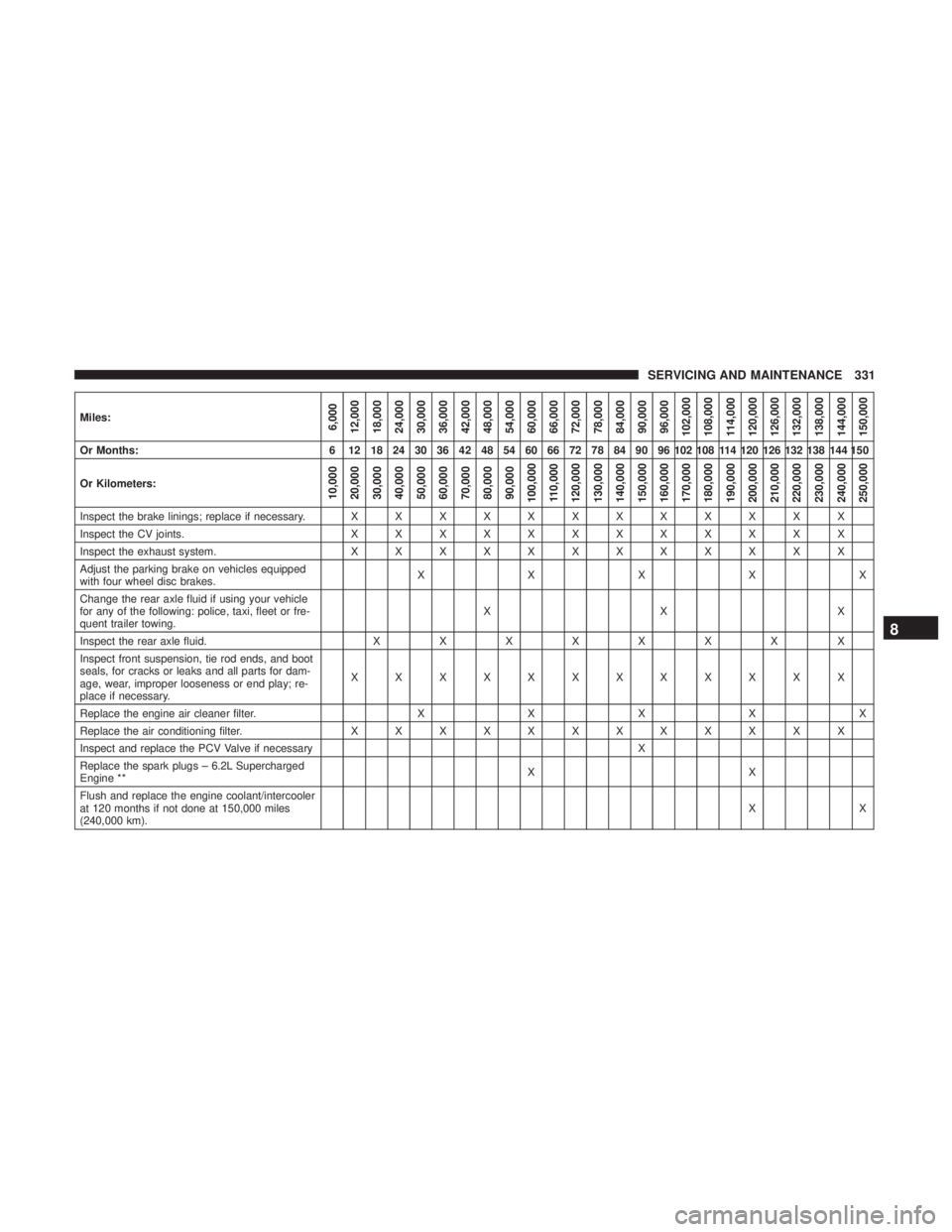
Inspect the brake linings; replace if necessary. X X X X X X X X X X X X
Inspect the CV joints. X X X X X X X X X X X X
Inspect the exhaust system. X X X X X X X X X X X X
Adjust the parking brake on vehicles equipped
with four wheel disc brakes. XXXXX
Change the rear axle fluid if using your vehicle
for any of the following: police, taxi, fleet or fre-
quent trailer towing. XX X
Inspect the rear axle fluid. XXXXXXXX
Inspect front suspension, tie rod ends, and boot
seals, for cracks or leaks and all parts for dam-
age, wear, improper looseness or end play; re-
place if necessary. XXXXXXXXXXXX
Replace the engine air cleaner filter. X X X X X
Replace the air conditioning filter. X X X X X X X X X X X X
Inspect and replace the PCV Valve if necessary X
Replace the spark plugs – 6.2L Supercharged
Engine ** XX
Flush and replace the engine coolant/intercooler
at 120 months if not done at 150,000 miles
(240,000 km). XX
8
SERVICING AND MAINTENANCE 331
Page 349 of 496
CAUTION!(Continued)
•Damage to the catalytic converter can result if your
vehicle is not kept in proper operating condition. In the
event of engine malfunction, particularly involving
engine misfire or other apparent loss of performance,
have your vehicle serviced promptly. Continued opera-
tion of your vehicle with a severe malfunction could
cause the converter to overheat, resulting in possible
damage to the converter and vehicle.
Under normal operating conditions, the catalytic converter
will not require maintenance. However, it is important to
keep the engine properly tuned to assure proper catalyst
operation and prevent possible catalyst damage.
NOTE: Intentional tampering with emissions control sys-
tems can result in civil penalties being assessed against
you.
In unusual situations involving grossly malfunctioning
engine operation, a scorching odor may suggest severe and abnormal catalyst overheating. If this occurs, stop the
vehicle, turn off the engine and allow it to cool. Service,
including a tune-up to manufacturer’s specifications,
should be obtained immediately.
To minimize the possibility of catalytic converter damage:
•
Do not shut off the engine or interrupt the ignition when
the transmission is in gear and the vehicle is in motion.
• Do not try to start the engine by pushing or towing the
vehicle.
• Do not idle the engine with any spark plug wires
disconnected or removed, such as when diagnostic
testing, or for prolonged periods during very rough idle
or malfunctioning operating conditions.
NOTE: Your vehicle’s exhaust system may be equipped
with an Electronic Exhaust Valve (EEV) system, if the
exhaust system is replaced with aftermarket products a
Malfunction Indicator Lamp (MIL) will illuminate.
8
SERVICING AND MAINTENANCE 347
Page 364 of 496
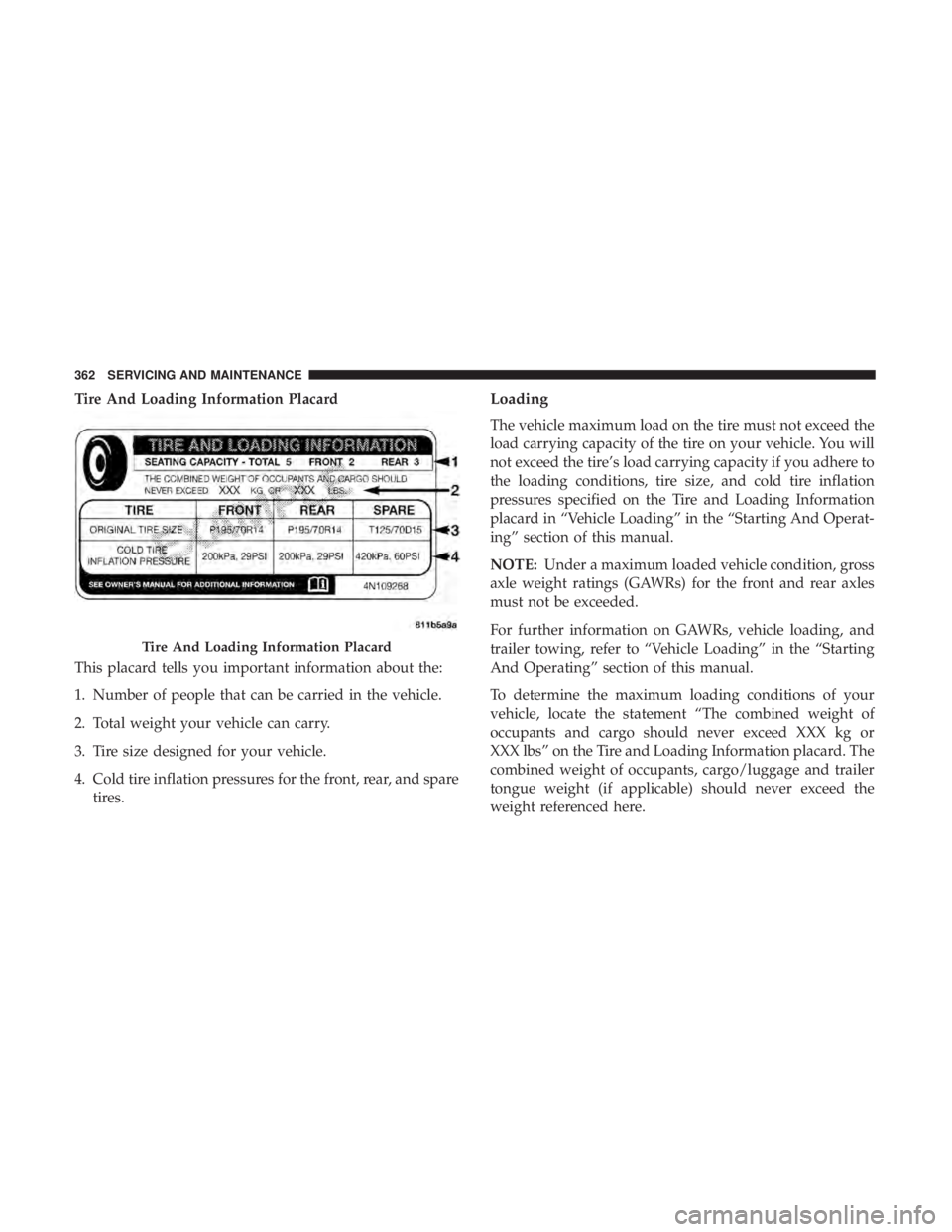
Tire And Loading Information Placard
This placard tells you important information about the:
1. Number of people that can be carried in the vehicle.
2. Total weight your vehicle can carry.
3. Tire size designed for your vehicle.
4. Cold tire inflation pressures for the front, rear, and sparetires.Loading
The vehicle maximum load on the tire must not exceed the
load carrying capacity of the tire on your vehicle. You will
not exceed the tire’s load carrying capacity if you adhere to
the loading conditions, tire size, and cold tire inflation
pressures specified on the Tire and Loading Information
placard in “Vehicle Loading” in the “Starting And Operat-
ing” section of this manual.
NOTE: Under a maximum loaded vehicle condition, gross
axle weight ratings (GAWRs) for the front and rear axles
must not be exceeded.
For further information on GAWRs, vehicle loading, and
trailer towing, refer to “Vehicle Loading” in the “Starting
And Operating” section of this manual.
To determine the maximum loading conditions of your
vehicle, locate the statement “The combined weight of
occupants and cargo should never exceed XXX kg or
XXX lbs” on the Tire and Loading Information placard. The
combined weight of occupants, cargo/luggage and trailer
tongue weight (if applicable) should never exceed the
weight referenced here.
Tire And Loading Information Placard
362 SERVICING AND MAINTENANCE
Page 365 of 496
Steps For Determining Correct Load Limit—
(1) Locate the statement “The combined weight of
occupants and cargo should never exceed XXX kg or
XXX lbs.” on your vehicle’s placard.
(2) Determine the combined weight of the driver and
passengers that will be riding in your vehicle.
(3) Subtract the combined weight of the driver and
passengers from XXX kg or XXX lbs.
(4) The resulting figure equals the available amount of
cargo and luggage load capacity. For example, if “XXX”
amount equals 1400 lbs. and there will be five 150 lb
passengers in your vehicle, the amount of available
cargo and luggage load capacity is 650 lbs. (1400-750
(5x150) = 650 lbs.)
(5) Determine the combined weight of luggage and
cargo being loaded on the vehicle. That weight may not
safely exceed the available cargo and luggage load
capacity calculated in Step 4.
(6) If your vehicle will be towing a trailer, load from
your trailer will be transferred to your vehicle. Consult
this manual to determine how this reduces the available
cargo and luggage load capacity of your vehicle.Metric Example For Load Limit
For example, if “XXX” amount equals 635 kg and there will
be five 68 kg passengers in your vehicle, the amount of
available cargo and luggage load capacity is 295 kg (635-
340 (5x68) = 295 kg) as shown in step 4.
NOTE:
•If your vehicle will be towing a trailer, load from your
trailer will be transferred to your vehicle. The following
table shows examples on how to calculate total load,
cargo/luggage, and towing capacities of your vehicle
with varying seating configurations and number and
size of occupants. This table is for illustration purposes
only and may not be accurate for the seating and load
carry capacity of your vehicle.
• For the following example, the combined weight of
occupants and cargo should never exceed 865 lbs
(392 kg).
8
SERVICING AND MAINTENANCE 363
Page 374 of 496
Snow Tires
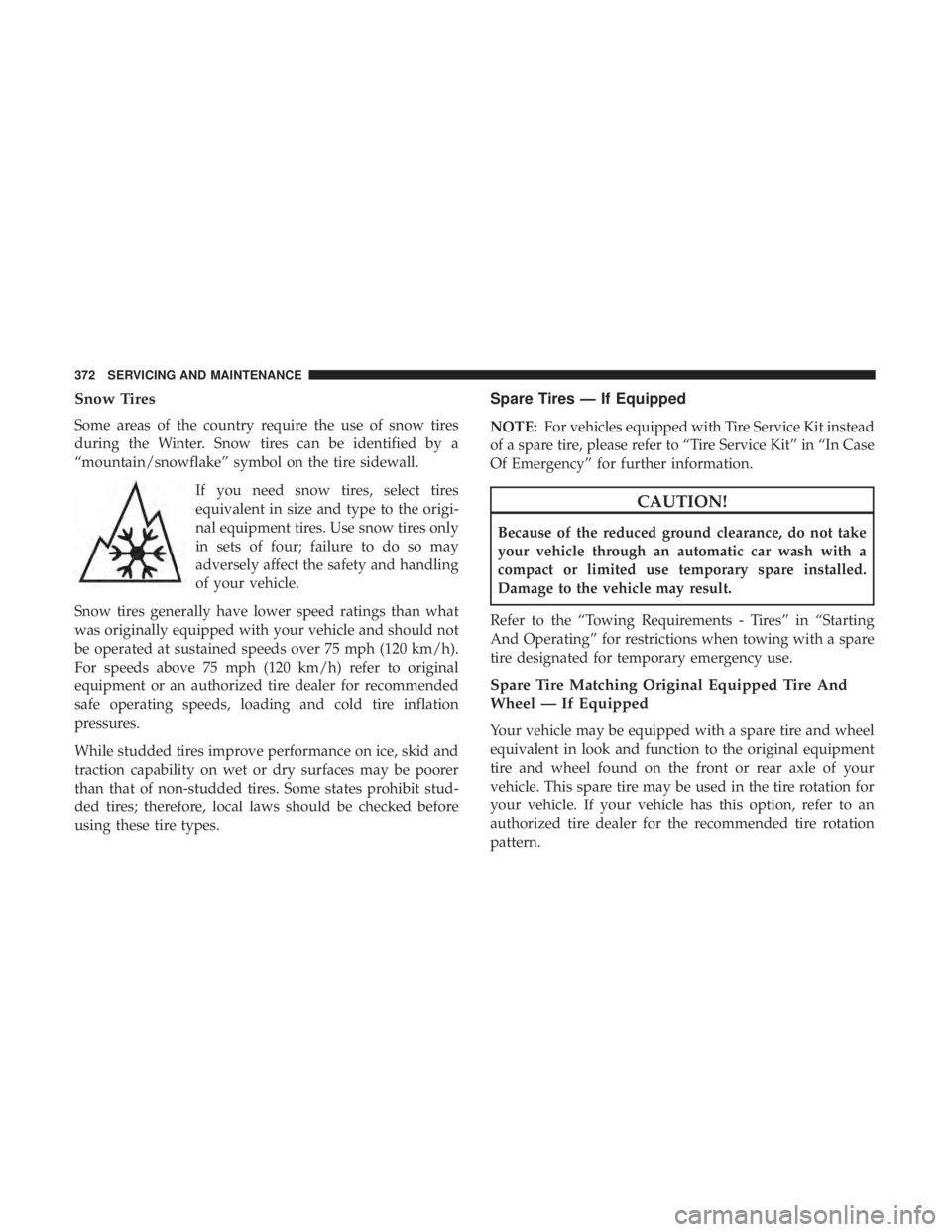
Some areas of the country require the use of snow tires
during the Winter. Snow tires can be identified by a
“mountain/snowflake” symbol on the tire sidewall.If you need snow tires, select tires
equivalent in size and type to the origi-
nal equipment tires. Use snow tires only
in sets of four; failure to do so may
adversely affect the safety and handling
of your vehicle.
Snow tires generally have lower speed ratings than what
was originally equipped with your vehicle and should not
be operated at sustained speeds over 75 mph (120 km/h).
For speeds above 75 mph (120 km/h) refer to original
equipment or an authorized tire dealer for recommended
safe operating speeds, loading and cold tire inflation
pressures.
While studded tires improve performance on ice, skid and
traction capability on wet or dry surfaces may be poorer
than that of non-studded tires. Some states prohibit stud-
ded tires; therefore, local laws should be checked before
using these tire types.
Spare Tires — If Equipped
NOTE: For vehicles equipped with Tire Service Kit instead
of a spare tire, please refer to “Tire Service Kit” in “In Case
Of Emergency” for further information.
CAUTION!
Because of the reduced ground clearance, do not take
your vehicle through an automatic car wash with a
compact or limited use temporary spare installed.
Damage to the vehicle may result.
Refer to the “Towing Requirements - Tires” in “Starting
And Operating” for restrictions when towing with a spare
tire designated for temporary emergency use.
Spare Tire Matching Original Equipped Tire And
Wheel — If Equipped
Your vehicle may be equipped with a spare tire and wheel
equivalent in look and function to the original equipment
tire and wheel found on the front or rear axle of your
vehicle. This spare tire may be used in the tire rotation for
your vehicle. If your vehicle has this option, refer to an
authorized tire dealer for the recommended tire rotation
pattern.
372 SERVICING AND MAINTENANCE
Page 489 of 496
Paint Care............................... .379
Panic Alarm ...............................22
Parking Brake ............................ .218
ParkSense System, Rear ..................... .259
Passing Light ..............................65
Passive Entry ..............................38
Performance ..............................114
Personalized Main Menu .....................399
Pets ................................... .204
Pinch Protection ............................87
Placard, Tire And Loading Information ...........361
Power Brakes ............................... .386
Deck Lid Release .........................89
Distribution Center (Fuses) ..................297
Door Locks ..............................37
Mirrors ................................61
Outlet (Auxiliary Electrical Outlet) ............102
Seats ..................................46
Steering .............................. .235
Sunroof ................................85
Tilt/Telescoping Steering Column ..............57
Windows ...............................82
Power Seats Forward ................................46 Lumbar
................................47
Rearward ...............................46
Recline .................................46
Power Steering Fluid .....................393, 395
Pregnant Women And Seat Belts ................173
Pretensioners Seat Belts ............................. .173
Radial Ply Tires ........................... .367
Radiator Cap (Coolant Pressure Cap) .............351
Radio Frequency General Information ................27, 33, 34, 42
Radio Operation .......................... .454
Rain Sensitive Wiper System ...................73
Rear Axle (Differential) ..................... .355
Rear Camera ............................. .271
Rear Cross Path ........................... .153
Rear ParkSense System ..................... .259
Rear Seats, Folding ..........................
44
Recreational Towing ........................ .277
Reformulated Gasoline ...................... .389
Refrigerant ........................... .339, 340
Release, Hood ..............................88
Reminder, Lights On .........................66
Reminder, Seat Belt ........................ .166
12
INDEX 487
Page 493 of 496
Wheel Nut Torque....................... .387
Tire Safety Information ...................... .356
Tire Service Kit......301, 302, 303, 305, 309, 310, 311, 313, 316, 317
To Open Hood .............................88
Towing ................................. .277
Behind A Motorhome ..................... .277
Recreational ........................... .277
Traction ............................. .277, 278
Traction Control .......................... .147
Trailer Towing ............................ .277
Transfer Case Fluid ................................ .393
Transmission Automatic ......................... .222, 354
Fluid ............................. .393, 395
Maintenance ........................... .354
Shifting .............................. .220
Transporting Pets ......................... .204
Tread Wear Indicators ...................... .368
Trunk Lid (Deck Lid) .........................89
Trunk Release Remote Control ..................89
Turn Signals ........................... .67, 132Uconnect
Uconnect Settings .................21, 22, 33, 401
Uconnect 4C/4C Nav With 8.4-Inch Display ........402
Uconnect Settings Customer Programmable Features ........33, 38, 401
Passive Entry Programming ..................38
Uniform Tire Quality Grades ..................377
Universal Garage Door Opener (HomeLink) ........92
Universal Transmitter ........................92
Unleaded Gasoline ........................ .388
Untwisting Procedure, Seat Belt ................171
USB................................... .454
Vanity Mirrors .............................62
Vehicle Certification Label ....................276
Vehicle Identification Number (VIN) .............386
Vehicle Loading .....................275, 277, 362
Vehicle Modifications/Alterations .................5
Vehicle Security Alarm ........................35
V
ehicle Storage ......................... .81, 378
Vehicle User Guide In Vehicle Help ...........................17
Navigation ..............................17
Operating Instructions ......................17
Searching User Guide ......................17
12
INDEX 491