2019 DODGE CHALLENGER check
[x] Cancel search: checkPage 9 of 270
Tire Loading And Tire Pressure
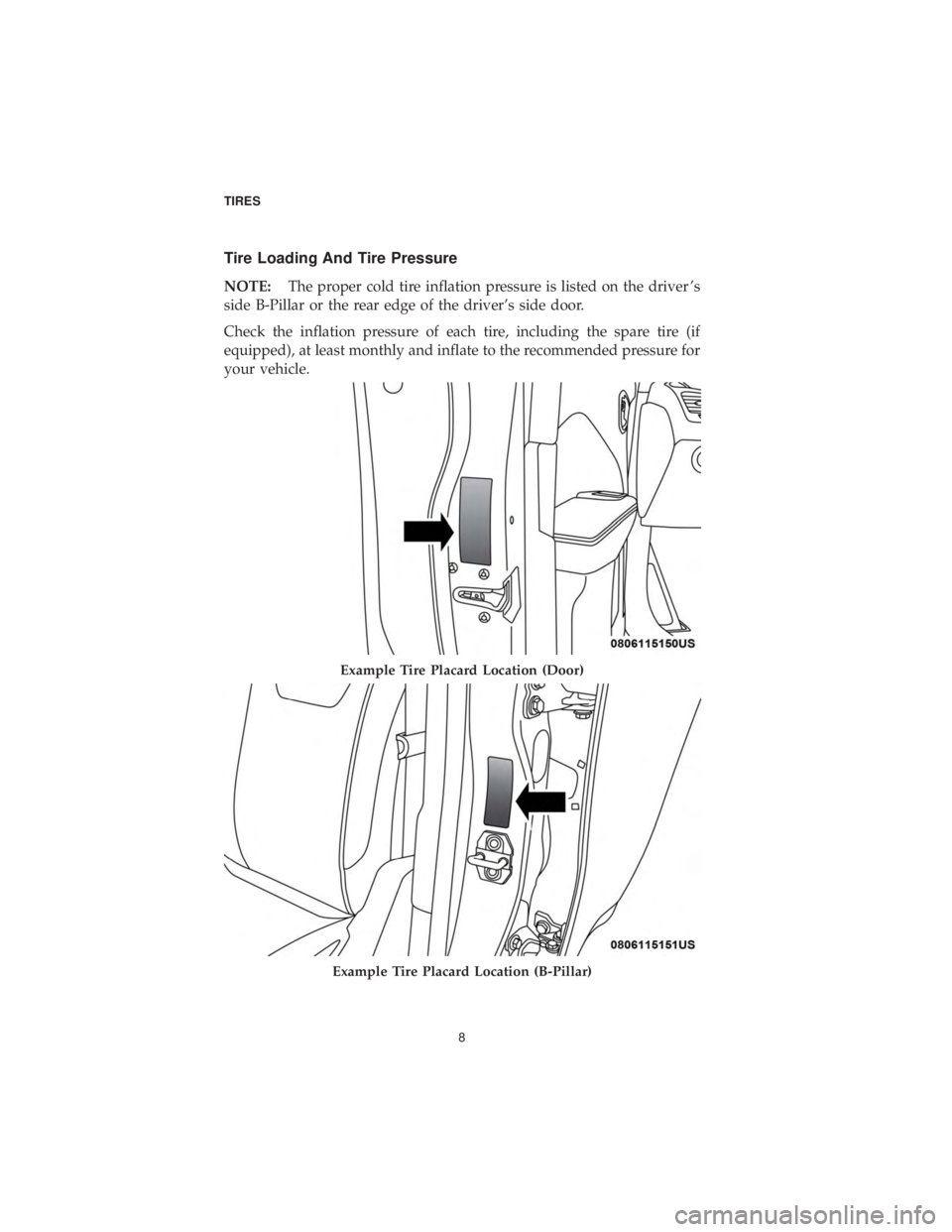
NOTE:The proper cold tire inflation pressure is listed on the driver ’s
side B-Pillar or the rear edge of the driver’s side door.
Check the inflation pressure of each tire, including the spare tire (if
equipped), at least monthly and inflate to the recommended pressure for
your vehicle.
Example Tire Placard Location (Door)
Example Tire Placard Location (B-Pillar)
TIRES
8
Page 14 of 270
Fuel Economy
Underinflated tires will increase tire rolling resistance resulting in higher
fuel consumption.
Tread Wear
Improper cold tire inflation pressures can cause abnormal wear patterns
and reduced tread life, resulting in the need for earlier tire replacement.
Ride Comfort And Vehicle Stability
Proper tire inflation contributes to a comfortable ride. Over-inflation
produces a jarring and uncomfortable ride.
Tire Inflation Pressures
The proper cold tire inflation pressure is listed on the driver’s side
B-Pillar or rear edge of the driver’s side door.
At least once a month:
•Check and adjust tire pressure with a good quality pocket-type
pressure gauge. Do not make a visual judgement when determining
proper inflation. Tires may look properly inflated even when they are
under-inflated.
• Inspect tires for signs of tire wear or visible damage.
CAUTION!
After inspecting or adjusting the tire pressure, always reinstall the
valve stem cap. This will prevent moisture and dirt from entering the
valve stem, which could damage the valve stem.
Inflation pressures specified on the placard are always “cold tire inflation
pressure”. Cold tire inflation pressure is defined as the tire pressure after
the vehicle has not been driven for at least three hours, or driven less than
1 mile (1.6 km) after sitting for a minimum of three hours. The cold tire
inflation pressure must not exceed the maximum inflation pressure
molded into the tire sidewall.
Check tire pressures more often if subject to a wide range of outdoor
temperatures, as tire pressures vary with temperature changes.
Tire pressures change by approximately 1 psi (7 kPa) per 12°F (7°C) of air
temperature change. Keep this in mind when checking tire pressure
inside a garage, especially in the Winter.
TIRES
13
Page 21 of 270
authorized tire dealer for recommended safe operating speeds, loading
and cold tire inflation pressures.
While studded tires improve performance on ice, skid and traction
capability on wet or dry surfaces may be poorer than that of non-studded
tires. Some states prohibit studded tires; therefore, local laws should be
checked before using these tire types.
Spare Tires — If Equipped
NOTE:For vehicles equipped with Tire Service Kit instead of a spare tire,
please refer to “Tire Service Kit” in “In Case Of Emergency” in your
Owner ’s Manual for further information.
CAUTION!
Because of the reduced ground clearance, do not take your vehicle
through an automatic car wash with a compact or limited use
temporary spare installed. Damage to the vehicle may result.
Spare Tire Matching Original Equipped Tire And Wheel — If
Equipped
Your vehicle may be equipped with a spare tire and wheel equivalent in
look and function to the original equipment tire and wheel found on the
front or rear axle of your vehicle. This spare tire may be used in the tire
rotation for your vehicle. If your vehicle has this option, refer to an
authorized tire dealer for the recommended tire rotation pattern.
Compact Spare Tire — If Equipped
The compact spare is for temporary emergency use only. You can identify
if your vehicle is equipped with a compact spare by looking at the spare
tire description on the Tire and Loading Information Placard located on
the driver ’s side door opening or on the sidewall of the tire. Compact
spare tire descriptions begin with the letter “T” or “S” preceding the size
designation. Example: T145/80D18 103M.
T, S = Temporary Spare Tire
Since this tire has limited tread life, the original equipment tire should be
repaired (or replaced) and reinstalled on your vehicle at the first
opportunity.
Do not install a wheel cover or attempt to mount a conventional tire on
the compact spare wheel, since the wheel is designed specifically for the
TIRES
20
Page 27 of 270
WARNING!
Death, serious injury and/or property damage may result from tire
failure due to tire damage and/or improper tire maintenance.
•All tires (including spare) should be inspected regularly by a
qualified technician for signs of wear, and signs of damage, such as
puncture, impact, improper maintenance, under-inflation or over-
inflation and overloading.
• Only qualified persons should repair tires. See Rubber Manufac-
turer ’s Association (RMA) established repair procedures at www.r-
ma.org for information on proper repair procedures.
• Only specially trained persons should mount tires.
Check Your Tires For Damage
Frequent (at least monthly) inspection of your tires for signs of damage,
uneven tread wear and their general condition is important for safety.
Impacts, penetrations, cracks, knots, bulges or air loss always require tire
removal and expert inspection.
NOTE: All tire warranties are made by the tire manufacturer. Tires are
not covered under your New Vehicle Limited Warranty.
TIRE WARRANTY
26
Page 29 of 270
•Misapplication, improper maintenance, racing, underinflation, overin-
flation or other abuse;
• Operation without a properly functioning low pressure warning
system, for Comp T/A® ZR SSS tires;
• Uneven or rapid wear which is caused by mechanical irregularity in
the vehicle such as wheel misalignment, (a measured tread difference
of 2/32 nds of an inch (1.6 mm) or more across the tread on the same
tire);
• Accident, fire, chemical corrosion, tire alteration or vandalism;
• Flat spotting caused by improper storage or brake lock;
• The adding of liquid, solid or gaseous materials other than air, nitrogen
or carbon dioxide (for example, waterbase sealers or balancing
substances);
• Ozone or weather checking.
HOW REPLACEMENT CHARGES ARE CALCULATED
Passenger And Light Truck Tires Workmanship/Materials
A tire which becomes unserviceable due to a condition covered by this
workmanship and materials limited warranty will be replaced with a
comparable new BFGoodrich brand tire, free of charge, when 2/32 nds of
an inch (1.6 mm) or less of the original tread is worn, (or 25% or less,
whichever is more beneficial to you) and within 12 months of the date of
purchase. The cost of mounting and balancing the tire is included. Yo u
pay the cost of any other service charges and applicable taxes.
When more than 2/32 nds of an inch (1.6 mm) of the original tread has
been worn (or more than 25%, whichever is more beneficial to you) or
after 12 months from the date of purchase, you must pay the cost of a
comparable new BFGoodrich brand passenger or light truck replacement
tire on a pro rated basis. The retailer shall determine the charge by
multiplying the percentage of the original usable tread worn by the
current selling price at the adjustment location or the price on the current
BFGoodrich brand Base Price List, whichever is lower. This list is based
on a predetermined price intended to fairly represent the actual selling
price of the tire.
You pay the cost of mounting, balancing, and or any other service
charges and applicable taxes.
BFGOODRICH TIRES
28
Page 32 of 270
DRIVING ON ANY TIRE THAT DOES NOT HAVE THE CORRECT
INFLATION PRESSURE IS DANGEROUS
Any underinflated tire builds up excessive heat that may result in sudden
tire destruction. If tires are supplied as original equipment, refer to the
tire decal on the vehicle (check vehicle and/or vehicle owner ’s manual
for decal location) for the recommended operating pressures. For replace-
ment tires, the correct inflation pressure will be provided by your tire
retailer; if not, refer to the vehicle decal.
These inflation pressures must be maintained as a minimum. However,
do not exceed the maximum pressure rating indicated on the tire
sidewall.
CHECK THE COLD INFLATION PRESSURES IN ALL YOUR TIRES,
INCLUDING THE SPARE, AT LEAST ONCE EACH MONTH
Failure to maintain correct inflation may result in improper vehicle
handling and may cause rapid and irregular tire wear, sudden tire
destruction, loss of vehicle control and serious personal injury. Therefore,
inflation pressures should be checked at least once each month and
always prior to long distance trips. This applies to all tires, including
sealant types, and Self-Supporting tires which are as susceptible to losing
air pressure as any other type of tire if not properly maintained.
UNDERINFLATION
It is impossible to determine whether tires are properly inflated by
simply looking at them. It is almost impossible to “feel or hear” when a
tire is being run underinflated or nearly flat. Tires must be checked
monthly with a tire pressure gauge.
Pressures should be checked when tires are cold, in other words, before
they have been driven on. Driving, even for a short distance, causes tires
to heat up and air pressure to increase.
Checking pressure when tires are hot:
If pressures are checked after tires have been driven for more than three
minutes or more than one mile, (1.6 km) the tires become hot and the
pressures will increase by approximately 4 psi. Therefore when the tire
pressure is adjusted under these conditions, it should be increased to a
gauge reading of 4 psi greater than the recommended cold inflation
pressure.
BFGOODRICH TIRES
31
Page 33 of 270

For Example Only:
Gauge reading of hot tire:................................ 32 psi (220 kPa)
If recommended cold inflation pressure is: ............. 30 psi (205 kPa)
Desired gauge reading of hot tire 3 0+4psi=........
34 psi (205 + 30 = 235 kPa)
Therefore: add 2 psi ....................................... (15 kPa)
Check cold pressure as soon as possible, preferably within 24 hours.
“Bleeding” air from hot tires could result in under-inflation. Use an
accurate tire gauge to check pressures. Never allow children to inflate
or deflate tires.
TIRE PRESSURE MONITORING SYSTEMS (TPMS):
Your vehicle may be equipped with a Tire Pressure Monitoring System
(TPMS) that is designed to monitor the pressure of tires mounted on your
vehicle and sends a signal to the driver if a tire pressure falls below a
predetermined level. A TPMS should not replace monthly manual
pressure checks for all four (4) tires and the spare. We recommend that
you manually monitor and check tire pressure inflation with a pressure
gauge.
Your tires should have the recommended pressure listed by your
vehicle’s manufacturer. This information can be found in the vehicle
owner ’s manual and often on a placard located in the vehicle’s door
jamb, inside the fuel hatch, or on the glove compartment door. If you
have a plus size fitment that requires a higher inflation pressure, your tire
pressure monitoring system will require re-calibration to the new infla-
tion pressure. Refer to your tire dealer/installer of plus size tires for
proper inflation pressure.
We recommend checking air pressure once each month, and before a long
trip. Whether you have a full-sized or mini-spare, make sure that it is
properly inflated as well. If the TPMS generates improper monitoring or
signals we recommend that you consult your owner ’s manual provided
with your vehicle and follow-up with your vehicle’s manufacturer.
BFGOODRICH TIRES
32
Page 37 of 270

Anytime you see any damage to your tires or wheels, replace with the
spare at once and immediately visit any BFGoodrich® tire retailer.
IMPACT DAMAGE
A tire impacted by a road hazard (curb, pothole, debris) may be damaged
but not have visible signs of damage on its surface. A tire damaged by an
impact may sustain a sudden failure a day, week, or even months later.
You may not recall hitting an object that damaged or injured your tires.
Air loss, unusual tire wear, localized wear or vibrations can also be signs
of internal tire damage.
If you suspect any damage to your tire or wheel from an impact with a
curb, pothole, debris on the road or any other road hazard, or if you feel
or hear any unusual vibration, replace with a properly inflated spare at
once and immediately visit any qualified tire technician.
INSPECTION
When inspecting your tires, including the spare, check the air pressures.
If the pressure check indicates that one of your tires has lost pressure of
two pounds or more, look for signs of penetration, valve leakage or wheel
damage that may account for the air loss.
Always look for bulges, cracks, cuts, penetrations and abnormal tire
wear, particularly on the edges of the tire tread, which may be caused
by misalignment or underinflation. If any such
All tires will wear out faster when subjected to high speeds as well as
hard cornering, rapid starts, sudden stops, frequent driving on roads
which are in poor condition, and off road use. Roads with holes and rocks
or other objects can damage tires and cause misalignment of your vehicle.
When driving on such roads, drive carefully and slowly, and before
driving again at normal or highway speeds, examine your tires for any
damage, such as cuts, bulges, penetrations, unusual wear patterns, etc.
WEAR BARS
BFGoodrich® tires contain “Wear-Bars” in the grooves of the tire tread
which show up when only 2/32 nds of an inch (1.6 mm) of tread is
remaining. At this stage, your tires must be replaced. Tires worn beyond
this stage are extremely dangerous.
DO NOT OVERLOAD - DRIVING ON ANY OVERLOADED TIRE IS
DANGEROUS
BFGOODRICH TIRES36