Page 322 of 532
WARNING!(Continued)
in injuries that are serious or fatal to you, your
passengers, and others around you.
• Take care not to allow the contents of Tire Service Kit
to come in contact with hair, eyes, or clothing. Tire
Service Kit sealant is harmful if inhaled, swallowed,
or absorbed through the skin. It causes skin, eye, and
respiratory irritation. Flush immediately with plenty
of water if there is any contact with eyes or skin.
Change clothing as soon as possible, if there is any
contact with clothing.
• Tire Service Kit Sealant solution contains latex. In
case of an allergic reaction or rash, consult a physi-
cian immediately. Keep Tire Service Kit out of reach
of children. If swallowed, rinse mouth immediately
with plenty of water and drink plenty of water. Do
not induce vomiting! Consult a physician immedi-
ately.
Sealing A Tire With Tire Service Kit
(A) Whenever You Stop To Use Tire Service Kit:
1. Pull over to a safe location and turn on the vehicle’s Hazard Warning flashers. 2. Verify that the valve stem (on the wheel with the
deflated tire) is in a position that is near to the ground.
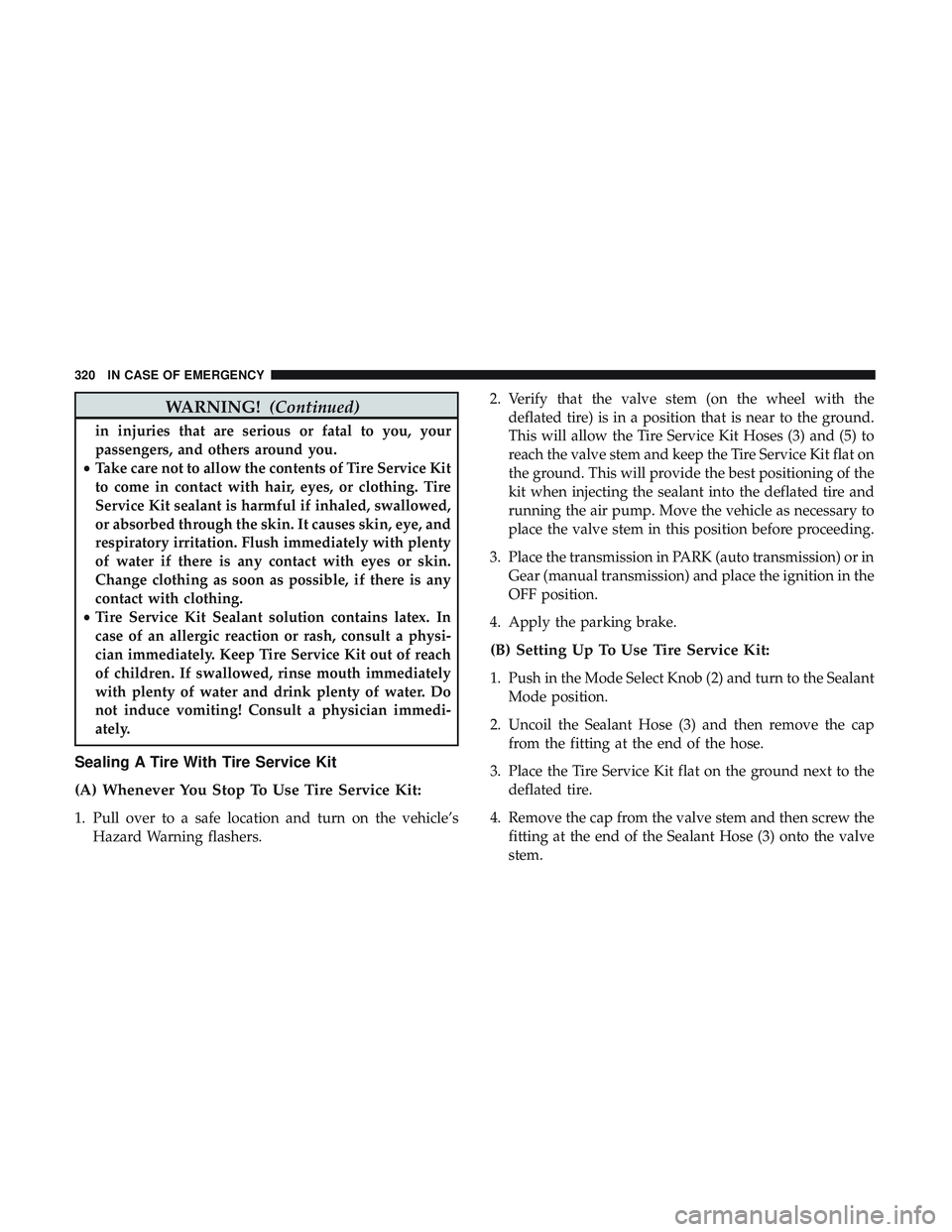
This will allow the Tire Service Kit Hoses (3) and (5) to
reach the valve stem and keep the Tire Service Kit flat on
the ground. This will provide the best positioning of the
kit when injecting the sealant into the deflated tire and
running the air pump. Move the vehicle as necessary to
place the valve stem in this position before proceeding.
3. Place the transmission in PARK (auto transmission) or in Gear (manual transmission) and place the ignition in the
OFF position.
4. Apply the parking brake.
(B) Setting Up To Use Tire Service Kit:
1. Push in the Mode Select Knob (2) and turn to the Sealant Mode position.
2. Uncoil the Sealant Hose (3) and then remove the cap from the fitting at the end of the hose.
3. Place the Tire Service Kit flat on the ground next to the deflated tire.
4. Remove the cap from the valve stem and then screw the fitting at the end of the Sealant Hose (3) onto the valve
stem.
320 IN CASE OF EMERGENCY
Page 323 of 532
5. Uncoil the Power Plug (7) and insert the plug into thevehicle’s 12 Volt power outlet.
NOTE: Do not remove foreign objects (e.g., screws or
nails) from the tire.
(C) Injecting Tire Service Kit Sealant Into The
Deflated Tire:
• Always start the engine before turning ON the Tire
Service Kit.
NOTE: Manual transmission vehicles must have the park-
ing brake engaged and the gear selector in NEUTRAL.
• After pushing the Power Button (1), the sealant (white
fluid) will flow from the Sealant Bottle (4) through the
Sealant Hose (3) and into the tire.
NOTE: Sealant may leak out through the puncture in the
tire.
If the sealant (white fluid) does not flow within0–10
seconds through the Sealant Hose (3):
1. Push the Power Button (1) to turn Off the Tire Service Kit. Disconnect the Sealant Hose (3) from the valve stem.
Make sure the valve stem is free of debris. Reconnect the
Sealant Hose (3) to the valve stem. Check that the Mode Select Knob (2) is in the Sealant Mode position and not
Air Mode. Push the Power Button (1) to turn On the Tire
Service Kit.
2. Connect the Power Plug (7) to a different 12 Volt power outlet in your vehicle or another vehicle, if available.
Make sure the engine is running before turning ON the
Tire Service Kit.
3. The Sealant Bottle (4) may be empty due to previous use. Call for assistance.
NOTE: If the Mode Select Knob (2) is on Air Mode and the
pump is operating, air will dispense from the Air Pump
Hose (5) only, not the Sealant Hose (3).
If the sealant (white fluid) does flow through the Sealant
Hose (3):
1. Continue to operate the pump until sealant is no longer flowing through the hose (typically takes 30 - 70 sec-
onds). As the sealant flows through the Sealant Hose (3),
the Pressure Gauge (8) can read as high as 70 psi
(4.8 Bar). The Pressure Gauge (8) will decrease quickly
from approximately 70 psi (4.8 Bar) to the actual tire
pressure when the Sealant Bottle (4) is empty.
7
IN CASE OF EMERGENCY 321
Page 337 of 532
SERVICING AND MAINTENANCE
CONTENTS
�SCHEDULED SERVICING .................337
▫ 3.6L And 5.7L Engines ...................337
▫ 6.4L Engine ......................... .341
� ENGINE COMPARTMENT .................345
▫ 3.6L Engine ......................... .345
▫ 5.7L Engine ......................... .346
▫ 6.4L Engine ......................... .347
▫ Checking Oil Level — 3.6L And 5.7L Engine . . .348
▫ Checking Oil Level — 6.4L Engine ...........348
▫ Adding Washer Fluid ...................349
▫ Maintenance-Free Battery .................349
� DEALER SERVICE ...................... .350
▫ Engine Oil .......................... .351
▫ Engine Oil Filter ...................... .355▫
Engine Air Cleaner Filter .................355
▫ Air Conditioner Maintenance ..............356
▫ Accessory Drive Belt Inspection ............359
▫ Body Lubrication ..................... .360
▫ Windshield Wiper Blades .................361
▫ Exhaust System ....................... .363
▫ Cooling System ....................... .365
▫ Brake System ........................ .369
▫ Clutch Hydraulic System — Manual
Transmission (If Equipped) ................371
▫ Manual Transmission — If Equipped ........371
▫ Automatic Transmission — If Equipped ......371
▫ All Wheel Drive (AWD) — If Equipped .......373
▫ Rear
Axle ........................... .373
8
Page 415 of 532

FLUIDS AND LUBRICANTS
Engine
ComponentFluid, Lubricant, or Genuine Part
Engine Coolant We recommend you use Mopar Antifreeze/Coolant 10 Year/150,000
(240,000 km)Mile Formula OAT (Organic Additive Technology).
Engine Oil – 3.6L & 5.7L Engine We recommend you use API Certified SAE 5W-20 Engine Oil, meeting the requirements of FCA Material Standard MS-6395 such as Mopar SAE 5W-20,
Pennzoil SAE 5W-20, and Pennzoil gold 5W-20 semi-synthetic oil. Refer to
your engine oil filler cap for correct SAE grade.
Engine Oil – 6.4L Engine For best performance and maximum protection under all types of operating
conditions, the manufacturer only recommends full synthetic engine oils.
The manufacturer recommends the use of Pennzoil Ultra Platinum 0W-40 or
equivalent Mopar engine oil meeting the requirements of FCA Material Stan-
dard MS-12633 for use in all operating temperatures.
Engine Oil Filter We recommend you use Mopar Engine Oil Filters.
Spark Plugs We recommend you use Mopar Spark Plugs.
Fuel Selection – 3.6 Engine 87 Octane, 0-15% Ethanol.
Fuel Selection – 5.7 Engine With Au-
tomatic Transmission 89 Octane recommended – 87 Octane acceptable, 0-15% Ethanol.
Fuel Selection – 6.4L Engine & 5.7
Engine With Manual Transmission 91 Octane or higher, 0-15% Ethanol.
9
TECHNICAL SPECIFICATIONS 413
Page 467 of 532
2. Press the gear icon and select the following option fromthe menu:
• Set Widget: Top Left
• Set Widget: Top Right
• Set Widget: Bottom Left
• Set Widget: Bottom Right
3. After selecting a Widget location: select the gauge to display:
• Gauge: Oil Temp
• Gauge: Oil Pressure
• Gauge: Coolant Temp
• Gauge: Battery Voltage
• Gauge: Trans Temp — If Equipped with an Automatic
Transmission
• Gauge: Boost Pressure — If Equipped
• Gauge: Air/Fuel Ratio — If Equipped •
Gauge: I/C Coolant Temp — If Equipped
• Gauge: Intake Air Temp
• Gauge: Engine Torque
• Gauge: Engine Power
• Gauge: G-Force
• Gauge: Steering Angle
• Gauge: Current Gear
• Gauge: Current Speed
• Timer: 0-60 MPH
• Timer: 0-100 MPH
• Timer: 1/8 Mile
• Timer: 1/4 Mile
• Timer: Brake Distance
• Timer: Reaction Time
10
MULTIMEDIA 465
Page 471 of 532
•Coolant Temperature
Shows the actual coolant temperature.
• Battery Voltage
Shows the actual battery voltage
• Trans Oil Temp — If Equipped with an Automatic
Transmission
Shows the actual transmission oil temperature.
• Boost Pressure — If Equipped
Shows actual boost pressure.
• Air Fuel Ratio — If Equipped
Shows current air fuel ratio
• I/C Coolant Temp — If Equipped
Shows actual I/C Coolant temperature.
• Intake Air Temperature
Shows the actual intake air temperature.
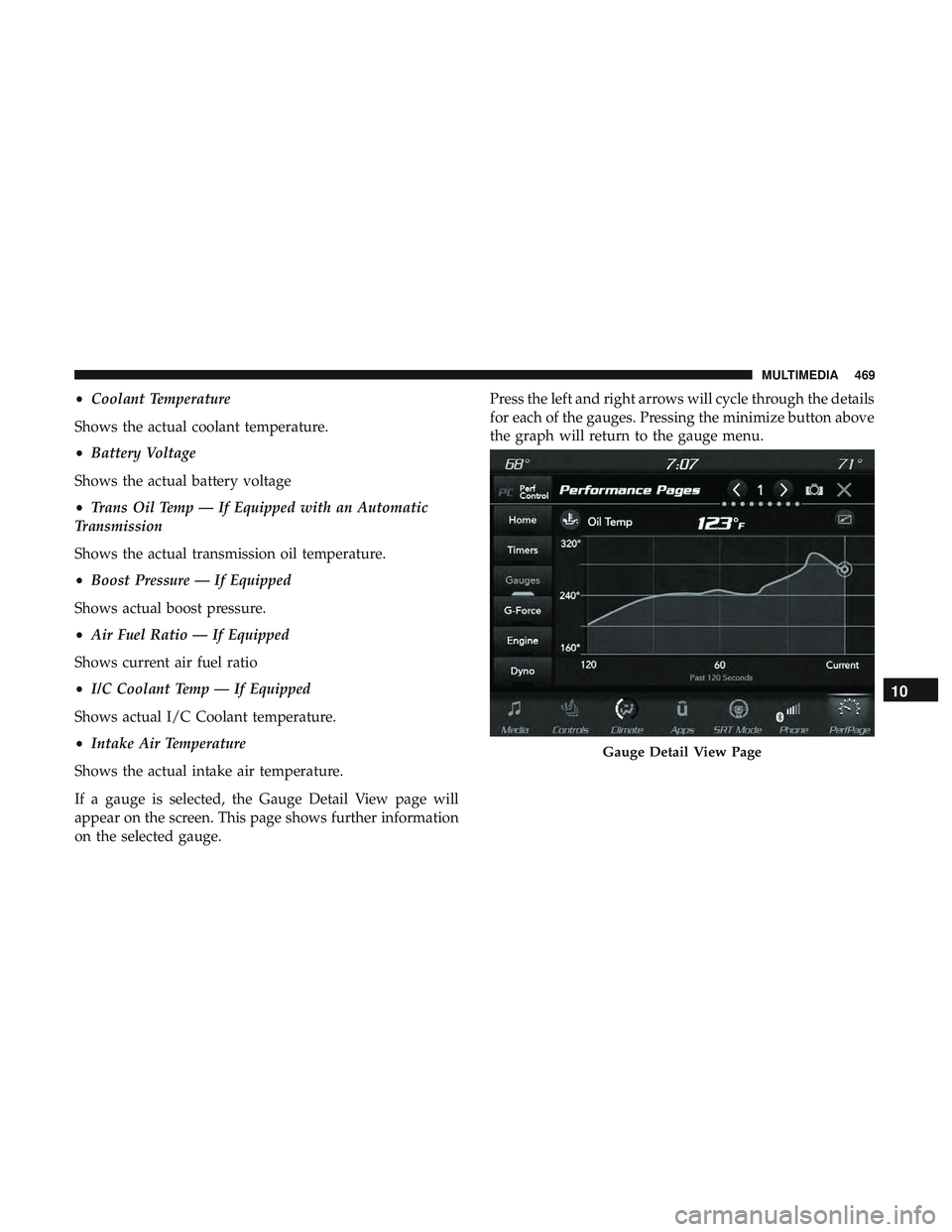
If a gauge is selected, the Gauge Detail View page will
appear on the screen. This page shows further information
on the selected gauge. Press the left and right arrows will cycle through the details
for each of the gauges. Pressing the minimize button above
the graph will return to the gauge menu.
Gauge Detail View Page
10
MULTIMEDIA 469
Page 474 of 532
•Engine Torque
Shows the instantaneous torque.
• Oil Pressure (6.4L only)
Shows the actual engine oil pressure.
• Gear (Automatic Transmission Only)
Shows the current (or pending) operating gear of the
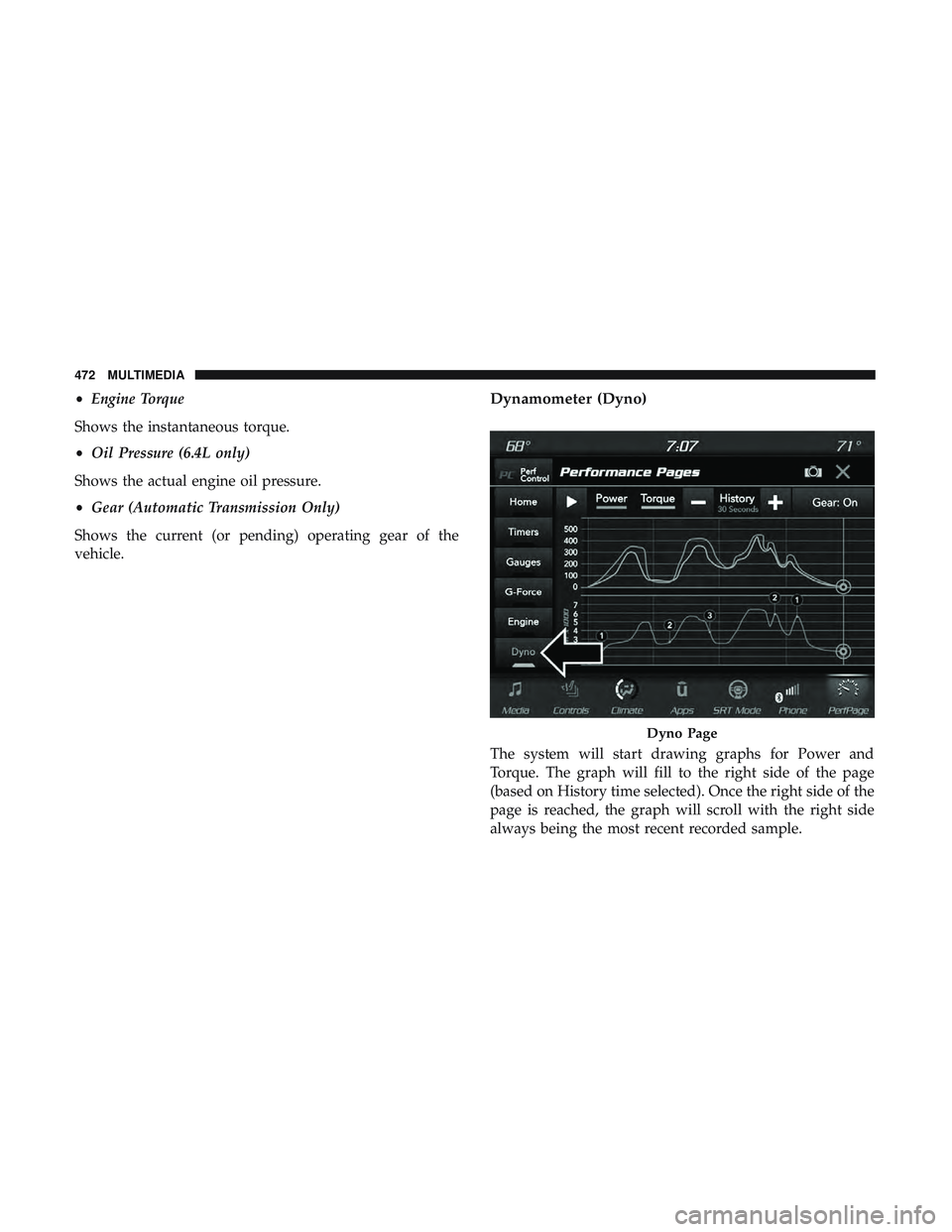
vehicle.Dynamometer (Dyno)
The system will start drawing graphs for Power and
Torque. The graph will fill to the right side of the page
(based on History time selected). Once the right side of the
page is reached, the graph will scroll with the right side
always being the most recent recorded sample.
Dyno Page
472 MULTIMEDIA
Page 522 of 532
Maintenance Schedule.............337, 338, 341, 342
Malfunction Indicator Light (Check Engine) .....119,126
Manual Backward ........................... .42, 43
Forward ............................ .42, 43
Park Release ........................... .328
Rearward ...............................42
Service ............................... .510
Tilt ...................................43
Manual Transmission .................218, 371, 373
Fluid Level Check .....................371, 373
Map/Reading Lights .........................64
Methanol ............................... .409
Mirrors ..................................57
Electric Powered ..........................58
Electric Remote ...........................58
Heated .................................59
Outside ................................58
Rearview ........................... .57, 281
Vanity .................................59
Modifications/Alterations Vehicle .................................5
Monitor, Tire Pressure System ..................149
Mopar Parts ............................. .509Multi-Function Control Lever
...................60
New Vehicle Break-In Period ..................214
Occupant Restraints ........................ .155
Octane Rating, Gasoline (Fuel) ..............406, 413
Oil Change Indicator ....................... .107
Reset ................................ .107
Oil, Engine ........................... .351, 413
Capacity ...............................411
Change Interval ........................ .351
Checking ............................. .348
Dipstick .............................. .348
Disposal .............................. .355
Filter ............................. .355, 413
Filter Disposal .......................... .355
Identification Logo ...................... .352
Materials Added To ...................... .355
Pr
essure Warning Light ....................117
Recommendation .....................351, 411
Synthetic ............................. .353
Viscosity ....................... .352, 353, 411
Oil Filter, Change ......................... .355
Oil Filter, Selection ......................... .355
Oil Pressure Light ..........................117
520 INDEX