2019 DODGE CHALLENGER radiator
[x] Cancel search: radiatorPage 368 of 532
NOTE:
•Mixing of engine coolant (antifreeze) other than speci-
fied Organic Additive Technology (OAT) engine coolant
(antifreeze), may result in engine damage and may
decrease corrosion protection. Organic Additive Tech-
nology (OAT) engine coolant is different and should not
be mixed with Hybrid Organic Additive Technology
(HOAT) engine coolant (antifreeze) or any “globally
compatible” coolant (antifreeze). If a non-OAT engine
coolant (antifreeze) is introduced into the cooling system
in an emergency, the cooling system will need to be
drained, flushed, and refilled with fresh OAT coolant
(conforming to MS.90032), by an authorized dealer as
soon as possible.
• Do not use water alone or alcohol-based engine coolant
(antifreeze) products. Do not use additional rust inhibi-
tors or antirust products, as they may not be compatible
with the radiator engine coolant and may plug the
radiator.
• This vehicle has not been designed for use with propyl-
ene glycol-based engine coolant (antifreeze). Use of
propylene glycolbased engine coolant (antifreeze) is not
recommended. •
Some vehicles require special tools to add coolant prop-
erly. Failure to fill these systems properly could lead to
severe internal engine damage. If any coolant is needed
to be added to the system please contact an authorized
dealer.
Adding Coolant
Your vehicle has been built with an improved engine
coolant (OAT coolant conforming to MS.90032) that allows
extended maintenance intervals. This engine coolant (anti-
freeze) can be used up to ten years or 150,000 miles
(240,000 km) before replacement. To prevent reducing this
extended maintenance period, it is important that you use
the same engine coolant (OAT coolant conforming to
MS.90032) throughout the life of your vehicle.
Please review these recommendations for using Organic
Additive Technology (OAT) engine coolant (antifreeze)
that meets the requirements of FCA Material Standard
MS.90032. When adding engine coolant (antifreeze):
• We recommend using Mopar Antifreeze/Coolant 10
Year/150,000 Mile (240,000 km) Formula OAT (Organic
Additive Technology) that meets the requirements of
FCA Material Standard MS.90032.
366 SERVICING AND MAINTENANCE
Page 369 of 532
•Mix a minimum solution of 50% OAT engine coolant
that meets the requirements of FCA Material Standard
MS.90032 and distilled water. Use higher concentrations
(not to exceed 70%) if temperatures below 34°F (37°C)
are anticipated. Please contact an authorized dealer for
assistance.
• Use only high purity water such as distilled or deionized
water when mixing the water/engine coolant (anti-
freeze) solution. The use of lower quality water will
reduce the amount of corrosion protection in the engine
cooling system.
NOTE:
• It is the owner’s responsibility to maintain the proper
level of protection against freezing according to the
temperatures occurring in the area where the vehicle is
operated.
• Some vehicles require special tools to add coolant prop-
erly. Failure to fill these systems properly could lead to
severe internal engine damage. If any coolant is needed
to be added to the system, please contact a local autho-
rized dealer.
• Mixing engine coolant (antifreeze) types is not recom-
mended and can result in cooling system damage. If HOAT and OAT coolant are mixed in an emergency,
have a authorized dealer drain, flush, and refill with
OAT coolant (conforming to MS.90032) as soon as pos-
sible.
Cooling System Pressure Cap
The cap must be fully tightened to prevent loss of engine
coolant (antifreeze), and to ensure that engine coolant
(antifreeze) will return to the radiator from the coolant
expansion bottle/recovery tank if so equipped.
The cap should be inspected and cleaned if there is any
accumulation of foreign material on the sealing surfaces.
WARNING!
•
Do not open hot engine cooling system. Never add
engine coolant (antifreeze) when the engine is over-
heated. Do not loosen or remove the cap to cool an
overheated engine. Heat causes pressure to build up
in the cooling system. To prevent scalding or injury,
do not remove the pressure cap while the system is
hot or under pressure.
• Do not use a pressure cap other than the one speci-
fied for your vehicle. Personal injury or engine
damage may result.
8
SERVICING AND MAINTENANCE 367
Page 370 of 532
Disposal Of Used Coolant
Used ethylene glycol-based coolant (antifreeze) is a regu-
lated substance requiring proper disposal. Check with your
local authorities to determine the disposal rules for your
community. To prevent ingestion by animals or children,
do not store ethylene glycol-based coolant in open contain-
ers or allow it to remain in puddles on the ground. If
ingested by a child or pet, seek emergency assistance
immediately. Clean up any ground spills immediately.
Coolant Level
The coolant bottle provides a quick visual method for
determining that the engine coolant (antifreeze) level is
adequate. With the engine OFF and cold, the level of the
engine coolant (antifreeze) in the bottle should be between
the ranges indicated on the bottle.
The radiator normally remains completely full, so there is
no need to remove the radiator cap unless checking for
engine coolant (antifreeze) freeze point or replacing engine
coolant (antifreeze). Advise your service attendant of this.
As long as the engine operating temperature is satisfactory,
the coolant bottle need only be checked once a month.When additional engine coolant (antifreeze) is needed to
maintain the proper level, it should be added to the coolant
bottle. Do not overfill.
Points To Remember
NOTE:
When the vehicle is stopped after a few miles/
kilometers of operation, you may observe vapor coming
from the front of the engine compartment. This is normally
a result of moisture from rain, snow, or high humidity
accumulating on the radiator and being vaporized when
the thermostat opens, allowing hot engine coolant (anti-
freeze) to enter the radiator.
If an examination of your engine compartment shows no
evidence of radiator or hose leaks, the vehicle may be
safely driven. The vapor will soon dissipate.
• Do not overfill the coolant expansion bottle.
• Check the coolant freeze point in the radiator and in the
coolant expansion bottle. If engine coolant (antifreeze)
needs to be added, the contents of the coolant expansion
bottle must also be protected against freezing.
• If frequent engine coolant (antifreeze) additions are
required, the cooling system should be pressure tested
for leaks.
368 SERVICING AND MAINTENANCE
Page 371 of 532
•Maintain engine coolant (antifreeze) concentration at a
minimum of 50% OAT coolant (conforming to
MS.90032) and distilled water for proper corrosion pro-
tection of your engine which contains aluminum com-
ponents.
• Make sure that the coolant expansion bottle overflow
hoses are not kinked or obstructed.
• Keep the front of the radiator clean. If your vehicle is
equipped with air conditioning, keep the front of the
condenser clean.
• Do not change the thermostat for Summer or Winter
operation. If replacement is ever necessary, install ONLY
the correct type thermostat. Other designs may result in
unsatisfactory engine coolant (antifreeze) performance,
poor gas mileage, and increased emissions.
Brake System
In order to assure brake system performance, all brake
system components should be inspected periodically. Refer
to the “Maintenance Plan” in this section for the proper
maintenance intervals.
WARNING!
Riding the brakes can lead to brake failure and possi-
bly a collision. Driving with your foot resting or riding
on the brake pedal can result in abnormally high brake
temperatures, excessive lining wear, and possible
brake damage. You would not have your full braking
capacity in an emergency.
Fluid Level Check — Brake Master Cylinder
Check the fluid level in the master cylinder immediately if
the brake system warning light indicates system failure.
Check the fluid level in the master cylinder when perform-
ing underhood services.
Clean the top of the master cylinder area before removing
the cap. Add fluid to bring the level up to the top of the
“FULL” mark on the side of the master cylinder reservoir.
Overfilling of fluid is not recommended because it may
cause leaking in the system.
8
SERVICING AND MAINTENANCE 369
Page 416 of 532

CAUTION!
•Mixing of engine coolant (antifreeze) other than
specified Organic Additive Technology (OAT) en-
gine coolant (antifreeze), may result in engine dam-
age and may decrease corrosion protection. Organic
Additive Technology (OAT) engine coolant is differ-
ent and should not be mixed with Hybrid Organic
Additive Technology (HOAT) engine coolant (anti-
freeze) or any “globally compatible” coolant (anti-
freeze). If a non-OAT engine coolant (antifreeze) is
introduced into the cooling system in an emergency,
the cooling system will need to be drained, flushed,
(Continued)
CAUTION! (Continued)
and refilled with fresh OAT coolant (conforming to
MS.90032), by an authorized dealer as soon as pos-
sible.
• Do not use water alone or alcohol-based engine
coolant (antifreeze) products. Do not use additional
rust inhibitors or antirust products, as they may not
be compatible with the radiator engine coolant and
may plug the radiator.
• This vehicle has not been designed for use with
propylene glycol-based engine coolant (antifreeze).
Use of propylene glycol-based engine coolant (anti-
freeze) is not recommended.
414 TECHNICAL SPECIFICATIONS
Page 516 of 532
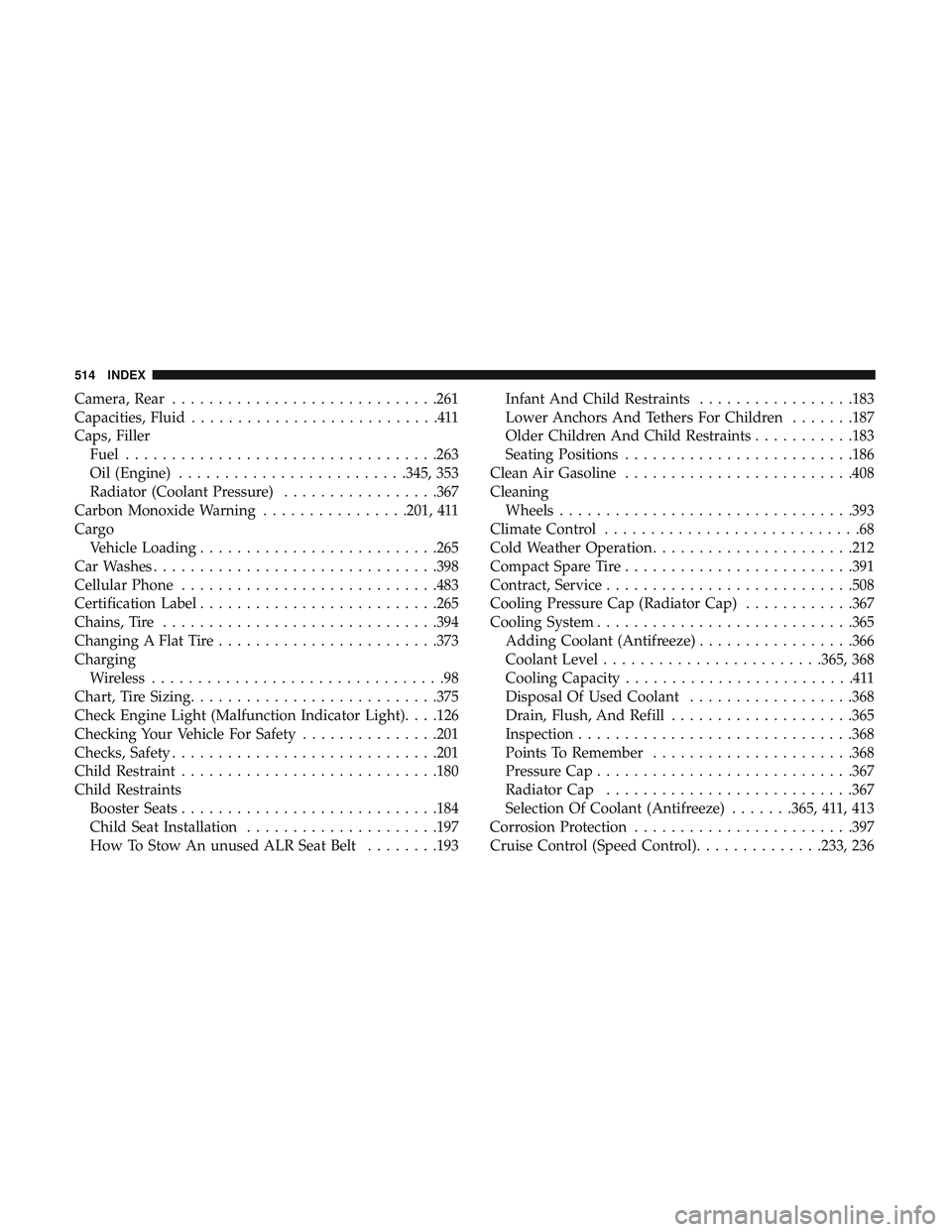
Camera, Rear............................ .261
Capacities, Fluid ...........................411
Caps, Filler Fuel ................................. .263
Oil (Engine) ........................ .345, 353
Radiator (Coolant Pressure) .................367
Carbon Monoxide Warning ................201, 411
Cargo Vehicle Loading ......................... .265
Car Washes .............................. .398
Cellular Phone ........................... .483
Certification Label ......................... .265
Chains, Tire ............................. .394
Changing A Flat Tire ....................... .373
Charging Wireless ................................98
Chart, Tire Sizing .......................... .375
Check Engine Light (Malfunction Indicator Light). . . .126
Checking Your Vehicle For Safety ...............201
Checks, Safety ............................ .201
Child Restraint ........................... .180
Child Restraints Booster Seats ........................... .184
Child Seat Installation .....................197
How To Stow An unused ALR Seat Belt ........193Infant And Child Restraints
.................183
Lower Anchors And Tethers For Children .......187
Older Children And Child Restraints ...........183
Seating Positions ........................ .186
Clean Air Gasoline ........................ .408
Cleaning Wheels ............................... .393
Climate Control ............................68
Cold Weather Operation ..................... .212
Compact Spare Tire ........................ .391
Contract, Service .......................... .508
Cooling Pressure Cap (Radiator Cap) ............367
Cooling System ........................... .365
Adding Coolant (Antifreeze) .................366
Coolant
Level ....................... .365, 368
Cooling Capacity .........................411
Disposal Of Used Coolant ..................368
Drain, Flush, And Refill ....................365
Inspection ............................. .368
Points To Remember ..................... .368
Pressure Cap ........................... .367
Radiator Cap .......................... .367
Selection Of Coolant (Antifreeze) .......365, 411, 413
Corrosion Protection ....................... .397
Cruise Control (Speed Control) ..............233, 236
514 INDEX
Page 523 of 532
Onboard Diagnostic System...................125
Operating Precautions ...................... .125
Operator Manual Owner’s Manual .......................5,510
Outside Rearview Mirrors .....................58
Overheating, Engine ....................... .327
Owner ’s Manual (Operator Manual) ...............5
Paddle Shifters ........................... .229
Paddle Shift Mode ......................... .229
Paint Care ............................... .397
Panic Alarm ...............................21
Parking Brake ............................ .215
ParkSense System, Rear ..................... .254
Passenger Seat Easy Entry ..............................50
Passing Light ..............................61
Personalized Main Menu .....................419
Pets ................................... .201
Pinch Protection ............................82
Placard, Tire And Loading Information ...........379
Power Brakes ............................... .404
Deck Lid Release .........................84
Distribution Center (Fuses) ..................295 Door Locks
..............................36
Mirrors ................................58
Outlet (Auxiliary Electrical Outlet) .............95
Seats ..................................45
Steering .............................. .232
Sunroof ................................80
Tilt/Telescoping Steering Column ..............55
Windows ...............................79
Power Seats Forward ................................46
Lumbar ................................46
Rearward ...............................46
Power Steering Fluid .....................413, 415
Pregnant Women And Seat Belts ................164
Preparation For Jacking ..................... .303
Pretensioners Seat Belts ............................. .164
Programmable Features ..................... .421
Radial Ply Tires ........................... .385
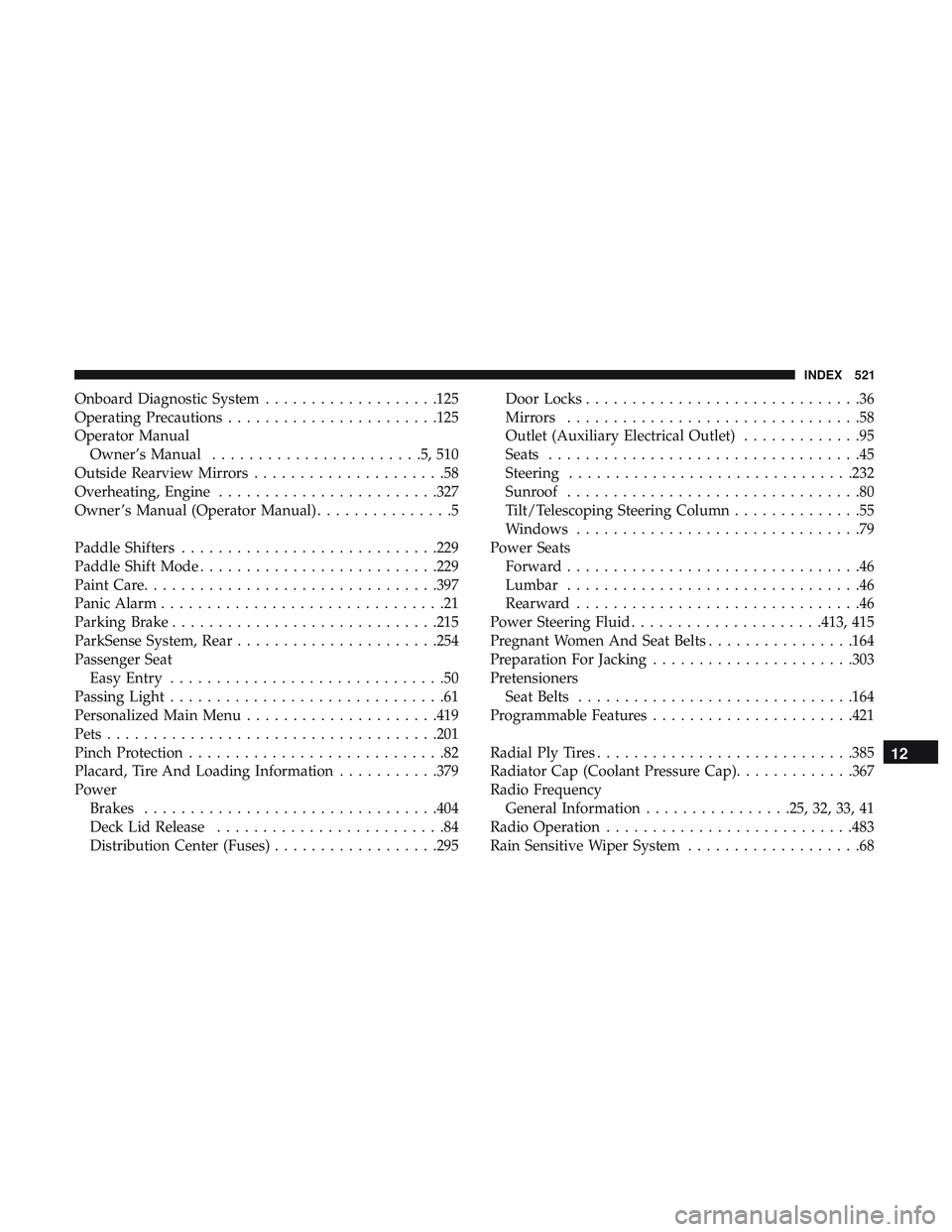
Radiator Cap (Coolant Pressure Cap) .............367
Radio
Frequency
General Information ................25, 32, 33, 41
Radio Operation .......................... .483
Rain Sensitive Wiper System ...................68
12
INDEX 521