2019 CITROEN DS7 CROSSBACK The design
[x] Cancel search: The designPage 160 of 244

158
Practical information07
Fitting on longitudinal bars
The transverse bars must be fixed at the markings
located on the longitudinal bars.
Direct fitting on roof
The transverse bars must only be fixed at the
four anchorage points located on the roof frame.
These points are concealed by the vehicle doors
when the doors are closed.
The roof bar fixings have a stud which must be
inserted into the opening of each anchorage
point.
Recommendations
Distribute the load uniformly, taking care
to avoid overloading one of the sides.
Arrange the heaviest part of the load as close
as possible to the roof.
Secure the load firmly.
Drive gently: the vehicle will be more
susceptible to the effects of side winds and its
stability may be affected.
Regularly check the security and tight
fastening of the roof bars, at least before each
trip.
Remove the roof bars once they are no longer
needed.
Very cold climate screens
(Depending on country of sale)
This removable device prevents the accumulation
of snow around the radiator cooling fan.
It consists of a first element for the upper part
of the front grille and a second element for the
lower part.
In case of difficulty with installation/
removal
Contact a dealer or a qualified workshop.
Before any operation, ensure that the
engine is off and the cooling fan has
stopped.
It is essential to remove them when:
– the outside t emperature exceeds 10°C.
–
rec
overy is in progress.
–
the speed is abo
ve 75 mph (120 km/h).
Snow chains
In wintry conditions, snow chains improve
traction as well as the behaviour of the vehicle
when braking.
Snow chains must be fitted only to the
front wheels. They must never be fitted to
"space-saver" type spare wheels.
Observe the legislation in force in your
country relating to the use of snow chains
and maximum authorised speeds.
Only use chains that have been designed to be
fitted to the type of wheel on the vehicle:
Original tyre size Maximum link size 225/55 R18 9 mm
205/55 R19 9 mm
235/50 R19 Cannot be fitted with chains
235/45 R20 Cannot be fitted with chains
245/35 R21 Cannot be fitted with chains
Page 167 of 244

165
Practical information07
the shock absorbers have a major impact on road
holding and braking performance.
For your safety and driving comfort, it is important
to have them regularly checked by a dealer or a
qualified workshop.
Timing and accessory kits
The timing and accessory kits are used
from the time the engine is started until it
is switched off. It is normal for them to wear over
time.
A faulty timing or accessory kit can damage
the engine, rendering it unusable. Observe the
recommended replacement frequency, stated in
distance travelled or time elapsed, whichever is
reached first.
AdBlue® (BlueHDi)
To respect the environment and ensure
compliance with the Euro 6 standard, without
adversely affecting the performance or
fuel consumption of its Diesel engines, the
Manufacturer has taken the decision to equip
its vehicles with a system that combines SCR
(Selective Catalytic Reduction) with a Diesel
Particle Filter (DPF) for the treatment of exhaust
gases.
SCR system
Using a liquid called AdBlue® that contains
urea, a catalytic converter turns up to 85% of
the nitrogen oxides (NOx) into nitrogen and
water, which are harmless to health and the
environment.
The AdBlue® is contained in a special tank
holding about 17 litres.
Its capacity allows a driving range of
approximately 3,900 miles (6,500 km), which may
vary considerably depending on your driving style.
An alert system is triggered once the reserve level
is reached: it is then possible to drive for a further
1,500 miles (2,400 km) before the tank is empty
and the vehicle is immobilised.
For more information on the Warning and
indicator lamps and the associated alerts,
or the Indicators, please refer to the
corresponding sections.
Once the AdBlue® tank is empty, a device
required by law prevents the engine from
being restarted.
If the SCR system is faulty, the level of
emissions from the vehicle will no longer meet
the Euro 6 standard and the vehicle starts
polluting the environment.
In the event of a confirmed SCR system
malfunction, it is essential to visit a dealer or a
qualified workshop. After 660 miles (1,100 km),
a device is automatically activated to prevent
the engine from starting.
In both cases, a range indicator indicates
the distance that can be travelled before the
vehicle is stopped.
Freezing of the AdBlue®
AdBlue® freezes at temperatures below
around -11°C.
The SCR system includes a heater for the
AdBlue
® tank, allowing you to continue driving
in very cold conditions.
Supply of AdBlue®
It is recommended that the AdBlue® be topped up
as soon as the first alert is issued indicating that
the reserve level has been reached.
For the correct operation of the SCR
system:
–
U
se only AdBlue
® fluid that meets the ISO
22241 standard.
–
Ne
ver transfer AdBlue
® to another container
as it would lose its purity.
–
Ne
ver dilute AdBlue
® with water.
You can obtain AdBlue
® from a dealer or a
qualified workshop, as well as service stations
equipped with AdBlue
® pumps specially designed
for passenger vehicles.
Recommendations on storage
AdBlue® freezes at about -11°C and deteriorates
above +25°C. Containers should be stored in a
cool area and protected from direct sunlight.
Under these conditions, the fluid can be kept for
at least a year.
If the fluid has frozen, it can be used once it has
completely thawed out at room temperature.
Page 174 of 244

172In the event of a breakdown08
List of tools
1.Chocks to immobilise the vehicle (depending
on equipment)
2. Socket for the wheel security bolts (located in
the glove box) (depending on equipment)
To adapt the wheelbrace to the special
‘security’ bolts.
3. Removable towing eye and tool to open the
rear protective cover
For more information on Towing the vehicle and
using the removable towing eye, refer to the
corresponding section.
With temporary puncture repair kit
4. 12 V compressor with cartridge of sealant and
speed limit sticker
For temporary repair of a tyre and to adjust the
tyre pressure.
For more information on the Temporary puncture
repair kit, refer to the corresponding section.
With spare wheel
5. Wheelbrace
For removing the wheel bolts.
6. Jack with integrated handle
To raise the vehicle.
7. Wheel bolt cap removal tool (depending on
equipment)
For removing the wheel bolt head finishers on
alloy wheels.
For more information on the Spare wheel, refer to
the corresponding section.
Temporary puncture repair
kit
Visit this link to view explanatory videos:
http://q-r.to/bagGl9
Made up of a compressor and a sealant
cartridge, it allows you to carry out a temporary
repair of the tyre so that you can drive to the
nearest garage.
It is designed to repair most punctures located on
the tyre tread.
The vehicle's electric system allows the
connection of the compressor to the 12 V
Page 182 of 244

180
In the event of a breakdown08
► Using the opening tool, unclip the cover of
the access flap on the rear screw thread of the
towing eye, then pull it towards you.
► Insert the screwdriver head diagonally in the
cylindrical guide until you reach the lamp unit
fixing bolt.
► Slacken the bolt by about 10 turns then pull
the lamp unit to release it from the bumper.
► Disconnect the harness.
For each lamp:
► Turn the bulb holder a quarter turn anti-
clockwise and remove it.
► Remove the bulb and replace it.
Fuses
Changing a fuse
All work must be carried out only by a
dealer or a qualified workshop.
The replacement of a fuse by a third party
could cause a serious malfunction of the
vehicle.
Installing electrical accessories
The vehicle's electrical system is
designed to operate with standard or optional
equipment.
Before fitting other electrical equipment or
accessories to your vehicle, contact a dealer or
a qualified workshop.
The Manufacturer accepts no
responsibility for the cost incurred in
repairing the vehicle or for rectifying
malfunctions resulting from the installation of
accessories not supplied or not approved by it
and not installed in accordance with its
specifications, in particular when the
combined power consumption of all of the
additional equipment connected exceeds 10
milliamperes.
Page 183 of 244
181
In the event of a breakdown08
12 V battery/Accessory
batteries
Lead-acid starter batteries
These batteries contain harmful
substances (sulphuric acid and lead).
They must be disposed of in accordance
with regulations and must never under any
circumstances be discarded with household
waste.
Dispose of used batteries at a designated
collection point.
Protect your eyes and face before
handling the battery.
All operations on the battery must be carried
out in a well ventilated area and away from
naked flames and sources of sparks, to avoid
any risk of explosion or fire.
Wash your hands afterwards.
Electronic control units/LED technology
headlamps
Never connect the negative jump lead to the
metal part of the electronic control units or at
the back of the headlamps.
Risk of destroying the electronic control units
and/or headlamps!
Connect to the remote earth point provided for
this purpose.
Frozen battery
Never try to charge a frozen battery - risk
of explosion!
If the battery has frozen, have it checked by
a dealer or by a qualified workshop, who will
verify that the internal components have not
been damaged and that the case has not
cracked, which could lead to a risk of leakage
of toxic and corrosive acid.
Never try to start the engine by pushing
the vehicle.
Symbols
No sparks or naked flames, no smoking.
Always protect your eyes. Explosive gases
can cause blindness and injury.
Keep the vehicle's battery out of the reach
of children.
The vehicle's battery contains sulphuric
acid which can make you go blind or cause
severe burns.
For more information, refer to the
handbook.
Explosive gases can be present close to
the battery.
With petrol/Diesel engines
Procedure for starting the engine using another
battery or for charging a discharged battery.
Accessing the battery
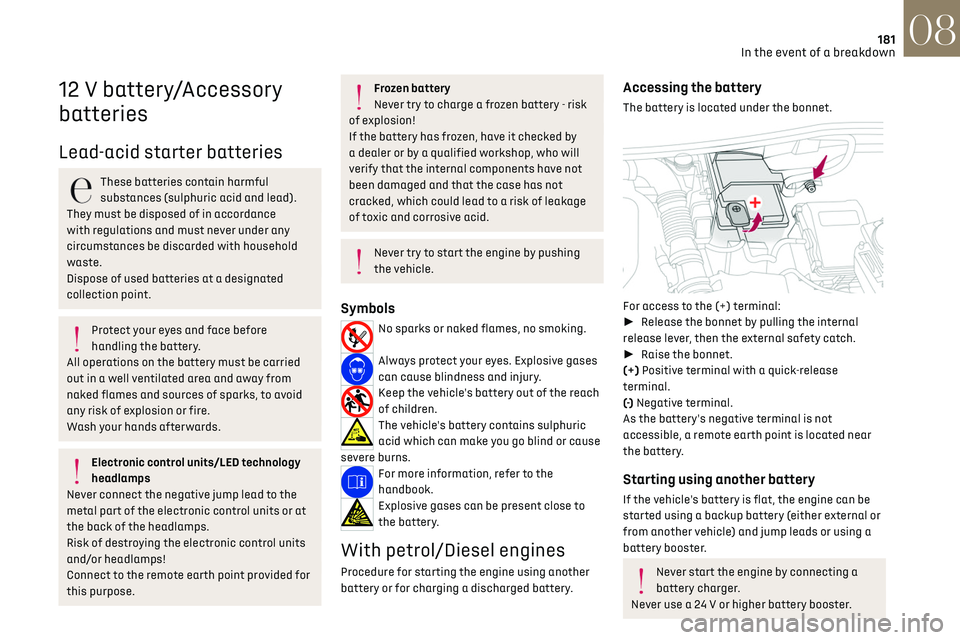
The battery is located under the bonnet.
For access to the (+) terminal:
► Release the bonnet by pulling the internal
release lever, then the external safety catch.
► Raise the bonnet.
(+) Positive terminal with a quick-release
terminal.
(-) Negative terminal.
As the battery's negative terminal is not
accessible, a remote earth point is located near
the battery.
Starting using another battery
If the vehicle's battery is flat, the engine can be
started using a backup battery (either external or
from another vehicle) and jump leads or using a
battery booster.
Never start the engine by connecting a
battery charger.
Never use a 24 V or higher battery booster.