Page 144 of 718
WARNING!(Continued)
ON/RUN mode. Occupants, particularly unattended
children, can become entrapped by the power sun-
roof while operating the power sunroof switch. Such
entrapment may result in serious injury or death.
• In a collision, there is a greater risk of being thrown
from a vehicle with an open sunroof. You could also
be seriously injured or killed. Always fasten your
seat belt properly and make sure all passengers are
also properly secured.
• Do not allow small children to operate the sunroof.
Never allow your fingers, other body parts, or any
object, to project through the sunroof opening. In-
jury may result.
Opening Sunroof
Express Mode
Push the switch rearward and release it within one second.
The sunroof will open automatically from any position and
stop at the full open position. This is called “Express
Open.” During Express Open operation, any other actua-
tion of the sunroof switch will stop the sunroof. NOTE:
If the sunshade is in the closed position when the
open switch is pushed, the sunshade will automatically
cycle to the halfway open position prior to the sunroof
opening.
Manual Mode
Push and hold the switch rearward and the sunroof will
open to the full open position. Any release of the switch
will stop the movement. The sunroof will remain in a
partially opened condition until the sunroof switch is
pushed again.
Venting Sunroof — Express
Push and release the �Vent�button within one second and
the sunroof will open to the vent position. This is called
“Express Vent”, and it will occur regardless of sunroof
position.
NOTE: If the sunshade is in the closed position when the
vent switch is pushed, the sunshade will automatically
cycle to the halfway open position prior to the sunroof
opening to the Vent position.
142 GETTING TO KNOW YOUR VEHICLE
Page 147 of 718
HOOD
Opening
The hood release lever (to open the primary latch) and
safety latch (to open the secondary latch) must be released
to open the hood.
1. Pull the hood release lever located under the driver ’sside of the instrument panel.
2. Move to the outside of the front of the vehicle. 3. Push the safety latch release lever toward the passenger
side of the vehicle. The safety latch is located behind the
center front edge of the hood.
4. Remove the support rod from the locking tab and insert it into the seat located on the underside of the hood.
NOTE:
• Before lifting the hood, check that the wiper arms are not
in motion and not in the lifted position.
• While lifting the hood, use both hands.
• Vehicle must be at a stop and the transmission must be
in PARK.
Hood Release Lever
Safety Latch Release Lever Location
3
GETTING TO KNOW YOUR VEHICLE 145
Page 148 of 718

Closing
1. Hold up the hood with one hand and with the otherhand remove the support rod from its seat and reinsert
it into the locking tab.
2. Lower the hood to approximately 12 inches (30 cm) from the engine compartment and drop it. Make sure that the
hood is completely closed.
WARNING!
Be sure the hood is fully latched before driving your
vehicle. If the hood is not fully latched, it could open
when the vehicle is in motion and block your vision.
Failure to follow this warning could result in serious
injury or death.
CAUTION!
To prevent possible damage, do not slam the hood to
close it. Lower hood to approximately 12 inches (30 cm)
and drop the hood to close. Make sure hood is fully
closed for both latches. Never drive vehicle unless
hood is fully closed, with both latches engaged.
LIFTGATE
Opening
To Unlock/Enter The Liftgate
The liftgate may be released in several ways:
•Overhead console liftgate button
• Key fob
• Outside handle
Push the liftgate button on the key fob twice within five
seconds to release the liftgate.
Unlock Liftgate Using Key Fob
146 GETTING TO KNOW YOUR VEHICLE
Page 154 of 718

Gas props support the liftgate in the open position. How-
ever, because the gas pressure drops with temperature, it
may be necessary to assist the props when opening the
liftgate in cold weather.
NOTE:Allow the power system to open the liftgate.
Manually pushing or pulling the liftgate may activate the
liftgate obstacle detection feature and stop the power
operation or reverse its direction.
WARNING!
During power operation, personal injury or cargo
damage may occur. Ensure the liftgate travel path is
clear. Make sure the liftgate is closed and latched
before driving away.
Cargo Area Features
Cargo Area Storage
When the third row seats are not in the stowed position,
there is a large area for cargo storage. NOTE:
With all rear seats stowed or removed,4x8ft(1.2
x 2.4 m) sheets of building material will fit on the vehicle
floor with the liftgate closed. The front seats must be
moved slightly forward of the rearmost position.
Stow ‘n Vac Integrated Vacuum — If Equipped
Your vehicle may be equipped with an integrated vacuum
system. This vacuum is for in-vehicle use only and should
only be used on dry materials and on in-vehicle surfaces. It
is located in the rear trim panel behind the sliding door on
the driver ’s side of the vehicle.
Rear Cargo Area
152 GETTING TO KNOW YOUR VEHICLE
Page 157 of 718

Engine Running (ON) Operation - For more than 10
minutes of operation•Position vehicle outdoors and fully open all side
windows.
• Always apply the parking brake, shift the transmission
into PARK, and leave engine running.
WARNING!
Carbon monoxide (CO) in exhaust gases can cause
serious injury or death. Follow the precautions below
to prevent carbon monoxide poisoning:
• Do not inhale exhaust gases.
• Do not start or run an engine in a closed garage or
confined area. Always position vehicle outdoors and
fully open all side windows before using vacuum
system with the engine running.
• Guard against carbon monoxide with proper main-
tenance. Have the exhaust system inspected every
time the vehicle is raised. Have any abnormal condi-
tions repaired promptly.
2. Unclip the vacuum nozzle and pull to extend vacuum hose from the storage location.
NOTE: The hose can reach every corner of the vehicle floor. 3. Install desired attachment if needed.
NOTE:
To access crevice or upholstery attachments, open
the front Attachment Compartment.
•Crevice Tool — Able to reach into tight spaces includ-
ing the seat latches located in the floor.
• Upholstery Tool — Use to agitate dirt and debris from
carpets and seats. This tool can also be used to pick up
pet hair.
Front Storage Compartments
1 — Vacuum Nozzle Storage Location
2 — Attachment Compartment
3
GETTING TO KNOW YOUR VEHICLE 155
Page 158 of 718
•Hose Extension — Use to add another 12 ft (3.6 m) of
usable length to the vacuum hose. Hose extension is
located in the upper access panel behind the third row
seat on the driver ’s side.
4. Push vacuum On/Off button
located under the
vacuum nozzle storage location. Use vacuum as
needed.
NOTE:
•When the vacuum is ON, the LED indicator on the
On/Off button will illuminate.
• When the vacuum is OFF, the LED indicator will also
be off.
• After nine minutes of operation in ACC mode (engine
not running), the Low Power Indicator Light (LOW
PWR) will illuminate.
Power Buttons
1 — Low Power Indicator Light
2 — On/Off Button
156 GETTING TO KNOW YOUR VEHICLE
Page 160 of 718
WARNING!(Continued)
near gasoline-dispensing equipment or service sta-
tions, park vehicle at least 20 ft (6 m) away from the
exterior enclosure of any dispensing pump. The
vacuum is mounted more than 18 inches (45 cm) above
ground level in your vehicle.
5. When finished, push power button to turn vacuum off and store vacuum hose and any attachments.
6. Before exiting the vehicle: •If vehicle is in ACC mode, push ignition button to
place ignition in the OFF mode, remove key fob from
the vehicle, and lock the vehicle.
• If the engine is running, raise all of the windows, push
ignition button to place ignition in the OFF mode,
remove key fob from the vehicle, close all of the doors
and the liftgate and lock the vehicle.
Vacuum Troubleshooting
• DO NOT use with any opening blocked. If an object
becomes lodged in the hose, attempt to fully extend the
hose in a straight line while the vacuum motor is
running. If this does not dislodge the object, turn the
vacuum OFF and remove the hose from the vehicle following the removal instructions below. If the filter is
clogged, follow the emptying debris bin procedure and
lightly tap the filter on the collection bin to remove any
collected debris from the filter. Both the bin and the filter
can be rinsed with water if needed. To avoid mold and
stale odors, allow both to dry completely before rein-
stalling in your vehicle. If filter has tears, holes or other
damage and needs to be replaced, please contact your
authorized dealer.
• If there are any other issues with your vacuum, contact
your authorized dealer. Your vacuum has no user ser-
viceable parts.
Debris Bin
The debris bin is located behind the lower access panel
behind the third row seat on the driver ’s side.
To Empty
1. Push power button to turn vacuum OFF.
2. Open the lower access panel by pulling the finger grip towards you and then pull downward.
158 GETTING TO KNOW YOUR VEHICLE
Page 161 of 718
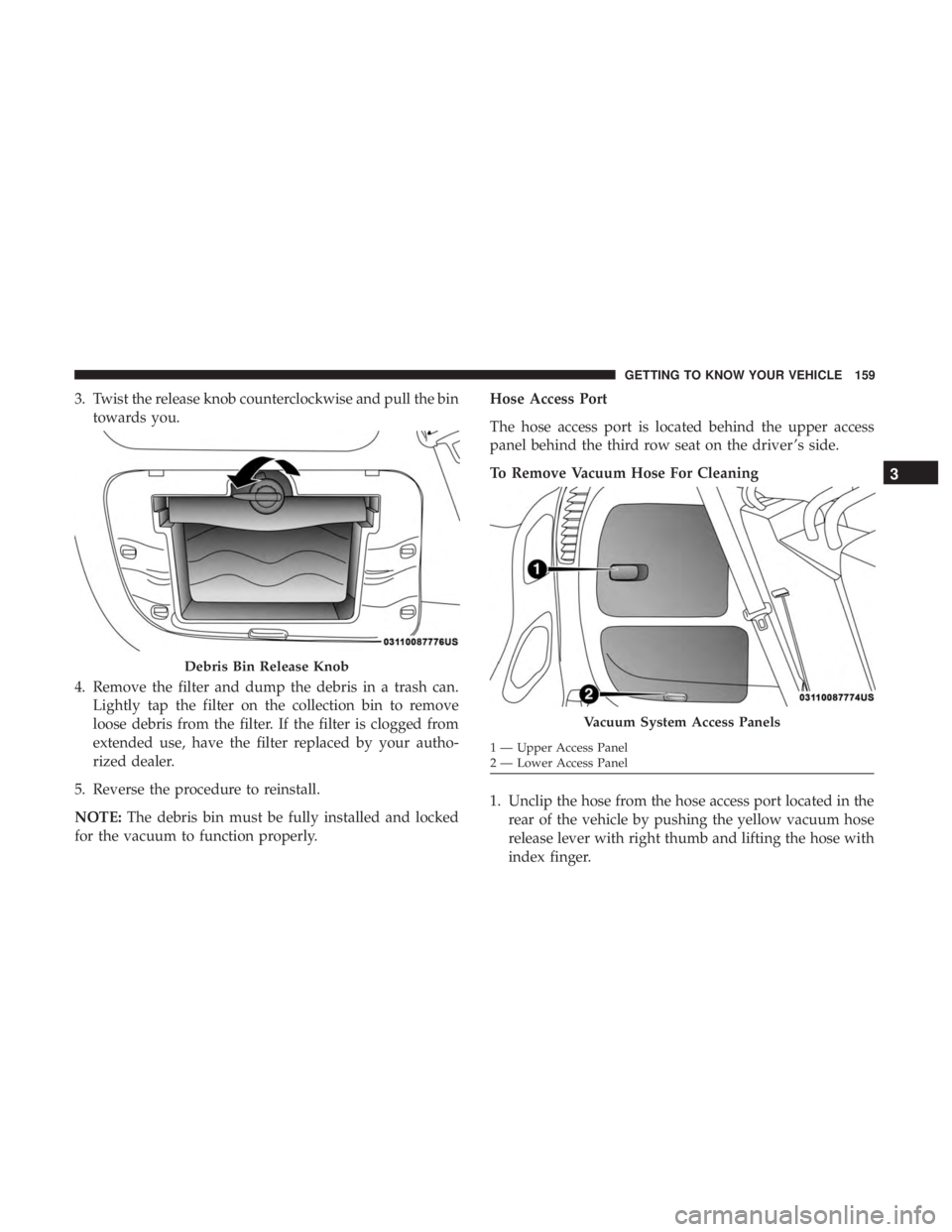
3. Twist the release knob counterclockwise and pull the bintowards you.
4. Remove the filter and dump the debris in a trash can. Lightly tap the filter on the collection bin to remove
loose debris from the filter. If the filter is clogged from
extended use, have the filter replaced by your autho-
rized dealer.
5. Reverse the procedure to reinstall.
NOTE: The debris bin must be fully installed and locked
for the vacuum to function properly. Hose Access Port
The hose access port is located behind the upper access
panel behind the third row seat on the driver ’s side.
To Remove Vacuum Hose For Cleaning
1. Unclip the hose from the hose access port located in the
rear of the vehicle by pushing the yellow vacuum hose
release lever with right thumb and lifting the hose with
index finger.
Debris Bin Release Knob
Vacuum System Access Panels
1 — Upper Access Panel
2 — Lower Access Panel
3
GETTING TO KNOW YOUR VEHICLE 159