2019 CHRYSLER PACIFICA traction control
[x] Cancel search: traction controlPage 441 of 718

difference in the surface traction under the front (driving)
wheels.
WARNING!
Rapid acceleration on slippery surfaces is dangerous.
Unequal traction can cause sudden pulling of the front
wheels. You could lose control of the vehicle and
possibly have a collision. Accelerate slowly and care-
fully whenever there is likely to be poor traction (ice,
snow, wet, mud, loose sand, etc.).
Traction
When driving on wet or slushy roads, it is possible for a
wedge of water to build up between the tire and road
surface. This is hydroplaning and may cause partial or
complete loss of vehicle control and stopping ability. To
reduce this possibility, the following precautions should be
observed:
•Slow down during rainstorms or when the roads are
slushy.
• Slow down if the road has standing water or puddles.
• Replace the tires when tread wear indicators first be-
come visible. •
Keep tires properly inflated.
• Maintain sufficient distance between your vehicle and
the vehicle in front of you to avoid a collision in a
sudden stop.
Driving Through Water
Driving through water more than a few inches/centimeters
deep will require extra caution to ensure safety and pre-
vent damage to your vehicle.
Flowing/Rising Water
WARNING!
Do not drive on or across a road or path where water is
flowing and/or rising (as in storm run-off). Flowing
water can wear away the road or path’s surface and
cause your vehicle to sink into deeper water. Further-
more, flowing and/or rising water can carry your ve-
hicle away swiftly. Failure to follow this warning may
result in injuries that are serious or fatal to you, your
passengers, and others around you.
6
STARTING AND OPERATING 439
Page 556 of 718
WARNING!(Continued)
may change suspension dimensions and perfor-
mance characteristics, resulting in changes to steer-
ing, handling, and braking of your vehicle. This can
cause unpredictable handling and stress to steering
and suspension components. You could lose control
and have a collision resulting in serious injury or
death. Use only the tire and wheel sizes with load
ratings approved for your vehicle.
• Never use a tire with a smaller load index or capacity,
other than what was originally equipped on your
vehicle. Using a tire with a smaller load index could
result in tire overloading and failure. You could lose
control and have a collision.
• Failure to equip your vehicle with tires having ad-
equate speed capability can result in sudden tire
failure and loss of vehicle control.
CAUTION!
Replacing original tires with tires of a different size
may result in false speedometer and odometer read-
ings.
Tire Types
All Season Tires — If Equipped
All Season tires provide traction for all seasons (Spring,
Summer, Fall, and Winter). Traction levels may vary be-
tween different all season tires. All season tires can be
identified by the M+S, M&S, M/S or MS designation on the
tire sidewall. Use all season tires only in sets of four; failure
to do so may adversely affect the safety and handling of
your vehicle.
Summer Or Three Season Tires — If Equipped
Summer tires provide traction in both wet and dry condi-
tions, and are not intended to be driven in snow or on ice.
If your vehicle is equipped with Summer tires, be aware
these tires are not designed for Winter or cold driving
conditions. Install Winter tires on your vehicle when am-
bient temperatures are less than 40°F (5°C) or if roads are
covered with ice or snow. For more information, contact an
authorized dealer.
Summer tires do not contain the all season designation or
mountain/snowflake symbol on the tire sidewall. Use
Summer tires only in sets of four; failure to do so may
adversely affect the safety and handling of your vehicle.
554 SERVICING AND MAINTENANCE
Page 557 of 718
WARNING!
Do not use Summer tires in snow/ice conditions. You
could lose vehicle control, resulting in severe injury or
death. Driving too fast for conditions also creates the
possibility of loss of vehicle control.
Snow Tires
Some areas of the country require the use of snow tires
during the Winter. Snow tires can be identified by a
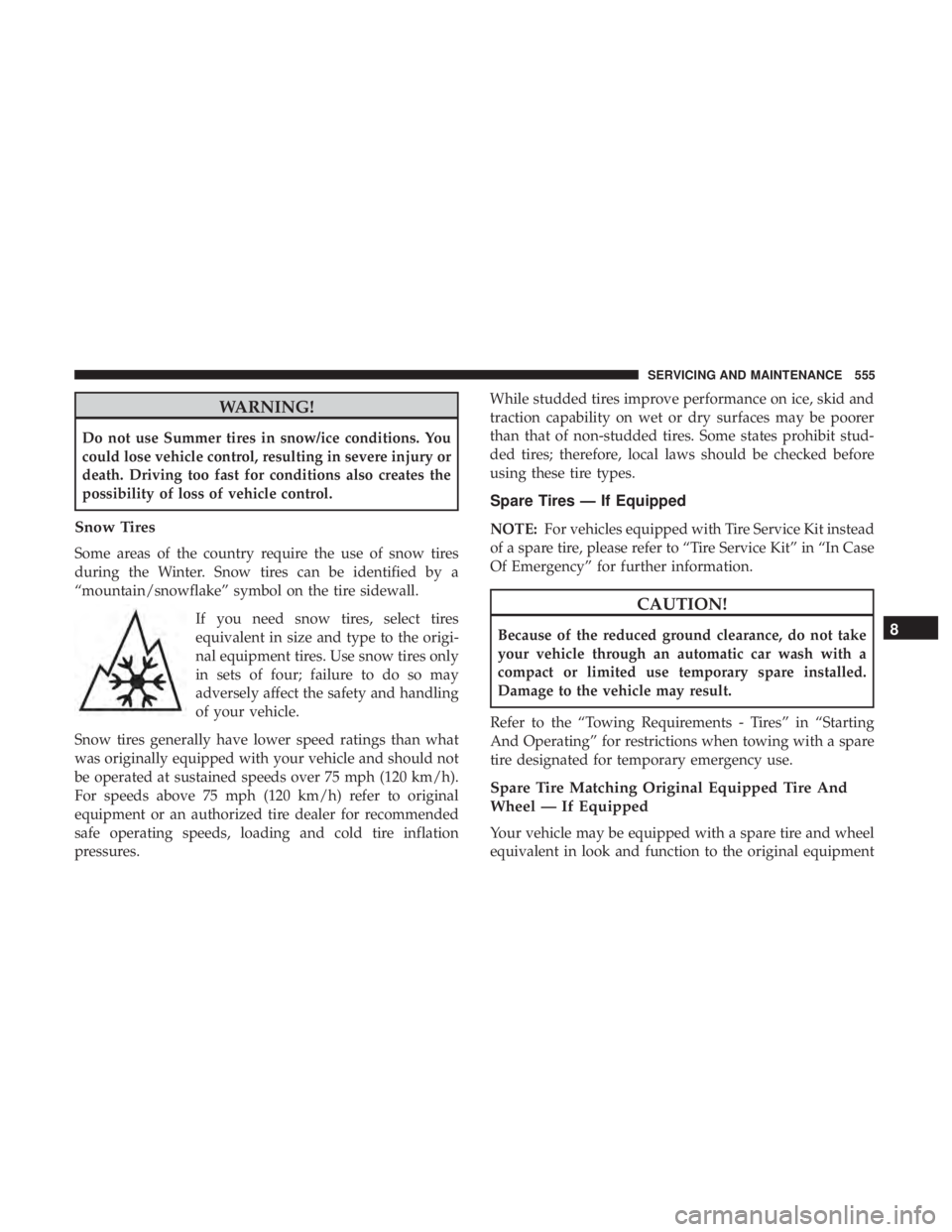
“mountain/snowflake” symbol on the tire sidewall.If you need snow tires, select tires
equivalent in size and type to the origi-
nal equipment tires. Use snow tires only
in sets of four; failure to do so may
adversely affect the safety and handling
of your vehicle.
Snow tires generally have lower speed ratings than what
was originally equipped with your vehicle and should not
be operated at sustained speeds over 75 mph (120 km/h).
For speeds above 75 mph (120 km/h) refer to original
equipment or an authorized tire dealer for recommended
safe operating speeds, loading and cold tire inflation
pressures. While studded tires improve performance on ice, skid and
traction capability on wet or dry surfaces may be poorer
than that of non-studded tires. Some states prohibit stud-
ded tires; therefore, local laws should be checked before
using these tire types.
Spare Tires — If Equipped
NOTE:
For vehicles equipped with Tire Service Kit instead
of a spare tire, please refer to “Tire Service Kit” in “In Case
Of Emergency” for further information.
CAUTION!
Because of the reduced ground clearance, do not take
your vehicle through an automatic car wash with a
compact or limited use temporary spare installed.
Damage to the vehicle may result.
Refer to the “Towing Requirements - Tires” in “Starting
And Operating” for restrictions when towing with a spare
tire designated for temporary emergency use.
Spare Tire Matching Original Equipped Tire And
Wheel — If Equipped
Your vehicle may be equipped with a spare tire and wheel
equivalent in look and function to the original equipment
8
SERVICING AND MAINTENANCE 555
Page 561 of 718
CAUTION!(Continued)
Only car wash soap, Mopar Wheel Cleaner or equiva-
lent is recommended.
NOTE: If you intend parking or storing your vehicle for an
extended period after cleaning the wheels with wheel
cleaner, drive your vehicle and apply the brakes to remove
the water droplets from the brake components. This activ-
ity will remove the red rust on the brake rotors and prevent
vehicle vibration when braking.
Dark Vapor Chrome, Black Satin Chrome, or Low Gloss
Clear Coat Wheels
CAUTION!
If your vehicle is equipped with these specialty
wheels, DO NOT USE wheel cleaners, abrasives, or
polishing compounds. They will permanently damage
this finish and such damage is not covered by the New
Vehicle Limited Warranty. HAND WASH ONLY US-
ING MILD SOAP AND WATER WITH A SOFT
CLOTH. Used on a regular basis; this is all that is
required to maintain this finish.
Tire Chains (Traction Devices)
Use of traction devices require sufficient tire-to-body clear-
ance. Follow these recommendations to guard against
damage:
• Traction device must be of proper size for the tire, as
recommended by the traction device manufacturer.
• Install on front tires only.
• For a 235/65R17 or 235/60R18 tire, use of a snow
traction device with a maximum projection of 9 mm
beyond the tire profile is recommended.
WARNING!
Using tires of different size and type (M+S, Snow)
between front and rear axles can cause unpredictable
handling. You could lose control and have a collision.
CAUTION!
To avoid damage to your vehicle or tires, observe the
following precautions:
• Because of restricted traction device clearance be-
tween tires and other suspension components, it is
(Continued)
8
SERVICING AND MAINTENANCE 559
Page 563 of 718
DEPARTMENT OF TRANSPORTATION UNIFORM
TIRE QUALITY GRADES
The following tire grading categories were established
by the National Highway Traffic Safety Administration.
The specific grade rating assigned by the tire’s manu-
facturer in each category is shown on the sidewall of the
tires on your vehicle.
All passenger vehicle tires must conform to Federal
safety requirements in addition to these grades.Treadwear
The Treadwear grade is a comparative rating, based on
the wear rate of the tire when tested under controlled
conditions on a specified government test course. For
example, a tire graded 150 would wear one and one-half
times as well on the government course as a tire graded
100. The relative performance of tires depends upon the
actual conditions of their use, however, and may depart
significantly from the norm due to variations in driving
habits, service practices, and differences in road charac-
teristics and climate.
Traction Grades
The Traction grades, from highest to lowest, are AA, A,
B, and C. These grades represent the tire’s ability to stop
on wet pavement, as measured under controlled condi-
tions on specified government test surfaces of asphalt
and concrete. A tire marked C may have poor traction
performance.
WARNING!
The traction grade assigned to this tire is based on
straight-ahead braking traction tests, and does not
(Continued)
Tire Rotation8
SERVICING AND MAINTENANCE 561
Page 564 of 718
WARNING!(Continued)
include acceleration, cornering, hydroplaning, or
peak traction characteristics.
Temperature Grades
The Temperature grades are A (the highest), B, and C,
representing the tire’s resistance to the generation of
heat and its ability to dissipate heat, when tested under
controlled conditions on a specified indoor laboratory
test wheel.
Sustained high temperature can cause the material of
the tire to degenerate and reduce tire life, and excessive
temperature can lead to sudden tire failure. The grade C
corresponds to a level of performance, which all pas-
senger vehicle tires must meet under the Federal Motor
Vehicle Safety Standard No. 109. Grades B and A
represent higher levels of performance on the laboratory
test wheel, than the minimum required by law.
WARNING!
The temperature grade for this tire is established for
a tire that is properly inflated and not overloaded.
(Continued)
WARNING! (Continued)
Excessive speed, under-inflation, or excessive load-
ing, either separately or in combination, can cause
heat buildup and possible tire failure.
STORING THE VEHICLE
If the vehicle should remain stationary for more than a
month, observe the following precautions:
• Park your vehicle in a covered, dry and possibly airy
location the windows open slightly.
• Check that the Electric Park Brake is not engaged.
• Disconnect the negative (-) terminal from the battery
post and be sure that the battery is fully charged. During
storage check battery charge quarterly.
• If you do not disconnect the battery from the electrical
system, check the battery charge every 30 days.
• Clean and protect the painted parts by applying protec-
tive waxes.
• Clean and protect polished metal parts by applying
protective waxes.
562 SERVICING AND MAINTENANCE
Page 705 of 718

Points To Remember..................... .534
Pressure Cap ........................... .533
Radiator Cap .......................... .533
Selection Of Coolant (Antifreeze) .......531, 576, 577
Corrosion Protection ....................... .563
Cruise Control (Speed Control) .................348
Cruise Light .......................... .214, 215
Customer Assistance ....................... .694
Cybersecurity ............................ .585
Daytime Brightness, Interior Lights ..............104
Daytime Running Lights ......................97
Dealer Service ............................ .516
Defroster, Windshield ....................... .313
Delay (Intermittent) Wipers ...................105
Diagnostic System, Onboard ...................216
Dimmer Switch Headlight ...............................97
Dipsticks Oil (Engine) ........................... .514
Disable Vehicle Towing ..................... .503
Disposal Antifreeze (Engine Coolant) .................534
Disturb ................................. .687
Door Ajar ............................ .206, 208Door Ajar Light
....................... .206, 208
Drag And Drop Menu ...................... .584
Driver ’s Seat Back Tilt ........................50
Driving Through Flowing, Rising, Or Shallow Standing
Water ................................ .439
DVD Player (Video Entertainment System) .........641
Electric Brake Control System ..................221
Anti-Lock Brake System ....................220
Traction Control System ....................221
Electric Parking Brake ...................... .328
Electric Remote Mirrors .......................94
Electronic Speed Control (Cruise Control) .........346
Electronic Stability Control (ESC) ...............224
Electronic Throttle Control Warning Light .........207
Emer
gency, In Case Of
Hazard Warning Flasher ...................443
Jacking ........................ .466, 468, 538
Jump Starting .......................... .495
Overheating ........................... .499
Towing ............................... .503
Emission Control System Maintenance ............217
Engine ................................. .513
Air Cleaner ............................ .518
Block Heater ........................... .327
12
INDEX 703
Page 709 of 718

Bulb Replacement.....................449, 453
Center Mounted Stop ..................... .455
Cruise ............................ .214, 215
Daytime Running .........................97
Dimmer Switch, Headlight ...................97
Engine Temperature Warning ................207
Exterior ........................... .315, 453
Fog .............................. .100, 454
Headlights ....................... .97, 99, 451
High Beam/Low Beam Select .................97
Instrument Cluster ........................97
Intensity Control ........................ .103
Interior ............................... .101
Lights On Reminder ....................97, 100
Malfunction Indicator (Check Engine) ..........211
Parade Mode (Daytime Brightness) ............104
Park ................................. .215
Passing ............................. .97, 99
Reading .............................. .101
Seat Belt Reminder ...................... .208
Security Alarm ......................... .209
Service ............................... .449
Side Marker ........................... .453
SmartBeams .............................98
Traction Control ........................ .226Turn Signals
...................97, 215, 315, 453
Warning Instrument Cluster Descriptions . . . .207, 215
Load Floor, Cargo ......................... .152
Loading Vehicle ....................... .152, 424
Tires................................. .544
Load Shed Battery Saver Mode .................202
Load Shed Battery Saver On ...................202
Load Shed Electrical Load Reduction .............202
Load Shed Intelligent Battery Sensor .............202
Low Tire Pressure System .....................241
Lubrication, Body ......................... .523
Luggage Carrier .......................... .180
Lug
Nuts ............................... .571
Maintenance Free Battery .....................515
Maintenance Schedule ...................... .509
Malfunction Indicator Light (Check Engine) .....211,217
Manual Park Release ........................... .500
Service ............................... .698
Map/Reading Lights ....................... .101
Marker Lights, Side ........................ .453
Media Hub .............................. .640
Memory Feature (Memory Seats) ................50
Memory Seat ........................... .50, 94
12
INDEX 707