2019 CHEVROLET MALIBU engine coolant
[x] Cancel search: engine coolantPage 226 of 382
Chevrolet Malibu Owner Manual (GMNA-Localizing-U.S./Canada/Mexico-
12461813) - 2019 - crc - 12/11/18
226 Driving and Operating
Following Distance
Stay at least twice as far behind the
vehicle ahead as you would when
driving without a trailer. This can
help to avoid heavy braking and
sudden turns.
Passing
More passing distance is needed
when towing a trailer. The
combination of the vehicle and
trailer will not accelerate as quickly
and is much longer than the vehicle
alone. It is necessary to go much
farther beyond the passed vehicle
before returning to the lane. Pass
on level roadways. Avoid passing
on hills if possible.
Backing Up
Hold the bottom of the steering
wheel with one hand. To move the
trailer to the left, move that hand to
the left. To move the trailer to the
right, move that hand to the right.
Always back up slowly and,
if possible, have someone
guide you.
Making Turns
Caution
Turn more slowly and make wider
arcs when towing a trailer to
prevent damage to your vehicle.
Making very sharp turns could
cause the trailer to contact the
vehicle.
Make wider turns than normal when
towing, so trailer will not go over soft
shoulders, over curbs, or strike road
signs, trees, or other objects.
Always signal turns well in advance.
Do not steer or brake suddenly.
Driving on Grades
Reduce speed and shift to a lower
gear before starting down a long or
steep downhill grade. If the
transmission is not shifted down, the
brakes may overheat and result in
reduced braking efficiency.The vehicle can tow in D (Drive).
Shift the transmission to a lower
gear if the transmission shifts too
often under heavy loads and/or hilly
conditions.
When towing at higher altitudes,
engine coolant will boil at a lower
temperature than at lower altitudes.
If the engine is turned off
immediately after towing at high
altitude on steep uphill grades, the
vehicle could show signs similar to
engine overheating. To avoid this,
let the engine run, preferably on
level ground, with the transmission
in P (Park) for a few minutes before
turning the engine off. If the
overheat warning comes on, see
Engine Overheating0253.Parking on Hills
{Warning
To prevent serious injury or death,
always park your vehicle and
trailer on a level surface when
possible.
Page 238 of 382

Chevrolet Malibu Owner Manual (GMNA-Localizing-U.S./Canada/Mexico-
12461813) - 2019 - crc - 12/11/18
238 Vehicle Care
1.Engine Air Cleaner/Filter0247.
2. Engine Oil Fill Cap. See
Engine Oil0242.
3. Engine Oil Dipstick. See
Engine Oil0242.
4. Engine Cooling Fan (Out of
View). SeeCooling System
(Power Electronics)0253or
Cooling System (Engine)
0248.
5. Brake Fluid Reservoir. See
Brakes0255.
6. Coolant Surge Tank and
Pressure Cap. SeeCooling
System (Power Electronics)
0253or
Cooling System (Engine)
0248.
7.Battery - North America0257.
8. Remote Positive (+) Battery
Terminal (Under Cover). See
Jump Starting - North America
0312.
9.Engine Compartment Fuse
Block0268.10. Windshield Washer Fluid
Reservoir. SeeWasher Fluid
0254.
11. Remote Negative (-) Battery
Terminal. SeeJump Starting -
North America0312.
Page 240 of 382

Chevrolet Malibu Owner Manual (GMNA-Localizing-U.S./Canada/Mexico-
12461813) - 2019 - crc - 12/11/18
240 Vehicle Care
1.Engine Air Cleaner/Filter0247.
2. Engine Cooling Fan (Out of
View). SeeCooling System
(Power Electronics)0253or
Cooling System (Engine)
0248.
3. Engine Oil Dipstick. See
Engine Oil0242.
4. Engine Oil Fill Cap. See
Engine Oil0242.
5. Brake Fluid Reservoir. See
Brakes0255.
6. Automatic Transmission Fluid
Fill Cap. SeeAutomatic
Transmission Fluid0246.
7. Coolant Surge Tank and
Pressure Cap. SeeCooling
System (Power Electronics)
0253or
Cooling System (Engine)
0248.
8. Remote Positive (+) Battery
Terminal (Under Cover). See
Jump Starting - North America
0312.9. Power Electronics Coolant
Reservoir. SeeCooling System
(Power Electronics)0253or
Cooling System (Engine)
0248.
10.Engine Compartment Fuse
Block0268.
11. Windshield Washer Fluid
Reservoir. SeeWasher Fluid
0254.
12. Remote Negative (-) Battery
Terminal. SeeJump Starting -
North America0312.
Page 242 of 382
Chevrolet Malibu Owner Manual (GMNA-Localizing-U.S./Canada/Mexico-
12461813) - 2019 - crc - 12/11/18
242 Vehicle Care
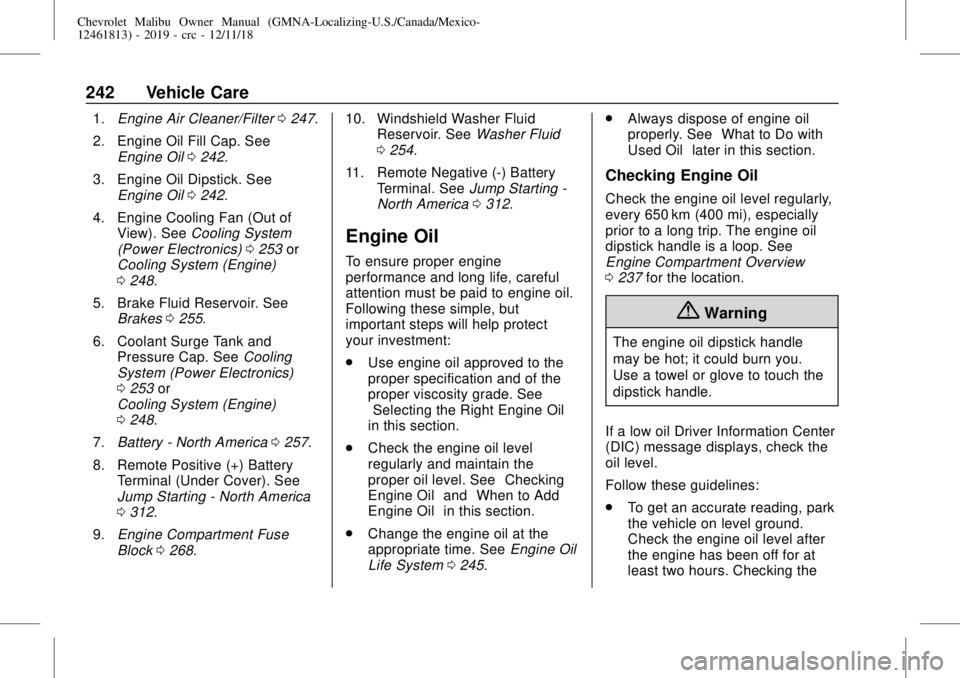
1.Engine Air Cleaner/Filter0247.
2. Engine Oil Fill Cap. See
Engine Oil0242.
3. Engine Oil Dipstick. See
Engine Oil0242.
4. Engine Cooling Fan (Out of
View). SeeCooling System
(Power Electronics)0253or
Cooling System (Engine)
0248.
5. Brake Fluid Reservoir. See
Brakes0255.
6. Coolant Surge Tank and
Pressure Cap. SeeCooling
System (Power Electronics)
0253or
Cooling System (Engine)
0248.
7.Battery - North America0257.
8. Remote Positive (+) Battery
Terminal (Under Cover). See
Jump Starting - North America
0312.
9.Engine Compartment Fuse
Block0268.10. Windshield Washer Fluid
Reservoir. SeeWasher Fluid
0254.
11. Remote Negative (-) Battery
Terminal. SeeJump Starting -
North America0312.
Engine Oil
To ensure proper engine
performance and long life, careful
attention must be paid to engine oil.
Following these simple, but
important steps will help protect
your investment:
.
Use engine oil approved to the
proper specification and of the
proper viscosity grade. See
“Selecting the Right Engine Oil”
in this section.
.
Check the engine oil level
regularly and maintain the
proper oil level. See“Checking
Engine Oil”and“When to Add
Engine Oil”in this section.
.
Change the engine oil at the
appropriate time. SeeEngine Oil
Life System0245..
Always dispose of engine oil
properly. See“What to Do with
Used Oil”later in this section.
Checking Engine Oil
Check the engine oil level regularly,
every 650 km (400 mi), especially
prior to a long trip. The engine oil
dipstick handle is a loop. See
Engine Compartment Overview
0237for the location.
{Warning
The engine oil dipstick handle
may be hot; it could burn you.
Use a towel or glove to touch the
dipstick handle.
If a low oil Driver Information Center
(DIC) message displays, check the
oil level.
Follow these guidelines:
.
To get an accurate reading, park
the vehicle on level ground.
Check the engine oil level after
the engine has been off for at
least two hours. Checking the
Page 249 of 382
Chevrolet Malibu Owner Manual (GMNA-Localizing-U.S./Canada/Mexico-
12461813) - 2019 - crc - 12/11/18
Vehicle Care 249
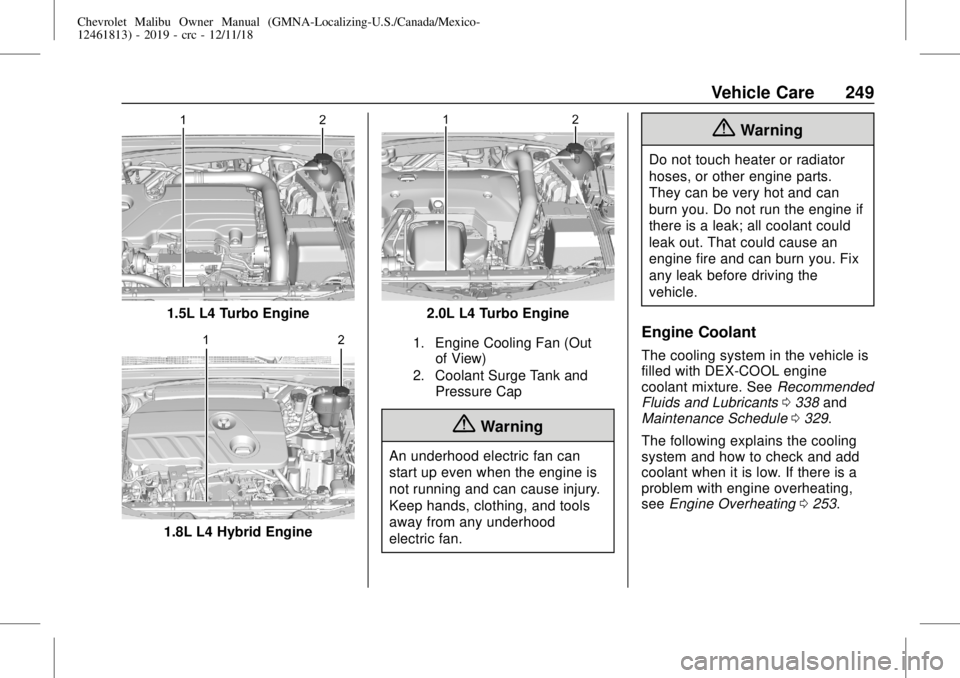
1.5L L4 Turbo Engine
1.8L L4 Hybrid Engine
2.0L L4 Turbo Engine
1. Engine Cooling Fan (Out
of View)
2. Coolant Surge Tank and
Pressure Cap
{Warning
An underhood electric fan can
start up even when the engine is
not running and can cause injury.
Keep hands, clothing, and tools
away from any underhood
electric fan.
{Warning
Do not touch heater or radiator
hoses, or other engine parts.
They can be very hot and can
burn you. Do not run the engine if
there is a leak; all coolant could
leak out. That could cause an
engine fire and can burn you. Fix
any leak before driving the
vehicle.
Engine Coolant
The cooling system in the vehicle is
filled with DEX-COOL engine
coolant mixture. SeeRecommended
Fluids and Lubricants0338and
Maintenance Schedule0329.
The following explains the cooling
system and how to check and add
coolant when it is low. If there is a
problem with engine overheating,
seeEngine Overheating0253.
Page 250 of 382
Chevrolet Malibu Owner Manual (GMNA-Localizing-U.S./Canada/Mexico-
12461813) - 2019 - crc - 12/11/18
250 Vehicle Care
What to Use
{Warning
Plain water, or other liquids such
as alcohol, can boil before the
proper coolant mixture will. With
plain water or the wrong mixture,
the engine could get too hot but
there would not be an overheat
warning. The engine could catch
fire and you or others could be
burned.
Use a 50/50 mixture of clean,
drinkable water and DEX-COOL
coolant. This mixture:
.
Gives freezing protection down
to−37 °C (−34 °F), outside
temperature.
.
Gives boiling protection up to
129 °C (265 °F), engine
temperature.
.
Protects against rust and
corrosion.
.
Will not damage aluminum parts..
Helps keep the proper engine
temperature.Caution
Do not use anything other than a
mix of DEX-COOL coolant that
meets GM Standard
GMW3420 and clean, drinkable
water. Anything else can cause
damage to the engine cooling
system and the vehicle, which
would not be covered by the
vehicle warranty.
Never dispose of engine coolant by
putting it in the trash, or by pouring
it on the ground, or into sewers,
streams or bodies of water. Have
the coolant changed by an
authorized service center, familiar
with legal requirements regarding
used coolant disposal. This will help
protect the environment and your
health.
Checking Coolant
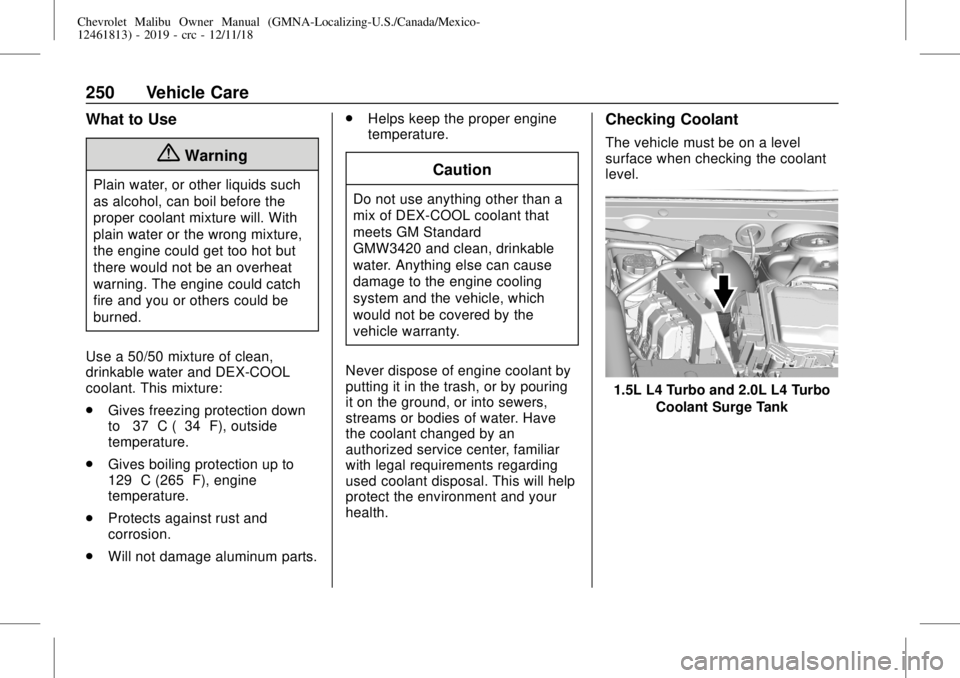
The vehicle must be on a level
surface when checking the coolant
level.
1.5L L4 Turbo and 2.0L L4 Turbo
Coolant Surge Tank
Page 251 of 382
Chevrolet Malibu Owner Manual (GMNA-Localizing-U.S./Canada/Mexico-
12461813) - 2019 - crc - 12/11/18
Vehicle Care 251
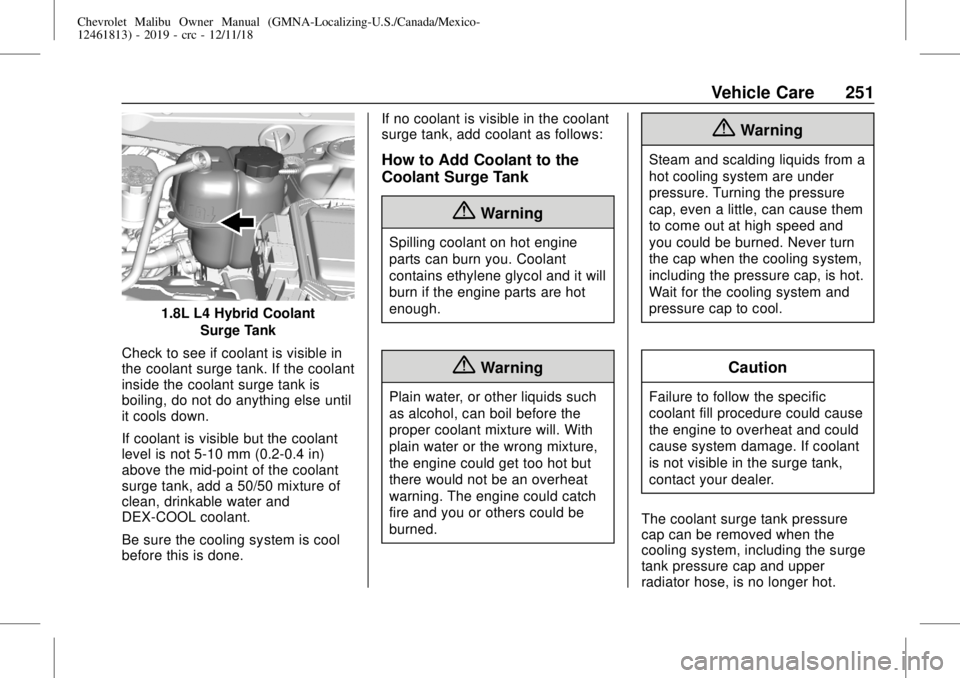
1.8L L4 Hybrid Coolant
Surge Tank
Check to see if coolant is visible in
the coolant surge tank. If the coolant
inside the coolant surge tank is
boiling, do not do anything else until
it cools down.
If coolant is visible but the coolant
level is not 5-10 mm (0.2-0.4 in)
above the mid-point of the coolant
surge tank, add a 50/50 mixture of
clean, drinkable water and
DEX-COOL coolant.
Be sure the cooling system is cool
before this is done.If no coolant is visible in the coolant
surge tank, add coolant as follows:
How to Add Coolant to the
Coolant Surge Tank
{Warning
Spilling coolant on hot engine
parts can burn you. Coolant
contains ethylene glycol and it will
burn if the engine parts are hot
enough.
{Warning
Plain water, or other liquids such
as alcohol, can boil before the
proper coolant mixture will. With
plain water or the wrong mixture,
the engine could get too hot but
there would not be an overheat
warning. The engine could catch
fire and you or others could be
burned.
{Warning
Steam and scalding liquids from a
hot cooling system are under
pressure. Turning the pressure
cap, even a little, can cause them
to come out at high speed and
you could be burned. Never turn
the cap when the cooling system,
including the pressure cap, is hot.
Wait for the cooling system and
pressure cap to cool.
Caution
Failure to follow the specific
coolant fill procedure could cause
the engine to overheat and could
cause system damage. If coolant
is not visible in the surge tank,
contact your dealer.
The coolant surge tank pressure
cap can be removed when the
cooling system, including the surge
tank pressure cap and upper
radiator hose, is no longer hot.
Page 252 of 382
Chevrolet Malibu Owner Manual (GMNA-Localizing-U.S./Canada/Mexico-
12461813) - 2019 - crc - 12/11/18
252 Vehicle Care
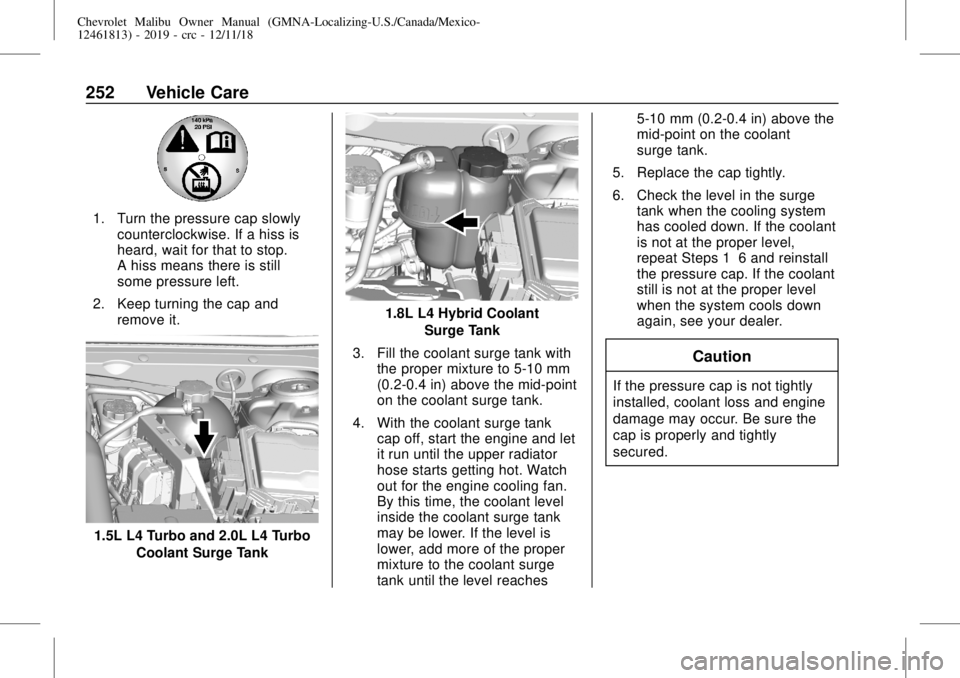
1. Turn the pressure cap slowly
counterclockwise. If a hiss is
heard, wait for that to stop.
A hiss means there is still
some pressure left.
2. Keep turning the cap and
remove it.
1.5L L4 Turbo and 2.0L L4 Turbo
Coolant Surge Tank
1.8L L4 Hybrid Coolant
Surge Tank
3. Fill the coolant surge tank with
the proper mixture to 5-10 mm
(0.2-0.4 in) above the mid-point
on the coolant surge tank.
4. With the coolant surge tank
cap off, start the engine and let
it run until the upper radiator
hose starts getting hot. Watch
out for the engine cooling fan.
By this time, the coolant level
inside the coolant surge tank
may be lower. If the level is
lower, add more of the proper
mixture to the coolant surge
tank until the level reaches5-10 mm (0.2-0.4 in) above the
mid-point on the coolant
surge tank.
5. Replace the cap tightly.
6. Check the level in the surge
tank when the cooling system
has cooled down. If the coolant
is not at the proper level,
repeat Steps 1–6 and reinstall
the pressure cap. If the coolant
still is not at the proper level
when the system cools down
again, see your dealer.
Caution
If the pressure cap is not tightly
installed, coolant loss and engine
damage may occur. Be sure the
cap is properly and tightly
secured.