2019 AUDI TT ROADSTER lock
[x] Cancel search: lockPage 218 of 304
Child safety
— Never install a rearward facing child safety
seat on the front passenger seat unless the
PASSENGER AIR BAG OFF 3%; light comes
on and stays on. If the PASSENGER AIR
BAG OFF #¥; light does not come on and stay
on the inflating airbag will hit the child safe-
ty seat or infant carrier with great force and
will smash the child safety seat and child
against the backrest, center armrest, door
or roof. Have the airbag system inspected
immediately by your Audi dealer.
— Never place or use any electrical device
(such as a laptop, CD player, electronic
games device, power inverter or seat heater
for child seats) on the front passenger seat
if the device is connected to the 12-volt
socket or the cigarette lighter socket.
— If a seat heater has been retrofitted or oth-
erwise added to the front passenger seat,
never install any child restraint system on
this seat.
— Make sure that there are no wet objects
(such as a wet towel) and no water or other
liquids on the front passenger seat cushion.
— Never place objects on the seat (such as a
laptop, CD player, electronic games device,
power inverter or seat heater for child
seats). These may influence the electrical
capacitance measured by the capacitive pas-
senger detection system and can also fly
around in an accident and cause serious per-
sonal injury.
— Always read and heed all WARNINGS when-
ever using a child restrained in a vehicle is
being used > page 182, Safety belts,
=> page 189, Airbag system and > page 210,
Important information.
216
Convertible child safety seats
Properly used convertible child safety seats can
help protect toddlers and children over age one
who weigh between 20 and 40 lbs (9 and 18 kg)
inacrash.
BFV-0192
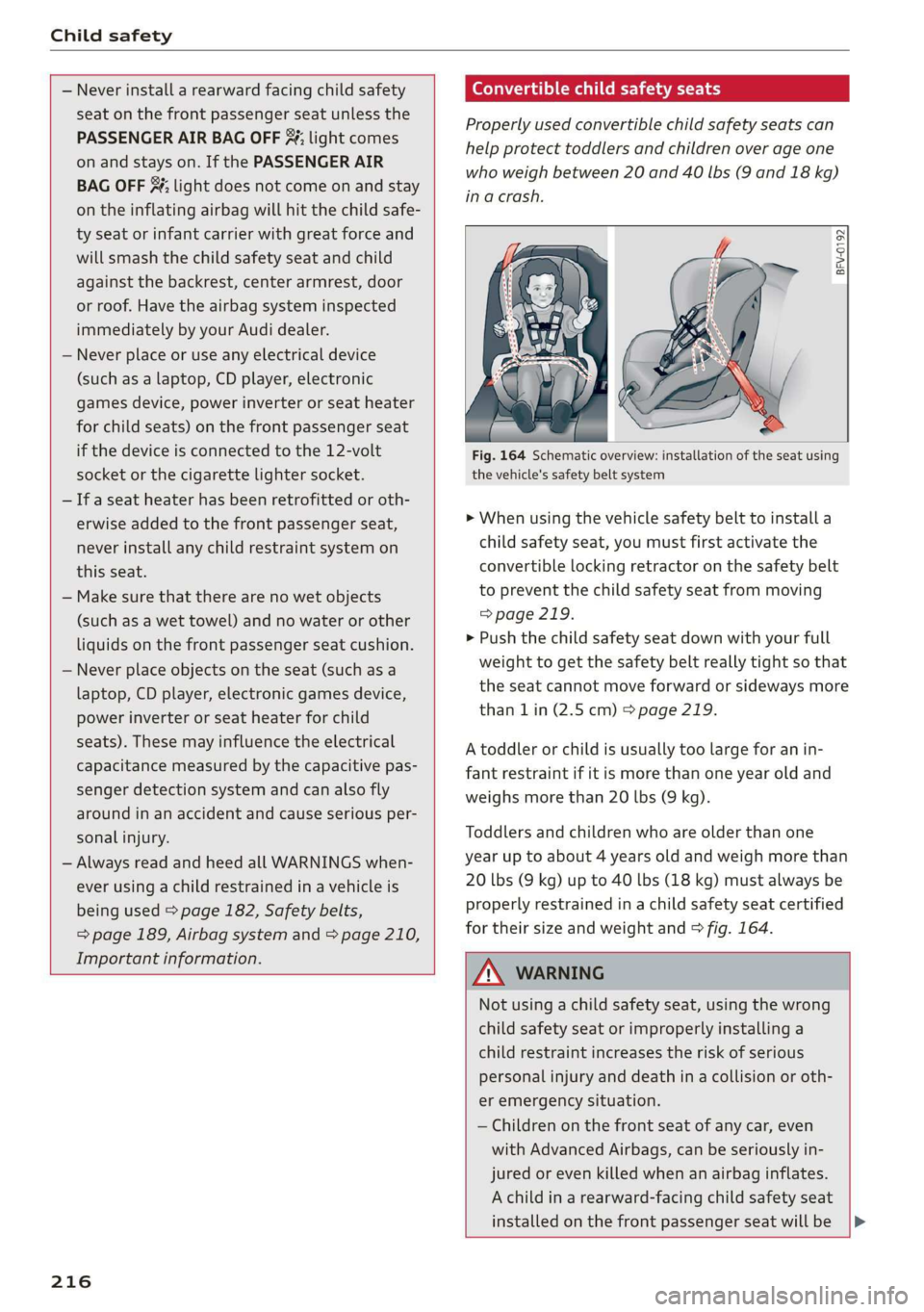
Fig. 164 Schematic overview: installation of the seat using
the vehicle's safety belt system
> When using the vehicle safety belt to install a
child safety seat, you must first activate the
convertible locking retractor on the safety belt
to prevent the child safety seat from moving
> page 219.
> Push the child safety seat down with your full
weight to get the safety belt really tight so that
the seat cannot move forward or sideways more
than 1 in (2.5 cm) > page 219.
A toddler or child is usually too large for an in-
fant restraint if it is more than one year old and
weighs more than 20 lbs (9 kg).
Toddlers and children who are older than one
year up to about 4 years old and weigh more than
20 lbs (9 kg) up to 40 Lbs (18 kg) must always be
properly restrained in a child safety seat certified
for their size and weight and > fig. 164.
Z\ WARNING
Not using a child safety seat, using the wrong
child safety seat or improperly installing a
child restraint increases the risk of serious
personal injury and death in a collision or oth-
er emergency situation.
— Children on the front seat of any car, even
with Advanced Airbags, can be seriously in-
jured or even killed when an airbag inflates.
A child in a rearward-facing child safety seat
installed on the front passenger seat willbe |>
Page 220 of 304
Child safety
The vehicle's safety belts alone will not fit most
children until they are at least 4 ft 9 in (57 in/
1.45 m) tall and weigh about 80 lbs (36 kg).
Booster seats raise these children up so that the
safety belt will pass properly over the stronger
parts of their bodies and the safety belt can help
protect them ina crash.
> Do not use the convertible locking retractor
when using the vehicle's safety belt to restrain
a child on a booster seat.
> The shoulder belt must lie as close to the cen-
ter of the child's collar bone as possible and
must lie flat and snug on the upper body. It
must never lie across the throat or neck. The
lap belt must lie across the pelvis and never
across the stomach or abdomen. Make sure the
belt lies flat and snug. Pull on the belt to tight-
en if necessary.
Children up to at least 8 years old (over 40 lbs or
18 kg) are best protected in child safety seats de-
signed for their age and weight. Experts say that
the skeletal structure, particularly the pelvis, of
these children is not fully developed, and they
must not use the vehicle safety belts without a
suitable child restraint.
It is usually best to put these children in appro-
priate booster seats. Be sure the booster seat
meets all applicable safety standards.
Booster seats raise the seating position of the
child and reposition both the lap and shoulder
parts of the safety belt so that they pass across
the child's body in the right places. The routing of
the belt over the child's body is very important
for the child's protection, whether or not a boos-
ter seat is used.
Never use the lap belt portion of the vehicle's
safety belt alone to restrain any child, regardless
of how big the child is. Always remember that
children do not have the pronounced pelvic struc-
ture required for the proper function of lap belt
portion of the vehicle's three point lap and
shoulder belts. The child's safety absolutely re-
quires that a lap belt portion of the safety belt be
fastened snugly and as low as possible around
the pelvis. Never let the lap belt portion of the
218
safety belt pass over the child's stomach or abdo-
men.
Ina crash, airbags must inflate within a blink of
an eye and with considerable force. In order to do
its job, the airbag needs room to inflate so that it
will be there to protect the occupant as the occu-
pant moves forward into the airbag.
A vehicle occupant who is out of position and too
close to the airbag gets in the way of an inflating
airbag. When an occupant is too close, he or she
will be struck violently and will receive serious or
possibly even fatal injury.
In order for the airbag to offer protection, it is
important that all vehicle occupants, especially
any children, who must be in the front seat be-
cause of exceptional circumstances, be properly
restrained and as far away from the airbag as
possible. By keeping room between the child's
body and the front of the passenger compart-
ment, the airbag can inflate completely and pro-
vide supplemental protection in certain frontal
collisions.
ZA WARNING
Not using a booster seat, using the booster
seat improperly, incorrectly installing a boos-
ter seat or using the vehicle safety belt im-
properly increases the risk of serious personal
injury and death in a collision or other emer-
gency situation. To help reduce the risk of se-
rious personal injury and/or death:
— The shoulder belt must lie as close to the
center of the child’s collar bone as possible
and must lie flat and snug on the upper
body. It must never lie across the throat or
neck. The lap belt must lie across the pelvis
and never across the stomach or abdomen.
Make sure that the belt lies flat and snug.
Pull on the belt to tighten if necessary.
— Failure to properly route safety belts over a
child's body will cause severe injuries in an
accident or other emergency situation
=> page 182.
— The rear side of the child safety seat should
be positioned as close as possible to the
backrest on the vehicle seat.
Page 221 of 304
8S8012721BA
Child safety
— Children on the front seat of any car, even
with Advanced Airbags, can be seriously in-
jured or even killed when an airbag inflates.
— Never let a child stand or kneel on the seat.
— Never let a child ride in the cargo area of
your vehicle.
— Always remember that a child leaning for-
ward, sitting sideways or out of position in
any way during an accident can be struck by
a deploying airbag. This will result in serious
personal injury or death.
— If you must install a booster seat on the
front passenger seat because of exceptional
circumstances the PASSENGER AIR BAG
OFF %; light must come on and stay on,
whenever the ignition is switched on.
— If the PASSENGER AIR BAG OFF 3%; light
does not come on and stay on, perform the
checks described > page 200, Monitoring
the Advanced Airbag System.
— If the PASSENGER AIR BAG OFF %; light
does not come on and stay on whenever the
ignition is switched on the inflating airbag
will hit the child safety seat or infant carrier
with great force and will smash the child
safety seat and child against the backrest,
center armrest, door or roof. Have the air-
bag system inspected immediately by your
Audi dealer.
— Always read and heed all WARNINGS when-
ever using a child restrained in a vehicle is
being used > page 182, Safety belts,
=> page 189, Airbag system and > page 210,
Important information.
Securing child safety
seats
Securing a child safety seat using a safety
Py i3
Safety belts for the front passenger can be
locked with the convertible locking retractor to
properly secure child safety seats.
The safety belt emergency locking retractor for
the front passenger’s seat safety belt have a con-
vertible locking retractor for child restraints. The
safety belt must be locked so that belt webbing
cannot unreel. The retractor can be activated to
lock the safety belt and prevent the safety belt
webbing from loosening up during normal driv-
ing. A child safety seat can only be properly in-
stalled when the safety belt is locked so that the
child and child safety seat will stay in place.
Always remember: Even though your vehicle is
equipped with an Advanced Airbag system, a
child should always ride in the seat properly re-
strained for its age and size.
ZA\ WARNING
Improperly installed child safety seats in-
crease the risk of serious personal injury and
death in a collision.
— Always make sure that the safety belt retrac-
tor is locked when installing a child safety
seat. An unlocked safety belt retractor can-
not hold the child safety seat in place during
normal driving or in a crash.
— Always buckle the child safety seat firmly in
place even if a child is not sitting in it. A
loose child safety seat can fly around during
a sudden stop or ina collision.
— If the backrest is not securely latched, the
child and the child restraint will be thrown
forward together with the backrest and will
strike parts of the vehicle interior. The child
can be seriously injured or killed.
— The inflating airbag will hit the child safety
seat or infant carrier with great force and
will smash the child safety seat and child
against the backrest, center armrest, door
or roof.
— Forward-facing child safety seats or infant
carriers installed on the front passenger's
seat may interfere with the deployment of
the airbag and cause serious injury to the
child.
— Always read and heed all WARNINGS when-
ever using a child restrained in a vehicle is
being used > page 210. Special precautions
apply when installing a child safety seat on
the front passenger seat > page 190, Child
restraints on the front seat - some impor-
tant things to know.
219
Page 222 of 304
Child safety
ZA WARNING
Always take special precautions if you must
install a forward or rearward-facing child re-
straint on the front passenger's seat in excep-
tional situations:
— Whenever a forward or rearward-facing
child restraint is installed on the front pas-
senger seat, the PASSENGER AIR BAG OFF
#; light must come on and stay on whenever
the ignition is switched on.
— If the PASSENGER AIR BAG OFF %; light
does not come on and stay on, perform the
checks described > page 200, Monitoring
the Advanced Airbag System.
— If the PASSENGER AIR BAG OFF %; light
does not come on and stay on whenever the
ignition is switched on the inflating airbag
will hit the child safety seat or infant carrier
with great force and will smash the child
safety seat and child against the backrest,
center armrest, door or roof. Have the air-
bag system inspected immediately by your
Audi dealer.
— Improper installation of child restraints can
reduce their effectiveness or even prevent
them from providing any protection.
— An improperly installed child restraint can
interfere with the airbag as it deploys and
seriously
injure or even kill the child.
— Always carefully follow the manufacturer's
instructions provided with the child safety
seat or carrier.
— After checking to make sure that the child
restraint is properly installed, make certain
that the child restraint is correctly recog-
nized by the capacitive passenger detection
system in the front passenger seat and that
the PASSENGER AIR BAG OFF %; light sig-
nals the correct front passenger frontal air-
bag status.
A WARNING
Forward-facing child restraints:
— Always make sure the forward-facing seat
has been designed and certified by its manu-
facturer for use on a front seat with a pas-
senger front and side airbag.
220
— Never put the forward-facing child restraint
up, against or very near the instrument pan-
el,
— Always move the passenger seat into its
rearmost position in the seat's fore and aft
adjustment range, as far away from the air-
bag as possible before installing the for-
ward-facing child restraint. The backrest
must be adjusted to an upright position.
— Make sure that the PASSENGER AIR BAG
OFF #¥; light comes on and stays on all the
time whenever the ignition is switched on.
ZA WARNING
Rearward-facing child restraints:
—Achild in a rearward-facing child safety seat
installed on the front passenger seat will be
seriously injured and can be killed if the
front airbag inflates - even with an Ad-
vanced Airbag System.
— The inflating airbag will hit the child safety
seat or infant carrier with great force and
will smash the child safety seat and child
against the backrest, center armrest, door
or roof.
— Always be especially careful if you must in-
stall a rearward facing child safety seat on
the front passenger seat in exceptional cir-
cumstances.
— Make sure that the PASSENGER AIR BAG
OFF %; light comes on and stays on all the
time whenever the ignition is switched on.
— If the PASSENGER AIR BAG OFF #; light
does not come on and stay on, have the air-
bag system inspected by your Audi dealer.
Nae ee mama adl le Cole deme teeta
Use the convertible locking retractor to secure a
child restraint.
Always heed the child safety seat manufacturer's
instructions when installing a child restraint in
your vehicle. To activate the convertible locking
retractor:
> Place the child restraint on a seat.
> Slowly pull the belt all the way out.
Page 223 of 304
8S8012721BA
Child safety
> Route it around or through the child restraint
belt path > A\.
> Push the child safety seat down with your full
weight to get the safety belt really tight.
> Insert the belt tongue into the buckle for that
seating position.
> Guide the safety belt back into the retractor un-
til the belt lies flat and snug on the child safety
seat.
> You should hear a “clicking” noise as the belt
winds back into the inertia reel. Test the con-
vertible locking retractor by pulling on the belt.
You should no longer be able to pull the belt
out of the retractor. The convertible locking re-
tractor is now activated.
> Make sure that the red release button is facing
away from the child restraint so that it can be
unbuckled quickly.
> Pull on the belt to make sure the safety belt is
properly tight and fastened so that the seat
cannot move forward and sideways more than
lin (2.5 cm).
ZA WARNING
Using the wrong child restraint or an improp-
erly installed child restraint can cause serious
personal injury or death in a crash.
— Always make sure that the safety belt retrac-
tor is locked when installing a child safety
seat. An unlocked safety belt retractor can-
not hold the child safety seat in place during
normal driving or in a crash.
— Always buckle the child safety seat firmly in
place even if a child is not sitting in it. A
loose child safety seat can fly around during
a sudden stop or ina crash.
— Always make sure the seat backrest to which
the child restraint is installed is in an up-
right position. Otherwise, the seatback with
the child safety seat attached to it could fly
forward in the event of an accident or other
emergency situation.
— Always read and heed all WARNINGS when-
ever using a child restrained in a vehicle is
being used > page 210. Special precautions
apply when installing a child safety seat on
the front passenger seat > page 190, Child
restraints on the front seat - some impor-
tant things to know.
Deactivating the convertible locking
dela te] gy
The convertible locking retractor for child re-
straints will be deactivated automatically when
the belt is wound all the way back into the re-
tractor.
> Press the red button on the safety belt buckle.
The belt tongue will pop out of the buckle.
> Guide the safety belt all the way back into its
stowed position.
Always let the safety belt retract completely into
its stowed position. The safety belt can now be
used as an ordinary safety belt without the con-
vertible locking retractor for child restraints.
If the convertible locking retractor should be ac-
tivated inadvertently, the safety belt must be un-
fastened and guided completely back into its
stowed position to deactivate this feature. If the
convertible locking retractor is not deactivated,
the safety belt will gradually become tighter and
uncomfortable to wear.
A WARNING
Improperly installed child safety seats in-
crease the risk of serious personal injury and
death in a collision.
— Never unfasten the safety belt to deactivate
the convertible locking retractor for child re-
straints while the vehicle is moving. You
would not be restrained and could be seri-
ously injured in an accident.
— Always read and heed all WARNINGS when-
ever using a child restrained in a vehicle is
being used > page 210. Special precautions
apply when installing a child safety seat on
the front passenger seat > page 190, Child
restraints on the front seat - some impor-
tant things to know.
221
Page 226 of 304

Checking and Filling
— Do not use any gasoline mixture whose
composition cannot be identified.
— Audi does not assume any responsibility for
damage to the fuel system or for perform-
ance problems caused by using gasoline
mixtures different from those specified.
This type of damage also does not fall under
the New Vehicle Limited Warranty or under
the emissions control system warranty.
— If you notice a higher fuel consumption or
poor handling or performance problems due
to such gasoline mixtures, we recommend
fueling with unblended gasoline.
Gasoline additives
An important issue for many automobile manu-
facturers is combustion residue in the engine
that results from the use of certain fuels.
Although types of gasoline differ depending on
the manufacturer, there are similarities. Certain
substances in the gasoline may cause deposits in
the engine. Additives in the gasoline that should
keep the engine and fuel system clean do not all
function equally.
Audi recommends using TOP TIER Detergent Gas-
oline. For additional information on TOP TIER De-
tergent Gasoline, visit www.toptiergas.com.
If you use incorrect fuels over a long period of
time, the maximum engine performance may be
impaired by combustion residue.
@) Note
Damage or malfunctions caused by the use of
incorrect types of gasoline are not covered by
the New Vehicle Limited Warranty.
224
Refueling
Fueling procedure
Your vehicle is equipped with a capless fuel filler
system.
BFV-0225
Fig. 166 Right rear side of the vehicle: opening the fuel
filler door
BFV-0226
__ . —|)
Fig. 167 Right rear side of the vehicle: fuel pump nozzle
inserted
The fuel filler door is unlocked or locked by the
central locking system.
> Press on the left side of the fuel filler door to
open it > fig. 166.
> Insert the fuel pump nozzle all the way into the
fuel tank filler neck > fig. 167. Make sure it is
seated correctly.
> Begin fueling. Once the fuel pump nozzle turns
off the first time, the fuel tank is full. Do not
continue fueling, or else the expansion space in
the tank will be filled with fuel.
> After the fuel pump has switched off, wait five
seconds before removing the nozzle to allow
the rest of the fuel to finish dripping into the
fuel tank.
> Close the fuel filler door and then press on the
left side until it latches.
Page 227 of 304

8S8012721BA
Checking and Filling
The correct fuel type for your vehicle can be
found on a label located on the inside of the fuel
filler door. For additional information on fuel, see
=> page 223.
For the tank capacity in your vehicle, refer to the
Technical Data > page 285.
If the central locking system malfunctions, there
is a fuel filler door emergency release
=> page 226.
Z\ WARNING
Improper fueling procedures and improper
handling of fuel can lead to explosions, fires,
severe burns, and other injuries.
— Do not smoke. Keep away from open flames.
— The ignition must be switched off when re-
fueling.
— Mobile devices, radio devices, and other ra-
dio equipment should always be switched
off when refueling. Electromagnetic rays
could cause sparks and start a fire.
— If you do not insert the fuel pump nozzle all
the way into the filler tube, then fuel can
leak out. Spilled fuel can ignite and start a
fire.
— Never get into the vehicle when refueling. If
there is an exceptional situation where you
must enter the vehicle, close the door and
touch a metal surface before touching the
fuel pump nozzle again. This will reduce the
risk of electrostatic discharge that can cause
flying sparks. Sparks can start a fire when
refueling.
cur while refueling and the fuel vapors
could ignite.
— When using fuel containers made of met-
al, the fuel pump nozzle must always re-
main in contact with the container to re-
duce the risk of static charge.
— Insert the fuel pump nozzle as far as pos-
sible into the filler opening while refuel-
ing.
— Follow the applicable legal regulations in
the country where you are driving when
using, storing and transporting fuel con-
tainers.
— Make sure that the fuel container meets
the industry standards, for example ANSI
or ASTM F852-86.
Z\ WARNING
Transporting fuel containers inside the vehicle
is not recommended. Fuel could leak out of
the container and ignite, especially during an
accident. This can cause explosions, fires, and
injuries.
— If you must transport fuel in a fuel contain-
er, note the following:
— Always place the fuel container on the
ground before filling. Never fill the fuel
container with fuel while it is inside or on
the vehicle. Electrostatic discharge can oc-
C) Note
— Remove fuel that has overflowed onto any
vehicle
components immediately to reduce
the risk of damage to the vehicle.
— Never drive until the fuel tank is completely
empty. The irregular supply of fuel that re-
sults from that can cause engine misfires.
Uncombusted fuel may enter the exhaust
system and increase the risk of damage to
the catalytic converter.
@) For the sake of the environment
Do not overfill the fuel tank, or fuel could leak
out when the vehicle is warming up.
@) Tips
— If adverse weather conditions cause the fuel
filler door to freeze shut, press on the cen-
ter of the filler door with the heel of your
hand and then try opening it again.
— The fuel filler door on your vehicle does not
lock if you lock the vehicle from the inside
using the central locking switch.
G) Tips
— Your vehicle is equipped with a misfueling
guard. It allows the vehicle to be fueled only
with the correct fuel pump nozzle.
—Aworn or damaged nozzle or a nozzle that
is too small may not be able to open the
225
Page 228 of 304
Checking and Filling
diesel misfueling guard. If this is the case,
try turning the nozzle before inserting it in
the fuel filler neck, use a different fuel
pump, or see an authorized Audi dealer or
authorized Audi Service Facility for assis-
tance.
— The misfueling guard does not open when
adding fuel from a fuel container. When re-
fueling with a reserve canister, you must use
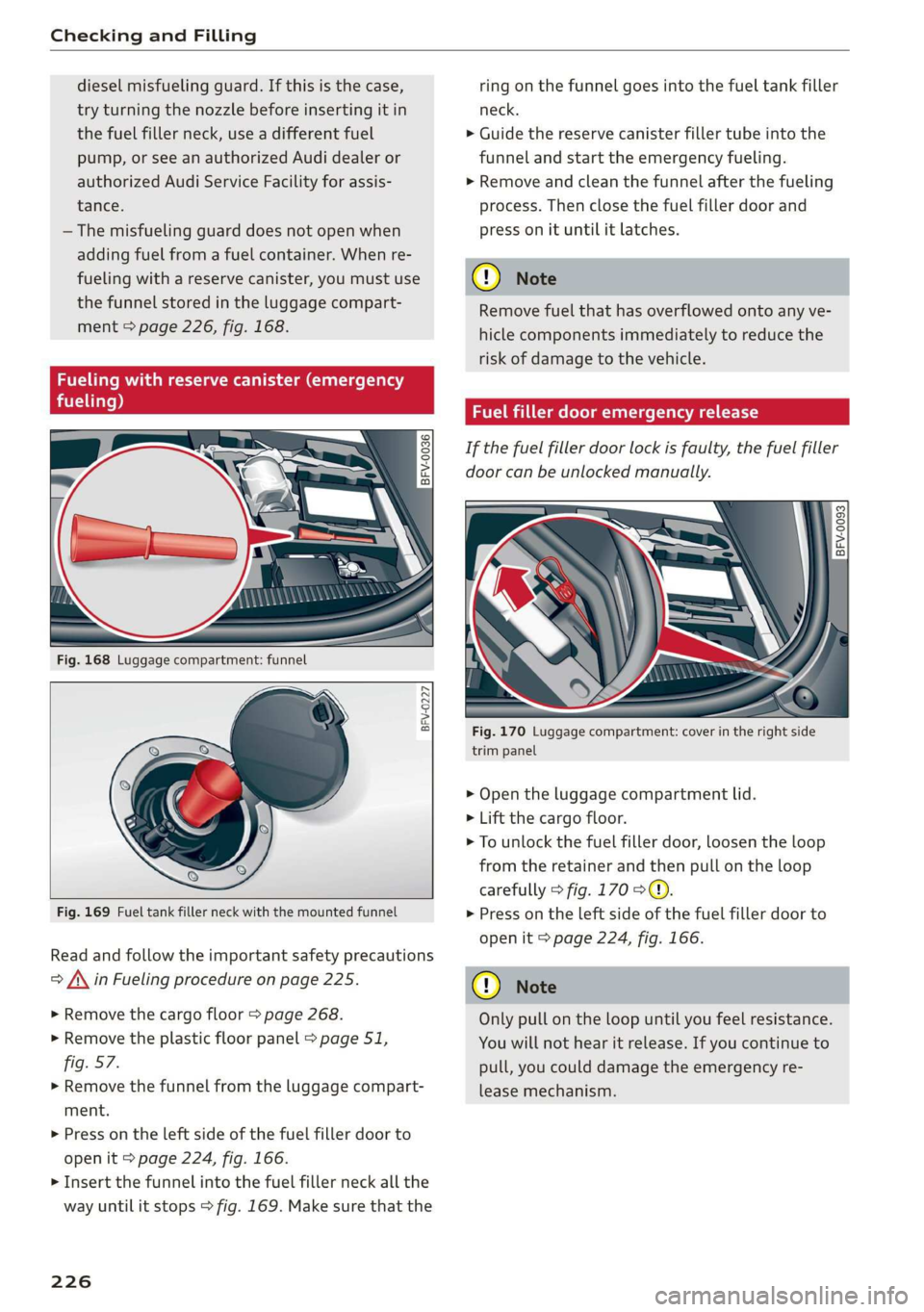
the
funnel stored in the luggage compart-
ment > page 226, fig. 168.
Fueling with reserve canister (emergency
fueling)
° i) 3°
8 >
c co
BFV-0227
Fig. 169 Fuel tank filler neck with the mounted funnel
Read and follow the important safety precautions
= A\ in Fueling procedure on page 225.
> Remove the cargo floor > page 268.
> Remove the plastic floor panel > page 51,
fig. 57.
> Remove the funnel from the luggage compart-
ment.
> Press on the left side of the fuel filler door to
open it > page 224, fig. 166.
> Insert the funnel into the fuel filler neck all the
way until it stops > fig. 169. Make sure that the
226
ring on the funnel goes into the fuel tank filler
neck.
> Guide the reserve canister filler tube into the
funnel and start the emergency fueling.
>» Remove and clean the funnel after the fueling
process. Then close the fuel filler door and
press on it until it latches.
() Note
Remove fuel that has overflowed onto any ve-
hicle components immediately to reduce the
risk of damage to the vehicle.
Fuel filler door emergency release
If the fuel filler door lock is faulty, the fuel filler
door can be unlocked manually.
| a 3
= >
cg a
Fig. 170 Luggage compartment: cover in the right side
trim panel
> Open the luggage compartment lid.
> Lift the cargo floor.
> To unlock the fuel filler door, loosen the loop
from the retainer and then pull on the loop
carefully > fig. 170 >@.
> Press on the left side of the fuel filler door to
open it > page 224, fig. 166.
@) Note
Only pull on the loop until you feel resistance.
You will not hear it release. If you continue to
pull, you could damage the emergency re-
lease mechanism.