2019 Alfa Romeo Stelvio Headlight
[x] Cancel search: HeadlightPage 69 of 244

Symbol What it means
WINDSCREEN WASHER LIQUID LEVEL
The symbol appears for some seconds to indicate that the level of the windscreen and headlight washing fluid (if any) is low.
Refill the liquid: to do this, please consult the "Level check" section in the "Service and care" chapter. Always use liquid with the
features indicated in the "Liquids and lubricants" section in the "Technical information" chapter.
LOW AdBlue® (UREA) DIESEL EMISSIONS ADDITIVE LEVEL WARNING (2.2 JTD versions only)
The Diesel Emissions Additive (UREA) low level symbol
A warning and a message indicating the need to top up AdBlue® (UREA) also appear on the display.
The symbol
stays on until the tank is topped up with at least 1.11 UK gal - 5 litres of AdBlue® (UREA).
If you do not top up, a specific message will appear on the instrument panel display whenever a certain threshold is reached until it
will no longer be possible to start the engine.
A message will appear permanently on the instrument panel and an acoustic tone will be heard when there is about 125 miles
(200 km) of range left.
A specific message will appear on the instrument panel display when there are 0 miles (0 km) of range left. It will no longer be
possible to restart the engine after it has been stopped. It will be possible to restart the engine after pouring at least 1.11 UK gal –
5 litres of AdBlue® (UREA) into the tank. Top up the AdBlue® (UREA) tank as soon as possible with at least 1.11 UK gal - 5 litres of
AdBlue® (UREA). If topping up is done with remaining range of AdBlue® (UREA) in the tank equal to 0 miles (0 zero), you may need to
wait 2 minutes before starting the engine.
18)
67
lights when the UREA level is low.
IMPORTANT
18)When the AdBlue® (UREA) tank is empty and the engine is stopped it is no longer possible to restart it until the AdBlue® (UREA) tank is topped
up with at least 5 litres of AdBlue® (UREA).
Page 71 of 244

Green symbols
Symbol What it means
LOW BEAM HEADLIGHTS (on 7" TFT display)
The warning light switches on when the dipped beam headlights are turned on.
AUTOMATIC DIPPED BEAM HEADLIGHTS (on 7" TFT display)
The symbol lights up when the automatic dipped beam headlights are on.
START & STOP EVO OPERATION
The warning light comes on in the event of Start & Stop Evo system intervention (stopping the engine).
When the engine is restarted, the warning light switches off (for the engine restarting modes see the "Start & Stop Evo" paragraph
in the "Starting and driving" chapter).
CRUISE CONTROL SYSTEM
The symbol comes on when the Cruise Control system is activated.
ACTIVE CRUISE CONTROL SYSTEM
The symbol comes on when the Active Cruise Control system is activated.
HILL DESCENT CONTROL HDC SYSTEM
The symbol lights up when the HDC system intervenes.
Blue symbols
Symbol What it means
AUTOMATIC MAIN BEAM HEADLIGHTS (on 7" TFT display)
The symbol comes on when the automatic main beam headlights are activated.
MAIN BEAM HEADLIGHTS (on 7" TFT display)
The symbol comes on when the main beam headlights are activated.
69
Page 87 of 244

61)Should one or more wheels be fitted
without sensors, the system will no longer be
available and a warning message will be
shown on the display, until wheels with
sensors are fitted again.
62)The TPMS cannot indicate sudden tyre
pressure drops (e.g. if a tyre bursts). In this
case, stop the vehicle, braking with caution
and avoiding abrupt steering.
63)Changes in outside temperature may
cause tyre pressures to vary. The system
may temporarily indicate insufficient
pressure. In this case, check the tyre
pressure when cold and, if necessary,
restore the inflation values.
64)Replacing standard tyres with winter
tyres and vice versa requires TPMS system
adjustment that must only be performed by
Alfa Romeo Dealerships.
65)When a tyre is removed, it is advisable
to replace the rubber valve seal as well:
contact an Alfa Romeo Dealership. The
fitting/removal of the tyres and/or rims
require special care. To avoid damaging or
fitting the sensors incorrectly, tyre and/or
rim fitting/removal operations should only
be carried out by specialised staff. Contact
an Alfa Romeo Dealership.
IMPORTANT
19)The system may have limited or absent
operation due to weather conditions such as:
heavy rain, hail, thick fog, heavy snow.
20)The section of the bumper before the
sensor must not be covered with adhesives,
auxiliary headlights or any other object.21)System intervention might be
unexpected or delayed when other vehicles
transport loads projecting from the side,
above or from the rear, with respect to the
normal size of the vehicle.
22)Operation can be adversely affected by
any structural change made to the vehicle,
such as a modification to the front geometry,
tyre change, or a heavier load than the
standard load of the vehicle.
23)Incorrect repairs made on the front part
of the vehicle (e.g. bumper, chassis) may alter
the position of the radar sensor, and
adversely affect its operation. Go to an Alfa
Romeo Dealership for any operation of this
type.
24)Do not tamper with nor carry out any
intervention on the radar sensor or on the
camera on the windscreen. In the event of a
sensor failure, contact an Alfa Romeo
Dealership.
25)Do not wash with high-pressure jets in
the bumper lower area: in particular do not
operate on the system's electrical connector.
26)Be careful in the case of repairs and new
paintings in the area around the sensor
(panel covering the sensor on the left side of
the bumper). In the event of a frontal impact
the sensor may automatically deactivate
and display a warning to indicate that the
sensor needs to be repaired. Even without a
malfunction warning, deactivate the system
operation if you think that the position of the
radar sensor has changed (e.g. due to
low-speed frontal impact as during parking
manoeuvres). In these cases, go to an Alfa
Romeo Dealership to have the radar sensor
realigned or replaced.27)When towing a trailer, a vehicle or during
loading manoeuvres on a vehicle transporter
(or in vehicle for transport), the system must
be deactivated via the Connect system.
28)The Tire Repair Kit, provided with the
vehicle, is compatible with the TPMS
sensors. Using sealants different from that
in the original kit may compromise its
operation. If sealants not equivalent with the
original ones are used, it is recommended to
have the TPMS sensor operation checked by
a qualified repair centre.
85
Page 128 of 244

utmost attention at all times and be
always ready to press the brakes if
needed.
Small cars
Some narrow cars (e.g. bicycles and
motorcycles) travelling near the outer
edges of the lane or which enter the lane
from kerbside are not detected until they
are fully in the lane.
Sufficient distance from the cars ahead
may not be guaranteed in these cases.
Stationary objects and vehicles
The device cannot detect the presence of
stationary vehicles or objects. For
example, the device will not operate if
the vehicle ahead leaves the lane and a
vehicle ahead of that one is standing on
the lane. Pay the utmost attention at all
times and be always ready to press the
brakes if needed.
Objects and cars moving in opposite or
crosswise direction
The device cannot detect the presence of
objects or vehicles travelling in opposite
or at right-angles and consequently will
not be operated.
WARNING
114)Pay the utmost attention while driving
at all times and be always ready to press the
brakes if needed.115)The system is an aid for the driver, who
must always pay full attention while driving.
The responsibility always rests with the
driver, who must take into account the
traffic conditions in order to drive in
complete safety. The driver must always
maintain a safe distance from the vehicle in
front.
116)The device is not activated in presence
of pedestrians, oncoming vehicles in the
opposite direction of travel or moving in the
crosswise direction and stationary objects
(e.g. a vehicle standing in a queue or a broken
down vehicle).
117)The device cannot take account of
road, traffic and weather conditions, and
conditions of poor visibility (e.g. fog).
118)The device does not always fully
recognise complex driving conditions that
could cause it to determine the safe distance
to be held incorrectly or not at all.
119)The device cannot apply the maximum
braking force: the car will not be stopped
completely.
IMPORTANT
37)The system may have limited or absent
operation due to weather conditions such as:
heavy rain, hail, thick fog, heavy snow.
38)The section of the bumper before the
sensor must not be covered with adhesives,
auxiliary headlights or any other object.
39)Operation can be adversely affected by
any structural change made to the vehicle,
such as a modification to the front geometry,
tyre change, or a heavier load than the
standard load of the vehicle.40)Incorrect repairs made on the front part
of the vehicle (e.g. bumper, chassis) may alter
the position of the radar sensor, and
adversely affect its operation. Go to an Alfa
Romeo Dealership for any operation of this
type.
41)Do not tamper with nor carry out any
intervention on the radar sensor or on the
camera on the windscreen. In the event of a
sensor failure, contact an Alfa Romeo
Dealership.
42)Do not wash with high-pressure jets in
the bumper lower area: in particular do not
operate on the system's electrical connector.
43)Be careful in the case of repairs and new
paintings in the area around the sensor
(panel covering the sensor on the left side of
the bumper). In the event of a frontal impact
the sensor may automatically deactivate
and display a warning to indicate that the
sensor needs to be repaired. Even without a
malfunction warning, deactivate the system
operation if you think that the position of the
radar sensor has changed (e.g. due to
low-speed frontal impact as during parking
manoeuvres). In these cases, go to an Alfa
Romeo Dealership to have the radar sensor
realigned or replaced.
126
STARTING AND DRIVING
Page 138 of 244

AdBlue® (UREA) ADDITIVE FOR
DIESEL EMISSIONS
(2.2 JTD versions only)
The car is equipped with an UREA
injection system and Selective Catalytic
Reduction to meet emission standards.
These two systems ensure compliance
with the diesel emissions requirements;
at the same time, they ensure
fuel-efficiency, handling, torque and
power. For messages and system
warnings, refer to the "Warning lights and
messages" paragraph in the "Knowing the
instrument panel" chapter.
AdBlue® (UREA) is considered a very
stable product with a long shelf life.
Stored at temperatures LOWER than
89.6° F (32 °C), it has a shelf life of at
least one year.
For more information on the AdBlue®
liquid type, see the “Fluids and lubricants”
paragraph in the “Technical
specifications” chapter.
The car is provided with an automatic
AdBlue® heating system when the engine
starts allowing the system to work
correctly at temperatures lower
than -11 °C.
IMPORTANT AdBlue® freezes at
temperatures lower than 12.2 °F (-11 °C).
SUGGESTIONS FOR DRIVING
SAVING FUEL
Below are some suggestions which may
help you save fuel and thus lower the
amount of harmful emissions released
into the atmosphere.
Vehicle maintenance
Checks and operations should be carried
out in accordance with the "Scheduled
Servicing Plan" (see chapter
"Maintenance and care").
Tyres
Check the tyre pressures at least once
every four weeks: if the pressure is too
low, consumption levels increase as
resistance to rolling is higher.
Unnecessary loads
Do not travel with an overloaded boot.
The weight of the vehicle and its
arrangement greatly affect fuel
consumption and stability.
Electric devices
Use electrical devices only for the
amount of time needed. The heated rear
window, additional headlights, screen
wipers and heater fan require a
considerable amount of energy;
increasing the current uptake increases
fuel consumption (by up to +25% in an
urban cycle).Climate control system
Using the climate control system will
increase consumption: use standard
ventilation when the temperature
outside permits.
Devices for aerodynamic control
The use of non-certified devices for
aerodynamic control may adversely
affect air drag and consumption levels.
DRIVING STYLE
Starting
Do not warm up the engine at low or high
revs when the vehicle is stationary; this
causes the engine to warm up more
slowly, thereby increasing fuel
consumption and emissions. It is
therefore advisable to move off
immediately, slowly, avoiding high
speeds: in this way the engine will warm
up more quickly.
Unnecessary actions
Avoid revving up when starting at traffic
lights or before stopping the engine. The
latter action, as well as double-
declutching, is unnecessary and causes
increased fuel consumption and
pollution.
Gear selection
Use a high gear when traffic and road
conditions allow it. Using a low gear for
faster acceleration will increase fuel
136
STARTING AND DRIVING
Page 148 of 244
HAZARD WARNING LIGHTS
CONTROL
54)
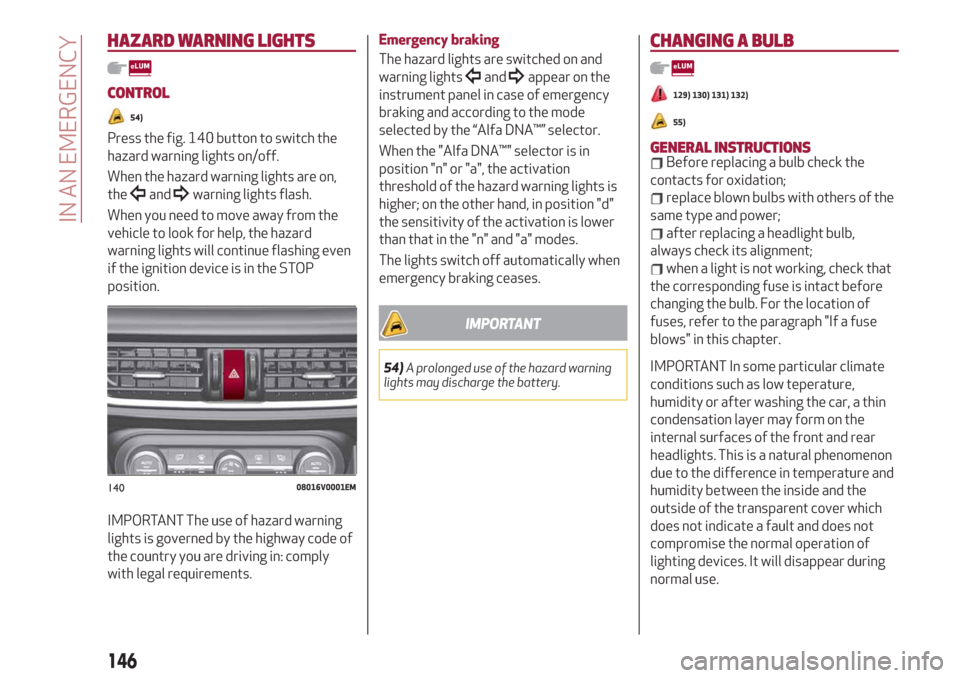
Press the fig. 140 button to switch the
hazard warning lights on/off.
When the hazard warning lights are on,
the
andwarning lights flash.
When you need to move away from the
vehicle to look for help, the hazard
warning lights will continue flashing even
if the ignition device is in the STOP
position.
IMPORTANT The use of hazard warning
lights is governed by the highway code of
the country you are driving in: comply
with legal requirements.
Emergency braking
The hazard lights are switched on and
warning lights
andappear on the
instrument panel in case of emergency
braking and according to the mode
selected by the “Alfa DNA™” selector.
When the "Alfa DNA™" selector is in
position "n" or "a", the activation
threshold of the hazard warning lights is
higher; on the other hand, in position "d"
the sensitivity of the activation is lower
than that in the "n" and "a" modes.
The lights switch off automatically when
emergency braking ceases.
IMPORTANT
54)A prolonged use of the hazard warning
lights may discharge the battery.
CHANGING A BULB
129) 130) 131) 132)
55)
GENERAL INSTRUCTIONSBefore replacing a bulb check the
contacts for oxidation;
replace blown bulbs with others of the
same type and power;
after replacing a headlight bulb,
always check its alignment;
when a light is not working, check that
the corresponding fuse is intact before
changing the bulb. For the location of
fuses, refer to the paragraph "If a fuse
blows" in this chapter.
IMPORTANT In some particular climate
conditions such as low teperature,
humidity or after washing the car, a thin
condensation layer may form on the
internal surfaces of the front and rear
headlights. This is a natural phenomenon
due to the difference in temperature and
humidity between the inside and the
outside of the transparent cover which
does not indicate a fault and does not
compromise the normal operation of
lighting devices. It will disappear during
normal use.
14008016V0001EM
146
IN AN EMERGENCY
Page 150 of 244
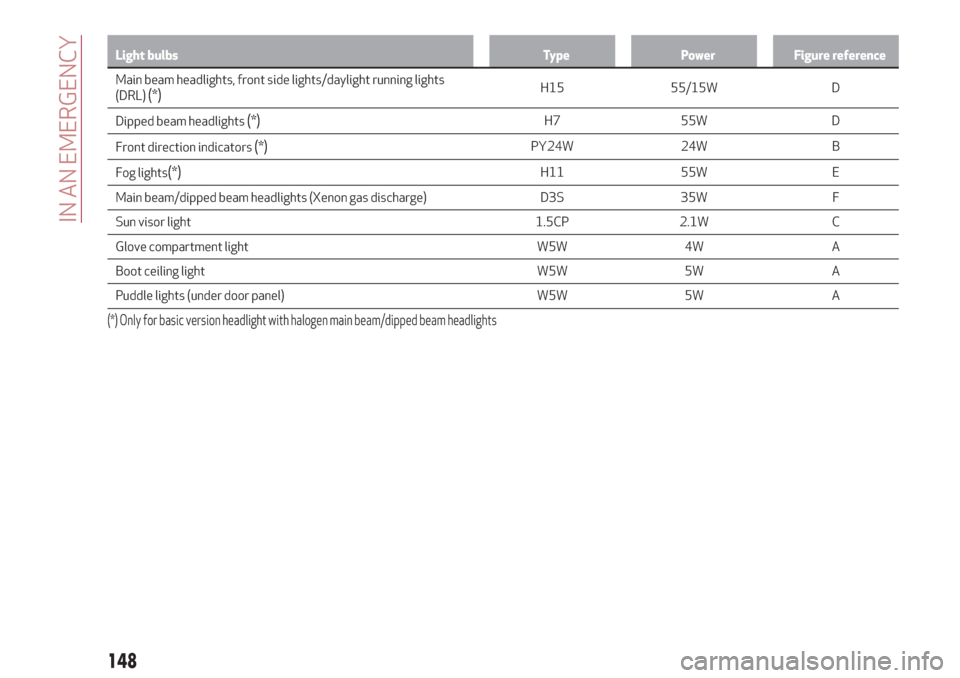
Light bulbs Type Power Figure reference
Main beam headlights, front side lights/daylight running lights
(DRL)(*)H15 55/15W D
Dipped beam headlights
(*)H7 55W D
Front direction indicators
(*)PY24W 24W B
Fog lights
(*)H11 55W E
Main beam/dipped beam headlights (Xenon gas discharge) D3S 35W F
Sun visor light 1.5CP 2.1W C
Glove compartment light W5W 4W A
Boot ceiling light W5W 5W A
Puddle lights (under door panel) W5W 5W A
(*) Only for basic version headlight with halogen main beam/dipped beam headlights
148
IN AN EMERGENCY
Page 151 of 244
REPLACING AN EXTERNAL BULB
Front light cluster with main
beam/dipped beam halogen headlights
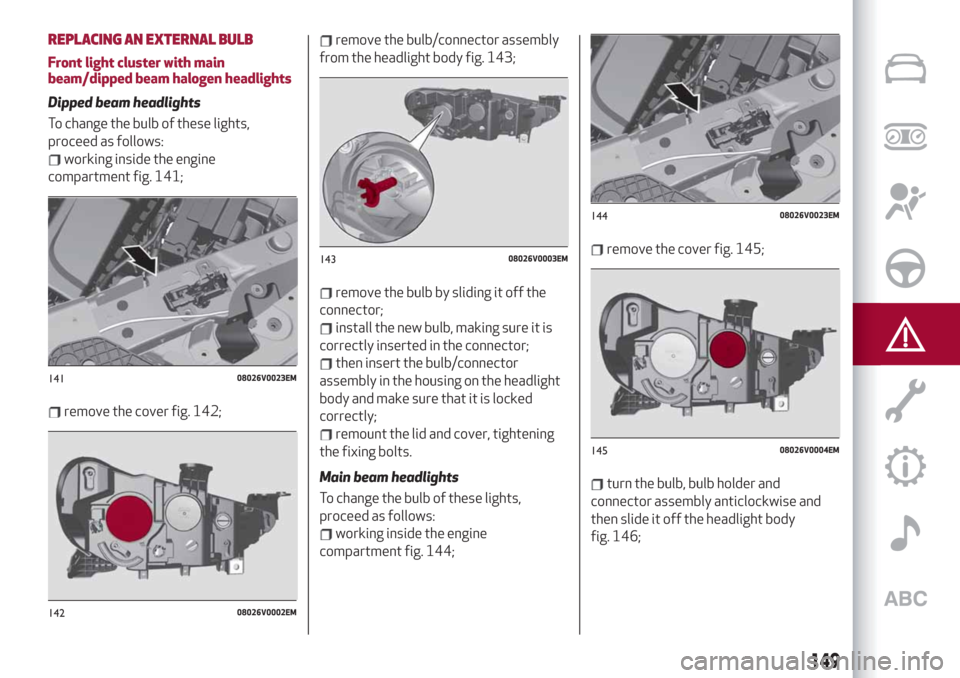
Dipped beam headlights
To change the bulb of these lights,
proceed as follows:
working inside the engine
compartment fig. 141;
remove the cover fig. 142;
remove the bulb/connector assembly
from the headlight body fig. 143;
remove the bulb by sliding it off the
connector;
install the new bulb, making sure it is
correctly inserted in the connector;
then insert the bulb/connector
assembly in the housing on the headlight
body and make sure that it is locked
correctly;
remount the lid and cover, tightening
the fixing bolts.
Main beam headlights
To change the bulb of these lights,
proceed as follows:
working inside the engine
compartment fig. 144;
remove the cover fig. 145;
turn the bulb, bulb holder and
connector assembly anticlockwise and
then slide it off the headlight body
fig. 146;
14108026V0023EM
14208026V0002EM
14308026V0003EM
14408026V0023EM
14508026V0004EM
149