Page 43 of 292
3. Turn the Blower Control counterclockwise to reducethe fan speed.
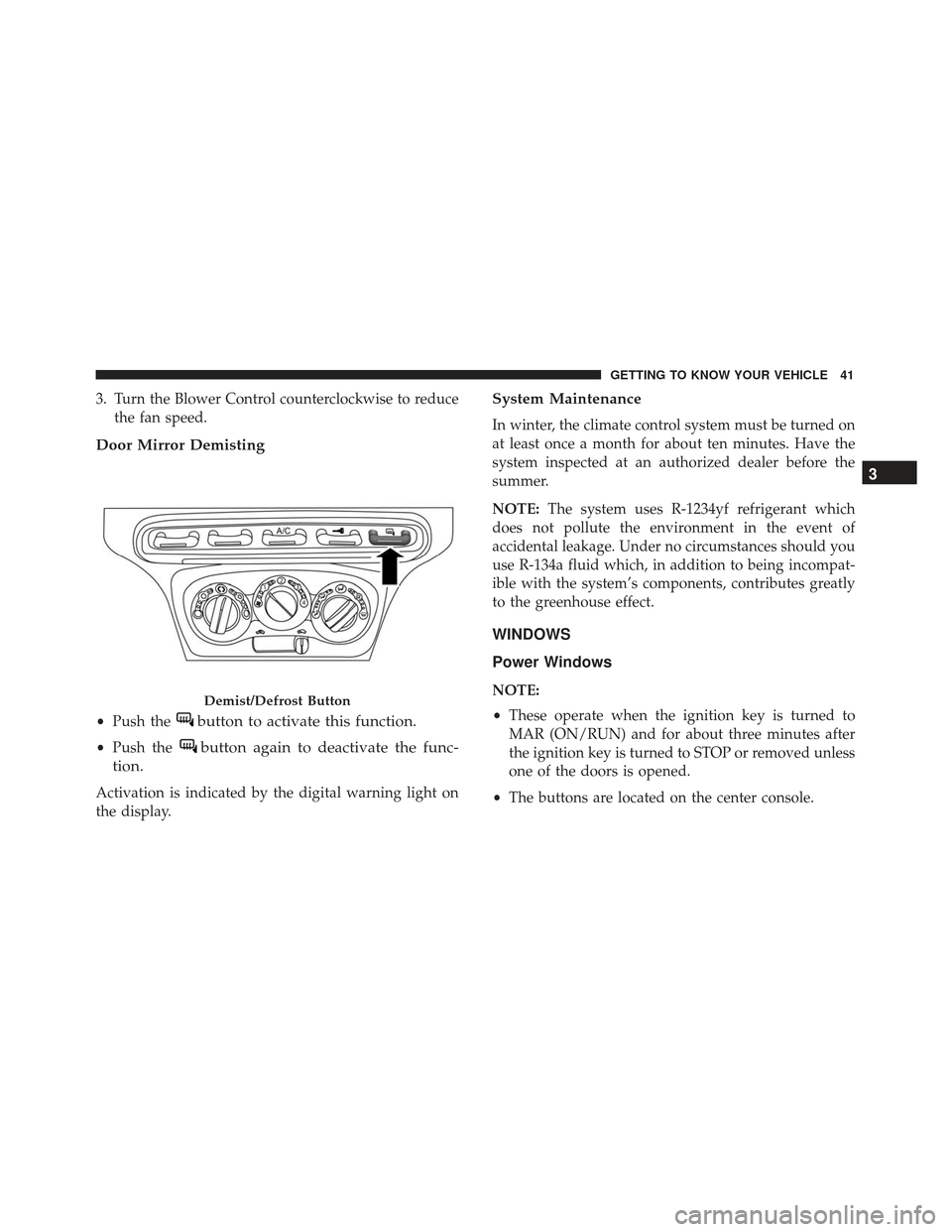
Door Mirror Demisting
•Push thebutton to activate this function.
•Push thebutton again to deactivate the func-
tion.
Activation is indicated by the digital warning light on
the display.
System Maintenance
In winter, the climate control system must be turned on
at least once a month for about ten minutes. Have the
system inspected at an authorized dealer before the
summer.
NOTE: The system uses R-1234yf refrigerant which
does not pollute the environment in the event of
accidental leakage. Under no circumstances should you
use R-134a fluid which, in addition to being incompat-
ible with the system’s components, contributes greatly
to the greenhouse effect.
WINDOWS
Power Windows
NOTE:
• These operate when the ignition key is turned to
MAR (ON/RUN) and for about three minutes after
the ignition key is turned to STOP or removed unless
one of the doors is opened.
• The buttons are located on the center console.Demist/Defrost Button
3
GETTING TO KNOW YOUR VEHICLE 41
Page 50 of 292
7. Check to make sure that the handles are locked inplace.
8. Repeat this procedure on both sides of the vehicle.
9. Insert the front locking handles located near the sun visors in the proper holes and turn them to the right
one quarter turn. NOTE:
•
Do not attach a roof rack on the soft top.
• Do not keep the soft top folded for long periods of
time.
• Do not remove ice from the top with a sharp object.
• Do not put objects on the top. The object could fall if
the top is operated causing damage and injury.
• The cooled air flow into the passenger compartment
may decrease if the automatic climate control system
is on and the top is not all the way closed.
Handles In Locked Position
Handles In Locked Position
48 GETTING TO KNOW YOUR VEHICLE
Page 132 of 292

Exhaust Gas
WARNING!
Exhaust gases can injure or kill. They contain
carbon monoxide (CO), which is colorless and odor-
less. Breathing it can make you unconscious and
can eventually poison you. To avoid breathing
(CO), follow these safety tips:
•Do not run the engine in a closed garage or in
confined areas any longer than needed to move
your vehicle in or out of the area.
• If you are required to drive with the trunk/
liftgate/rear doors open, make sure that all win-
dows are closed and the climate control BLOWER
switch is set at high speed. DO NOT use the
recirculation mode.
• If it is necessary to sit in a parked vehicle with the
engine running, adjust your heating or cooling
controls to force outside air into the vehicle. Set
the blower at high speed.
The best protection against carbon monoxide entry into
the vehicle body is a properly maintained engine ex-
haust system. Whenever a change is noticed in the sound of the
exhaust system, when exhaust fumes can be detected
inside the vehicle, or when the underside or rear of the
vehicle is damaged, have a competent mechanic inspect
the complete exhaust system and adjacent body areas
for broken, damaged, deteriorated, or mispositioned
parts. Open seams or loose connections could permit
exhaust fumes to seep into the passenger compartment.
In addition, inspect the exhaust system each time the
vehicle is raised for lubrication or oil change. Replace as
required.
Safety Checks You Should Make Inside The
Vehicle
Seat Belts
Inspect the seat belt system periodically, checking for
cuts, frays, and loose parts. Damaged parts must be
replaced immediately. Do not disassemble or modify
the system.
Front seat belt assemblies must be replaced after a
collision. Rear seat belt assemblies must be replaced
after a collision if they have been damaged (i.e., bent
retractor, torn webbing, etc.). If there is any question
regarding seat belt or retractor condition, replace the
seat belt.
130 SAFETY
Page 183 of 292

CavityVehicle Fuse
Number Mini Fuse
Description
10 F51 7.5 Amp Brown Headlamp Washer Relay, A/C Compressor Relay,
High Beam Relay, Parking ECU, Vehicle Radio,
Stop Lamp Switch
11 F37 7.5 Amp Brown Stop Light Switch, Instrument Panel Node
12 F49 5 Amp Tan Transmission Shifter Module, Cigar Lighter Light,
Drive Style Unit, Heated Mirrors Relay, Parkview
System
13 F31 5 Amp Tan Climate Control, Body Controller
14 F47 20 Amp Yellow Driver Power Window
TIRE SERVICE KIT
Small punctures up to 1/4 inch (6 mm) in the tire tread
can be sealed with the Tire Service Kit. Foreign objects
(e.g., screws or nails) should not be removed from the
tire. Tire Service Kit can be used in outside tempera-
tures approximately from -40°F (-40°C) to 122°F (50°C).
This kit will provide a temporary tire seal, allowing you
to drive your vehicle up to a maximum speed of 50 mph
(80 km/h).
Tire Service Kit Storage Location
The Tire Service Kit is located in the rear storage area
under the decklid.
7
IN CASE OF EMERGENCY 181
Page 250 of 292

Treadwear
The Treadwear grade is a comparative rating, based
on the wear rate of the tire when tested under
controlled conditions on a specified government test
course. For example, a tire graded 150 would wear
one and one-half times as well on the government
course as a tire graded 100. The relative performance
of tires depends upon the actual conditions of their
use, however, and may depart significantly from the
norm due to variations in driving habits, service
practices, and differences in road characteristics and
climate.
Traction Grades
The Traction grades, from highest to lowest, are AA,
A, B, and C. These grades represent the tire’s ability
to stop on wet pavement, as measured under con-
trolled conditions on specified government test sur-
faces of asphalt and concrete. A tire marked C may
have poor traction performance.WARNING!
The traction grade assigned to this tire is based
on straight-ahead braking traction tests, and does
not include acceleration, cornering, hydroplan-
ing, or peak traction characteristics.
Temperature Grades
The Temperature grades are A (the highest), B, and C,
representing the tire’s resistance to the generation of
heat and its ability to dissipate heat, when tested
under controlled conditions on a specified indoor
laboratory test wheel.
Sustained high temperature can cause the material of
the tire to degenerate and reduce tire life, and
excessive temperature can lead to sudden tire failure.
The grade C corresponds to a level of performance,
which all passenger vehicle tires must meet under
the Federal Motor Vehicle Safety Standard No. 109.
Grades B and A represent higher levels of perfor-
mance on the laboratory test wheel, than the mini-
mum required by law.
248 SERVICING AND MAINTENANCE
Page 279 of 292

Warning Light.........................75
Break-In Recommendations, New Vehicle .......139
Bulb Replacement ....................... .166
Bulbs, Light ........................ .133, 166
Camera .............................. .156
Camera, Rear .......................... .156
Capacities, Antifreeze (Engine Coolant) .........261
Capacities, Fluid ........................ .261
Caps, Filler Oil (Engine) ...................... .204, 210
Radiator (Coolant Pressure) ...............219
Carbon Monoxide Warning ..............130, 261
Car Washes ........................... .250
Cellular Phone ......................... .268
Chains, Tire ........................... .246
Changing A Flat Tire ..................... .225
Chart, Tire Sizing ....................... .227
Check Engine Light (Malfunction Indicator Light) . .84
Checking Your Vehicle For Safety .............129
Checks, Safety ......................... .129
Child Restraint ......................... .121
Child Restraints Booster Seats ........................ .124
Child Seat Installation ...................127 Infant And Child Restraints
...............123
Older Children And Child Restraints ........123
Clean Air Gasoline ...................... .258
Cleaning Wheels ............................ .245
Windshield Wiper Blades .................213
Climate Control ..........................35
Manual ..............................35
Compact Spare Tire ...................... .243
Contract, Service ........................ .271
Coolant (Antifreeze) ...................261, 262
Cooling Pressure Cap (Radiator Cap) ..........219
Cooling System ......................... .216
Adding Coolant (Antifreeze) ..............218
Coolant
Level .....................217, 220
Disposal Of Used Coolant ................220
Drain, Flush, And Refill ..................217
Inspection .......................... .220
Points To Remember ....................220
Pressure Cap ........................ .219
Radiator Cap ........................ .219
Selection Of Coolant (Antifreeze) ...........217
Corrosion Protection ..................... .249
Cruise Light .............................82
Cupholders .............................56
12
INDEX 277
