Page 82 of 132
7-21
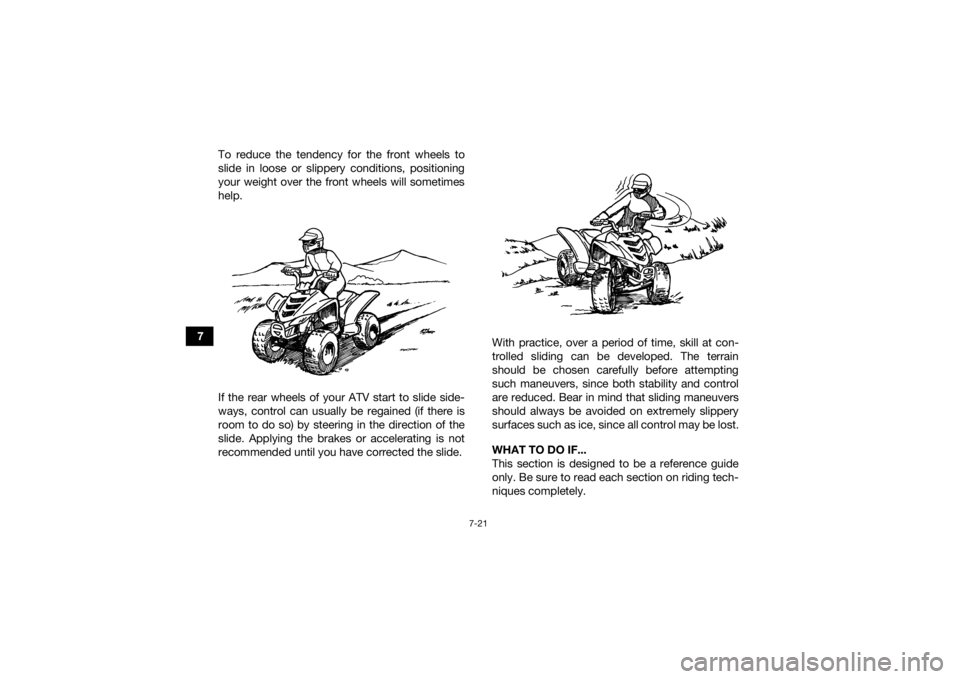
7To reduce the tendency for the front wheels to
slide in loose or slippery conditions, positioning
your weight over the front wheels will sometimes
help.
If the rear wheels of your ATV start to slide side-
ways, control can usually be regained (if there is
room to do so) by steering in the direction of the
slide. Applying the brakes or accelerating is not
recommended until you have corrected the slide.
With practice, over a period of time, skill at con-
trolled sliding can be developed. The terrain
should be chosen carefully before attempting
such maneuvers, since both stability and control
are reduced. Bear in mind that sliding maneuvers
should always be avoided on extremely slippery
surfaces such as ice, since all control may be lost.
WHAT TO DO IF...
This section is designed to be a reference guide
only. Be sure to read each section on riding tech-
niques completely.
UBD362E0.book Page 21 Tuesday, January 31, 2017 5:10 PM
Page 83 of 132

7-22
7
WHAT TO DO...
If your ATV doesn’t turn when you want it to:
Bring the ATV to a stop and practice the turning
maneuvers again. Be sure you are putting your
weight on the footboard to the outside of the
turn. Position your weight over the front wheels
for better control. (See page 7-12.)
If your ATV begins to tip while turning:
Lean more into the turn to regain balance. If
necessary, gradually let off the throttle and/or
steer to the outside of the turn. (See page 7-12.)
If your ATV starts to slide sideways:
Steer in the direction of the slide if you have the
room. Applying the brakes or accelerating is not
recommended until you have corrected the
slide. (See page 7-20.)
If your ATV can’t make it up a hill you are trying
to climb:
Turn the ATV around if you still have forward
speed. If not, stop, dismount on the uphill side
of the ATV and physically turn the ATV around.
If the ATV starts to slip backwards, DO NOT
USE THE REAR BRAKE – the ATV may tip over
on top of you. Dismount the ATV on the uphill
side. (See page 7-13.)
If your ATV is traversing a sloping surface:
Be sure to ride with your weight positioned to-
wards the uphill side of the ATV to maintain
proper balance. If the ATV starts to tip, steer
down the hill (if there are no obstacles in your
way) to regain balance. If you discover that the
ATV is going to tip over, dismount on the uphill
side. (See page 7-17.)
If your ATV encounters shallow water:
Ride slowly and carefully through slow moving
water, watching for obstacles. Be sure to let wa-
ter drain from the ATV and CHECK YOUR
BRAKES FOR PROPER OPERATION when you
come out of the water. Do not continue to ride
your ATV until you have regained adequate
braking ability. (See page 7-18.)
UBD362E0.book Page 22 Tuesday, January 31, 2017 5:10 PM
Page 108 of 132
8-25
8
TIPAfter adjusting the brake lever free play, check the
rear brake shoes for wear. EBU34014Drive chain slackThe drive chain slack should be checked before
each ride and adjusted if necessary.TIPWhen checking and adjusting the drive chain
slack, there should be no weight on the ATV and
all tires must be touching the ground.
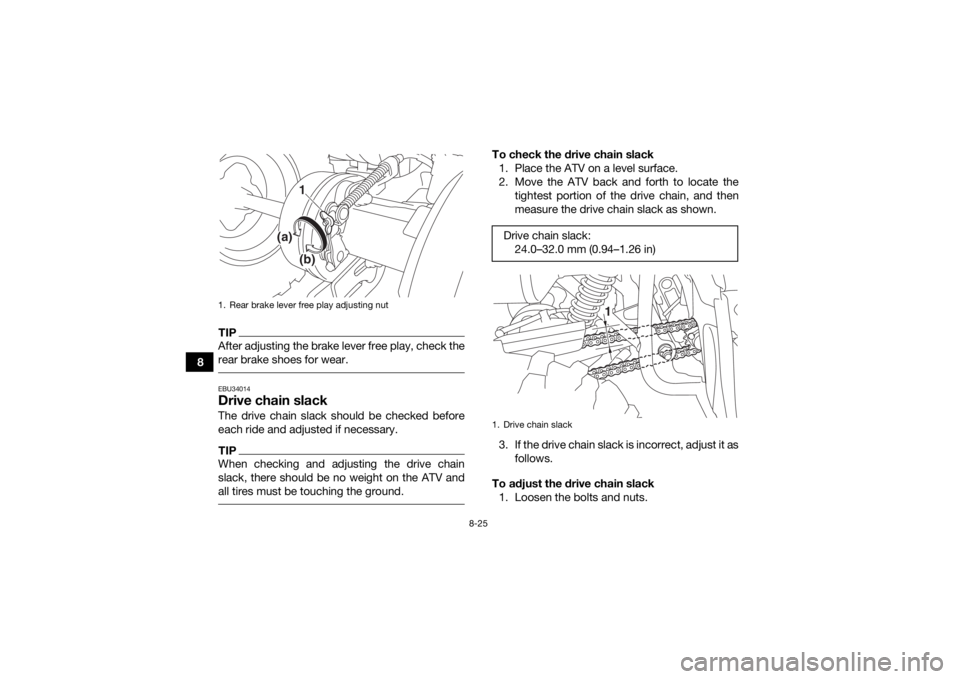
To check the drive chain slack1. Place the ATV on a level surface.
2. Move the ATV back and forth to locate the tightest portion of the drive chain, and then
measure the drive chain slack as shown.
3. If the drive chain slack is incorrect, adjust it as follows.
To adjust the drive chain slack 1. Loosen the bolts and nuts.
1. Rear brake lever free play adjusting nut
1
(a)
(b)
Drive chain slack: 24.0–32.0 mm (0.94–1.26 in)1. Drive chain slack
1
UBD362E0.book Page 25 Tuesday, January 31, 2017 5:10 PM
Page 124 of 132

10-1
10
EBU25962
SPECIFICATIONS
Dimensions:Overall length:1485 mm (58.5 in)
Overall width: 1020 mm (40.2 in)
Overall height:
955 mm (37.6 in)
Seat height: 750 mm (29.5 in)
Wheelbase: 1030 mm (40.6 in)
Ground clearance:
100 mm (3.9 in)
Minimum turning radius: 3000 mm (118 in)Weight:Curb weight:
126.5 kg (279 lb)Noise and vibration level:Noise level (77/311/EEC):73.0 dB(A) (EUR, FRA, GBR)
Uncertainty of measurement:
3.0 dB(A) (EUR, FRA, GBR)
Vibration on seat (EN1032, ISO5008): 0.6 m/s² (EUR, FRA, GBR)
Uncertainty of measurement: 0.3 m/s² (EUR, FRA, GBR) Vibration on handle (EN1032, ISO5008):
6.3 m/s² (EUR, FRA, GBR)
Uncertainty of measurement: 1.3 m/s² (EUR, FRA, GBR)
Engine:Engine type:
Air cooled 4-stroke, SOHC
Cylinder arrangement: Single cylinder
Displacement: 90 cm³
Bore × stroke:
47.0 × 51.8 mm (1.85 × 2.04 in)
Compression ratio: 9.2 : 1
Starting system: Electric starter and kickstarter
Lubrication system:
Wet sumpEngine oil:Recommended brand:YAMALUBE
UBD362E0.book Page 1 Tuesday, January 31, 2017 5:10 PM
Page 126 of 132
10-3
10
Caster angle:3.40 °
Trail: 19.8 mm (0.78 in)Front tire:Type:Tubeless
Size: AT18 x 7-8
Manufacturer/model:
DURO/DI2017Rear tire:Type:Tubeless
Size:
AT18 x 9-8
Manufacturer/model: DURO/DI2016Loading:Maximum loading limit:
82.0 kg (181 lb)
(Total weight of rider, cargo, accessories, and tongue)Tire air pressure (measured on cold tires):Recommended:Front:
24.0 kPa (0.240 kgf/cm², 3.5 psi)
Rear: 24.0 kPa (0.240 kgf/cm², 3.5 psi)
Minimum: Front: 20.7 kPa (0.207 kgf/cm², 3.0 psi) Rear:
20.7 kPa (0.207 kgf/cm², 3.0 psi)
Front wheel:Wheel type:
Panel wheel
Rim size: 8 x 5.5ATRear wheel:Wheel type:
Panel wheel
Rim size: 8 x 5.5ATFront brake:Type:
Mechanical leading, trailing drum brake
Operation: Right hand operationRear brake:Type:
Mechanical leading, trailing drum brake
Operation: Left hand operationFront suspension:Type:
Swing axle
Spring/shock absorber type: Coil spring/oil damper
Wheel travel: 126 mm (5.0 in)
UBD362E0.book Page 3 Tuesday, January 31, 2017 5:10 PM
Page:
< prev 1-8 9-16 17-24