Page 72 of 116

Periodic maintenance and adjustment
7-9
7
EAU36112
Canister
This model is equipped with a canister
to prevent the discharging of fuel vapor
into the atmosphere. Before operating
this vehicle, make sure to check the
following:
Check each hose connection.
Check each hose and canister for
cracks or damage. Replace if
damaged.
Make sure that the canister
breather is not blocked, and if
necessary, clean it.
EAUM3980
Engine oil and oil filter ele-
ment
The engine oil level should be checked
before each ride. In addition, the oil
must be changed and the oil filter ele-
ment replaced at the intervals specified
in the periodic maintenance and lubri-
cation chart.
To check the engine oil level
1. Place the vehicle on a level sur-
face and hold it in an upright posi-
tion. A slight tilt to the side can
result in a false reading.
2. Start the engine, warm it up for
several minutes, and then turn it
off.
3. Wait a few minutes until the oil set-
tles, and then check the oil level
through the check window locat-
ed at the bottom-right side of the
crankcase.
TIP
The engine oil should be between the
minimum and maximum level marks.
1. Canister
2. Canister breather hose
2
1
ZAUM1458
1. Engine oil level check window
2. Maximum level mark
3. Minimum level mark
3
1
2
UBY3E0E0.book Page 9 Friday, September 15, 2017 3:59 PM
Page 76 of 116
Periodic maintenance and adjustment
7-13
7
EAU20071
Coolant
The coolant level should be checked
before each ride. In addition, the cool-
ant must be changed at the intervals
specified in the periodic maintenance
and lubrication chart.
EAU78580To check the coolant level
1. Place the vehicle on the center-
stand.
TIP
The coolant level must be
checked on a cold engine since
the level varies with engine tem-
perature.
Make sure that the vehicle is posi-
tioned straight up when checking
the coolant level. A slight tilt to the
side can result in a false reading.
2. Check the coolant level through
the check window.
TIP
The coolant should be between the
minimum and maximum level marks.
3. If the coolant is at or below the
minimum level mark, remove the
left floorboard mat by pulling it up.
4. Remove the coolant reservoir cov-
er.
5. Remove the coolant reservoir cap,
add coolant to the maximum level
mark, and then install the reservoir
cap. WARNING! Remove only
the coolant reservoir cap. Never
attempt to remove the radiator
cap when the engine is hot.
[EWA15162] NOTICE: If coolant is not
available, use distilled water or
soft tap water instead. Do not
use hard water or salt water
since it is harmful to the engine.
If water has been used instead
of coolant, replace it with cool-
ant as soon as possible, other-
wise the cooling system will not
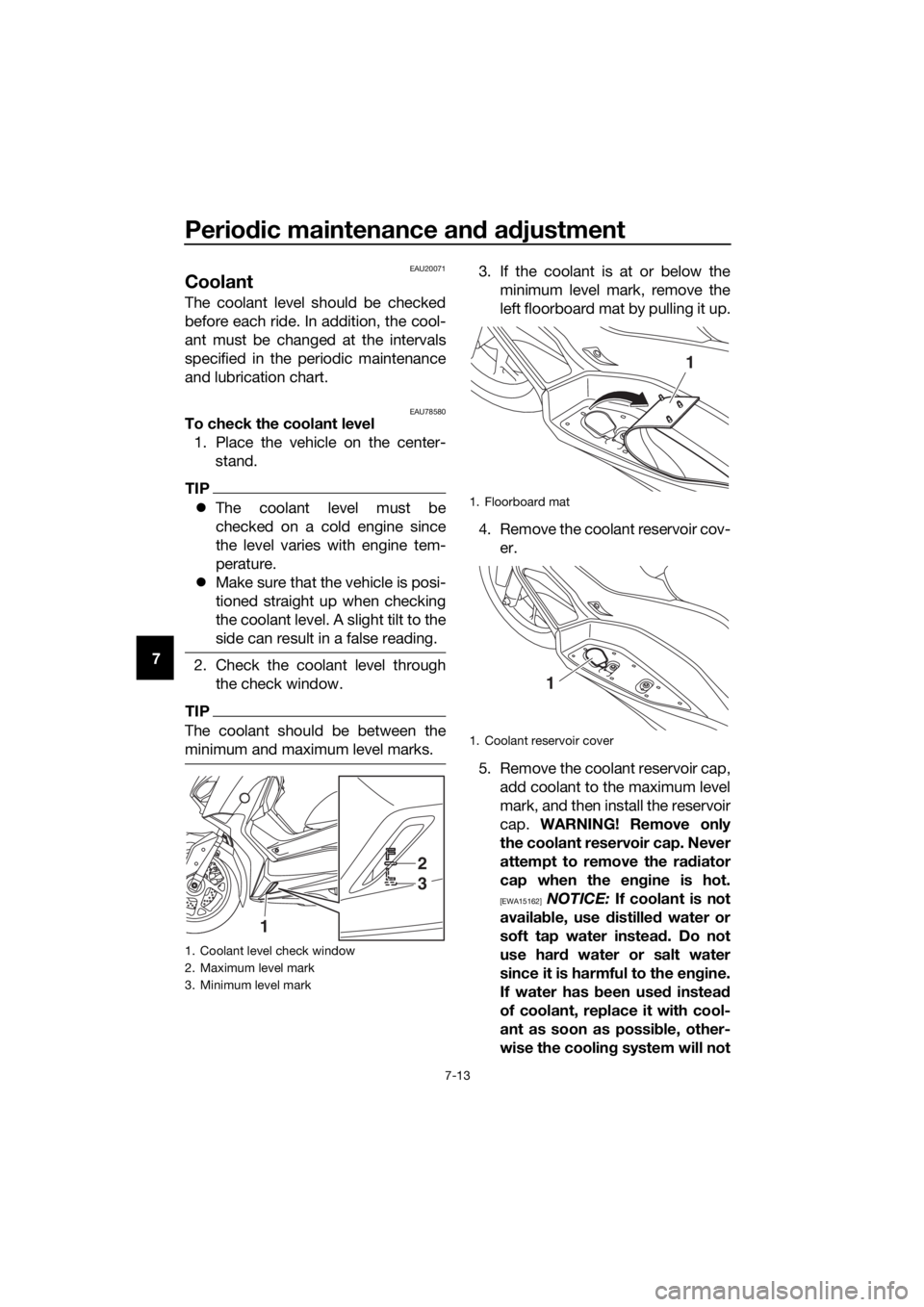
1. Coolant level check window
2. Maximum level mark
3. Minimum level mark
1
2
3
1. Floorboard mat
1. Coolant reservoir cover
1
1
UBY3E0E0.book Page 13 Friday, September 15, 2017 3:59 PM
Page 80 of 116
Periodic maintenance and adjustment
7-17
75. Lift up the air filter case slightly, re-
move the rear wheel sensor lead
from the holder, and then remove
the V-belt case cover.
6. Remove the V-belt case air filter
cover by removing the bolts.7. Remove the air filter element, and
then blow out the dirt with com-
pressed air from the clean side as
shown.
8. Check the V-belt case air filter ele-
ment for damage and replace it if
necessary.
9. Insert the element into the V-belt
case.
10. Install the V-belt case air filter cov-
er by installing the bolts.
11. Install the rear wheel sensor lead
into the holder at the white tape on
the lead as shown.
1. Bolt
1. Rear wheel sensor lead
2. Lead holder
1. V-belt case air filter cover
2. Bolt
1
1
22
1
2
2
1. V-belt case air filter element
1. Clean side
1
1
UBY3E0E0.book Page 17 Friday, September 15, 2017 3:59 PM
Page 94 of 116
Periodic maintenance and adjustment
7-31
7
If a fuse is blown, replace it as follows.
1. Turn the main switch off and turn
off the electrical circuit in ques-
tion.
2. Remove the blown fuse, and then
install a new fuse of the specified
amperage. WARNING! Do not
use a fuse of a higher amperage
rating than recommended to
avoid causing extensive dam-
age to the electrical system and
possibly a fire.
[EWA15132]
3. Turn the main switch on and turn
on the electrical circuit in question
to check if the device operates.
4. If the fuse immediately blows
again, have a Yamaha dealer
check the electrical system.
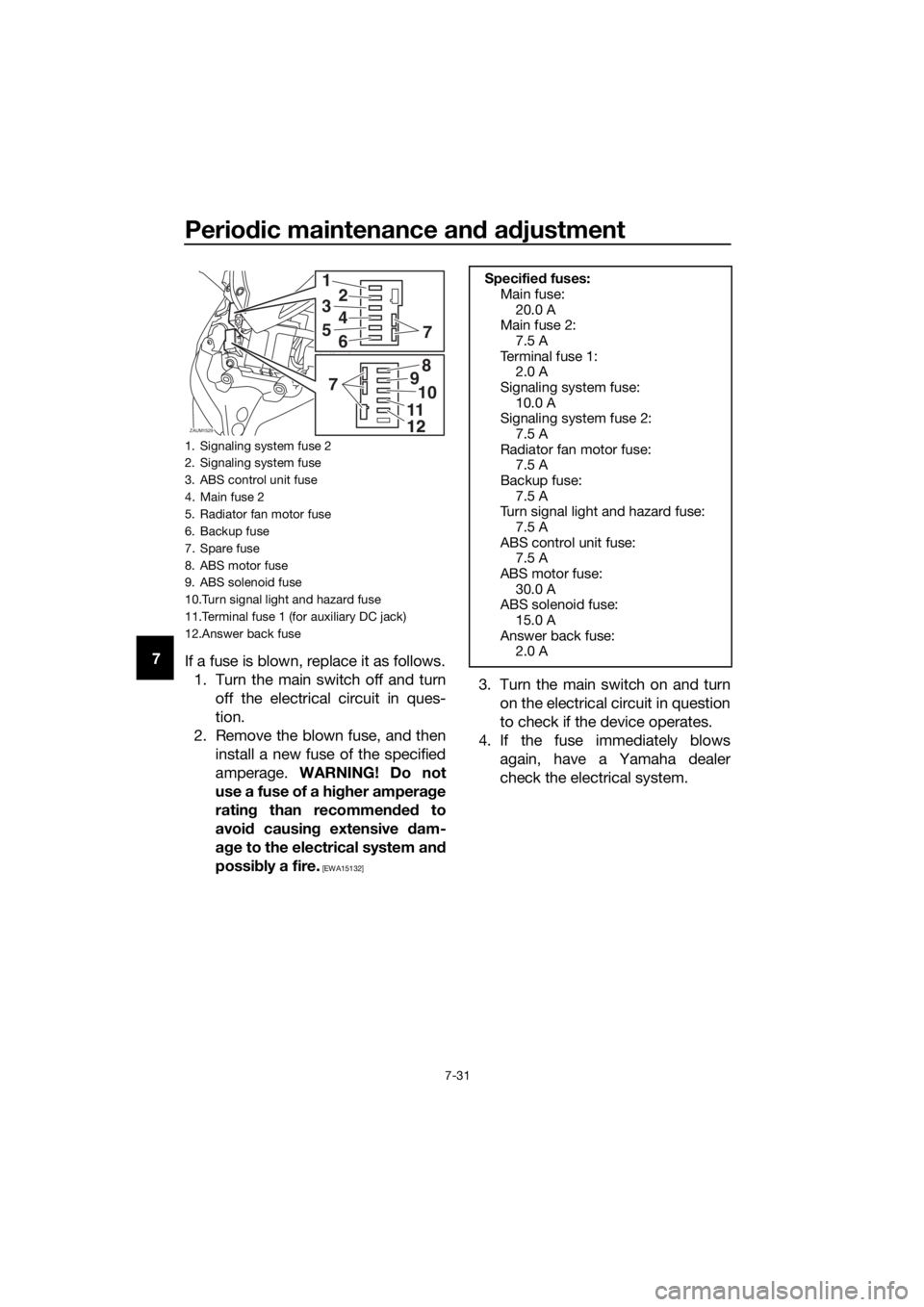
1. Signaling system fuse 2
2. Signaling system fuse
3. ABS control unit fuse
4. Main fuse 2
5. Radiator fan motor fuse
6. Backup fuse
7. Spare fuse
8. ABS motor fuse
9. ABS solenoid fuse
10.Turn signal light and hazard fuse
11.Terminal fuse 1 (for auxiliary DC jack)
12.Answer back fuse
ZAUM1529
1234567
8910
11
7
Specified fuses:
Main fuse:
20.0 A
Main fuse 2:
7.5 A
Terminal fuse 1:
2.0 A
Signaling system fuse:
10.0 A
Signaling system fuse 2:
7.5 A
Radiator fan motor fuse:
7.5 A
Backup fuse:
7.5 A
Turn signal light and hazard fuse:
7.5 A
ABS control unit fuse:
7.5 A
ABS motor fuse:
30.0 A
ABS solenoid fuse:
15.0 A
Answer back fuse:
2.0 A
UBY3E0E0.book Page 31 Friday, September 15, 2017 3:59 PM
Page 95 of 116
Periodic maintenance and adjustment
7-32
7
EAU64070
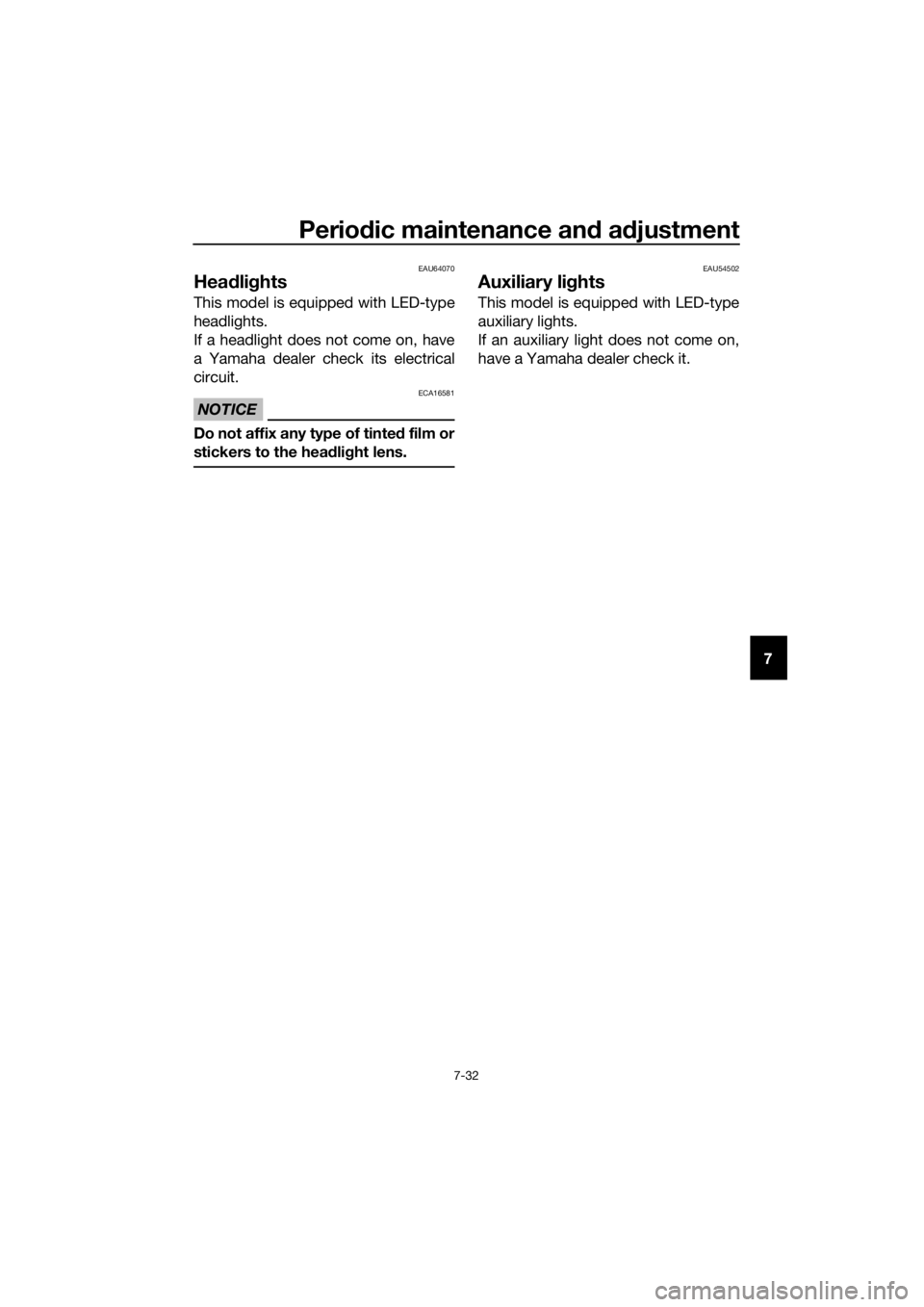
Headlights
This model is equipped with LED-type
headlights.
If a headlight does not come on, have
a Yamaha dealer check its electrical
circuit.
NOTICE
ECA16581
Do not affix any type of tinted film or
stickers to the headlight lens.
EAU54502
Auxiliary lights
This model is equipped with LED-type
auxiliary lights.
If an auxiliary light does not come on,
have a Yamaha dealer check it.
UBY3E0E0.book Page 32 Friday, September 15, 2017 3:59 PM
Page 96 of 116
Periodic maintenance and adjustment
7-33
7
EAU70540
Brake/tail light
This model is equipped with an LED-
type brake/tail light.
If the brake/tail light does not come on,
have a Yamaha dealer check it.
EAU39881
Front turn signal light
If a front turn signal light does not
come on, have a Yamaha dealer check
its electrical circuit or replace the bulb.
UBY3E0E0.book Page 33 Friday, September 15, 2017 3:59 PM
Page 97 of 116
Periodic maintenance and adjustment
7-34
7
EAUT1331
Rear turn signal light bulb
If a rear turn signal light does not come
on, have a Yamaha dealer check the
electrical circuit or replace the bulb.
EAU78560
Replacing the license plate
light bulb
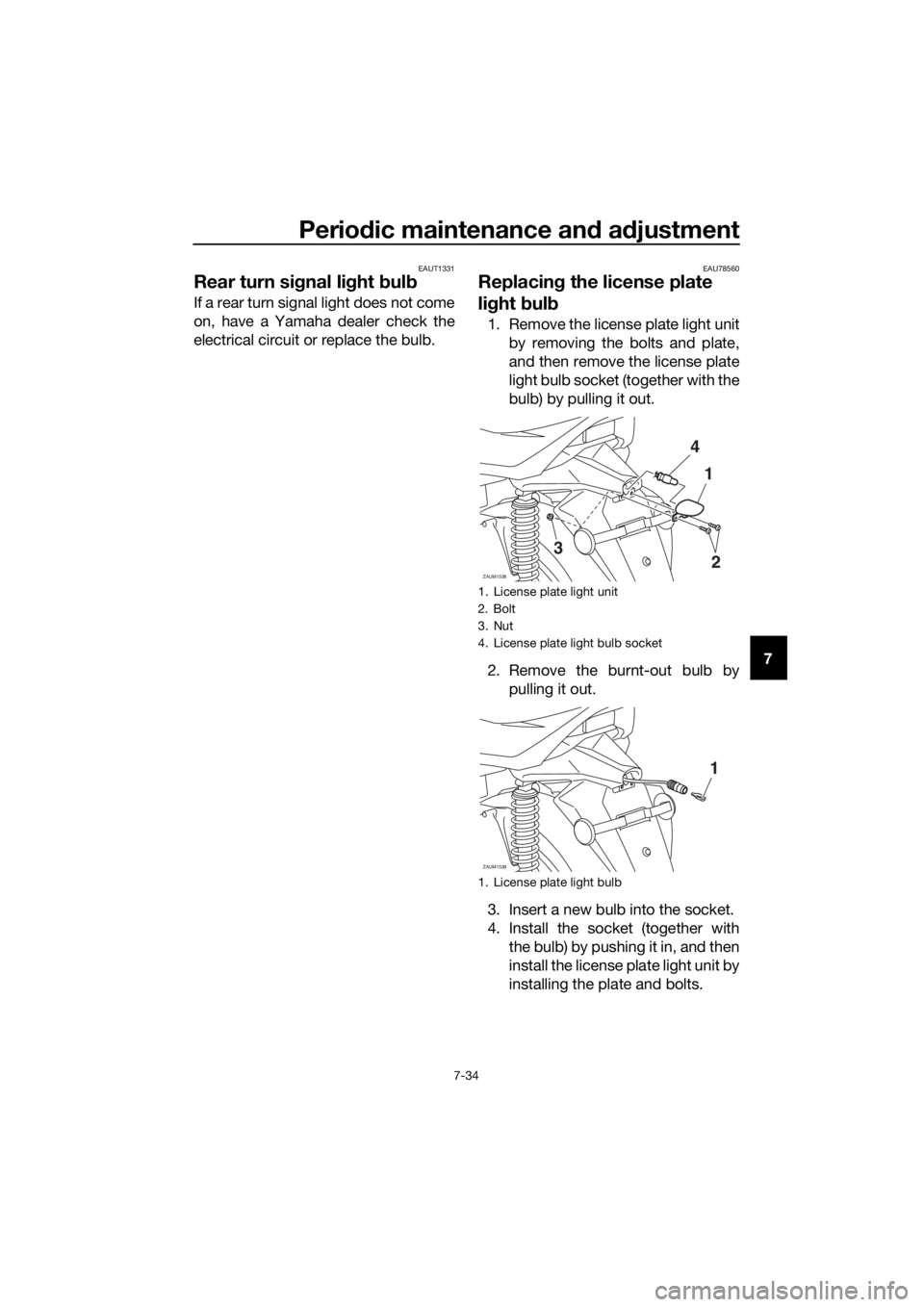
1. Remove the license plate light unit
by removing the bolts and plate,
and then remove the license plate
light bulb socket (together with the
bulb) by pulling it out.
2. Remove the burnt-out bulb by
pulling it out.
3. Insert a new bulb into the socket.
4. Install the socket (together with
the bulb) by pushing it in, and then
install the license plate light unit by
installing the plate and bolts.
1. License plate light unit
2. Bolt
3. Nut
4. License plate light bulb socket
1. License plate light bulb
ZAUM1538
1 4
3
2
ZAUM1539
1
UBY3E0E0.book Page 34 Friday, September 15, 2017 3:59 PM
Page 98 of 116

Periodic maintenance and adjustment
7-35
7
EAU60701
Troubleshooting
Although Yamaha vehicles receive a
thorough inspection before shipment
from the factory, trouble may occur
during operation. Any problem in the
fuel, compression, or ignition systems,
for example, can cause poor starting
and loss of power.
The following troubleshooting charts
represent quick and easy procedures
for checking these vital systems your-
self. However, should your vehicle re-
quire any repair, take it to a Yamaha
dealer, whose skilled technicians have
the necessary tools, experience, and
know-how to service the vehicle prop-
erly.
Use only genuine Yamaha replace-
ment parts. Imitation parts may look
like Yamaha parts, but they are often
inferior, have a shorter service life and
can lead to expensive repair bills.
WARNING
EWA15142
When checking the fuel system, do
not smoke, and make sure there are
no open flames or sparks in the ar-
ea, including pilot lights from water
heaters or furnaces. Gasoline or
gasoline vapors can ignite or ex-
plode, causing severe injury or prop-
erty damage.
EAU76551Smart key system troubleshooting
Please check the following items when
the smart key system does not work.
Is the smart key turned on? (See
page 3-5.)
Is the smart key battery dis-
charged? (See page 3-6.)Is the smart key battery installed
correctly? (See page 3-6.)
Is the smart key being used in a lo-
cation with strong radio waves or
other electromagnetic noise? (See
page 3-1.)
Are you using the smart key that is
registered to the vehicle?
Is the vehicle battery discharged?
When the vehicle battery is dis-
charged, the smart key system will
not operate. Please have the vehi-
cle battery charged or replaced.
(See page 7-29.)
If the smart key system does not work
after checking the above items, have a
Yamaha dealer check the smart key
system.
TIP
See Emergency mode on page 7-38
for information on starting the engine
without the smart key.
UBY3E0E0.book Page 35 Friday, September 15, 2017 3:59 PM