2018 YAMAHA XMAX 300 check oil
[x] Cancel search: check oilPage 72 of 116

Periodic maintenance and adjustment
7-9
7
EAU36112
Canister
This model is equipped with a canister
to prevent the discharging of fuel vapor
into the atmosphere. Before operating
this vehicle, make sure to check the
following:
Check each hose connection.
Check each hose and canister for
cracks or damage. Replace if
damaged.
Make sure that the canister
breather is not blocked, and if
necessary, clean it.
EAUM3980
Engine oil and oil filter ele-
ment
The engine oil level should be checked
before each ride. In addition, the oil
must be changed and the oil filter ele-
ment replaced at the intervals specified
in the periodic maintenance and lubri-
cation chart.
To check the engine oil level
1. Place the vehicle on a level sur-
face and hold it in an upright posi-
tion. A slight tilt to the side can
result in a false reading.
2. Start the engine, warm it up for
several minutes, and then turn it
off.
3. Wait a few minutes until the oil set-
tles, and then check the oil level
through the check window locat-
ed at the bottom-right side of the
crankcase.
TIP
The engine oil should be between the
minimum and maximum level marks.
1. Canister
2. Canister breather hose
2
1
ZAUM1458
1. Engine oil level check window
2. Maximum level mark
3. Minimum level mark
3
1
2
UBY3E0E0.book Page 9 Friday, September 15, 2017 3:59 PM
Page 73 of 116
Periodic maintenance and adjustment
7-10
7 4. If the engine oil is below the mini-
mum level mark, add sufficient oil
of the recommended type to raise
it to the correct level.
To change the engine oil (with or
without oil filter element replace-
ment)
1. Start the engine, warm it up for
several minutes, and then turn it
off.
2. Place an oil pan under the engine
to collect the used oil.
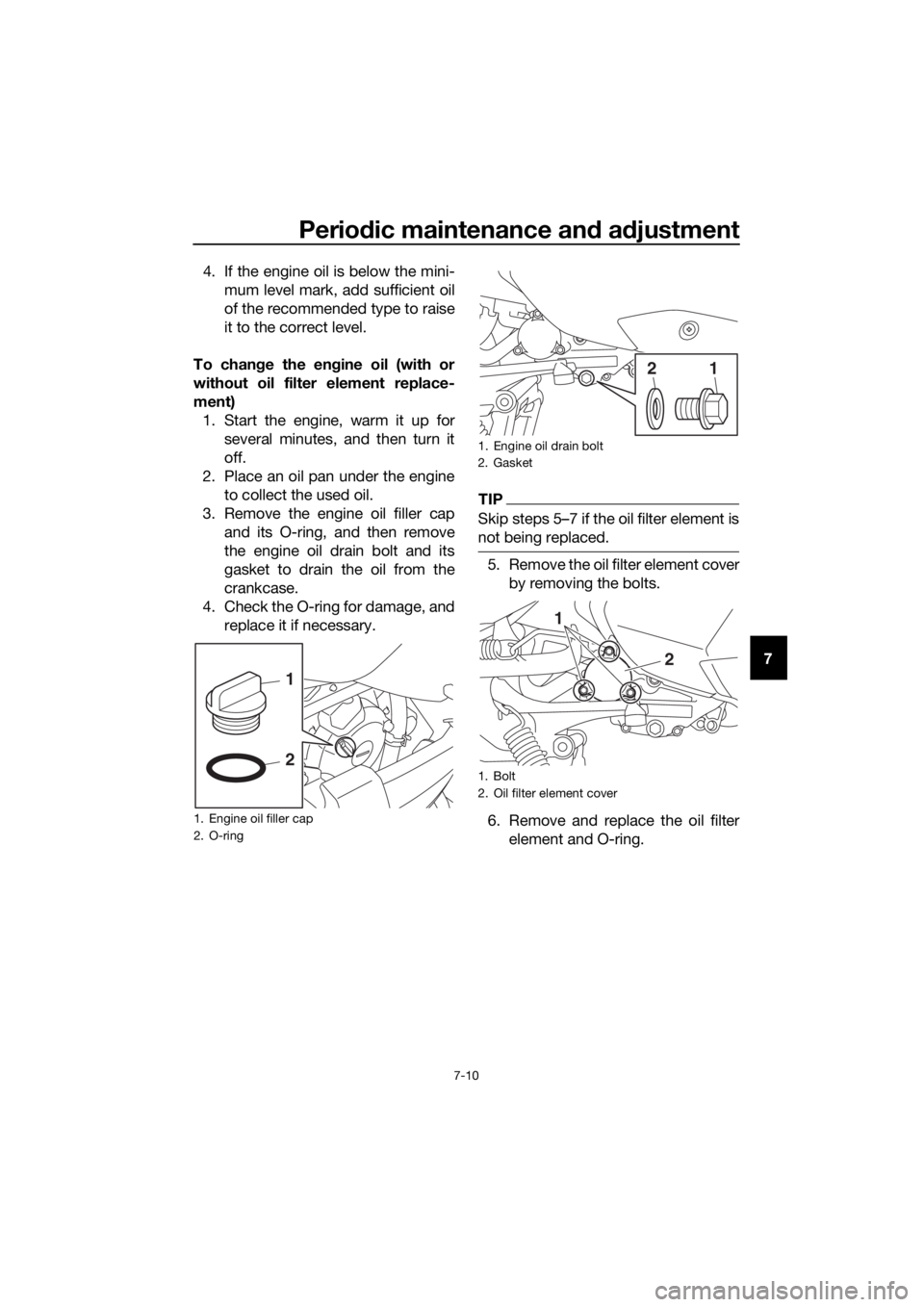
3. Remove the engine oil filler cap
and its O-ring, and then remove
the engine oil drain bolt and its
gasket to drain the oil from the
crankcase.
4. Check the O-ring for damage, and
replace it if necessary.
TIP
Skip steps 5…7 if the oil filter element is
not being replaced.
5. Remove the oil filter element cover
by removing the bolts.
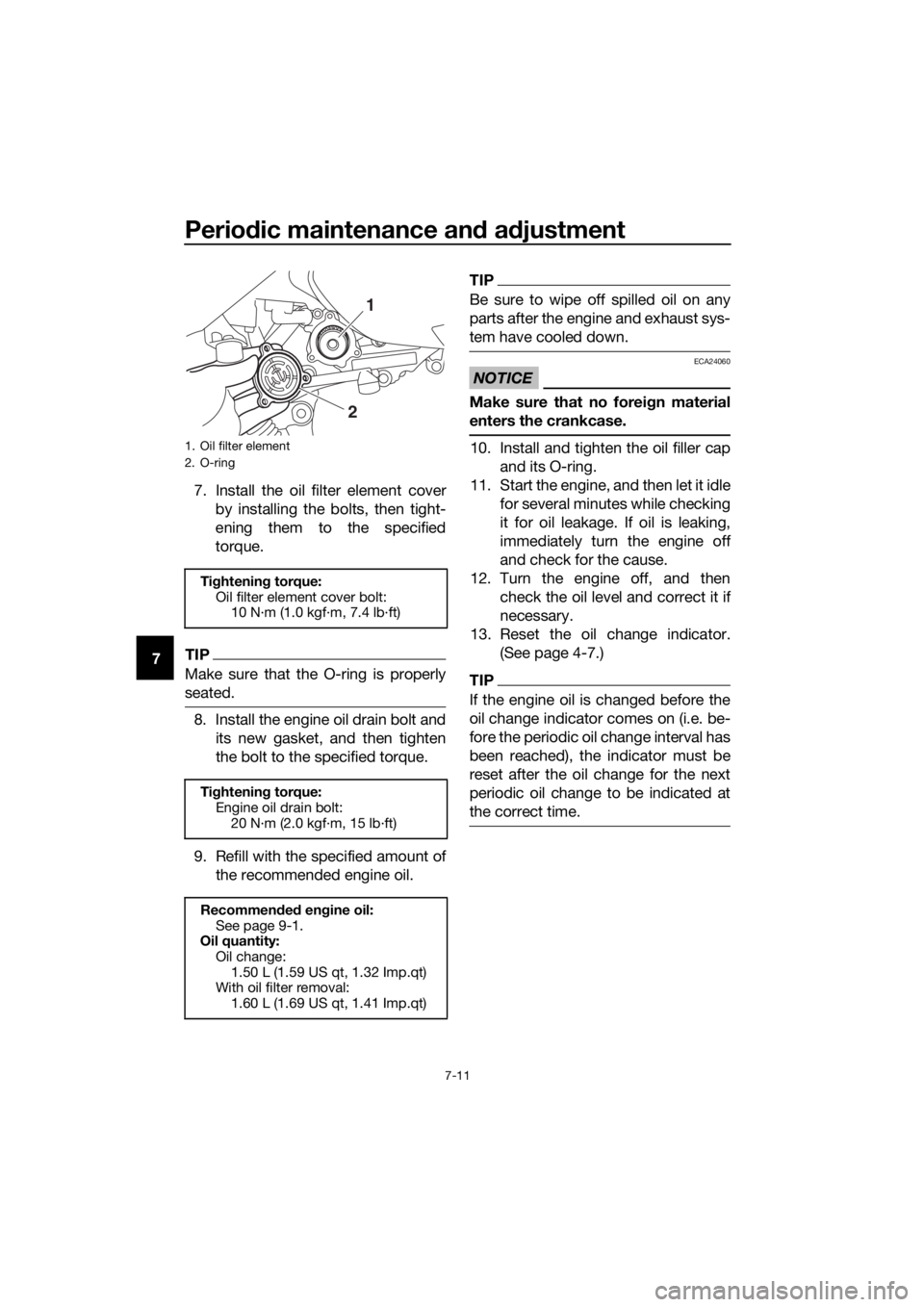
6. Remove and replace the oil filter
element and O-ring.
1. Engine oil filler cap
2. O-ring
1
2
1. Engine oil drain bolt
2. Gasket
1. Bolt
2. Oil filter element cover
12
2 1
UBY3E0E0.book Page 10 Friday, September 15, 2017 3:59 PM
Page 74 of 116
Periodic maintenance and adjustment
7-11
77. Install the oil filter element cover
by installing the bolts, then tight-
ening them to the specified
torque.TIP
Make sure that the O-ring is properly
seated.
8. Install the engine oil drain bolt and
its new gasket, and then tighten
the bolt to the specified torque.
9. Refill with the specified amount of
the recommended engine oil.
TIP
Be sure to wipe off spilled oil on any
parts after the engine and exhaust sys-
tem have cooled down.
NOTICE
ECA24060
Make sure that no foreign material
enters the crankcase.
10. Install and tighten the oil filler cap
and its O-ring.
11. Start the engine, and then let it idle
for several minutes while checking
it for oil leakage. If oil is leaking,
immediately turn the engine off
and check for the cause.
12. Turn the engine off, and then
check the oil level and correct it if
necessary.
13. Reset the oil change indicator.
(See page 4-7.)
TIP
If the engine oil is changed before the
oil change indicator comes on (i.e. be-
fore the periodic oil change interval has
been reached), the indicator must be
reset after the oil change for the next
periodic oil change to be indicated at
the correct time.
1. Oil filter element
2. O-ring
Tightening torque:
Oil filter element cover bolt:
10 N·m (1.0 kgf·m, 7.4 lb·ft)
Tightening torque:
Engine oil drain bolt:
20 N·m (2.0 kgf·m, 15 lb·ft)
Recommended engine oil:
See page 9-1.
Oil quantity:
Oil change:
1.50 L (1.59 US qt, 1.32 Imp.qt)
With oil filter removal:
1.60 L (1.69 US qt, 1.41 Imp.qt)
1
2
UBY3E0E0.book Page 11 Friday, September 15, 2017 3:59 PM
Page 75 of 116
Periodic maintenance and adjustment
7-12
7
EAU20067
Final transmission oil
The final transmission case must be
checked for oil leakage before each
ride. If any leakage is found, have a
Yamaha dealer check and repair the
scooter. In addition, the final transmis-
sion oil must be changed as follows at
the intervals specified in the periodic
maintenance and lubrication chart.
1. Start the engine, warm up the final
transmission oil by riding the
scooter for several minutes, and
then stop the engine.
2. Place the scooter on the center-
stand.
3. Place an oil pan under the final
transmission case to collect the
used oil.
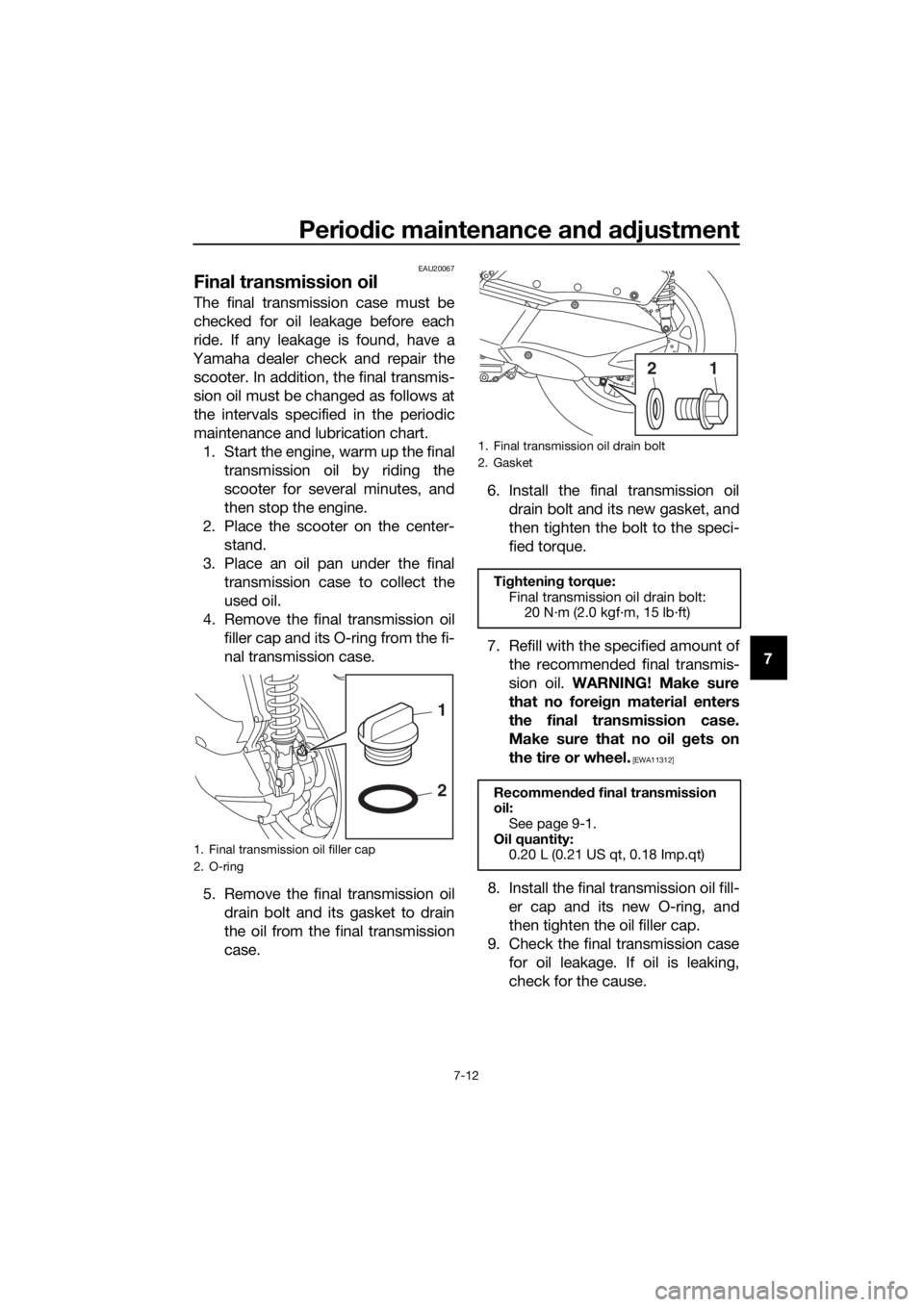
4. Remove the final transmission oil
filler cap and its O-ring from the fi-
nal transmission case.
5. Remove the final transmission oil
drain bolt and its gasket to drain
the oil from the final transmission
case.6. Install the final transmission oil
drain bolt and its new gasket, and
then tighten the bolt to the speci-
fied torque.
7. Refill with the specified amount of
the recommended final transmis-
sion oil. WARNING! Make sure
that no foreign material enters
the final transmission case.
Make sure that no oil gets on
the tire or wheel.
[EWA11312]
8. Install the final transmission oil fill-
er cap and its new O-ring, and
then tighten the oil filler cap.
9. Check the final transmission case
for oil leakage. If oil is leaking,
check for the cause.
1. Final transmission oil filler cap
2. O-ring
1
2
1. Final transmission oil drain bolt
2. Gasket
Tightening torque:
Final transmission oil drain bolt:
20 N·m (2.0 kgf·m, 15 lb·ft)
Recommended final transmission
oil:
See page 9-1.
Oil quantity:
0.20 L (0.21 US qt, 0.18 Imp.qt)
12
UBY3E0E0.book Page 12 Friday, September 15, 2017 3:59 PM
Page 87 of 116

Periodic maintenance and adjustment
7-24
7 Clean the filler cap before re-
moving. Use only DOT 4 brake
fluid from a sealed container.
Use only the specified brake flu-
id; otherwise, the rubber seals
may deteriorate, causing leak-
age.
Refill with the same type of
brake fluid. Adding a brake fluid
other than DOT 4 may result in a
harmful chemical reaction.
Be careful that water or dust
does not enter the brake fluid
reservoir when refilling. Water
will significantly lower the boil-
ing point of the fluid and may re-
sult in vapor lock, and dirt may
clog the ABS hydraulic unit
valves.NOTICE
ECA17641
Brake fluid may damage painted
surfaces or plastic parts. Always
clean up spilled fluid immediately.
As the brake pads wear, it is normal for
the brake fluid level to gradually go
down. A low brake fluid level may indi-
cate worn brake pads and/or brake
system leakage; therefore, be sure to
check the brake pads for wear and the
brake system for leakage. If the brake
fluid level goes down suddenly, have a
Yamaha dealer check the cause before
further riding.
EAU22734
Changing the brake fluid
Have a Yamaha dealer change the
brake fluid every 2 years. In addition,
have the seals of the master cylinders
and brake calipers, as well as the brake
hoses replaced at the intervals listed
below or sooner if they are damaged or
leaking.
Brake seals: every 2 years
Brake hoses: every 4 years
UBY3E0E0.book Page 24 Friday, September 15, 2017 3:59 PM
Page 90 of 116

Periodic maintenance and adjustment
7-27
7
EAU23215
Checking and lubricating the
centerstand and sidestand
The operation of the centerstand and
sidestand should be checked before
each ride, and the pivots and metal-to-
metal contact surfaces should be lubri-
cated if necessary.
WARNING
EWA10742
If the centerstand or sidestand does
not move up and down smoothly,
have a Yamaha dealer check or re-
pair it. Otherwise, the centerstand or
sidestand could contact the ground
and distract the operator, resulting
in a possible loss of control.
EAU23273
Checking the front fork
The condition and operation of the
front fork must be checked as follows
at the intervals specified in the periodic
maintenance and lubrication chart.
To check the condition
Check the inner tubes for scratches,
damage and excessive oil leakage.
To check the operation
1. Place the vehicle on a level sur-
face and hold it in an upright posi-
tion. WARNING! To avoid injury,
securely support the vehicle so
there is no danger of it falling
over.
[EWA10752]
2. While applying the front brake,
push down hard on the handle-
bars several times to check if the
front fork compresses and re-
bounds smoothly.
NOTICE
ECA10591
If any damage is found or the front
fork does not operate smoothly,
have a Yamaha dealer check or re-
pair it.
Recommended lubricant:
Lithium-soap-based grease
UBY3E0E0.book Page 27 Friday, September 15, 2017 3:59 PM
Page 106 of 116

Scooter care and storage
8-4
8
EAU36564
Storage
Short-term
Always store your scooter in a cool, dry
place and, if necessary, protect it
against dust with a porous cover. Be
sure the engine and the exhaust sys-
tem are cool before covering the
scooter.
NOTICE
ECA10821
Storing the scooter in a poorly
ventilated room or covering it
with a tarp, while it is still wet,
will allow water and humidity to
seep in and cause rust.
To prevent corrosion, avoid
damp cellars, stables (because
of the presence of ammonia)
and areas where strong chemi-
cals are stored.
Long-term
Before storing your scooter for several
months:
1. Follow all the instructions in the
“Care” section of this chapter.
2. Fill up the fuel tank and add fuel
stabilizer (if available) to prevent
the fuel tank from rusting and the
fuel from deteriorating.
3. Perform the following steps to
protect the cylinder, piston rings,
etc. from corrosion.
a. Remove the spark plug cap
and spark plug.
b. Pour a teaspoonful of engine
oil into the spark plug bore.
c. Install the spark plug cap onto
the spark plug, and then place
the spark plug on the cylinderhead so that the electrodes are
grounded. (This will limit spark-
ing during the next step.)
d. Turn the engine over several
times with the starter. (This will
coat the cylinder wall with oil.)
e. Remove the spark plug cap
from the spark plug, and then
install the spark plug and the
spark plug cap. WARNING! To
prevent damage or injury
from sparking, make sure to
ground the spark plug elec-
trodes while turning the en-
gine over.
[EWA10952]
4. Lubricate all control cables and
the pivoting points of all levers and
pedals as well as of the side-
stand/centerstand.
5. Check and, if necessary, correct
the tire air pressure, and then lift
the scooter so that both of its
wheels are off the ground. Alterna-
tively, turn the wheels a little every
month in order to prevent the tires
from becoming degraded in one
spot.
6. Cover the muffler outlet with a
plastic bag to prevent moisture
from entering it.
7. Remove the battery and fully
charge it. Store it in a cool, dry
place and charge it once a month.
Do not store the battery in an ex-
cessively cold or warm place [less
than 0 °C (30 °F) or more than 30
°C (90 °F)]. For more information
on storing the battery, see page
7-29.
UBY3E0E0.book Page 4 Friday, September 15, 2017 3:59 PM
Page 113 of 116

11-1
11
Index
A
ABS ...................................................... 4-14
ABS warning light ................................... 4-1
Acceleration and deceleration................ 6-3
Air filter and V-belt case air filter
elements ............................................ 7-14
Auxiliary DC jack .................................. 4-29
Auxiliary lights ...................................... 7-32
B
Battery .................................................. 7-29
Brake fluid, changing ........................... 7-24
Brake fluid level, checking ................... 7-23
Brake lever, front .................................. 4-13
Brake lever, rear ................................... 4-14
Brake levers, lubricating ....................... 7-26
Brake/tail light ...................................... 7-33
Braking ................................................... 6-4
C
Cables, checking and lubricating ......... 7-25
Canister .................................................. 7-9
Care ........................................................ 8-1
Catalytic converters ............................. 4-20
Centerstand and sidestand, checking
and lubricating ................................... 7-27
Coolant ................................................. 7-13
D
Data recording, vehicle ........................ 10-2
Diagnostic connectors ......................... 10-2
Dimmer/Pass switch ............................ 4-12
E
Emergency mode ................................. 7-38
Engine break-in ...................................... 6-5
Engine oil and oil filter element .............. 7-9
Engine serial number............................ 10-1
Engine trouble warning light................... 4-1
F
Final transmission oil ............................ 7-12
Front and rear brake lever free play,
checking............................................. 7-22
Front and rear brake pads, checking ... 7-23
Front fork, checking ............................. 7-27
Front turn signal light ........................... 7-33
Fuel....................................................... 4-18
Fuel consumption, tips for reducing ...... 6-5
Fuel tank cap........................................ 4-17
Fuel tank overflow hose ....................... 4-19
Fuses, replacing ................................... 7-30
H
Handlebar position, adjusting .............. 4-25
Handlebar switches.............................. 4-12Hazard switch ....................................... 4-12
Headlights ............................................. 7-32
High beam indicator light........................ 4-1
Horn switch........................................... 4-12
I
Identification numbers .......................... 10-1
Ignition circuit cut-off system ............... 4-27
Indicator lights and warning lights .......... 4-1
K
Key, handling of smart and mechanical
keys ...................................................... 3-3
L
License plate light bulb, replacing ........ 7-34
M
Main switch............................................. 3-8
Maintenance and lubrication, periodic ... 7-4
Maintenance, emission control
system .................................................. 7-3
Matte color, caution ................................ 8-1
Model label ........................................... 10-1
Multi-function display ............................. 4-3
O
Operating range of the smart key
system .................................................. 3-2
P
Panel, removing and installing ................ 7-7
Parking .................................................... 6-6
Part locations .......................................... 2-1
S
Safe-riding points ................................... 1-5
Safety information................................... 1-1
Shock absorber assemblies,
adjusting ............................................. 4-25
Sidestand .............................................. 4-26
Smart key ................................................ 3-5
Smart key battery, replacing................... 3-6
Smart key system ................................... 3-1
Smart key system indicator light ............ 4-2
Smart key system, troubleshooting ...... 7-35
Spark plug, checking .............................. 7-8
Specifications ......................................... 9-1
Speedometer .......................................... 4-2
Starting off .............................................. 6-3
Starting the engine.................................. 6-2
Steering, checking ................................ 7-28
Stop/Run/Start switch .......................... 4-12
Storage ................................................... 8-4
Storage compartments ......................... 4-20
T
Tachometer............................................. 4-3
UBY3E0E0.book Page 1 Friday, September 15, 2017 3:59 PM