Page 45 of 116
Instrument and control functions
4-19
4
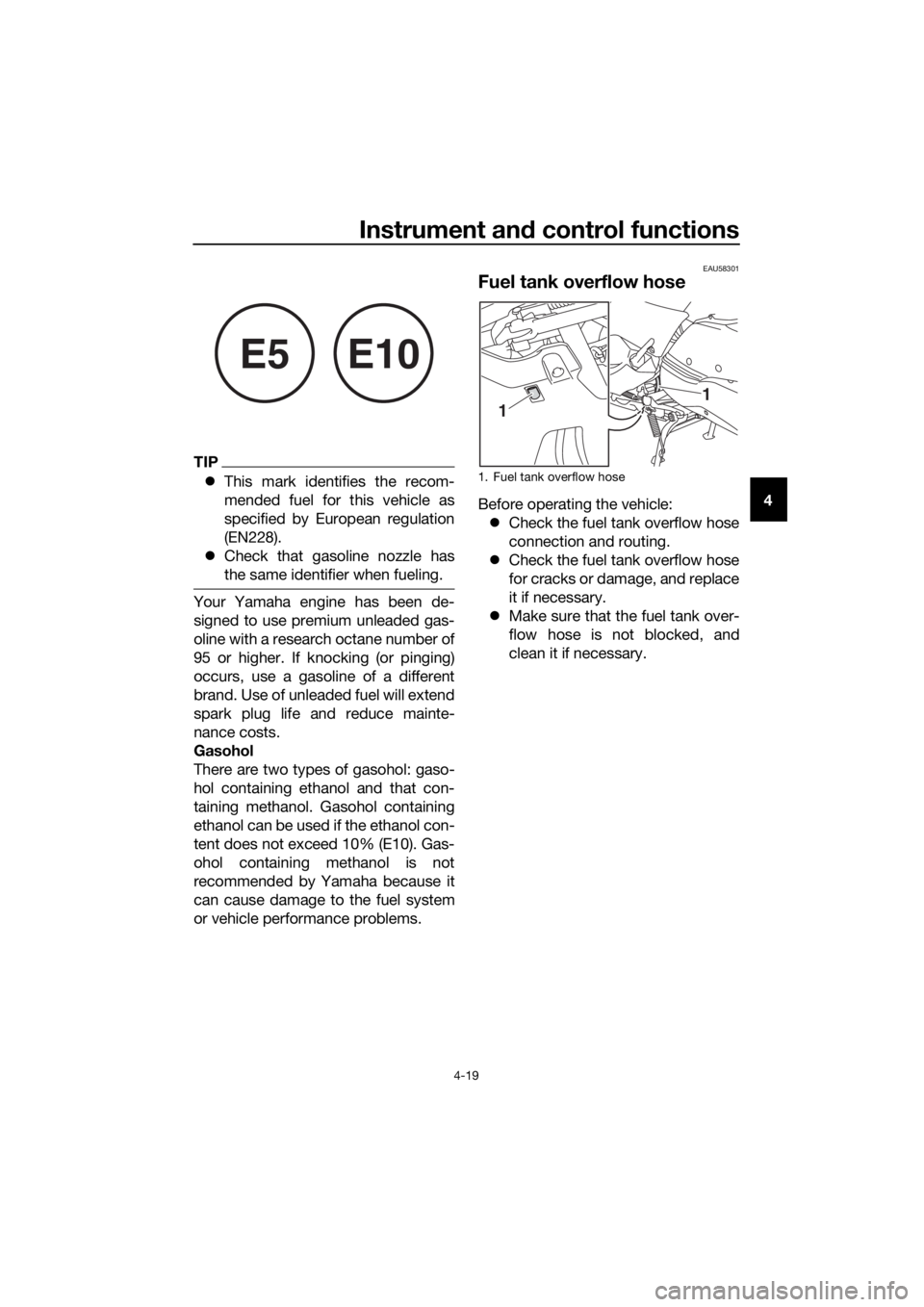
TIP
This mark identifies the recom-
mended fuel for this vehicle as
specified by European regulation
(EN228).
Check that gasoline nozzle has
the same identifier when fueling.
Your Yamaha engine has been de-
signed to use premium unleaded gas-
oline with a research octane number of
95 or higher. If knocking (or pinging)
occurs, use a gasoline of a different
brand. Use of unleaded fuel will extend
spark plug life and reduce mainte-
nance costs.
Gasohol
There are two types of gasohol: gaso-
hol containing ethanol and that con-
taining methanol. Gasohol containing
ethanol can be used if the ethanol con-
tent does not exceed 10% (E10). Gas-
ohol containing methanol is not
recommended by Yamaha because it
can cause damage to the fuel system
or vehicle performance problems.
EAU58301
Fuel tank overflow hose
Before operating the vehicle:
Check the fuel tank overflow hose
connection and routing.
Check the fuel tank overflow hose
for cracks or damage, and replace
it if necessary.
Make sure that the fuel tank over-
flow hose is not blocked, and
clean it if necessary.
E5E10
1. Fuel tank overflow hose
1
1
UBY3E1E0.book Page 19 Monday, June 4, 2018 1:33 PM
Page 53 of 116
Instrument and control functions
4-27
4
EAU78690
Ignition circuit cut-off system
The ignition circuit cut-off system
works with the sidestand switch and
brake light switches. It has the follow-
ing functions.
It prevents the engine from start-
ing when the sidestand is down.
It prevents the engine from start-
ing if the brakes are not applied.
It will stop the running engine if the
sidestand is moved down.
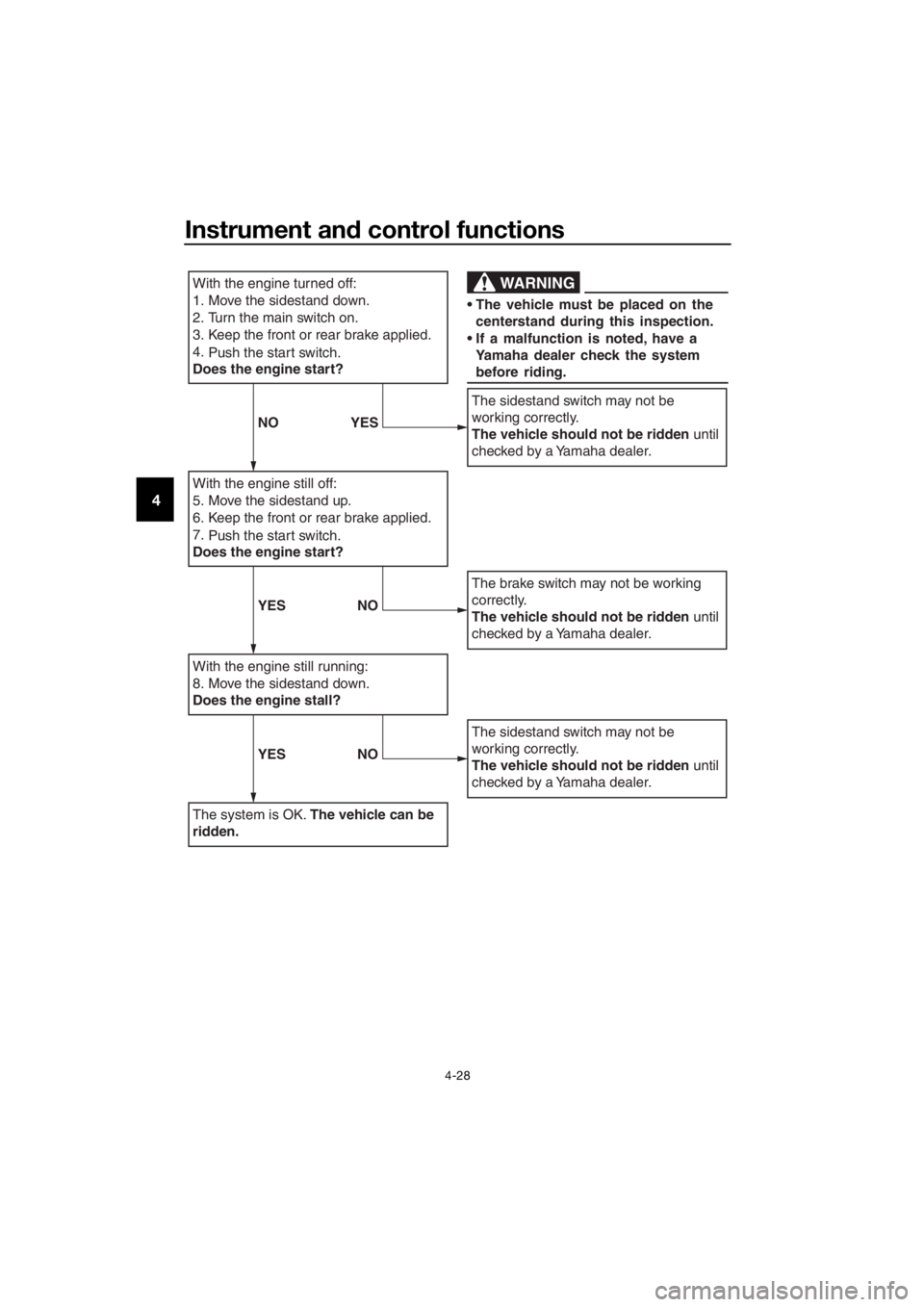
Periodically check the operation of the
ignition circuit cut-off system accord-
ing to the following procedure.
UBY3E0E0.book Page 27 Friday, September 15, 2017 3:59 PM
Page 54 of 116
Instrument and control functions
4-28
4
With the engine turned off:
1. Move the sidestand down.
2. Turn the main switch on.
3. Keep the front or rear brake applied.
Push the start switch. 4.
Does the engine start?
With the engine still off:
5. Move the sidestand up.
6. Keep the front or rear brake applied.
Push the start switch. 7.
Does the engine start?
With the engine still running:
8. Move the sidestand down.
Does the engine stall?
The system is OK. The vehicle can be
ridden.
The sidestand switch may not be
working correctly.
The vehicle should not be ridden until
checked by a Yamaha dealer.
The brake switch may not be working
correctly.
The vehicle should not be ridden until
checked by a Yamaha dealer.
The sidestand switch may not be
working correctly.
The vehicle should not be ridden until
checked by a Yamaha dealer.
WARNING
The vehicle must be placed on the
centerstand during this inspection.
If a malfunction is noted, have a
Yamaha dealer check the system
before riding.
NO YES
YES NO
YES NO
UBY3E0E0.book Page 28 Friday, September 15, 2017 3:59 PM
Page 56 of 116
For your safety – pre-operation checks
5-1
5
EAU63440
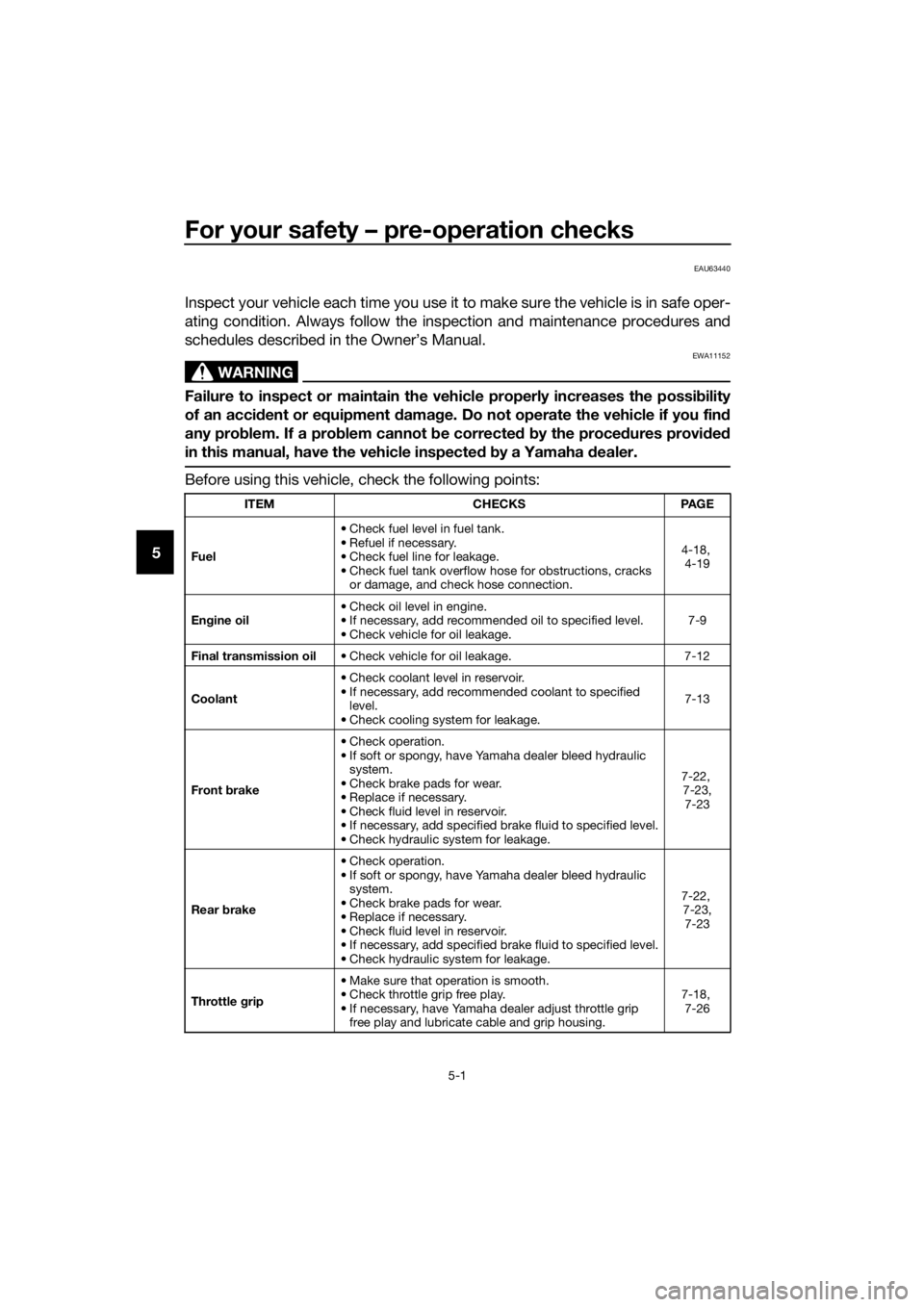
Inspect your vehicle each time you use it to make sure the vehicle is in safe oper-
ating condition. Always follow the inspection and maintenance procedures and
schedules described in the Owner’s Manual.
WARNING
EWA11152
Failure to inspect or maintain the vehicle properly increases the possibility
of an accident or equipment damage. Do not operate the vehicle if you find
any problem. If a problem cannot be corrected by the procedures provided
in this manual, have the vehicle inspected by a Yamaha dealer.
Before using this vehicle, check the following points:
ITEM CHECKS PAGE
Fuel• Check fuel level in fuel tank.
• Refuel if necessary.
• Check fuel line for leakage.
• Check fuel tank overflow hose for obstructions, cracks
or damage, and check hose connection.4-18,
4-19
Engine oil• Check oil level in engine.
• If necessary, add recommended oil to specified level.
• Check vehicle for oil leakage.7-9
Final transmission oil• Check vehicle for oil leakage. 7-12
Coolant• Check coolant level in reservoir.
• If necessary, add recommended coolant to specified
level.
• Check cooling system for leakage.7-13
Front brake• Check operation.
• If soft or spongy, have Yamaha dealer bleed hydraulic
system.
• Check brake pads for wear.
• Replace if necessary.
• Check fluid level in reservoir.
• If necessary, add specified brake fluid to specified level.
• Check hydraulic system for leakage.7-22,
7-23,
7-23
Rear brake• Check operation.
• If soft or spongy, have Yamaha dealer bleed hydraulic
system.
• Check brake pads for wear.
• Replace if necessary.
• Check fluid level in reservoir.
• If necessary, add specified brake fluid to specified level.
• Check hydraulic system for leakage.7-22,
7-23,
7-23
Throttle grip• Make sure that operation is smooth.
• Check throttle grip free play.
• If necessary, have Yamaha dealer adjust throttle grip
free play and lubricate cable and grip housing.7-18,
7-26
UBY3E0E0.book Page 1 Friday, September 15, 2017 3:59 PM
Page 59 of 116
Operation and important riding points
6-2
6
EAU78231
Starting the engine
NOTICE
ECA10251
See page 6-5 for engine break-in in-
structions prior to operating the ve-
hicle for the first time.
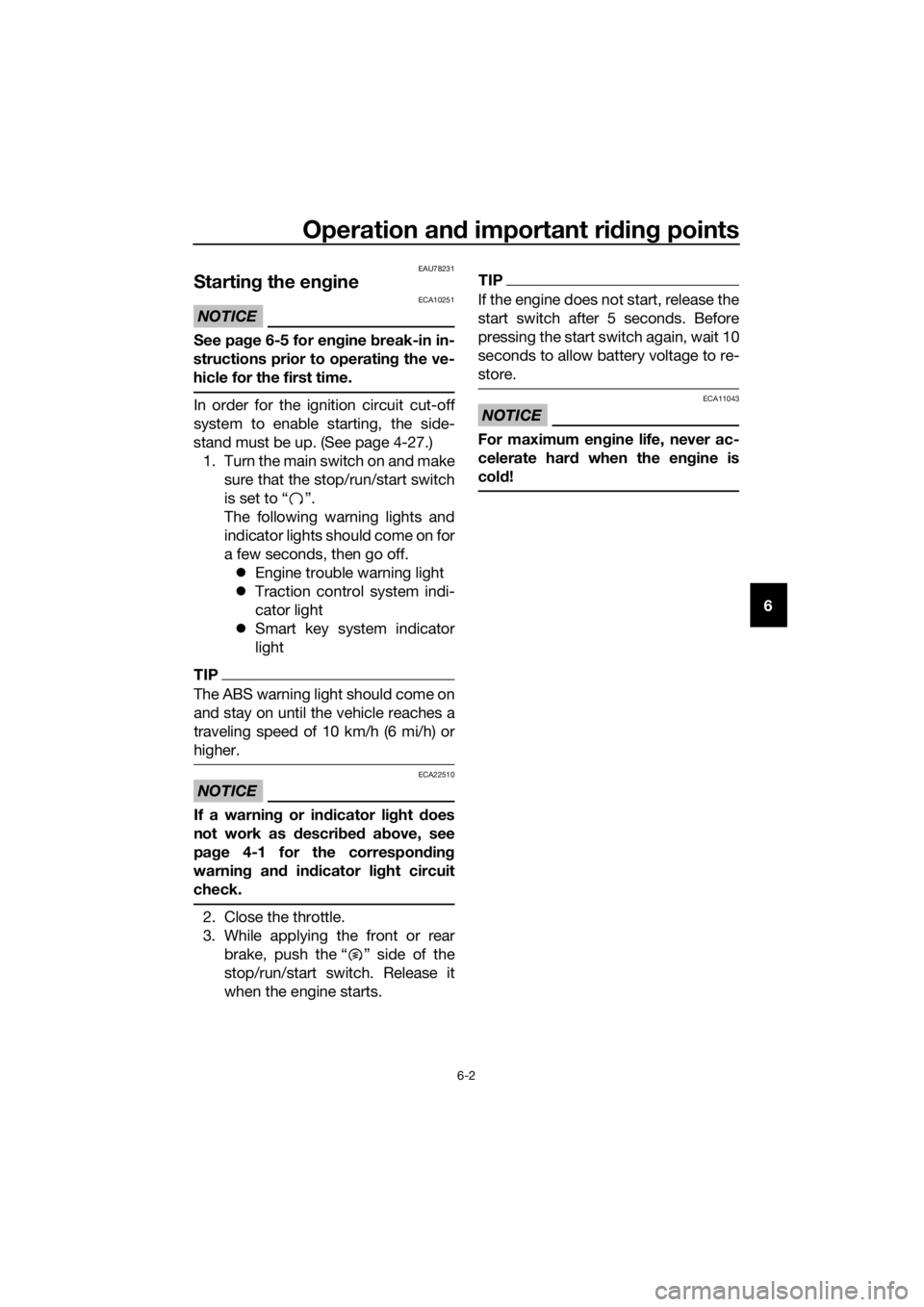
In order for the ignition circuit cut-off
system to enable starting, the side-
stand must be up. (See page 4-27.)
1. Turn the main switch on and make
sure that the stop/run/start switch
is set to “ ”.
The following warning lights and
indicator lights should come on for
a few seconds, then go off.
Engine trouble warning light
Traction control system indi-
cator light
Smart key system indicator
light
TIP
The ABS warning light should come on
and stay on until the vehicle reaches a
traveling speed of 10 km/h (6 mi/h) or
higher.
NOTICE
ECA22510
If a warning or indicator light does
not work as described above, see
page 4-1 for the corresponding
warning and indicator light circuit
check.
2. Close the throttle.
3. While applying the front or rear
brake, push the “ ” side of the
stop/run/start switch. Release it
when the engine starts.
TIP
If the engine does not start, release the
start switch after 5 seconds. Before
pressing the start switch again, wait 10
seconds to allow battery voltage to re-
store.
NOTICE
ECA11043
For maximum engine life, never ac-
celerate hard when the engine is
cold!
UBY3E0E0.book Page 2 Friday, September 15, 2017 3:59 PM
Page 62 of 116

Operation and important riding points
6-5
6
EAU16821
Tips for reducing fuel con-
sumption
Fuel consumption depends largely on
your riding style. Consider the follow-
ing tips to reduce fuel consumption:
Avoid high engine speeds during
acceleration.
Avoid high engine speeds with no
load on the engine.
Turn the engine off instead of let-
ting it idle for an extended length
of time (e.g., in traffic jams, at traf-
fic lights or at railroad crossings).
EAU16842
Engine break-in
There is never a more important period
in the life of your engine than the period
between 0 and 1600 km (1000 mi). For
this reason, you should read the fol-
lowing material carefully.
Since the engine is brand new, do not
put an excessive load on it for the first
1600 km (1000 mi). The various parts in
the engine wear and polish themselves
to the correct operating clearances.
During this period, prolonged full-throt-
tle operation or any condition that
might result in engine overheating
must be avoided.
EAU34323
0–1000 km (0–600 mi)
Avoid prolonged operation above 4500
r/min. NOTICE: After 1000 km (600
mi) of operation, be sure to replace
the engine oil, final transmission oil
and the oil filter element.
[ECA12932]
1000–1600 km (600–1000 mi)
Avoid prolonged operation above 5400
r/min.
1600 km (1000 mi) and beyond
The vehicle can now be operated nor-
mally.
NOTICE
ECA10311
Keep the engine speed out of
the tachometer red zone.
If any engine trouble should oc-
cur during the engine break-in
period, immediately have a
Yamaha dealer check the vehi-
cle.
UBY3E0E0.book Page 5 Friday, September 15, 2017 3:59 PM
Page 66 of 116
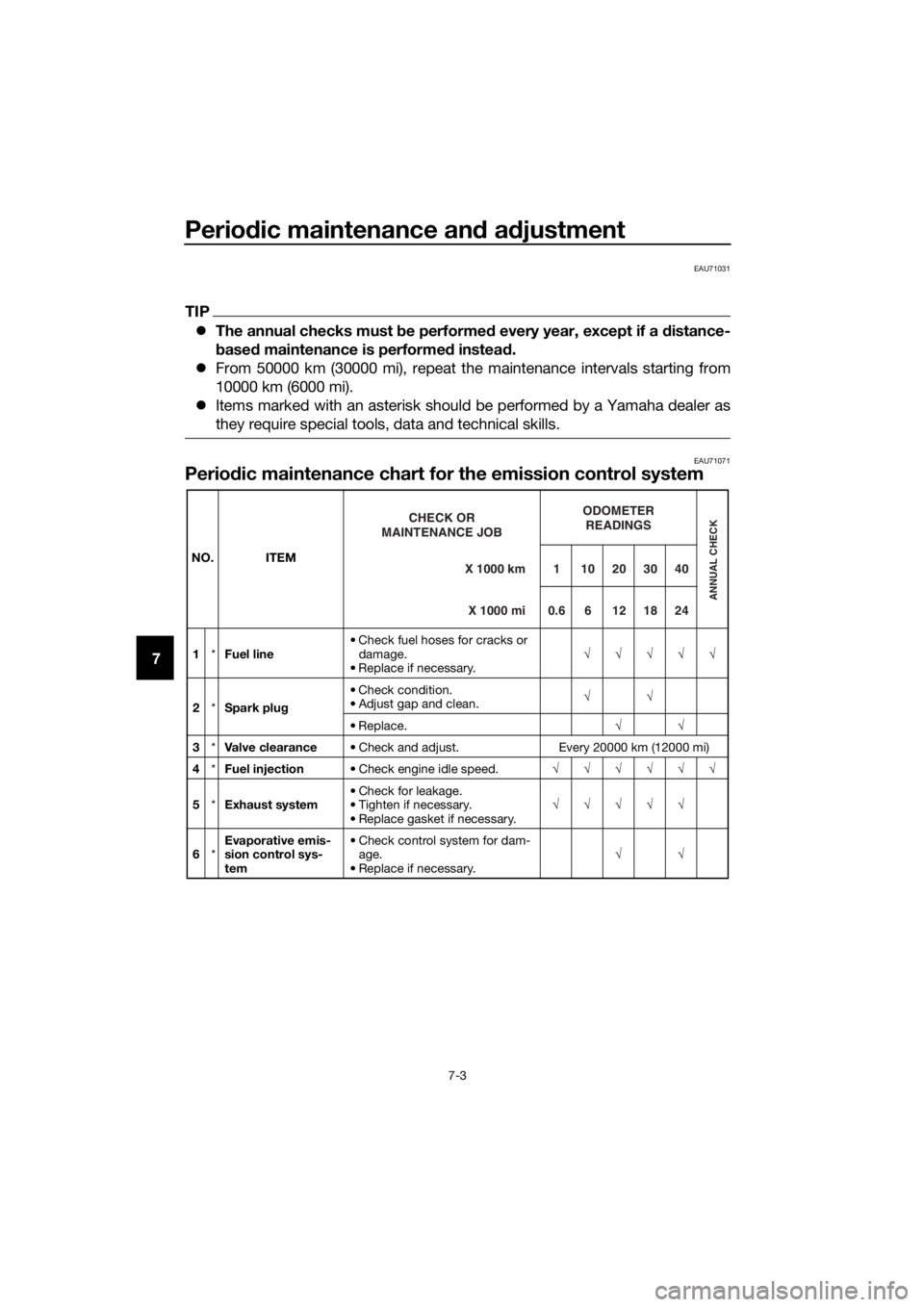
Periodic maintenance and adjustment
7-3
7
EAU71031
TIP
The annual checks must be performed every year, except if a distance-
based maintenance is performed instead.
From 50000 km (30000 mi), repeat the maintenance intervals starting from
10000 km (6000 mi).
Items marked with an asterisk should be performed by a Yamaha dealer as
they require special tools, data and technical skills.
EAU71071
Periodic maintenance chart for the emission control system
NO. ITEM
1*Fuel line• Check fuel hoses for cracks or
damage.
• Replace if necessary.√√√√√
2*Spark plug• Check condition.
• Adjust gap and clean.√√
• Replace.√√
3*Valve clearance• Check and adjust. Every 20000 km (12000 mi)
4*Fuel injection• Check engine idle speed.√√√√√√
5*Exhaust system• Check for leakage.
• Tighten if necessary.
• Replace gasket if necessary.√√√√√
6*Evaporative emis-
sion control sys-
tem• Check control system for dam-
age.
• Replace if necessary.√√X 1000 km CHECK OR
MAINTENANCE JOB
X 1000 miODOMETER
READINGS
ANNUAL CHECK
1 10203040
0.6 6 12 18 24
UBY3E0E0.book Page 3 Friday, September 15, 2017 3:59 PM
Page 68 of 116

Periodic maintenance and adjustment
7-5
7
14*Steering bearings• Check bearing assemblies for
looseness.√√ √
• Moderately repack with lithium-
soap-based grease.√√
15*Chassis fasteners• Make sure that all nuts, bolts
and screws are properly tight-
ened.√√√√√
16Front and rear
brake lever pivot
shaft• Lubricate with silicone grease.√√√√√
17Sidestand, center-
stand• Check operation.
• Lubricate with lithium-soap-
based grease.√√√√√
18*Sidestand switch• Check operation and replace if
necessary.√√√√√√
19*Front fork• Check operation and for oil
leakage.
• Replace if necessary.√√√√
20*Shock absorber
assemblies• Check operation and for oil
leakage.
• Replace if necessary.√√√√
21 Engine oil• Change (warm engine before
draining).
• Check oil level and vehicle for
oil leakage.At the initial interval and
when the oil change indi-
cator flashes or comes
on.√
22Engine oil filter el-
ement• Replace.√√√
23*Final transmission
oil• Check vehicle for oil leakage.√√√√√
• Change.√√√
24
*Cooling system• Check coolant level and vehicle
for coolant leakage.√√√√√
• Change. Every 3 years
25*V-belt• Replace.When the V-belt replacement
indicator flashes [every 20000
km (12000 mi)]
26*Front and rear
brake switches• Check operation.√√√√√√ NO. ITEM
X 1000 km CHECK OR
MAINTENANCE JOB
X 1000 miODOMETER
READINGS
ANNUAL CHECK
110203040
0.6 6 12 18 24
UBY3E0E0.book Page 5 Friday, September 15, 2017 3:59 PM