2018 VOLVO XC90 TWIN ENGINE charging
[x] Cancel search: chargingPage 419 of 686

HYBRID INFORMATION
417
NOTEIf the instrument panel is not used, it will go
dark after a period of time. To reactivate the
display:
•
depress the brake pedal,
• open one of the doors, or
• put the ignition in mode I by turning the
START knob clockwise and then releas-
ing.
Related information
• Charging the hybrid battery (p. 407)
• Twin Engine symbols and messages in the
instrument panel (p. 419)
• Charging status in the vehicle's charging
socket (p. 414)
• Charging status in the charging cable's
charging module (p. 415)
• Stopping hybrid battery charging (p. 418)
Page 420 of 686

HYBRID INFORMATION
* Option/accessory.
418 Stopping hybrid battery charging
To stop charging of the hybrid battery, unlock
the vehicle, unplug the charging cable from the
vehicle's charging socket and then unplug the
cable from the 120/240 V outlet (alternating
current).
NOTE Always unlock the vehicle so that charging is
cut off before the connection to the
120/240 V outlet (AC, alternating current) is
disconnected. Note that the charging cable
must be disconnected from the vehicle's
charging socket before it is disconnected
from the 120/240 V outlet, partly to prevent
damage to the system and party to prevent
unintentional interruption of charging.
Unlock the vehicle with the remote key.
Charging will stop. Press the lock button on the charging
cable's handle. The handle will be released/
unlocked. Remove the cable from the vehi-
cle's charging socket, put the socket's cover
back in place and close the charger door.
Unplug the cable from the 120/240 V outlet.
Stow the charging cable in the storage com-
partment under the cargo area floor.
Charging cable automatically locksIf the charging cable cannot be removed from the
charging socket, it will automatically lock into
place again after unlocking to maximize chargingand range and to enable preconditioning before
driving. The charging cable can be removed again
if the vehicle is unlocked using the remote key.
For vehicles with Passive Entry*, the handle can
be used to lock and unlock.
Related information
• Opening and closing the charging socket
cover (p. 411)
• Charge cable (p. 409)
• Charging the hybrid battery (p. 407)
• Initiating hybrid battery charging (p. 412)
Page 421 of 686

HYBRID INFORMATION
}}
419
Twin Engine symbols and messages
in the instrument panel
A number of symbols and messages relating to
the Twin Engine may be displayed in the instru-
ment panel. They may also appear in combina-
tion with general indicator and warning symbols
and disappear when the necessary action has
been taken.Symbol
Message Meaning12 V Battery
Charging fault, service urgent. Drive
to workshop
Battery fault. Contact a workshop
A
to have the battery checked as soon as possible. 12 V Battery
Charging fault Stop safely
Battery fault. Stop the vehicle as soon as possible and contact a worksh\
op
A
to have the battery
checked. 12 V Battery
Fuse failure Service required
Battery fault. Contact a workshop
A
to have the system checked as soon as possible. Hybrid battery
Overheated, stop safely
The hybrid battery's temperature seems to be rising at an abnormal ra\
te. Stop the vehicle and turn
off the engine. Wait at least 5 minutes before driving. Call a workshop
A
or inspect the vehicle to
make sure everything seems normal before continuing to drive. Reduced performance
Max vehicle speed limited
The hybrid battery's charge level is too low for driving at high spee\
ds. Charge the battery as soon as
possible.Hybrid system
Harsh behavior at low speed, vehicle
ok to use
The hybrid system is not functioning properly. Contact a workshop
A
to have the system checked as
soon as possible.
Page 422 of 686

||HYBRID INFORMATION
420
Symbol
Message MeaningHybrid system failure
Service required
The hybrid system is not functioning. Contact a workshop
A
to have the system checked as soon as
possible. Charge cable
Remove before start
Displayed when the driver attempts to start the vehicle with the chargin\
g cable still connected.
Remove the charging cable and close the charger cover.Charge cable
Removed? Turn and hold start knob
7s
Displayed when the driver again attempts to start the vehicle with the c\
harging cable connected.
Disconnect the charging cable or verify that the cable is completely dis\
connected and the charger
cover is closed.A
An authorized Volvo workshop is recommended.
Related information
• Initiating hybrid battery charging (p. 412)
• Stopping hybrid battery charging (p. 418)
• Charging the hybrid battery (p. 407)
• Warning symbols in the instrument panel
(p. 97)
• Indicator symbols in the instrument panel
(p. 94)
• Hybrid gauge (p. 87)
• Hybrid gauge (p. 88)
Page 423 of 686

HYBRID INFORMATION
421
Long-term storage of vehicles with
hybrid batteries
To help minimize degradation of the hybrid bat-
tery if the vehicle is not driven for a prolonged
period (longer than 1 month) the hybrid battery
charge level should be kept at approx. 25%
according to the gauge in the instrument panel.
Do as follows:
1. If the hybrid battery charge level is high, drive
the vehicle until the charge level is approxi-
mately 25%. If the charge level is low, charge
the battery until the level reaches approxi-
mately 25%. 2.
If the vehicle is not driven for more than 6
months or the hybrid battery's charge level is
noticeably below the 25% mark, charge the
battery to about 25% to help compensate for
the natural battery discharge that occurs in
long-term storage. Regularly check the
charge level using the gauge in the instru-
ment display.
NOTE Store the vehicle in as cool a location as pos-
sible to minimize battery aging during long-
term storage. In the summer, park the vehicle
indoors or in a shady location, whichever is
cooler.
Related information
•
Initiating hybrid battery charging (p. 412)
• Hybrid gauge (p. 88)
• Charging the hybrid battery (p. 407)
Page 445 of 686
STARTING AND DRIVING
}}
443
All Wheel Drive (AWD)
All-wheel drive, All Wheel Drive (AWD), also
called four-wheel drive, means that power is dis-
tributed to all four wheels, which improves trac-
tion.
The electric motor that powers the rear wheels
enables electronic all-wheel drive functionality.
To achieve the best traction, power is automati-
cally directed to the wheels that have the best
grip. The system continuously calculates the
need for torque to the rear wheels, and can
immediately redistribute up to half of the engine's
torque to the rear wheels.
All-wheel drive also has a stabilizing effect at
higher speeds. In normal driving conditions, most
of the engine's power is directed to the front
wheels. When the vehicle is stationary, all-wheel
drive is always activated in preparation for maxi-
mum traction during acceleration.
All-wheel drive reacts differently depending on
which drive mode is selected.
Related information
• Drive modes (p. 445)
• Low Speed Control (p. 453)
• Transmission (p. 438) Drive systems
Volvo Twin Engine combines a combustion
engine for the front wheels and an electric motor
for the rear wheels.
Two drive systemsDepending on the selected drive mode and
power available in the electric motor, the drive
systems can either be used separately or in tan-
dem.
The electric motor gets its energy from a hybrid
battery located under the tunnel console. The
hybrid can be charged from a wall outlet or in a
special charging station. The combustion engine
can also charge the hybrid battery using a special
high-voltage generator.
Both the combustion engine and the electric
motor can generate power directly to the wheels.
An advanced control system coordinates both the
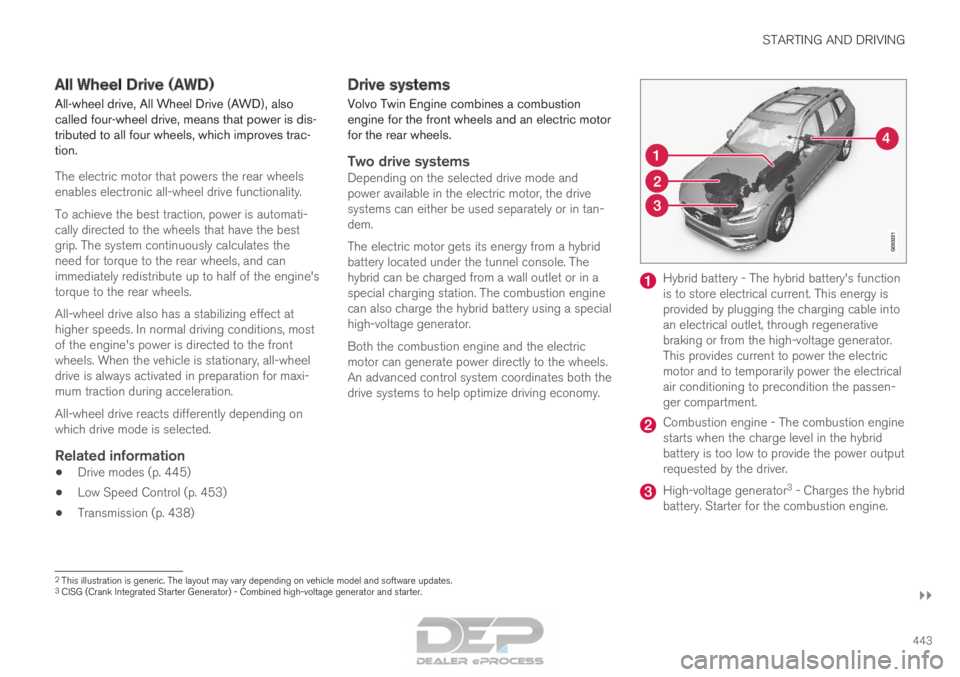
drive systems to help optimize driving economy. Hybrid battery - The hybrid battery's function
is to store electrical current. This energy is
provided by plugging the charging cable into
an electrical outlet, through regenerative
braking or from the high-voltage generator.
This provides current to power the electric
motor and to temporarily power the electrical
air conditioning to precondition the passen-
ger compartment.
Combustion engine - The combustion engine
starts when the charge level in the hybrid
battery is too low to provide the power output
requested by the driver.
High-voltage generator
3
- Charges the hybrid
battery. Starter for the combustion engine. 2
This illustration is generic. The layout may vary depending on vehicle m\
odel and software updates.
3 CISG (Crank Integrated Starter Generator) - Combined high-voltage gene\
rator and starter.
Page 447 of 686
STARTING AND DRIVING
}}
* Option/accessory. 445
Drive modes
Drive modes affect the vehicle's driving charac-
teristics in different ways to enhance and sim-
plify the driving experience in certain types of sit-
uations. Drive modes enable easy access to the vehicle's
many functions and settings in different driving
situations. The following systems are adapted to
help optimize driving characteristics in each drive
mode:
• Steering
• Engine/transmission/all-wheel drive
• Brakes
• Pneumatic suspension* and shock absorbers
• Instrument panel
• Climate control settings
Select the drive mode that is best suited to the
current driving conditions. Keep in mind that not
all drive modes are available in all situations.
Available drive modes
WARNING Keep in mind that the vehicle does not emit
any engine noise when using the electric
motor and may therefore be difficult to detect
for children, pedestrians, cyclists or animals.
This is particularly true at low speeds, e.g. in
parking lots.
WARNING
Do not leave the vehicle in an unventilated
area with a drive mode activated and the com-
bustion engine switched off. The engine will
start automatically if the charge level in the
hybrid battery is low and the resulting exhaust
gases can be very harmful to people and ani-
mals.
HYBRID
•
This is the default mode in which the electric
motor and combustion engine work together.
The vehicle starts in Hybrid mode. The control
system uses both the electric motor and the gas-
oline engine - separately or in tandem - and cal-
culates optimal utilization with regard to perform-
ance, fuel consumption and comfort. At high
speeds, ground clearance is automatically low-
ered 4
to reduce air resistance. Driving capacity on
the electric motor alone is determined by factors such as the hybrid battery's charge level, the
need for heat/cooling in the passenger compart-
ment, etc.
If there is sufficient charge in the battery, it is
possible to drive solely on electric power. When
the accelerator pedal is pressed, only the electric
motor will be activated until the battery reaches a
certain charge level. Above this level, the current
in the battery cannot supply the power requested
by the accelerator pedal and the combustion
engine will start.
When the hybrid battery's charge level is low, the
combustion engine will start more frequently to
save the remaining current in the battery. Charge
the hybrid battery from a 120-240 volt outlet
using a charging cable, or activate
Charge in
Function view to reset the option of only using
the electric motor.
This drive mode is designed for low energy con-
sumption with an optimized mix between the
electric motor and gasoline engine, without com-
promising on climate comfort or driving experi-
ence. When faster acceleration is requested by
the driver, the electric driveline will be utilized to
help provide maximum additional power. The
vehicle also monitors the driving conditions and
automatically engages all-wheel drive if neces-
sary. All-wheel drive and extra electric power are
always available regardless of the battery's
charging status. 4
For vehicles with pneumatic suspension.
Page 458 of 686

||STARTING AND DRIVING
456
Related information
•
Hill Descent Control (p. 454)
• Changing drive mode (p. 449) Economical driving
Drive economically and environmentally con-
scious by thinking ahead, avoiding rapid starts
and stops and adapting driving style and speed
to the current traffic conditions.
Planning for electric drivingIt is important to plan electric motor use carefully
to achieve the best possible mileage:
Charge
• Charge the vehicle regularly by plugging it
into an electrical outlet. Make it a habit to
always begin trips with the hybrid battery fully
charged.
• Locate charging stations along your route.
• If possible, choose parking spots with charg-
ing stations.
NOTE Charge the vehicle from the electricity grid as
often as possible!
Preconditioning
•
Whenever possible, precondition the vehicle
before driving by connecting the charging
cable to an electrical outlet.
• Avoid parking the vehicle somewhere where
the interior will become too hot or too cold
while the vehicle is parked. If possible, park
the vehicle in a climate-controlled garage. •
During a short drive after passenger com-
partment preconditioning, turn off the pas-
senger compartment fan or the air condition-
ing in a hot climate.
• If preconditioning is not possible when it is
cold outside, use seat and steering wheel
heating first. Avoid heating the entire pas-
senger compartment to reduce the amount
of current being taken from the hybrid bat-
tery.