Page 119 of 166

PRACTICAL INFORMATION
}}
* Option/accessory.117
CAUTION
Never touch the glass of bulbs with your fin- gers. Grease and oils from your fingers vapor-ize in the heat and will leave a deposit on thereflector, which will damage it.
WARNING
•The ignition should be switched off com- pletely (be in ignition mode
0) when
replacing bulbs.
• If the engine has been running just prior to replacing bulbs in the headlight hous-ing, please keep in mind that componentsin the engine compartment will be hot.
Before the halogen headlight bulbs can bereplaced, that plastic covering over the headlighthousing has to be removed and the housing hasto be lifted out of the vehicle.
–Release the pins in the plastic covering's four clips by pressing them down with ascrewdriver or similar object and remove thecovering.
NOTE
The pins in the clips have to be pressed back completely before the clips are placed in theplastic covering. When the covering is put back in place, the pins must be pressed so that their upper sur-face is flush with the surface of the clip.
Front bulbs (vehicles with halogen headlights)
Low beam
High beam
Parking light/Daytime Running Light
Turn signal
Fog light with corner illumination (LED) *
Page 129 of 166
PRACTICAL INFORMATION
}}
127
Volume:
• 5.8 qts (5.5 liters)
Related information
•
Opening and closing the hood (p. 127)
• Engine compartment overview (p. 81)
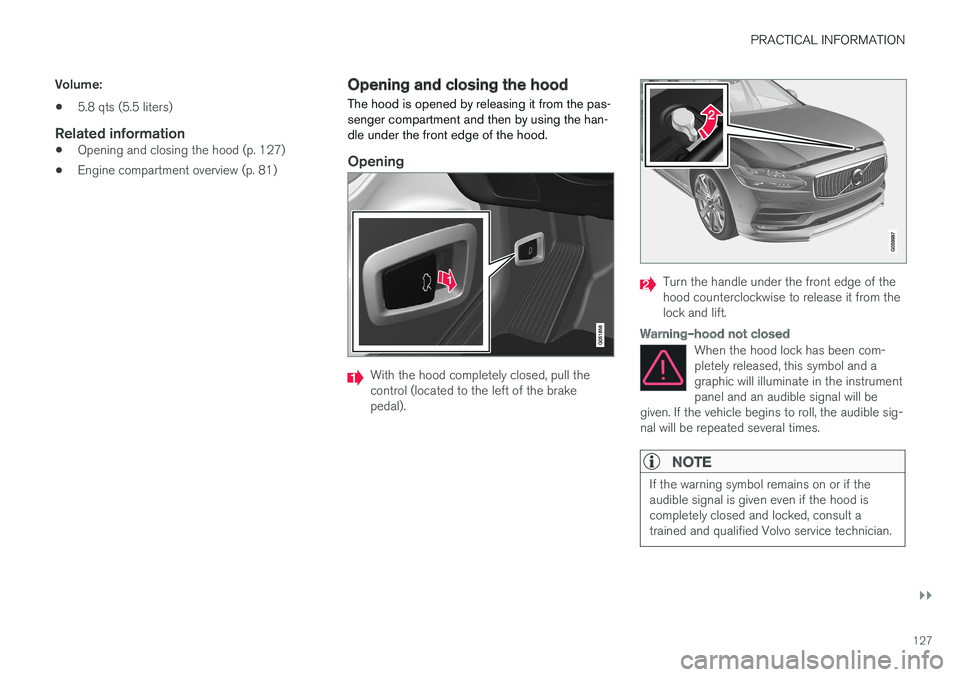
Opening and closing the hood The hood is opened by releasing it from the pas- senger compartment and then by using the han-dle under the front edge of the hood.
Opening
With the hood completely closed, pull the control (located to the left of the brakepedal).
Turn the handle under the front edge of the hood counterclockwise to release it from thelock and lift.
Warning–hood not closed
When the hood lock has been com- pletely released, this symbol and agraphic will illuminate in the instrumentpanel and an audible signal will be
given. If the vehicle begins to roll, the audible sig-nal will be repeated several times.
NOTE
If the warning symbol remains on or if the audible signal is given even if the hood iscompletely closed and locked, consult atrained and qualified Volvo service technician.
Page 130 of 166
||
PRACTICAL INFORMATION
128
Closing1. Press down the hood until it begins to closedue to its own weight.
2. When the handle under the front edge of the hood is in the lock, press down on the hood to close it completely.
WARNING
• Be sure the hood is completely unob- structed while it is being closed.
• Check that the hood locks properly whenclosed. It must audibly lock on both sides.
• Never drive if the hood is not completelyclosed and locked.
• While driving, if there are any indicationsthat the hood is not locked in the closedposition, stop safely as soon as possibleand close it completely.
Hood completely closed
Related information
•
Engine compartment overview (p. 81)
Page 132 of 166

FUSES
130
Fuses The fuses help protect the vehicle's electrical components from overloading or short circuits.
WARNING
Never use metal objects or fuses with higher amperage than those stated on the lists offuses. Doing so could seriously damage oroverload the vehicle's electrical system.
If an electrical component fails to function, this may be due to a blown fuse. If the same fuseblows repeatedly, this indicates a problem withthe component, which should be inspected by atrained and qualified Volvo service technician.
Location of the fuseboxes
Engine compartment
Under the glove compartment
Trunk
Related information
• Replacing fuses (p. 130)
• Fuses in the engine compartment (p. 131)
• Fuses in the passenger compartment (p. 135)
• Fuses in the trunk (p. 139)
Replacing fuses The fuses help protect the vehicle's electrical components from overloading or short circuits.
Fuse replacement1. See the list of fuse boxes for their locations.
2. Pull the fuse straight out and examine it from
the side to see if the curved metal wire in the fuse is intact.
3. If the wire is broken, insert a new fuse of the same color and amperage (written on thefuse).
WARNING
Never use metal objects or fuses with higher amperage than those stated on the followingpages. Doing so could seriously damage oroverload the vehicle's electrical system.
Related information
• Fuses (p. 130)
• Fuses in the trunk (p. 139)
• Fuses in the engine compartment (p. 131)
• Fuses in the passenger compartment (p. 135)
Page 143 of 166

FUSES
* Option/accessory.141
Positions
•Fuses 13–17 and 21–36 are called "Micro".
• Fuses 1–12, 18–20 and 37 are called "MCase" and should only be replaced by atrained and qualified Volvo service technician.
Function
A
Heated rear window 30
– –
Pneumatic suspension* compressor 40
Lock motor, rear seat backrest - passenger's side 15
– –
Lock motor, rear seat backrest - driver's side15
– –
– –
Power trunk release
*25
Power front seat (passenger side)
*
module 20
Trailer hitch
* control module 40
Seat belt tensioner module (pas- senger side) 40
Function
A
Internal relay windings 5
– –
Foot movement detection module for opening the power trunk release* 5
– –
– –
Trailer hitch
* control module 25
Power front seat (driver seat
* mod-
ule 20
Seat belt tensioner module (driver side)
40
Parking camera
* 5
– –
– –
– –
– –
Airbag and seat belt tensioner modules 5
– –
Function
A
Heated rear seat (driver side)*15
– –
Blind Spot Information (BLIS)
*,
Control module for exterior audible reverse warning (certain marketsonly) 5
– –
Seat belt tensioner modules 5
Emission system actuator 5
– –
– –
Heated rear seat (passenger side)
*15
– –
Related information
•Replacing fuses (p. 130)
• Fuses (p. 130)
• Fuses in the engine compartment (p. 131)
• Fuses in the passenger compartment (p. 135)
Page 153 of 166
SPECIFICATIONS
151
Air conditioning refrigerant
The air conditioning system in your car contains a CFC-free refrigerant.
A/C decal
R134a decal
Refrigerant
Weight Type
1.43 lbs (650 g) R134a
WARNING
The air conditioning system contains R134a refrigerant under pressure. Service andrepairs may only be carried out by a trainedand qualified Volvo service technician.
Compressor oil
Volume Type
2.03 fl. oz. (60 ml) PAG SP-A2
EvaporatorThe A/C system' s evaporator may never be repaired or replaced with a previously used evap-orator. A new evaporator must be certified andmarked according to SAE J2842.Brake fluid specification and volume
Brake fluid transfers braking force when the brake pedal is depressed to the master cylinderand to the slave cylinders on each wheel. Topping up or replacing brake fluid should only be done by a trained and qualified Volvo servicetechnician.
Specification: Volvo Original Dot 4 class 6 or
equivalent
Page 161 of 166
INDEX
159
A
Accessory installation warning 12, 16 Airbagsdisconnecting the front passenger