2018 VOLKSWAGEN TRANSPORTER resistance
[x] Cancel search: resistancePage 108 of 486
@ Main beam headlights switched on &. The indicator lamp m in the instrument cluster lights up.
Pull the lever briefly in the direction of the ar-row @to switch off the main beam headlights.
@ Operate headlight flasher. The headlight flash-er comes on for as long as the lever is pulled. The indicator lamp ID lights up.
Lane change flash
To operate the lane change flash, push the lever up or down to the point where you incur resistance and then release the lever. The turn signal flashes three times.
This lane change flash function can be deactivated at a qualified workshop.
A WARNING
Incorrect use of turn signals, a failure to use turn signals, or forgetting to switch off a turn signal can confuse other road users. This can lead to accidents and serious Injuries.
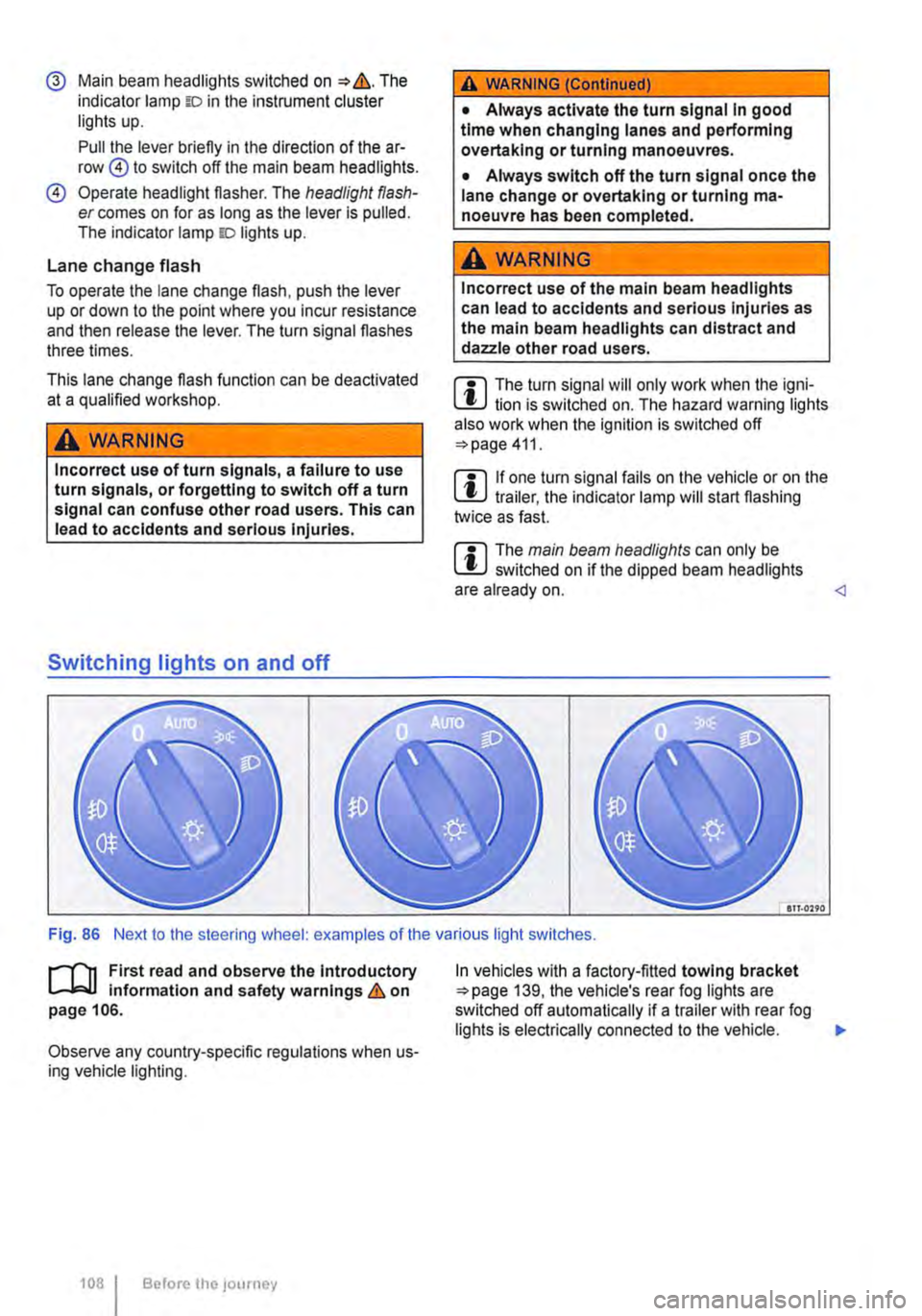
Switching lights on and off
A WARNING (Continued)
• Always activate the turn signal In good time when changing lanes and performing overtaking or turning manoeuvres.
• Always switch off the turn signal once the lane change or overtaking or turning ma-noeuvre has been completed.
A WARNING
Incorrect use of the main beam headlights can lead to accidents and serious Injuries as the main beam headlights can distract and dazzle other road users.
m The turn signal will only work when the igni-m lion is switched on. The hazard warning lights also work when the ignition is switched off 411.
m If one turn signal fails on the vehicle or on the m trailer, the indicator lamp will start flashing twice as fast.
m The main beam headlights can only be m switched on if the dipped beam headlights are already on.
l"'""'rT1 First read and observe the Introductory L--J,::.,U information and safety warnings & on page 106.
Observe any country-specific regulations when us-ing vehicle lighting.
1081 Before the; journey
In vehicles with a factory-fitted towing bracket 139, the vehicle's rear fog lights are switched off automatically if a trailer with rear fog lights is electrically connected to the vehicle. .,.
Page 138 of 486

Additional information and warnings:
• Lights 106
• Transporting 125
• Driving with respect for the environment 278
• Wheels and tyres 367
• Accessories, modifications, repairs and renewal of parts 394
A wARNING
When transporting heavy or bulky objects in the roof carrier, the vehicle's handling will change due to a shift in the centre of gravity and an increased susceptibility to cross-winds.
• Always secure loads properly using suita-ble and undamaged securing straps.
• Cargo that is large, heavy, bulky, long or flat will have a negative effect on the vehicle aerodynamics, centre of gravity and overall handling.
Attaching the mounts and roof carrier
r-Y'n First read and observe the introductory L-J,:.JJ information and safety warnings &. on page 137.
Your vehicle has special roof rails on the right and left for fitting the mounts. Therefore, standard roof carriers cannot be used. Volkswagen Commercial Vehicles recommends using only mounts and roof carriers that have been approved by Volkswagen Commercial Vehicles.
The mounts are the basis of a complete roof carrier system. Special fixtures must then be added to transport luggage, bicycles, skis, surfboards or boats safely on the roof. All components of this system are available at a Volkswagen Commercial Vehicles dealership.
The roof carrier system must always be installed exactly according to instructions and should be kept with the vehicle wallet.
138 I Before the journey
A WARNING (Continued)
• Avoid abrupt and sudden driving and braking manoeuvres.
• Always adapt your speed and driving style to suit visibility, weather, road and traffic con-ditions.
CD
• Always remove the roof carrier before driv-ing through an automatic car wash.
• The height of the vehicle is changed by the installation of a carrier system and the load se-cured to it. Check and compare the height of the vehicle with clearance heights, e.g. for un-derpasses and garage doors.
• The roof carrier system and its load must not obstruct you from opening and closing the sliding/tilting roof and tallgate. The roof aerial must also remain unaffected.
• When opening the tallgate, take care not to let it hit the roof load.
Driving with a fitted roof carrier will increase W air resistance and thus increase fuel con-sumption.
Incorrectly attaching the mounts and roof carrier, and using them Inappropriately, can cause the whole system to fail off the roof. This can cause accidents and injuries.
• Always observe the manufacturer's in-structions.
• Only use mounts and roof carriers when they are undamaged and fitted correctly.
• Fit mounts and roof carriers correctly.
• Check the bolts and anchorage points be-fore starting your journey and adjust as nec-essary after driving a short distance. During a long trip, check ail bolts and fasteners at each stop.
• Special fixtures for items such as bicy-cles, skis, surfboards, etc. should always be properly Installed.
• Do not carry out any alterations or repairs to the mounts and roof carrier.
W Read and observe the instructions provided L!J for the fitted roof carrier system and carry them in the vehicle at all times.
Page 280 of 486
Saving fuel
1/100 km
-10°C
+20 oc
L----------------tkm 5 15 25 30
en-o11S
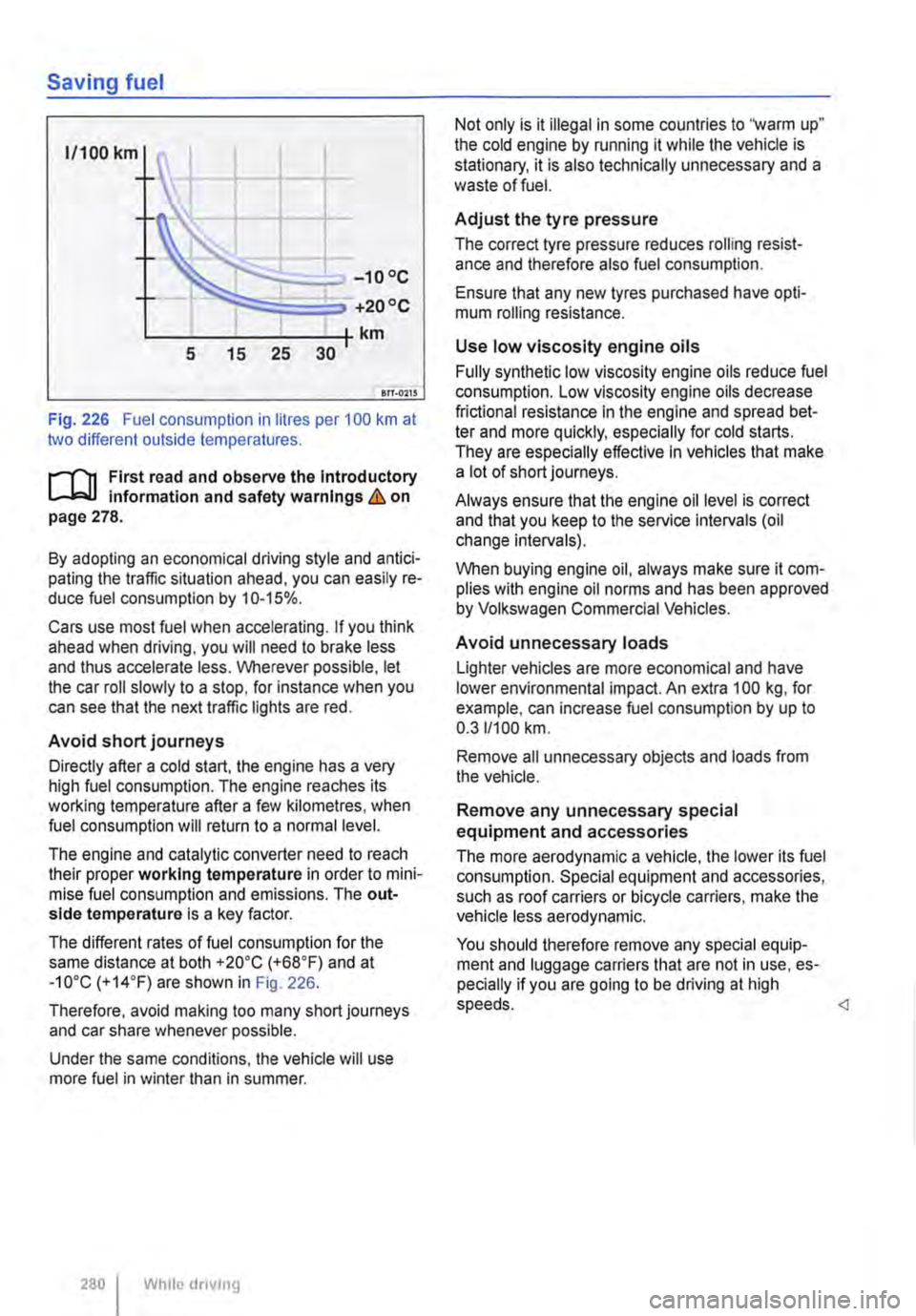
Fig. 226 Fuel consumption in litres per 100 km at two different outside temperatures.
r-1"'11 First read and observe the Introductory Information and safety warnings&. on page 278.
By adopting an economical driving style and antici-pating the traffic situation ahead, you can easily re-duce fuel consumption by 10-15%.
Cars use most fuel when accelerating. If you think ahead when driving, you will need to brake less and thus accelerate less. Wherever possible, let the car roll slowly to a stop, for instance when you can see that the next traffic lights are red.
Avoid short journeys
Directly after a cold start, the engine has a very high fuel consumption. The engine reaches its working temperature after a few kilometres, when fuel consumption will return to a normal level.
The engine and catalytic converter need to reach their proper working temperature in order to mini-mise fuel consumption and emissions. The out-side temperature is a key factor.
The different rates of fuel consumption for the same distance at both +20"C (+68"F) and at -10"C (+14"F) are shown in Fig. 226.
Therefore, avoid making too many short journeys and car share whenever possible.
Under the same conditions, the vehicle will use more fuel in winter than in summer.
280 I While dnvmg
Not only is it illegal in some countries to "warm up" the cold engine by running it while the vehicle is stationary, it is also technically unnecessary and a waste of fuel.
Adjust the tyre pressure
The correct tyre pressure reduces rolling resist-ance and therefore also fuel consumption.
Ensure that any new tyres purchased have opti-mum rolling resistance.
Use low viscosity engine oils
Fully synthetic low viscosity engine oils reduce fuel consumption. Low viscosity engine oils decrease frictional resistance in the engine and spread bet-ter and more quickly, especially for cold starts. They are especially effective In vehicles that make alotofshortjourneys.
Always ensure that the engine oil level is correct and that you keep to the service intervals (oil change intervals).
When buying engine oil, always make sure it com-plies with engine oil norms and has been approved by Volkswagen Commercial Vehicles.
Avoid unnecessary loads
Lighter vehicles are more economical and have lower environmental impact. An extra 100 kg, for example, can increase fuel consumption by up to 0.311100 km.
Remove all unnecessary objects and loads from the vehicle.
Remove any unnecessary special equipment and accessories
The more aerodynamic a vehicle, the lower its fuel consumption. Special equipment and accessories, such as roof carriers or bicycle carriers, make the vehicle less aerodynamic.
You should therefore remove any special equip-ment and luggage carriers that are not in use, es-pecially if you are going to be driving at high speeds.
Page 344 of 486

A WARNING (Continued)
• Switch off your mobile telephone or two-way radio when dealing with fuel. Electro-magnetic radiation can generate sparks which can in turn start a fire.
• Avoid electrostatic discharge and electro-magnetic radiation in the direct vicinity of fuels.
• Never spill fuel in the vehicle or In the lug-gage compartment.
Petrol
1"'111 First read and observe the introductory L-lo::.l.l information and safety warnings & on page 343.
Petrol types
Vehicles with a petrol engine must be run on un-leaded petrol in compliance with the European standard EN 228 =>
Volkswagen Commercial Vehicles recommends petrol with a low sulphur content or sulphur-free petrol for use with this engine. This reduces petrol consumption.
Petrol additives
The quality of petrol influences the running proper-ties, performance and service life of the engine. This is why the vehicle should be refuelled with good quality petrol that has only non-metallic addi-tives pre-added by the petroleum industry. These petrol additives help to prevent corrosion. keep the fuel system clean, and prevent the build-up of de-posits in the engine.
If good quality petrol containing non-metallic addi-tives is not available, or if engine problems arise. the necessary petrol additives must be added to the petrol when refuelling =>
A WARNING (Continued)
• Comply with any relevant safety Informa-tion and legislation concerning the handling of fuels.
Not all petrol additives are effective. The use of un-suitable petrol additives can cause considerable damage to the engine and catalytic converter. Met-allic additives should be avoided at all times.
Petrol additives on sale that are intended to im-prove knock resistance or increase the octane number can also contain metallic additives =>
• Before filling up with petrol, check whether the fuel corresponds to the vehicle's require-ments according to the fuel standard Informa-tion at the pump.
• Only use fuel that complies with the EN 228 standard and has the correct octane number. Otherwise, the engine and the fuel system can suffer considerable damage. The engine can al-so lose power or fall.
• The use of unsuitable petrol additives can cause considerable damage to the engine and catalytic converter.
• If, In an emergency, you have to use petrol with an octane number lower than the recom-mended number, drive at medium engine speeds and avoid high engine loading. Avoid high engine speeds and heavy engine loads. Failure to do so can result In engine damage. Fill the tank with petrol with the correct octane number as soon as possible. .,.
Page 463 of 486

Abbreviations
Abbreviation Definition
4MOTION
A2DP
ABS
ACC
Ad Blue®
ATA
SAS
ccm
ccs
C02
DCC
DIN
DPF
DSG®7
DVE
EC
EDL
EN
EPC
ESC
g/km
ICC
kN
kPa
kW
LED
LW
MFD
MG5
MG6
N
Nm
PGVW
PS
psi
PVC
RON
Four-wheel drive.
Advanced Audio Distribution Profile
Anti-lock brake system.
Adaptive cruise control.
Ad Blue® for diesel vehicles with SCR catalytic converters.
Anti-theft alarm.
Brake Assist system.
Cubic centimetres. Unit of displacement.
Cruise control system.
Carbon dioxide.
Adaptive chassis control.
German Standards Authority.
Diesel particulate filter.
DSG® automatic dual clutch gearbox.
Digital voice enhancement
Engine code.
Electronic differential lock.
European standard.
Engine management system (electronic power control).
Electronic Stability Control.
Carbon dioxide emissions in grams per kilometre.
In-car communication
Kilo Newton, pulling power.
Kilopascal. Unit of measurement for pressure.
Kilowatt, indication of engine power.
Light-emitting diode.
Long wheelbase
Multifunction display.
5-speed manual gearbox.
6-speed manual gearbox.
Newton, pulling power.
Newton metres, unit of engine torque.
Gross vehicle weight rating.
The approximate equivalent of brake horse power. formerly used to denote engine power.
Pound-force per square inch, imperial measure for the pressure
Polyvinyl chloride.
Research octane number, indication of the knock resistance of petrol.
Abbreviations I 463