2018 VAUXHALL COMBO D brake
[x] Cancel search: brakePage 130 of 203

128Driving and operatingbe displayed in the Driver Information
Centre 3 90. Seek the assistance of
a workshop to have the fault remedied.
The Hill start assist is not active
during an Autostop.
Stop-start system 3 116.Ride control systems
Traction Control system The Anti-Slip Regulator (ASR) is a
component of the Electronic Stability
Control (ESC).
ASR improves driving stability when
necessary, regardless of the type of
road surface or tyre grip, by
preventing the drive wheels from
spinning.
As soon as the drive wheels starts to spin, engine output is reduced and
the wheel spinning the most is braked
individually. This considerably
improves the driving stability of the
vehicle on slippery road surfaces.
ASR is operational after each engine
start as soon as the control indicator
R extinguishes.
When ASR operates, R flashes.
9 Warning
Do not let this special safety
feature tempt you into taking risks
when driving.
Adapt speed to the road
conditions.
Page 131 of 203
Driving and operating129Deactivation
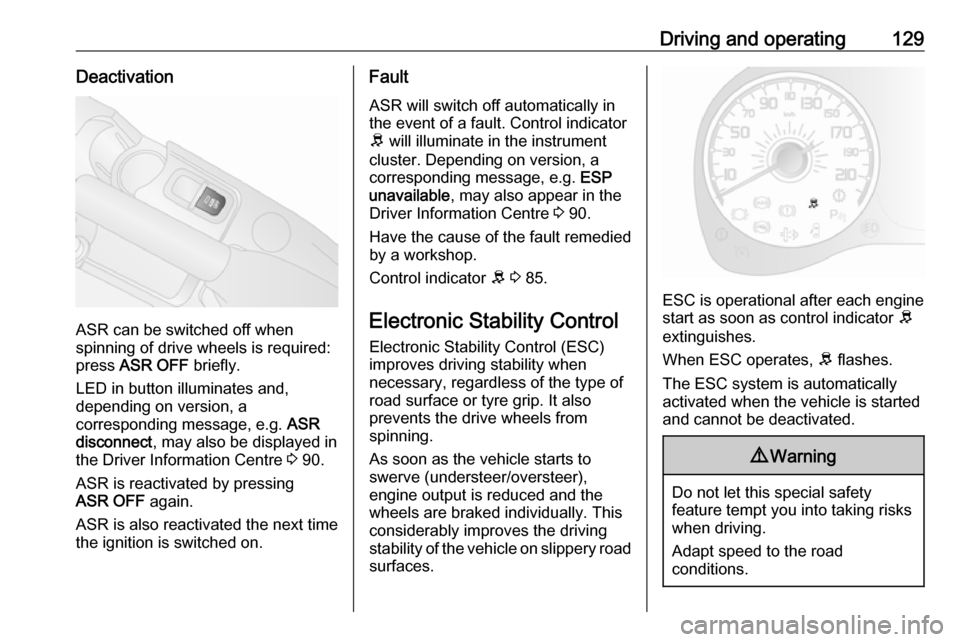
ASR can be switched off when
spinning of drive wheels is required:
press ASR OFF briefly.
LED in button illuminates and,
depending on version, a
corresponding message, e.g. ASR
disconnect , may also be displayed in
the Driver Information Centre 3 90.
ASR is reactivated by pressing
ASR OFF again.
ASR is also reactivated the next time
the ignition is switched on.
Fault
ASR will switch off automatically in the event of a fault. Control indicator
R will illuminate in the instrument
cluster. Depending on version, a
corresponding message, e.g. ESP
unavailable , may also appear in the
Driver Information Centre 3 90.
Have the cause of the fault remedied by a workshop.
Control indicator R 3 85.
Electronic Stability Control
Electronic Stability Control (ESC)
improves driving stability when
necessary, regardless of the type of
road surface or tyre grip. It also
prevents the drive wheels from
spinning.
As soon as the vehicle starts to
swerve (understeer/oversteer),
engine output is reduced and the wheels are braked individually. This
considerably improves the driving
stability of the vehicle on slippery road
surfaces.
ESC is operational after each engine
start as soon as control indicator R
extinguishes.
When ESC operates, R flashes.
The ESC system is automatically
activated when the vehicle is started
and cannot be deactivated.
9 Warning
Do not let this special safety
feature tempt you into taking risks
when driving.
Adapt speed to the road
conditions.
Page 133 of 203

Driving and operating131Turn end of lever to the ON position;
control indicator m 3 90 illuminates in
the instrument cluster. Depending on
version, a corresponding message,
e.g. Cruise Control on , may also be
displayed in the Driver Information
Centre 3 90.
Activation Accelerate to the desired speed and
push lever upwards ( +); the current
speed is stored and maintained.
Accelerator pedal can be released.
Vehicle speed can be increased by
depressing the accelerator pedal.
When the accelerator pedal is
released, the previously stored speed
is resumed.
Cruise control remains activated
while gearshifting.
Increase speed
With cruise control active, push lever
upwards ( +) or briefly push lever
upwards ( +) repeatedly: speed
increases continuously or in small
increments.Alternatively accelerate to the desired speed and store by pushing lever
upwards ( +).
Reduce speed
With cruise control active, push lever
downwards ( -) or briefly push lever
downwards ( -) repeatedly; speed
decreases continuously or in small
increments.
Deactivation Automatic deactivation: ● vehicle speed below approx. 20 mph
● the brake pedal is depressed
● the clutch pedal is depressed
● the traction control system/Anti- Slip Regulator (ASR) or
Electronic Stability Control (ESC)
is operating
● the antilock brake system (ABS) is operating
Resume stored speed
Press = at a speed above 20 mph.
The stored speed will be obtained.Switching off
Turn end of lever to the OFF position;
control indicator m extinguishes. The
stored speed is deleted. Switching off the ignition also deletes the stored
speed.
Parking assist9 Warning
It is the driver who bears full
responsibility for the parking
manoeuvre.
Always check the surrounding
area while reversing and using the parking assist system.
The parking assist makes parking
easier by measuring the distance between the vehicle and obstacles,
and giving acoustic signals.
Page 140 of 203

138Driving and operatingTrailer hitch
General information
Only use towing equipment that has
been approved for your vehicle.
Vehicles with natural gas engine may
require special towing equipment.
Entrust retrofitting of towing
equipment to a workshop. It may be
necessary to make changes that
affect the cooling system, heat
shields or other equipment.
Fitting of towing equipment could
cover the opening of the towing eye.
If this is the case use the coupling ball bar for towing. Always keep the
coupling ball bar in the vehicle.
Driving characteristics and towing tips
Before attaching a trailer, lubricate the coupling ball. However, do not do so if a stabiliser, which acts on the
coupling ball, is being used to reduce
snaking movements.For trailers with low driving stability
and caravan trailers with a permitted
gross vehicle weight of more than
1300 kg the use of a stabiliser is
strongly recommended when driving
above 50 mph.
If the trailer starts snaking, drive more slowly, do not attempt to correct the
steering and brake sharply if
necessary.
When driving downhill, drive in the
same gear as if driving uphill and
drive at a similar speed.
Adjust tyre pressure to the value
specified for full load 3 191.
Trailer towing
Trailer loads The permissible trailer loads are
vehicle and engine-dependent
maximum values which must not be
exceeded. The actual trailer load is the difference between the actual
gross weight of the trailer and the
actual coupling socket load with the
trailer coupled.The permissible trailer loads are
specified in the vehicle documents. In general, they are valid for gradients
up to max. 12%.
The permitted trailer load applies up to the specified incline and up to an
altitude of 1000 metres above sea
level. Since engine power decreases
as altitude increases due to the air
becoming thinner, therefore reducing
climbing ability, the permissible gross
train weight also decreases by 10%
for every 1000 metres of additional
altitude. The gross train weight does
not have to be reduced when driving
on roads with slight inclines (less than
8%, e.g. motorways).
The permissible gross train weight
must not be exceeded. This weight is specified on the identification plate
3 181.
Vertical coupling load
The vertical coupling load is the load
exerted by the trailer on the coupling
ball. It can be varied by changing the
weight distribution when loading the
trailer.
Page 142 of 203

140Vehicle careVehicle careGeneral Information...................140
Accessories and vehicle modifications .......................... 140
Vehicle storage ........................141
End-of-life vehicle recovery .....141
Vehicle checks ........................... 142
Performing work ......................142
Bonnet ..................................... 142
Engine oil ................................. 143
Engine coolant ......................... 144
Power steering fluid .................145
Washer fluid ............................ 145
Brakes ..................................... 145
Brake fluid ............................... 146
Vehicle battery ......................... 146
Wiper blade replacement ........148
Bulb replacement .......................149
Halogen headlights ..................149
Fog lights ................................. 151
Tail lights ................................. 151
Side turn signal lights ..............152
Centre high-mounted brake light ......................................... 152
Number plate light ...................152Interior lights ............................ 153
Instrument panel illumination ...154
Electrical system ........................155
Fuses ....................................... 155
Engine compartment fuse box . 156
Instrument panel fuse box .......157
Vehicle tools .............................. 159
Tools ........................................ 159
Wheels and tyres .......................159
Winter tyres ............................. 159
Tyre designations ....................160
Tyre pressure .......................... 160
Tyre pressure monitoring
system .................................... 161
Tread depth ............................. 162
Changing tyre and wheel size . 163 Wheel covers ........................... 163
Tyre chains .............................. 163
Tyre repair kit .......................... 164
Wheel changing .......................166
Spare wheel ............................ 168
Jump starting ............................. 170
Towing ....................................... 172
Towing the vehicle ...................172
Towing another vehicle ...........172
Appearance care .......................173
Exterior care ............................ 173
Interior care ............................. 175General Information
Accessories and vehiclemodifications
We recommend the use of genuine
parts and accessories and factory
approved parts specific for your
vehicle type. We cannot assess or guarantee reliability of other products
- even if they have a regulatory or
otherwise granted approval.
Any modification, conversion or other
changes made to standard vehicle
specifications (including, without
limitation, software modifications,
modifications of the electronic control units) may invalidate the warrantyoffered by Vauxhall. Furthermore,
such changes may affect driver
assistance systems, may impact fuel
consumption, CO 2 emissions and
other emissions of the vehicle and
cause the vehicle to no longer
conform to the operating permit,
impacting the validity of your vehicle
registration.
Page 143 of 203

Vehicle care141Caution
When transporting the vehicle on
a train or on a recovery vehicle, the
mud flaps might be damaged.
Vehicle storage
Storage for a long period of time
If the vehicle is to be stored for several months:
● Wash and wax the vehicle.
● Have the wax in the engine compartment and underbody
checked.
● Clean and preserve the rubber seals.
● Fill up fuel tank completely.
● Change the engine oil.
● Drain the washer fluid reservoir.
● Check the coolant antifreeze and
corrosion protection.
● Adjust tyre pressure to the value specified for full load.
● Park the vehicle in a dry, wellventilated place. Engage first or
reverse gear to prevent the
vehicle from rolling.
● Do not apply the parking brake.
● Open the bonnet, close all doors and lock the vehicle.
● Disconnect the clamp from the negative terminal of the vehicle
battery. Beware that all systems
are not functional, e.g. anti-theft
locking system.
Putting back into operation
When the vehicle is to be put back into operation:
● Connect the clamp to the negative terminal of the vehicle
battery. Activate the electronics
of the power windows.
● Check tyre pressure.
● Fill up the washer fluid reservoir.
● Check the engine oil level.
● Check the coolant level.
● Fit the number plates if necessary.End-of-life vehicle recovery
Information on end-of-life vehicle
recovery centres and the recycling of
end-of-life vehicles is available on our website. Only entrust this work to an
authorised recycling centre.
Natural gas vehicles must be recycled by a service centre authorised for
natural gas vehicles.
Page 147 of 203

Vehicle care145the coolant concentration checked
and have the cause of the coolant
loss remedied by a workshop.
Coolant and antifreeze 3 178.
Power steering fluidCaution
Extremely small amounts of
contamination can cause steering
system damage and cause it to not
work properly. Do not allow
contaminates to contact the fluid
side of the reservoir cap/dipstick or
from entering the reservoir.
If the fluid level in the reservoir falls
below the MIN mark consult a
workshop.
If an unusual noise sounds during
steering or the power steering reacts
conspicuously, seek the assistance of
a workshop.
Washer fluid
Fill with clean water mixed with a
suitable quantity of approved
windscreen washer fluid which
contains antifreeze.
Caution
Only washer fluid with a sufficient
antifreeze concentration provides
protection at low temperatures or
a sudden drop in temperature.
Use of washer fluid containing
isopropanol can damage exterior
lamps.
Washer fluid 3 178.
Brakes A squealing noise, or illumination of
brake pad wear control indicator F
indicates that the brake lining is at its
minimum thickness.
Continued driving is possible but
have the brake linings replaced as
soon as possible.
Once new brake linings are installed,
do not brake unnecessarily hard for
the first few journeys.
Brake pad wear indicator F 3 84.
Page 148 of 203

146Vehicle careBrake fluid9Warning
Brake fluid is poisonous and
corrosive. Avoid contact with eyes, skin, fabrics and painted surfaces.
The brake fluid level must be between
the MIN and MAX marks.
When topping up, ensure maximum cleanliness as contamination of the
brake fluid can lead to brake system
malfunctions. Have the cause of the
loss of brake fluid remedied by a
workshop.
Only use high-performance brake
fluid approved for the vehicle.
Brake and clutch fluid 3 178.
Vehicle battery
The vehicle battery is located in the
engine compartment.
The vehicle battery is maintenance-
free provided that the driving profile
allows sufficient charging of the
battery. Short-distance-driving and
frequent engine starts can discharge
the vehicle battery. Avoid the use of
unnecessary electrical consumers.
Batteries do not belong in household
waste. They must be disposed of at
an appropriate recycling collection
point.
Laying up the vehicle for more than
four weeks can lead to vehicle battery
discharge. Disconnect the clamp from
the negative terminal of the vehicle
battery.
Ensure the ignition is switched off
before connecting or disconnecting
the vehicle battery.
The anti-theft alarm siren must be deactivated as follows: Switch theignition on then off, disconnect the
vehicle's battery within 15 seconds.
Battery discharge protection 3 105.