Page 127 of 504
127
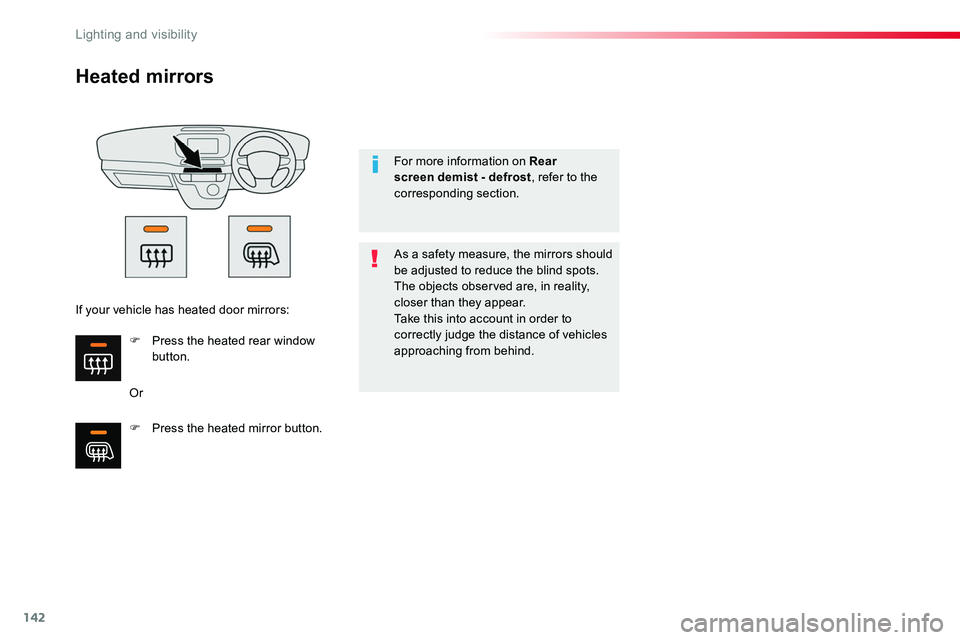
A setting around 21 enables you to obtain an optimum level of comfort. Depending on your requirements, a setting between 18 and 24 is usual.In addition, it is recommended that you avoid a left /right setting difference of more than 3.
Dual-zone automatic air conditioning
Offers the best compromise between a comfortable temperature and quiet operation.
Provides soft and quiet operation by limiting air flow.
Provides strong and effective air flow.
F Press the "AUTO" button repeatedly.
Automatic comfort mode
Temperature
F Push the button down to reduce the value or up to increase it.When the engine is cold, the air flow will only reach its optimum level gradually to prevent too great a distribution of c o l d a i r.In cold weather, it favours the distribution of warm air to the windscreen, the side windows and the footwells only.
The active mode appears in the display screen, as described below:
If desired, you can choose settings different to those offered by the system, by adjusting a setting manually. The other functions are still managed automatically.The "AUTO" symbol disappears if you modify a setting.
Manual mode
The driver and front passenger can each set the temperature to suit their requirements.The value indicated in the screen corresponds to a level of comfort and not to a temperature in degrees Celsius or Fahrenheit.
3
Ease of use and comfort
Page 128 of 504
128
Visibility programme
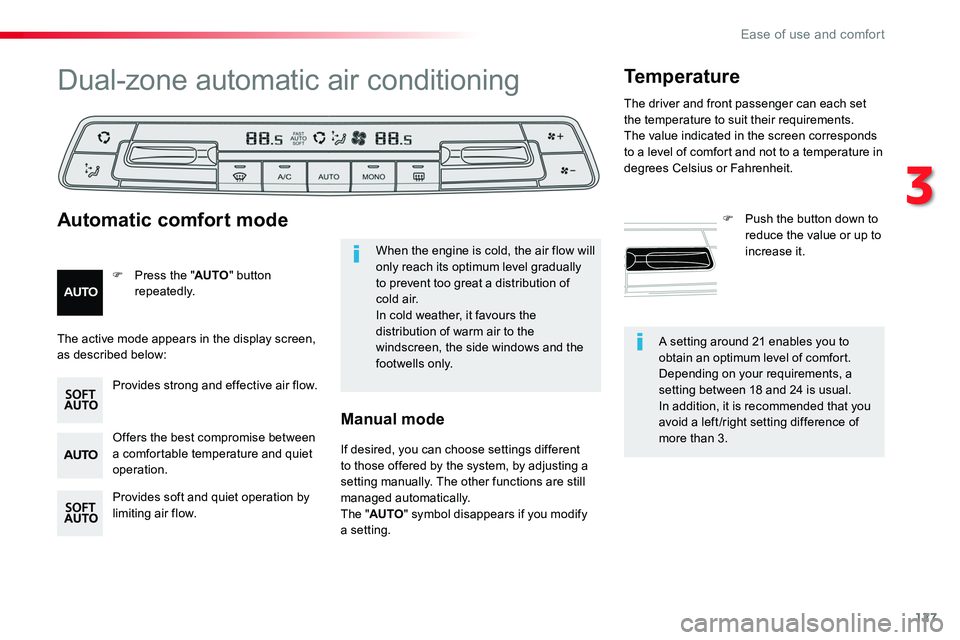
F Press the "visibility" button for faster demisting or defrosting of the windscreen and side windows.
F Press the "visibility" button again to stop the programme.
The system automatically manages the air conditioning, air flow and air intake and distributes the flow of air to the windscreen and
side windows to the best effect.
For maximum cooling or heating of the passenger compartment, you can exceed the minimum value of 14 or the maximum value of 28.
F Push the button down until "LO" is displayed or up until "HI" is displayed.
On entering the vehicle, if the interior temperature is much colder or warmer than the comfort value, there is no need to alter the value displayed in order to obtain the required level of comfort. The system corrects the temperature difference automatically and as quickly as possible.
"Mono" function
The comfort setting for the passenger side can be indexed to the driver's comfort setting (mono-zone).
The function is deactivated automatically if a passenger uses the temperature control.
Or
F Press the "AUTO" button to return to the automatic comfort programme.
F Press this button to activate / deactivate the "Mono" function.The indicator lamp in the button is on when the function is activated.
Ease of use and comfort
Page 129 of 504
129
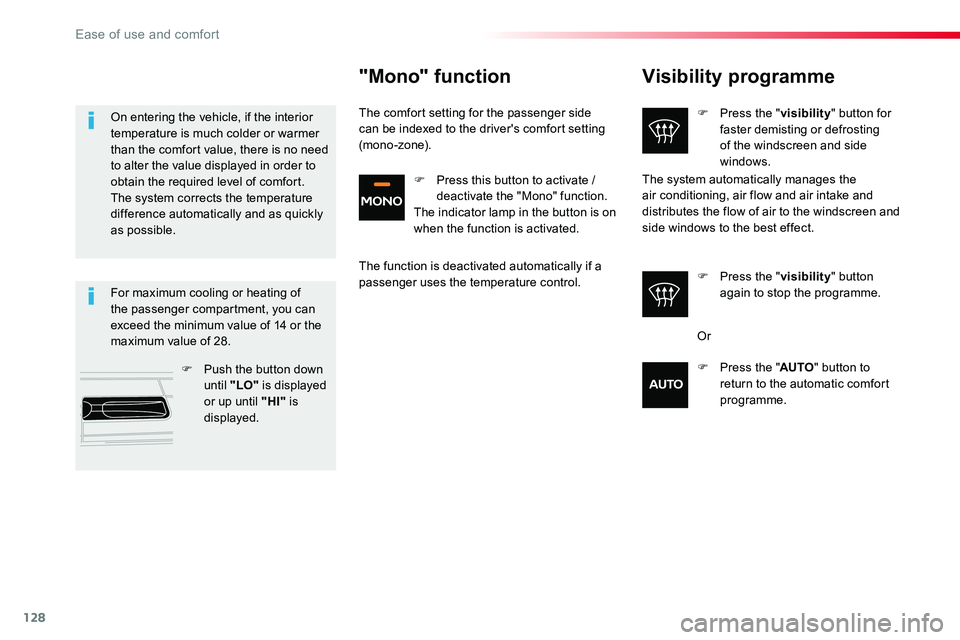
F Press this button to increase air f low.
Air distribution
F Press this button repeatedly to direct the air flow in turn to:
- the windscreen, the side windows and the footwells,- the footwells.
- the central vents, the side vents and the footwells,- the windscreen, the side windows, the centre vents and the footwells,- the centre and side vents,- the windscreen and side windows (demisting or defrosting),
Air flow
F Press this button to decrease air f low.
The air flow symbol (a fan) appears. It is filled in or emptied progressively according to the setting.
Air conditioning
It enables you to:- lower the temperature, in summer,- increase the effectiveness of the demisting in winter, above 3°C.
Switching on
With the engine running, the air conditioning is designed to operate effectively in all seasons, with the windows closed.
The air conditioning does not operate when the air flow adjustment is set to of f.
To obtain cool air more quickly, you can use interior air recirculation for a few moments. Then return to the intake of exterior air.
F Press this button; its indicator lamp comes on.
F Press this button again; its indicator lamp goes off.
Switching off
Switching off may result in some discomfort (humidity, misting).
3
Ease of use and comfort
Page 130 of 504
130
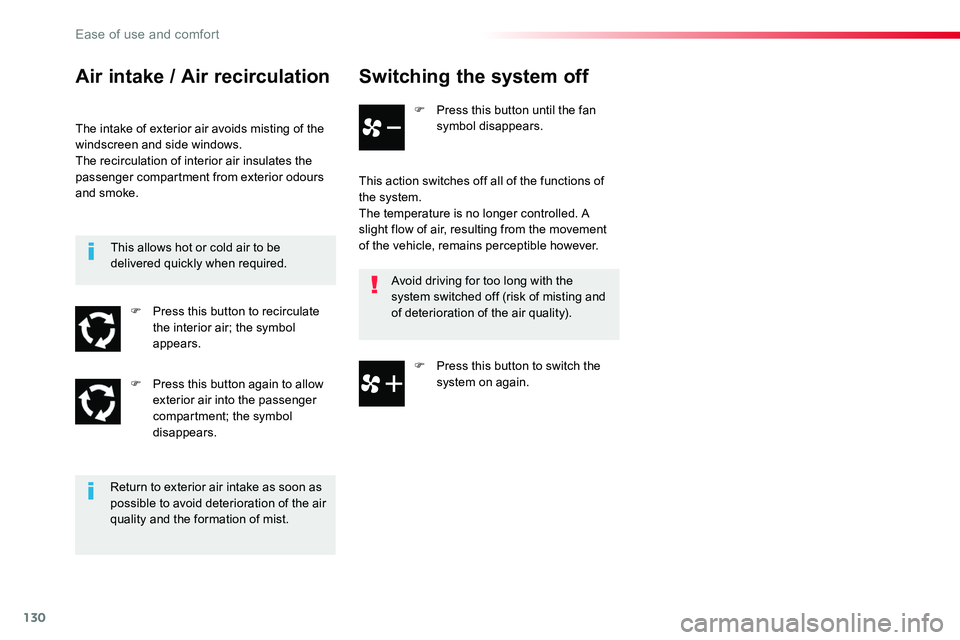
Switching the system off
F Press this button until the fan symbol disappears.
This action switches off all of the functions of the system.The temperature is no longer controlled. A slight flow of air, resulting from the movement of the vehicle, remains perceptible however.
Avoid driving for too long with the system switched off (risk of misting and of deterioration of the air quality).
Air intake / Air recirculation
The intake of exterior air avoids misting of the windscreen and side windows.The recirculation of interior air insulates the passenger compartment from exterior odours and smoke.
Return to exterior air intake as soon as possible to avoid deterioration of the air quality and the formation of mist.
This allows hot or cold air to be delivered quickly when required.
F Press this button to recirculate the interior air; the symbol appears.
F Press this button again to allow exterior air into the passenger compartment; the symbol disappears.
F Press this button to switch the system on again.
Ease of use and comfort
Page 131 of 504
131
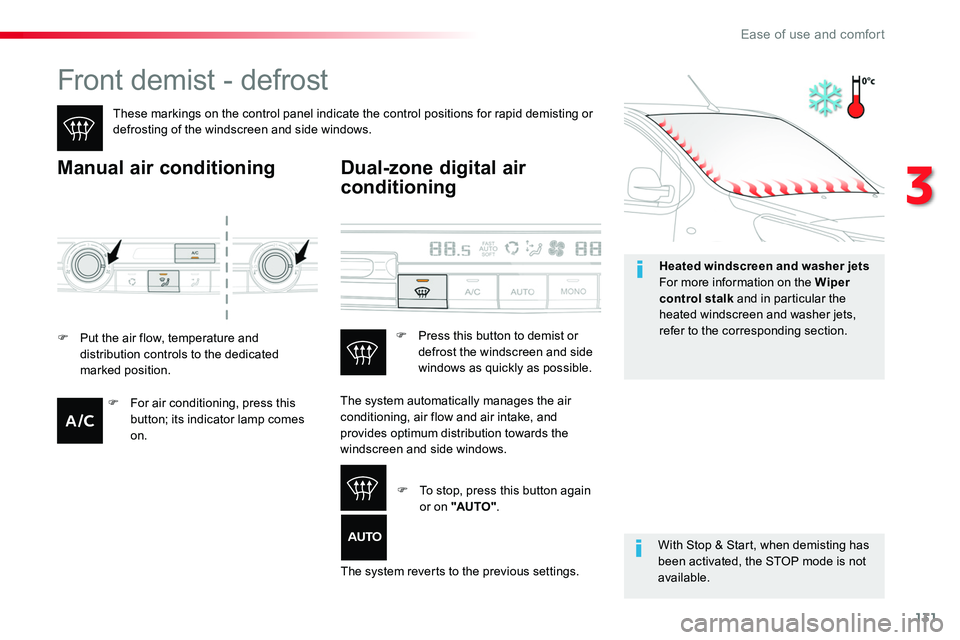
Front demist - defrost
These markings on the control panel indicate the control positions for rapid demisting or defrosting of the windscreen and side windows.
Manual air conditioning
With Stop & Start, when demisting has been activated, the STOP mode is not available.
Dual-zone digital air
conditioning
F Put the air flow, temperature and distribution controls to the dedicated marked position.
The system automatically manages the air conditioning, air flow and air intake, and
provides optimum distribution towards the windscreen and side windows.
The system reverts to the previous settings.
F Press this button to demist or defrost the windscreen and side windows as quickly as possible.
F To stop, press this button again or on "AUTO".
F For air conditioning, press this button; its indicator lamp comes
on.
Heated windscreen and washer jetsFor more information on the Wiper control stalk and in particular the heated windscreen and washer jets, refer to the corresponding section.
3
Ease of use and comfort
Page 142 of 504
142
Heated mirrors
Or
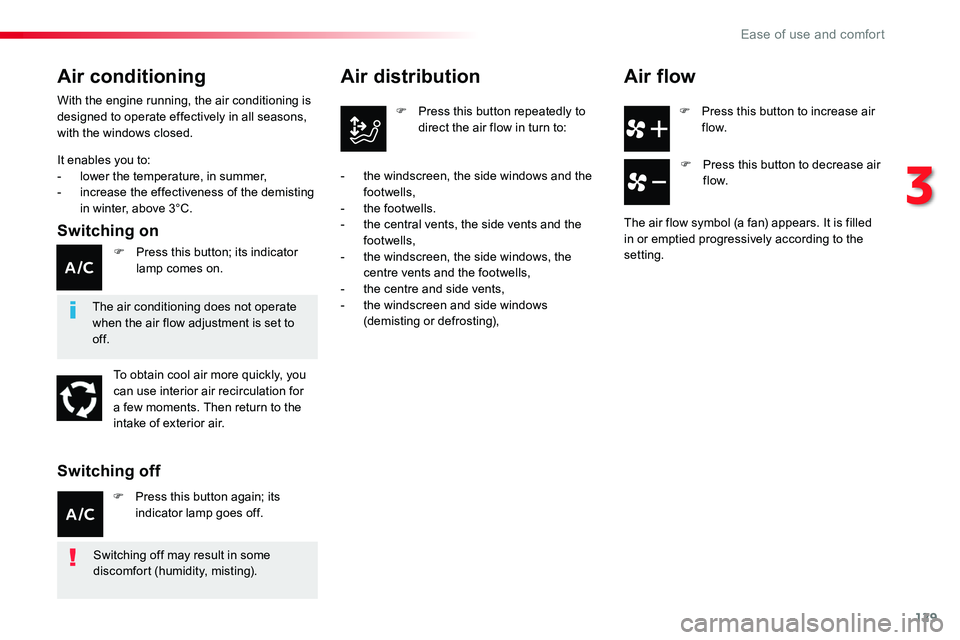
As a safety measure, the mirrors should be adjusted to reduce the blind spots.The objects observed are, in reality, closer than they appear.Take this into account in order to correctly judge the distance of vehicles approaching from behind.
For more information on Rear screen demist - defrost, refer to the corresponding section.
F Press the heated rear window button.
F Press the heated mirror button.
If your vehicle has heated door mirrors:
Lighting and visibility
Page 171 of 504
171
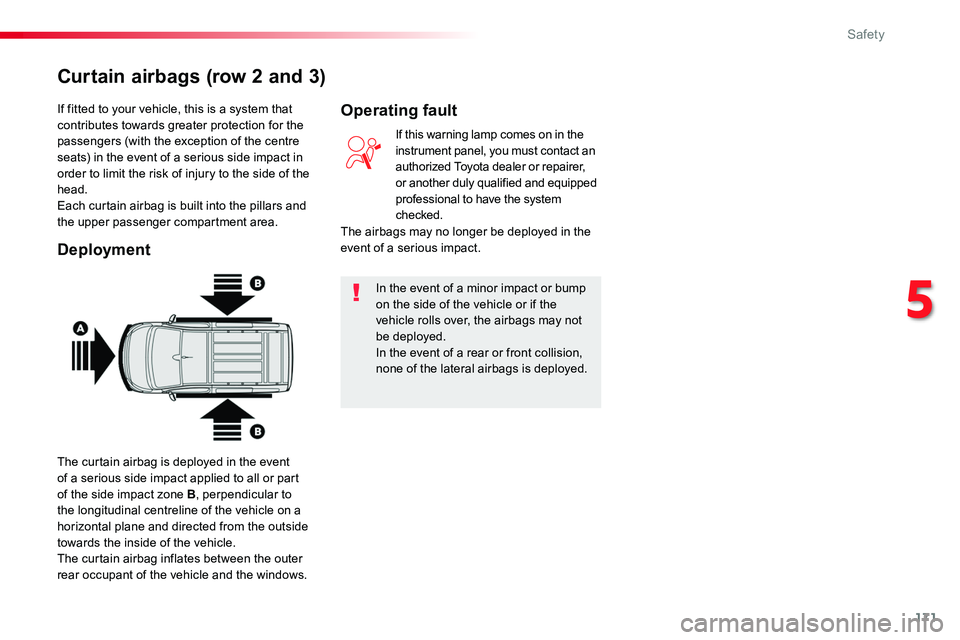
If fitted to your vehicle, this is a system that contributes towards greater protection for the passengers (with the exception of the centre seats) in the event of a serious side impact in order to limit the risk of injury to the side of the head.Each curtain airbag is built into the pillars and the upper passenger compartment area.
Deployment
In the event of a minor impact or bump on the side of the vehicle or if the vehicle rolls over, the airbags may not be deployed.In the event of a rear or front collision, none of the lateral airbags is deployed.
If this warning lamp comes on in the instrument panel, you must contact an authorized Toyota dealer or repairer, or another duly qualified and equipped professional to have the system checked.
Operating fault
Curtain airbags (row 2 and 3)
The airbags may no longer be deployed in the event of a serious impact.
The curtain airbag is deployed in the event of a serious side impact applied to all or part of the side impact zone B, perpendicular to the longitudinal centreline of the vehicle on a horizontal plane and directed from the outside towards the inside of the vehicle.The curtain airbag inflates between the outer rear occupant of the vehicle and the windows.
5
Safety
Page 189 of 504
189
Child seatsInstalling a booster
cushion
Recommendations
The legislation on carrying a child on the front passenger seat is specific to each country. Refer to the legislation in force in the country in which you are driving.Deactivate the passenger front airbag when a rear ward facing child seat is installed on the front passenger seat. Otherwise, the child would risk being seriously injured or killed if the airbag were deployed.
For optimum installation of the forward facing child seat, ensure that the back of the child seat is as close as possible to the backrest of the vehicle's seat, or in contact if possible.The head restraint must be removed before installing a child seat with a backrest on the passenger seat.Ensure that the head restraint is stowed or attached securely so that it is not thrown around the vehicle in the event of sharp braking.Refit the head restraint as soon as the child seat is removed.
The incorrect installation of a child seat in a vehicle compromises the child's protection in the event of an accident.Check that there is no seat belt or seat belt buckle under the child seat as this could destabilise it.Remember to fasten the seat belts or the child seat harnesses keeping the slack in relation to the child's body to a minimum, even for short journeys.For the installation of a child seat using a seat belt, ensure that this is well tensioned on the child seat and that it is holding the child seat firmly against the seat of your vehicle. If your front passenger seat is adjustable, move it for ward if necessary.At the rear seats, always leave sufficient space between the front seat and:- a rear ward facing child seat,- the feet of a child seated in a for ward facing child seat.For this, move the front seat for ward and if necessary straighten its backrest.
Children at the front
The chest part of the seat belt must be positioned on the child's shoulder without touching the neck.Ensure that the lap part of the seat belt passes correctly over the child's thighs.Toyota recommends the use of a booster seat which has a back, fitted with a seat belt guide at shoulder level.
As a safety precaution, do not leave:- one or more children alone and unsupervised in a vehicle,- a child or an animal in a vehicle which is exposed to the sun, with the windows closed,- the keys within reach of children inside the vehicle.To prevent accidental opening of the doors, use the child lock.Take care not to open the rear windows by more than one third.To protect young children from the rays of the sun, fit side blinds on the rear windows.
5
Safety