Page 487 of 607

4858-2. Steps to take in an emergency
PRIUS v_OM_OM47B78U_(U)
8
When trouble arises
WARNING
■Maintenance of the tires
Each tire, including the spare (if provided), should be checked monthly
when cold and inflated to the inflation pressure recommended by the
vehicle manufacturer on the vehicle placard or tire inflation pressure
label (tire and load information label). (If your vehicle has tires of a dif-
ferent size than the size indicated on the vehicle placard or tire inflation
pressure label [tire and load information label], you should determine
the proper tire inflation pressure for those tires.)
As an added safety feature, your vehicle has been equipped with a tire
pressure monitoring system (TPMS-tire pressure warning system) that
illuminates a low tire pressure telltale (tire pressure warning light) when
one or more of your tires is significantly under-inflated. Accordingly,
when the low tire pressure telltale (tire pressure warning light) illumi-
nates, you should stop and check your tires as soon as possible, and
inflate them to the proper pressure. Driving on a significantly under-
inflated tire causes the tire to overheat and can lead to tire failure.
Under-inflation also reduces fuel efficiency and tire tread life, and may
affect the vehicle’s handling and stopping ability.
Please note that the TPMS (tire pressure warning system) is not a sub-
stitute for proper tire maintenance, and it is the driver’s responsibility to
maintain correct tire pressure, even if under-inflation has not reached
the level to trigger illumination of the TPMS low tire pressure telltale (tire
pressure warning light).
Your vehicle has also been equipped with a TPMS (tire pressure warn-
ing system) malfunction indicator to indicate when the system is not
operating properly. The TPMS (tire pressure warning system) malfunc-
tion indicator is combined with the low tire pressure telltale (tire pressure
warning light). When the system detects a malfunction, the telltale will
flash for approximately one minute and then remain continuously illumi-
nated. This sequence will continue upon subsequent vehicle start-ups
as long as the malfunction exists. When the malfunction indicator is illu-
minated, the system may not be able to detect or signal low tire pres-
sure as intended.
TPMS (tire pressure warning system) malfunctions may occur for a vari-
ety of reasons, including the installation of replacement or alternate tires
or wheels on the vehicle that prevent the TPMS (tire pressure warning
system) from functioning properly. Always check the TPMS (tire pres-
sure warning system) malfunction telltale after replacing one or more
tires or wheels on your vehicle to ensure that the replacement or alter-
nate tires and wheels allow the TPMS (tire pressure warning system) to
continue to function properly.
Page 489 of 607
487
PRIUS v_OM_OM47B78U_(U)
8
When trouble arises
8-2. Steps to take in an emergency
If a warning message is displayed
Master warning light
The master warning light also
comes on or flashes in order to
indicate that a message is cur-
rently being displayed on the
multi-information display.
Multi-information display
If any of the warning lights come on again after the following actions
have been performed, contact your Toyota dealer.
If a warning is shown on the multi-information display, stay calm
and perform the following actions:
1
2
Page 495 of 607

4938-2. Steps to take in an emergency
PRIUS v_OM_OM47B78U_(U)
8
When trouble arises
Warning messageDetails/Actions
The Automatic High Beam switch was pressed
with the low beam headlights turned on.
Turn the high beam headlights on before
pressing the Automatic High Beam switch.
Indicates that, since the VSC (Vehicle Stability
Control) system was turned off, the pre-collision
brake system operation is stopped
Turn the VSC on. ( P. 255)
Indicates that the PCS (Pre-Collision System) is
temporarily unavailable
When conditions improve, the system
resumes operation. If this item is displayed
continuously, have the vehicle inspected
by your Toyota dealer.
Indicates that the PCS (Pre-Collision System) is
temporarily unavailable
When conditions improve, the system
resumes operation. If this item is displayed
continuously, have the vehicle inspected
by your Toyota dealer.
Indicates that part of the PCS (Pre-Collision Sys-
tem) sensor is dirty, covered with ice, etc.
Remove any dirt, ice, etc.
Hybrid battery (traction battery) inspection or
replacement time.
Have the hybrid battery (traction battery)
inspected by your Toyota dealer immedi-
ately.
Page 499 of 607

4978-2. Steps to take in an emergency
PRIUS v_OM_OM47B78U_(U)
8
When trouble arises
Shift control system malfunction A buzzer also sounds.
Have the vehicle inspected by your Toyota
dealer immediately. If not inspected, vehi-
cle systems may stop operating normally.
Shift control system communication malfunction
A buzzer also sounds.
Have the vehicle inspected by your Toyota
dealer.
• The hybrid system may not be able to start.
• May not be switched to the P position. When parking, choose a level location and
apply the parking brake securely.
• The automatically P position selection func- tion ( P. 178) may not function. Before
turning the power switch off, securely press
the P position switch, and be sure to check
that the shift position is in P by verifying the
shift position or P position switch operation
indicator lights.
• The power switch may not be able to be
turned off. In this case, the power switch
may be turned off by applying the parking
brake.
(If equipped)
Indicates a malfunction in the LED headlight sys-
temA buzzer also sounds.
Have the vehicle inspected by your Toyota
dealer.
Warning messageDetails/Actions
(Turns on or
Flashes)
Page 513 of 607
5118-2. Steps to take in an emergency
PRIUS v_OM_OM47B78U_(U)
8
When trouble arises
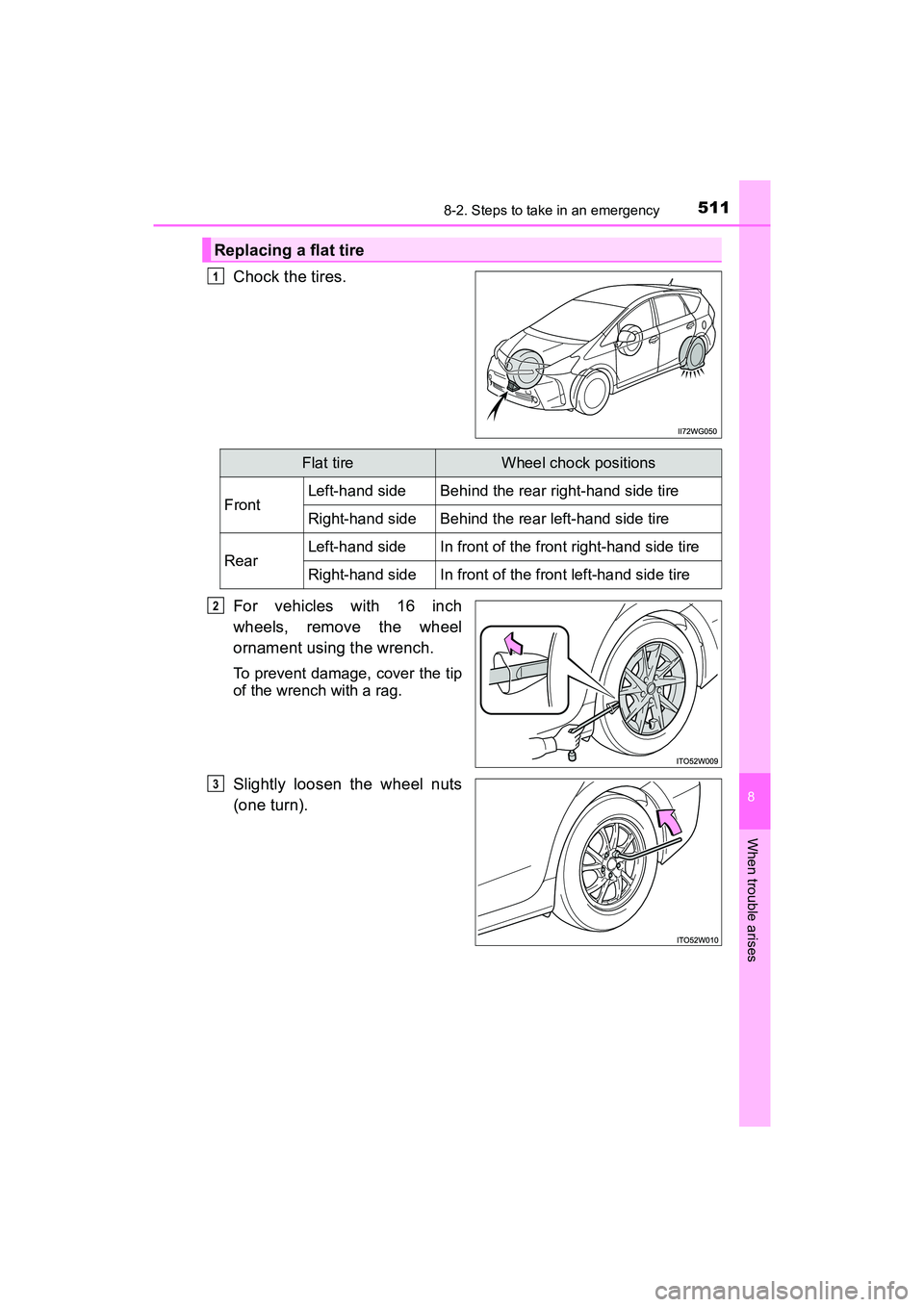
Chock the tires.
For vehicles with 16 inch
wheels, remove the wheel
ornament using the wrench.
To prevent damage, cover the tip
of the wrench with a rag.
Slightly loosen the wheel nuts
(one turn).
Replacing a flat tire
1
Flat tireWheel chock positions
FrontLeft-hand sideBehind the rear right-hand side tire
Right-hand sideBehind the rear left-hand side tire
RearLeft-hand sideIn front of the front right-hand side tire
Right-hand sideIn front of the front left-hand side tire
2
3
Page 514 of 607
5128-2. Steps to take in an emergency
PRIUS v_OM_OM47B78U_(U)
Turn the tire jack portion by
hand until the notch of the jack
is in contact with the jack point.
The jack point guides are located
under the rocker panel. They
indicate the jack point positions.
Raise the vehicle until the tire is
slightly raised off the ground.
Remove all the wheel nuts and
the tire.
When resting the tire on the
ground, place the tire so that the
wheel design faces up to avoid
scratching the wheel surface.
4A
5
6
Page 518 of 607

5168-2. Steps to take in an emergency
PRIUS v_OM_OM47B78U_(U)
■The compact spare tire
●The compact spare tire is identified by the label “TEMPORARY USE
ONLY” on the tire sidewall.
Use the compact spare tire temporarily, and only in an emergency.
●Make sure to check the tire inflation pressure of the compact spare tire.
( P. 543)
■After completing the tire change
The tire pressure warning system must be reset. ( P. 432)
■When using the compact spare tire
As the compact spare tire is not equipped with a tire pressure warning
valve and transmitter, low inflation pressure of the spare tire will not be
indicated by the tire pressure warning system. Also, if you replace the
compact spare tire after the tire pressure warning light comes on, the light
remains on.
■When the compact spare tire is equipped
The vehicle becomes lower when driving with the compact spare tire
compared to when driving with standard tires.
■If you have a flat front tire on a road covered with snow or ice
Install the compact spare tire on one of the rear wheels of the vehicle.
Perform the following steps and fit tire chains to the front tires:
Replace a rear tire with the compact spare tire.
Replace the flat front tire with the tire removed from the rear of the vehi-
cle.
Fit tire chains to the front tires.
1
2
3
Page 521 of 607

519
PRIUS v_OM_OM47B78U_(U)
8
When trouble arises
8-2. Steps to take in an emergency
If the hybrid system will not start
One of the following may be the cause of the problem:
●The electronic key may not be functioning properly.
* ( P. 521)
● There may not be sufficient fuel in the vehicle’s tank.
Refuel the vehicle. ( P. 8 0 )
● There may be a malfunction in the immobilizer system.
* ( P. 83)
● There may be a malfunction in the shift control system.
*
( P. 171, 489)
● The hybrid system may be malfunctioning due to an electrical prob-
lem such as electronic key battery depletion or a blown fuse. How-
ever, depending on the type of malfunction, an interim measure is
available to start the hybrid system. ( P. 520)
*: It may not be possible to shift the shift position other than P.
One of the following may be the cause of the problem:
● The 12-volt battery may be discharged. ( P. 523)
● The 12-volt battery terminal connections may be loose or corroded.
( P. 427)
Reasons for the hybrid system not starting vary depending on
the situation. Check the following and perform the appropriate
procedure:
The hybrid system will not start even though the correct starting
procedure is being followed. ( P. 168)
The interior lights and headlights are dim, or the horn does not
sound or sounds at a low volume.