2018 SUZUKI JIMNY Engine oil
[x] Cancel search: Engine oilPage 229 of 421

A WARNING
In addition to following the driving tips in this section, it is important to observe the following precautions. • Check that your tyres are in good condition and always maintain the specified tyre pressure. Refer to "Tyres" in "INSPECTION AND MAINTENANCE" section for details. (Continued)
A WARNING
(Continued) Do not use tyres other than those specified by SUZUKI. Never use different sizes or types of tyres on the front and rear wheels. For information regarding the specified tyres, refer to the tyre information label located on the driver's door lock pillar. Never use oversized tyres or spe~ cial shock absorbers and springs to raise uack up) your vehicle. This will change the handling characteristics. Oversized tyres may also rub against the fender over bumps, causing vehicle damage, drive train damage or tyre failure. After driving through water, test the brakes while driving at a slow speed to see if they have maintained their normal effectiveness. If the brakes are less effective than normal, dry them by repeatedly applying the brakes while driving slowly until the brakes have regained their normal effectiveness.
DRIVING TIPS
When encountering a flooded area
80J042
Avoid driving in a flooded area or a deep puddle. If driving in a flooded area is unavoidable, go slowly in the lowest gear. In case that you have driven in a flooded area, stop the vehicle in a safe place while checking the brake effectiveness. Then, ask a SUZUKI dealer or a qualified workshop to check the following inspection items. Function of brake Function of electrical components Changes of oil level and quality for engine, transmission and differential. In case that the oil is turbid whitely, water has been mixed in the oil and an oil change is required. Lubricant condition of the bearings, suspension joints, etc.
4-6
Page 230 of 421

DRIVING TIPS
NOTICE
Avoid driving in a flooded area or a deep puddle. It may cause an engine stall, short in electrical components, engine and transmission damages, etc.
4-7
Do not drive through deep or rush
ing water
Driving in deep or rushing water can be hazardous. You could lose control of the vehicle and the occupants could drown. Also, your vehicle could be seriously damaged. To avoid these risks, observe the following instructions and precautions. Do not drive through deep or rushing water. Deep or rushing water, such as fast-moving streams or fioodwaters, could carry your vehicle away from your intended path. The water is too deep if it covers your wheel hubs, axles, or exhaust tailpipe. Know the depth of the water before you attempt to drive through it.
If the vehicle goes across the river unavoidably, follow the instructions below before going across the river. 1) Confirm the depth of the river and the terrain. 2) Select the place which is less than 30cm (11.8 inch) in depth of water. Go across the river to a right angle for the river or lower part of the river 3) Drive slowly at less than 5 km/h (3.1 mph) not to raise the wave and go across the river immediately to avoid operating the gearshift lever.
If the vehicle goes across the river that is more than 30 cm (11.8 inch) in depth of water unavoidably, stop the vehicle in a safe place while checking the brake effectiveness. Then, ask a SUZUKI dealer or a qualified workshop to check the following
inspection items. Function of brake Function of electrical components Changes of oil level and quality for engine, transmission and differential. In case that the oil is turbid whitely, water has been mixed in the oil and an oil change is required. Lubricant condition of the bearings, suspension joints, etc. If water blocks the tailpipe, the engine may not start or run. If the water is deep enough to get drawn into the engine intake system, the engine will be badly damaged. Submerged brakes will have poor braking performance. Drive slowly and carefully. Driving slowly will also help avoid water splashing onto the ignition system, which could cause the engine to stall. Even when driving through shallow or still waters, drive carefully since the water may be hiding ground hazards such as holes, ditches, or bumps.
Page 257 of 421
Maintenance
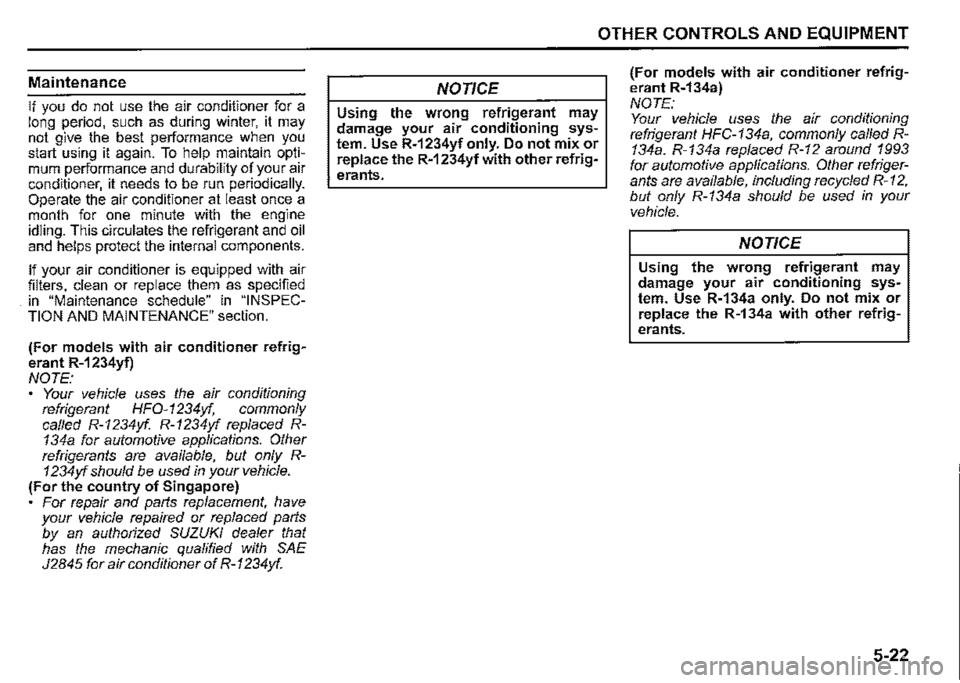
If you do not use the air conditioner for a long period, such as during winter, it may not give the best performance when you start using it again. To help maintain optimum performance and durability of your air conditioner, it needs to be run periodically. Operate the air conditioner at least once a month for one minute with the engine idling. This circulates the refrigerant and oil and helps protect the internal components.
If your air conditioner is equipped with air filters, clean or replace them as specified . in "Maintenance schedule" in "INSPECTION AND MAINTENANCE" section.
(For models with air conditioner refrigerant R-1234yf) NOTE: Your vehicle uses the air conditioning refrigerant HFO-1234yf, commonly called R-1234yf. R-1234yf replaced R-134a for automotive applications. Other refrigerants are available, but only R-1234yf should be used in your vehicle. (For the country of Singapore) • For repair and parts replacement, have your vehicle repaired or replaced parts by an authorized SUZUKI dealer that has the mechanic qualified with SAE J2845 for air conditioner of R-1234yf.
OTHER CONTROLS AND EQUIPMENT
NOTICE
Using the wrong refrigerant may damage your air conditioning system. Use R-1234yf only. Do not mix or replace the R-1234yf with other refrigerants.
(For models with air conditioner refrigerant R-134a) NOTE: Your vehicle uses the air conditioning refrigerant HFC-134a, commonly called R-134a. R-134a replaced R-12 around 1993 for automotive applications. Other refrigerants are available, including recycled R-12, but only R-134a should be used in your
vehicle.
NOTICE
Using the wrong refrigerant may damage your air conditioning system. Use R-134a only. Do not mix or replace the R-134a with other refrigerants.
5-22
Page 264 of 421

OTHER CONTROLS AND EQUIPMENT
Manual operation You can manually control the climate control system. Set the selectors to the desired positions.
NOTE: If you need maximum defrosting: push the defrost switch (5) to turn on the defroster (the air conditioning system will operate and FRESH AIR mode will be selected automatically},
set the blower speed selector to high, adjust the temperature selector to "HI" indication on the display, and adjust the side outlets so the air blows on the side windows.
5-29
Maintenance
If you do not use the air conditioner for a long period, such as during winter, it may not give the best performance when you start using it again. To help maintain optimum performance and durability of your air conditioner, it needs to be run periodically. Operate the air conditioner at least once a month for one minute with the engine idling. This circulates the refrigerant and oil and helps protect the internal components.
If your air conditioner is equipped with air filters, clean or replace them as specified in "Maintenance schedule" in "INSPECTION AND MAINTENANCE" section. Have this job done by a SUZUKI dealer as the lower glove box must be lowered for this job.
(For models with air conditioner refrigerant R-1234yf)
NOTE:
Your vehicle uses the air conditioning refrigerant HFO-1234yf, commonly called R-1234yf. R-1234yf replaced R-134a for automotive applications. Other refrigerants are available, but only R-1234yf should be used in your vehicle. (For the country of Singapore) For repair and parts replacement, have your vehicle repaired or replaced parts by an authorized SUZUKI dealer that has the mechanic qualified with SAE J2845 for air conditioner of R-1234yf.
NOTICE
Using the wrong refrigerant may damage your air conditioning system. Use R-1234yf only. Do not mix or replace the R-1234yfwith other refrigerants.
(For models with air conditioner refrigerant R-134a)
NOTE: Your vehicle uses the air conditioning refrigerant HFC-134a, commonly called R-134a. R-134a replaced R-12 around 1993 for automotive applications. Other refrigerants are available, including recycled R-12, but only R-134a should be used in your vehicle.
NOTICE
Using the wrong refrigerant may damage your air conditioning system. Use R-134a only. Do not mix or replace the R-134a with other refrigerants.
Page 317 of 421

INSPECTION AND MAINTENANCE
INSPECTION AND MAINTENANCE
Maintenance schedule ........................................................ 6-2
Periodic maintenance schedule
(except for EU countries and Israel) .................................. 6-3
Maintenance recommended under severe driving
conditions (except for EU countries and Israel) .............. 6-8
Periodic maintenance schedule
(for EU countries and Israel) .............................................. 6-13
Maintenance recommended under severe driving
conditions (for EU countries and Israel) ........................... 6-18
Drive belt .............................................................................. 6-23 -
Engine oil and filter ............................................................. 6-23
Engine coolant .................................................................... 6-28
Air cleaner ............................................................................ 6-30
Spark plugs .......................................................................... 6-30
Gear oil ................................................................................. 6-31
60G410 Clutch pedal ......................................................................... 6-33
Brakes .................................................................................. 6-33
Steering wheel ..................................................................... 6-36
Tyres ..................................................................................... 6-36
Battery .................................................................................. 6-41
Fuses .................................................................................... 6-42
Headlight aiming ................................................................. 6-46
Headlight Washer Fluid ...................................................... 6-46
Bulb replacement ................................................................ 6-47
Wiper blades ........................................................................ 6-54
Windshield washer fluid ..................................................... 6-57
Air conditioning system ..................................................... 6-58
Page 318 of 421

INSPECTION AND MAINTENANCE
60B128S
.A. WARNING
Take extreme care when working on· your vehicle to prevent accidental injury. Carefully observe the following precautions: • To prevent damage or unintended activation of the airbag system or seat belt pretensioner system, check that the lead-acid battery is disconnected and the ignition switch has been in "LOCK" position for at least 90 seconds before performing any electrical service work on your SUZUKI vehicle. Do not touch airbag system components, seat belt pretensioner system components or wires. The wires are wrapped with yellow tape or yellow tubing, and the couplers are yellow for easy identification. Do not leave the engine running in garages or other confined areas. (Continued)
6-1
.A. WARNING
(Continued) When the engine is running, keep hands, clothing, tools, and other objects away from the fan and drive belt. Even though the fan may not be moving, it can automatically turn on without warning . • When it is necessary to perform service work with the engine run~ ning, check that the parking brake is set fully and the transmission is in Neutral (for manual transmission vehicles) or Park (for automatic transmission vehicles). Do not touch ignition wires or other ignition system parts when starting the engine or when the engine is running, or you could receive an electric shock. • Be careful not to touch a hot engine, exhaust manifold and pipes, muffler, radiator and water hoses. Do not allow smoking, sparks, or flames around fuel or the battery. Flammable fumes are present. Do not get under your vehicle if it is supported only with the portable jack provided in your vehicle. • Be careful not to cause accidental short circuits between the positive and negative battery terminals. (Continued)
.A. WARNING
(Continued) Keep used oil, coolant, and other fluids away from children and pets. Dispose of used fluids properly; never pour them on the ground, into sewers, etc.
Page 321 of 421
INSPECTION AND MAINTENANCE
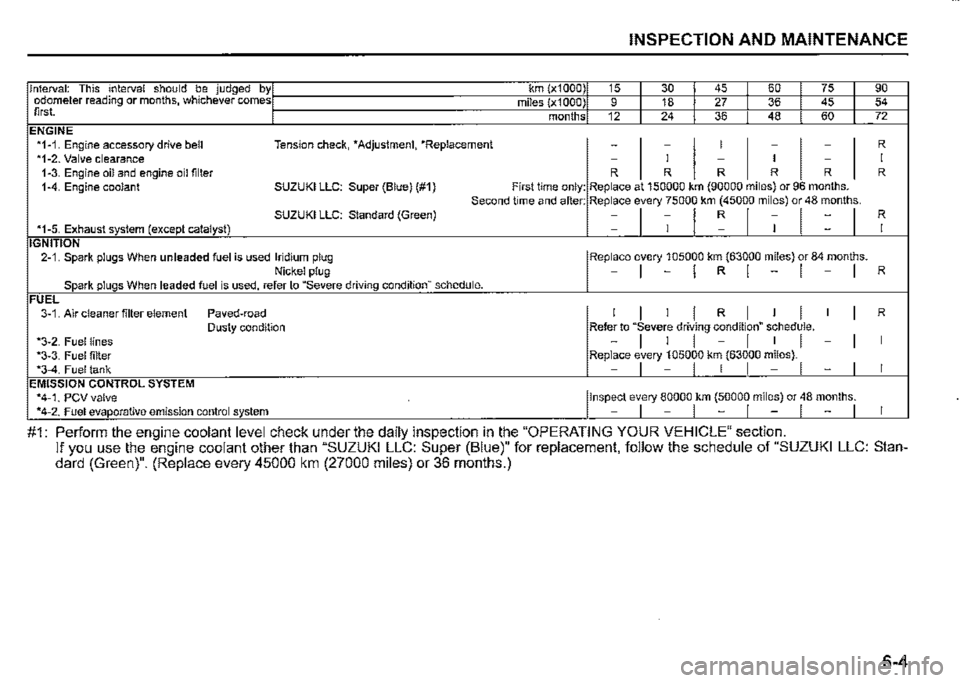
Interval: This interval should be judged by1 km (x1000) 15 I 30 I 45 I 60 I 75 I 90 odometer reading or months, whichever comesI miles (x1000) 9 I 18 I 27 I 36 I 45 I 54 first. 1 months 12 I 24 I 36 I 48 I 60 I 72 ENGINE *1-1. Engine accessory drive bell Tension check, *Adjustment, *Replacement -
I
-
I
I
I
-
I
-
I
R *1-2. Valve clearance -I -I -I 1-3. Engine oil and engine oil filter R R R R R R 1-4. Engine coolant SUZUKI LLC: Super (Blue) (#1) First time only: Replace at 150000 km (90000 miles) or 96 months. Second time and after: Replace every 75000 km (45000 miles) or 48 months. SUZUKI LLC: Standard (Green) =l1l~l1l=I R *1-5. Exhaust system (except catalyst) I IGNITION 2-1. Spark plugs When unleaded fuel is used Iridium plug I Replace every 105000 km (63000 miles) or 84 months. Nickel plug -I-IRl-1-1 R Spark plugs When leaded fuel is used, refer to "Severe driving conditionn schedule. FUEL 3-1. Air cleaner filter element Paved-road I I I I R I I I I I R Dusty condition Refer to "Severe driving condition" schedule. *3-2. Fuel lines -I I I -I I I -I I *3-3. Fuel filter Replace every 105000 km (63000 miles). *3-4. Fuel tank -I -I I I -I -I I EMISSION CONTROL SYSTEM *4-1. PCV valve I Inspect every 80000 km (50000 miles) or 48 months. *4-2. Fuel evaporative emission control system -1-1-1-1-1 I
#1: Perform the engine coolant level check under the daily inspection in the "OPERATING YOUR VEHICLE" section. If you use the engine coolant other than "SUZUKI LLC: Super (Blue)" for replacement, follow the schedule of "SUZUKI LLC: Standard (Green)". (Replace every 45000 km (27000 miles) or 36 months.)
6-4
Page 322 of 421

INSPECTION AND MAINTENANCE
Interval: This interval should be judged byl km (X1000) 105 I 120 I 135 I 150 I 165 I 180 odometer reading or months, whichever comesI miles (x1000) 63 I 72 I 81 I 90 I 99 I 108 first. I months 84 I 96 I 108 I 120 I 132 I 144 ENGINE *1-1. Engine accessory drive belt Tension check, • Adjustment, *Replacement -
I
-
I
I
I
-
I
-
I
R *1-2. Valve clearance -I -I -I 1-3. Engine oil and engine oil filter R R R R R R 1-4. Engine coolant SUZUKI LLC: Super (Blue) (#1) First time only: Replace at 150000 km (90000 miles) or 96 months. Second time and after: Replace every 75000 km (45000 miles) or 48 months. SUZUKI LLC: Standard (Green) =l~l~l~l=I R *1-5. Exhaust system (except catalyst) I IGNITION 2-1. Spark plugs When unleaded fuel is used Iridium plug I Replace every 105000 km (63000 miles) or 84 monlhs. Nickel plug -I-IRl-1-1 R Spark plugs When leaded fuel is used, refer to "Severe driving condition" schedule. FUEL 3-1. Air cleaner filter element Paved-road I I I I R I I I I I R Dusty condition Refer to MSevere driving condition" schedule. *3-2. Fuel lines -I I I -I I I -I I *3-3. Fuel filter Replace every 105000 km (63000 miles). *3-4. Fuel tank -I -I I I -I -I I EMISSION CONTROL SYSTEM *4-1. PCVvalve I Inspect every 80000 km (50000 miles) or 48 months. '"4-2. Fuel evaporative emission control system -I -I -I -I -I I
#1: Perform the engine coolant level check under the daily inspection in the "OPERATING YOUR VEHICLE" section. If you use the engine coolant other than "SUZUKI LLC: Super (Blue)" for replacement, follow the schedule of "SUZUKI LLC: Standard (Green)". (Replace every 45000 km (27000 miles) or 36 months.)
6-5