2018 SUBARU CROSSTREK coolant
[x] Cancel search: coolantPage 297 of 474
(306,1)
北米Model "A1320BE-C" EDITED: 2017/ 10/ 10
appears.
To deactivate:
Press the X-mode switch again. The X-
mode indicator will disappear when the X-
mode is deactivated.NOTE.Even if you try to activate the X-
mode by pressing the X-mode switch
when the vehicle speed is 12 mph (20
km/h) or more, the X-mode will not be
activated. At this time, a buzzer will
sound twice.
.If the vehicle speed reaches 25 mph
(40 km/h) or more while the X-mode is
activated, a buzzer will sound once and
the X-mode will be deactivated.
.While the engine is running, if any of
the following conditions is met, the X-
mode will be deactivated. In this case, it
is not possible to activate the X-mode.
–The CHECK ENGINE warning
light/malfunction indicator light illu-
minates.
–The AT OIL TEMP warning light
flashes.
–The ABS warning light illumi-
nates.
–The Vehicle Dynamics Control
warning light illuminates..If the engine could overheat because
of a temperature increase of the engine
coolant, it may not be possible to
activate the X-mode. Even while the X-
mode is activated, the X-mode will be
deactivated when the engine coolant
temperature increases.
&Hill descent control functionThe hill descent control function will be in
standby mode when the X-mode is acti-
vated and the vehicle speed is less than
approximately 12 mph (20 km/h).
The function will operate when the vehicle
speed is less than approximately 12 mph
(20 km/h) and the accelerator ratio is less
than approximately 10%.
The function will turn off when the vehicle
speed is more than approximately 12 mph
(20 km/h) and the accelerator pedal is
depressed.
CAUTION
The braking power of the hill des-
cent control function may not be
sufficient when strong braking
power is needed (e.g., when towing
a trailer).
NOTE.Even while the hill descent control
function is operating, you can vary the
vehicle speed by using the brake pedal
or accelerator pedal.
.During braking by the hill descent
control function, the hill descent con-
trol indicator will flash.
.The hill descent control function is
operable regardless of the gradient of
the road.
.The hill descent control function
may be considered normal when the
following conditions occur.
–An operating sound is heard
briefly from the engine compart-
ment while the hill descent control
function is operating.
–The sensation of depressing the
brake pedal is different, (harder than
usual etc.) when the brake pedal is
depressed during hill descent con-
trol function operation.
Starting and operating/X-mode
7-40
Page 351 of 474
(362,1)
北米Model "A1320BE-C" EDITED: 2017/ 10/ 10
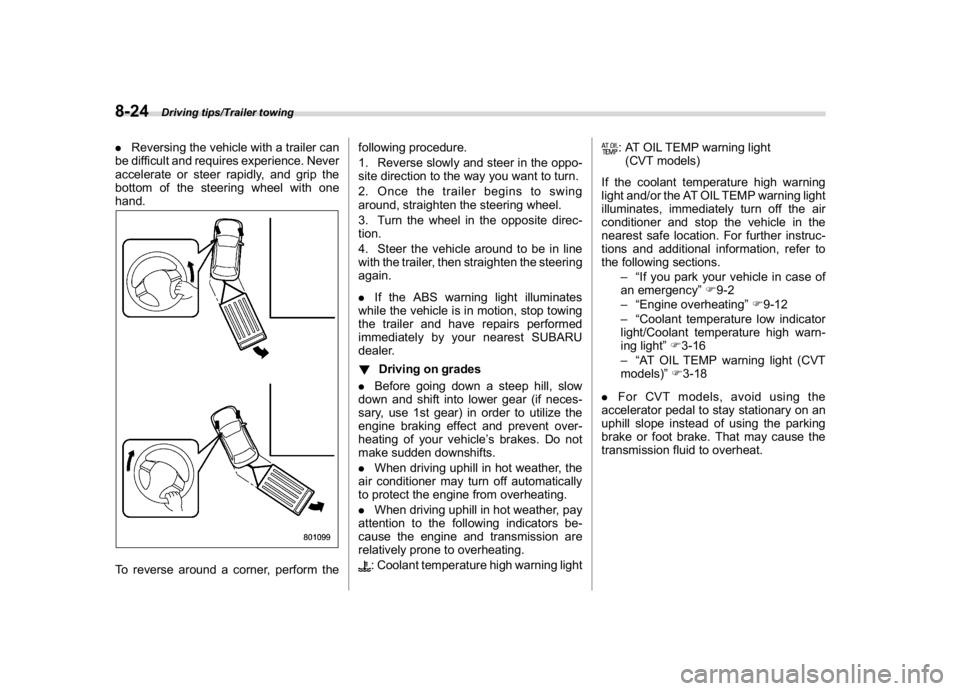
.Reversing the vehicle with a trailer can
be difficult and requires experience. Never
accelerate or steer rapidly, and grip the
bottom of the steering wheel with one
hand.To reverse around a corner, perform thefollowing procedure.
1. Reverse slowly and steer in the oppo-
site direction to the way you want to turn.
2. Once the trailer begins to swing
around, straighten the steering wheel.
3. Turn the wheel in the opposite direc-
tion.
4. Steer the vehicle around to be in line
with the trailer, then straighten the steering
again.
.If the ABS warning light illuminates
while the vehicle is in motion, stop towing
the trailer and have repairs performed
immediately by your nearest SUBARU
dealer.
!Driving on grades
.Before going down a steep hill, slow
down and shift into lower gear (if neces-
sary, use 1st gear) in order to utilize the
engine braking effect and prevent over-
heating of your vehicle’s brakes. Do not
make sudden downshifts.
.When driving uphill in hot weather, the
air conditioner may turn off automatically
to protect the engine from overheating.
.When driving uphill in hot weather, pay
attention to the following indicators be-
cause the engine and transmission are
relatively prone to overheating.
: Coolant temperature high warning light
: AT OIL TEMP warning light
(CVT models)
If the coolant temperature high warning
light and/or the AT OIL TEMP warning light
illuminates, immediately turn off the air
conditioner and stop the vehicle in the
nearest safe location. For further instruc-
tions and additional information, refer to
the following sections.
–“If you park your vehicle in case of
an emergency”F9-2
–“Engine overheating”F9-12
–“Coolant temperature low indicator
light/Coolant temperature high warn-
ing light”F3-16
–“AT OIL TEMP warning light (CVT
models)”F3-18
.For CVT models, avoid using the
accelerator pedal to stay stationary on an
uphill slope instead of using the parking
brake or foot brake. That may cause the
transmission fluid to overheat.
Driving tips/Trailer towing
8-24
Page 365 of 474
(376,1)
北米Model "A1320BE-C" EDITED: 2017/ 10/ 10
Engine overheating
WARNING
Never attempt to remove the radiator
cap until the engine has been shut
off and has fully cooled down. When
the engine is hot, the coolant is
under pressure. Removing the cap
while the engine is still hot could
release a spray of boiling hot cool-
ant, which could burn you very
seriously.
If the engine overheats, safely pull off the
road and stop the vehicle in a safe
location.&If steam is coming from the
engine compartment.Turn the ignition switch to the“LOCK”/
“OFF”position and get everyone away
from the vehicle until it cools down.
.Contact an authorized SUBARU deal-
er.&If no steam is coming from the
engine compartment1. Keep the engine running at idling
speed.2. Open the engine hood to ventilate the
engine compartment. Refer to“Engine
hood”F11-5.
Confirm that the cooling fan is turning. If
the fan is not turning, immediately turn off
the engine and contact an authorized
SUBARU dealer for repair.
3. After the coolant temperature high
warning light that has blinked or illumi-
nated inREDturns off, turn off the engine.
For details about the warning light, refer to
“Coolant temperature low indicator light/
Coolant temperature high warning light”
F3-16.
4. After the engine has fully cooled down,
check the coolant level in the reserve tank.
If the coolant level is below the“LOW”
mark, add coolant up to the“FULL”mark.
NOTEFor details about how to check the
coolant level or how to add coolant,
refer to“Engine coolant”F11-11.
5. If there is no coolant in the reserve
tank, add coolant to the reserve tank. Then
remove the radiator cap and fill the radiator
with coolant.
If you remove the radiator cap from a hot
radiator, first wrap a thick cloth around the
radiator cap, then turn the cap counter-
clockwise slowly without pressing downuntil it stops. Release the pressure from
the radiator. After the pressure has been
fully released, remove the cap by pressing
down and turning it.
In case of emergency/Engine overheating
9-12
Page 382 of 474

(395,1)
北米Model "A1320BE-C" EDITED: 2017/ 10/ 10
Maintenance schedule.......................................... 11-3
Maintenance precautions..................................... 11-3
Before checking or servicing in the engine
compartment...................................................... 11-4
When checking or servicing in the engine
compartment...................................................... 11-4
When checking or servicing in the engine
compartment while the engine is running............ 11-5
Engine hood.......................................................... 11-5
Engine compartment overview............................ 11-7
Engine oil............................................................... 11-8
Engine oil consumption........................................ 11-8
Locations of the oil level gauge, oil filler cap
and oil filter........................................................ 11-8
Checking the oil level............................................ 11-8
Changing the oil and oil filter................................ 11-9
Recommended grade and viscosity..................... 11-10
Synthetic oil........................................................ 11-10
Cooling system................................................... 11-10
Safety precautions.............................................. 11-10
Cooling fan, hose and connections..................... 11-11
Engine coolant.................................................... 11-11
Air cleaner element............................................. 11-12
Replacing the air cleaner element........................ 11-13
Spark plugs......................................................... 11-14
Recommended spark plugs................................. 11-14
Drive belts........................................................... 11-14
Manual transmission oil..................................... 11-14
Recommended grade and viscosity..................... 11-14
Continuously variable transmission fluid..........11-15
Front differential gear oil (CVT models) and
rear differential gear oil....................................11-15
Recommended grade and viscosity..................... 11-15
Brake fluid............................................................11-15
Checking the fluid level...................................... 11-15
Recommended brake fluid.................................. 11-16
Clutch fluid (MT models).....................................11-16
Checking the fluid level...................................... 11-16
Recommended clutch fluid................................. 11-17
Brake booster......................................................11-17
Brake pedal..........................................................11-18
Checking the brake pedal free play..................... 11-18
Checking the brake pedal reserve distance ......... 11-18
Clutch pedal (MT models)...................................11-18
Checking the clutch function .............................. 11-18
Checking the clutch pedal free play.................... 11-19
Hill start assist system.......................................11-19
Replacement of brake pad andlining................11-19
Breaking-in of new brake pads and linings .......... 11-20
Parking brake stroke...........................................11-20
Tires and wheels.................................................11-21
Types of tires..................................................... 11-21
Tire pressure monitoring system (TPMS)
(if equipped).................................................... 11-21
Tire inspection.................................................... 11-22
Tire pressures and wear..................................... 11-23
Wheel balance.................................................... 11-24
Wear indicators.................................................. 11-25
Maintenance and service
11
Page 385 of 474

(398,1)
北米Model "A1320BE-C" EDITED: 2017/ 10/ 10
erative. NEVER use a circuit tes-
ter for this wiring. If your SRS
airbag or seatbelt pretensioner
needs service, consult your near-
est SUBARU dealer.
NOTESUBARU does not endorse the use of
non-SUBARU approved flushing sys-
tems and strongly advises against
performing these services on a
SUBARU vehicle. Non-SUBARU ap-
proved flushing systems use chemi-
cals and/or solvents which have not
been tested or approved by SUBARU.
SUBARU warranties do not cover any
part of the vehicle which is damaged by
adding or applying chemicals and/or
solvents other than those approved or
recommended by SUBARU.&Before checking or servicing
in the engine compartment
WARNING
.Always stop the engine and apply
the parking brake firmly to pre-
vent the vehicle from moving.
.Always let the engine cool down.
Engine parts become very hotwhen the engine is running and
remain hot for some time after the
engine has stopped.
.Do not spill engine oil, engine
coolant, brake fluid or any other
fluid on hot engine components.
This may cause a fire.
.When the ignition switch is in the
“ON”position, the cooling fan
may operate suddenly even when
the engine is stopped. If your
body or clothes come into con-
tact with a rotating fan, that could
result in serious injury. To avoid
risk of injury, perform the follow-
ing precautions.
–Models with push-button start
system:
Always turn the push-button
ignition switch to the“OFF”
position and confirm that the
operation indicator on the
switch is turned off. Then take
the access key fob out from
the vehicle.
–Models without push-button
start system:
Always remove the key from
the ignition switch.
.Before performing any servicing
on a vehicle equipped with aremote engine start system (a
dealer option), temporarily place
the remote engine start system in
service mode to prevent it from
unexpectedly starting the engine.
&When checking or servicing
in the engine compartment
CAUTION
.Do not contact the drive belt
cover while checking the compo-
nents in the engine compartment.
Doing so may cause your hand to
slip off the cover and result in an
unexpected injury.
.Do not touch the oil filter until the
Maintenance and service/Maintenance precautions
11-4
Page 388 of 474

(401,1)
北米Model "A1320BE-C" EDITED: 2017/ 10/ 10
Engine compartment overview
1) Brake fluid reservoir/Clutch fluid reservoir
(MT models) (page 11-15)
2) Fuse box (page 11-34)
3) Battery (page 11-33)
4) Windshield washer tank (page 11-28)
5) Radiator cap (page 11-11)
6) Engine oil filler cap (page 11-8)
7) Engine coolant reservoir (page 11-11)
8) Engine oil filter (page 11-9)
9) Engine oil level gauge (page 11-8)
10) Air cleaner case (page 11-12)
Maintenance and service/Engine compartment overview
11-7
11
Page 391 of 474

(404,1)
北米Model "A1320BE-C" EDITED: 2017/ 10/ 10
self, observe the local regulations and
dispose of waste oil properly.&Recommended grade and
viscosity
CAUTION
Use only engine oil with the recom-
mended grade and viscosity.
Refer to“Engine oil”F12-4.NOTEEngine oil viscosity (thickness) affects
fuel economy. Oils of lower viscosity
provide better fuel economy. However,
in hot weather, oil of higher viscosity is
required to properly lubricate the en-
gine.&Synthetic oilYou should use synthetic engine oil that
meets the same requirements given for
conventional engine oil. When using syn-
thetic oil, you must use oil of the same
classification, viscosity and grade shown
in this Owner’s Manual. Refer to“Engine
oil”F12-4. Also, you must follow the oil
and filter changing intervals shown in the
Warranty and Maintenance booklet.
NOTESynthetic oil of the grade and viscosity
noted in chapter 12 is the recom-
mended engine oil for optimum engine
performance. Conventional oil may be
used if synthetic oil is unavailable.
Cooling system&Safety precautions
WARNING
Never attempt to remove the radiator
cap until the engine has been shut
off and has cooled down completely.
Since the coolant is under pressure,
you may suffer serious burns from a
spray of boiling hot coolant when
the cap is removed.
CAUTION
.Vehicles are filled at the factory
with SUBARU Super Coolant that
does not require the first change
for 11 years/137,500 miles (11
years/220,000 km). This coolant
should not be mixed with any
other brand or type of coolant
during this period. Mixing with a
different coolant will reduce the
life of the coolant. Should it be
necessary to top up the coolant
for any reason, use only SUBARU
Super Coolant.
If the SUBARU Super Coolant is
diluted with another brand or
Maintenance and service/Cooling system
11-10
Page 392 of 474

(405,1)
北米Model "A1320BE-C" EDITED: 2017/ 10/ 10
type, the maintenance interval is
shortened to that of the mixing
coolant.
.Do not splash the engine coolant
over painted parts. The alcohol
contained in the engine coolant
may damage the paint surface.
&Cooling fan, hose and con-
nectionsYour vehicle employs an electric cooling
fan which is thermostatically controlled to
operate when the engine coolant reaches
a specific temperature.
If the radiator cooling fan does not operate
even when the coolant temperature high
warning light blinks or illuminates inRED,
the cooling fan circuit may be defective.
Refer to“Coolant temperature low indica-
tor light/Coolant temperature high warning
light”F3-16.
Check the fuse and replace it if necessary.
Refer to“Fuses”F11-34 and“Fuse panel
located in the engine compartment”F12-
12.
If the fuse is not blown, have the cooling
system checked by your SUBARU dealer.
If frequent addition of coolant is necessary,
there may be a leak in the engine coolingsystem. It is recommended that the cooling
system and connections be checked for
leaks, damage, or looseness.
&Engine coolant!Checking the coolant level
WARNING
Never attempt to remove the radiator
cap until the engine has been shut
off and has cooled down completely.
Since the coolant is under pressure,
you may suffer serious burns from a
spray of boiling hot coolant when
the cap is removed.
1)“FULL”level mark
2)“LOW”level markCheck the coolant level at each fuel stop.
1. Check the coolant level on the outside
of the reservoir while the engine is cool.
2. If the level is close to or lower than the
“LOW”level mark, add coolant up to the
“FULL”level mark. If the reserve tank is
empty, remove the radiator cap and refill
coolant up to just below the filler neck as
shown in the following illustration.
–CONTINUED–
Maintenance and service/Cooling system
11-11
11