2018 SUBARU CROSSTREK lock
[x] Cancel search: lockPage 387 of 474
(400,1)
北米Model "A1320BE-C" EDITED: 2017/ 10/ 10
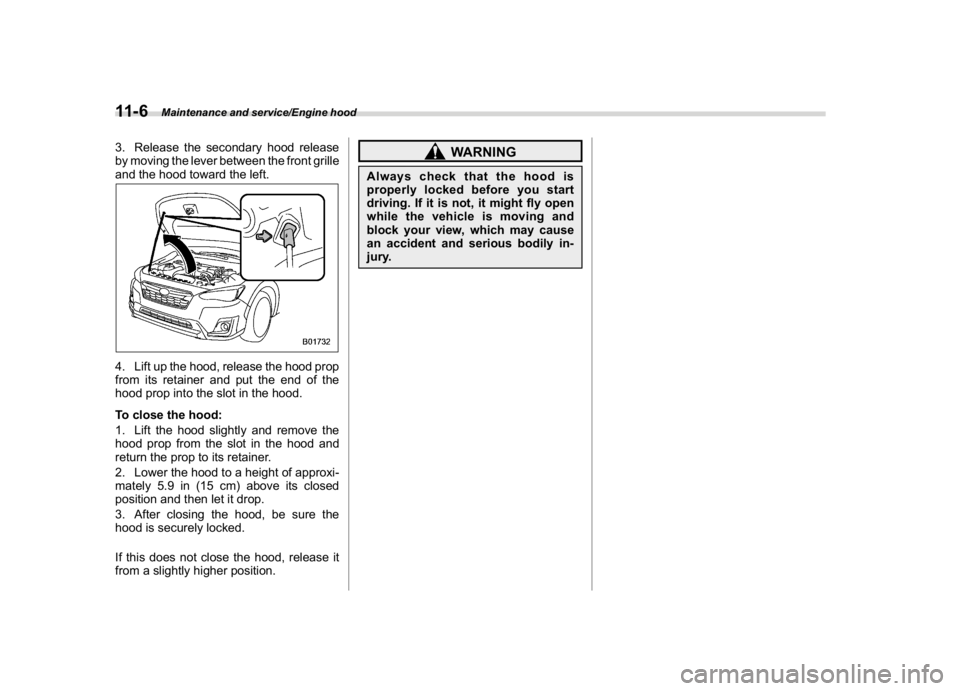
3. Release the secondary hood release
by moving the lever between the front grille
and the hood toward the left.4. Lift up the hood, release the hood prop
from its retainer and put the end of the
hood prop into the slot in the hood.
To close the hood:
1. Lift the hood slightly and remove the
hood prop from the slot in the hood and
return the prop to its retainer.
2. Lower the hood to a height of approxi-
mately 5.9 in (15 cm) above its closed
position and then let it drop.
3. After closing the hood, be sure the
hood is securely locked.
If this does not close the hood, release it
from a slightly higher position.
WARNING
Always check that the hood is
properly locked before you start
driving. If it is not, it might fly open
while the vehicle is moving and
block your view, which may cause
an accident and serious bodily in-
jury.
Maintenance and service/Engine hood
11-6
Page 389 of 474
(402,1)
北米Model "A1320BE-C" EDITED: 2017/ 10/ 10
Engine oil
CAUTION
.If the level gauge cannot be
pulled out easily, twist the level
gauge right and left, then gently
pull it out. Otherwise, you may be
injured accidentally straining
yourself.
.Use only engine oil with the
recommended grade and vis-
cosity.
.Be careful not to spill engine oil
when adding it. If oil touches the
exhaust pipe, it may cause a bad
smell, smoke, and/or a fire. If
engine oil gets on the exhaust
pipe, be sure to wipe it off.&Engine oil consumptionSome engine oil will be consumed while
driving. The rate of consumption can be
affected by such factors as transmission
type, driving style, terrain and tempera-
ture. Under the following conditions, oil
consumption can be increased and thus
require refilling between maintenance in-
tervals:
.When the engine is new and within thebreak-in period
.When the engine oil is of lower quality
.When the incorrect oil viscosity is used
.When engine braking is employed
(repeatedly)
.When the engine is operated at high
engine speeds (for extended periods of
time)
.When the engine is operated under
heavy loads (for extended periods of time)
.When towing a trailer
.When the engine idles for extended
periods of time
.When the vehicle is operated in stop
and go and/or heavy traffic situations
.When the vehicle is used under severe
thermal conditions
.When the vehicle accelerates and
decelerates frequently
Under these or similar conditions, you
should check your oil at least every 2nd
fuel fill-up and change your engine oil more
frequently. Different drivers in the same
car may experience different results. If
your oil consumption rate is greater than
expected, contact your authorized
SUBARU retailer who may perform a test
under controlled conditions.
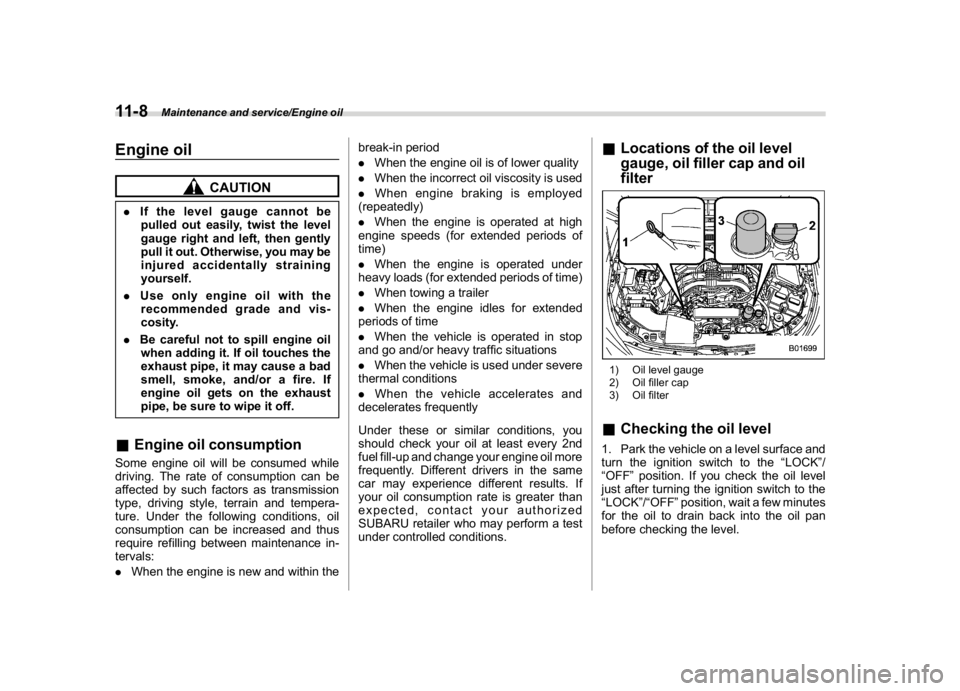
&Locations of the oil level
gauge, oil filler cap and oil
filter1) Oil level gauge
2) Oil filler cap
3) Oil filter&Checking the oil level1. Park the vehicle on a level surface and
turn the ignition switch to the“LOCK”/
“OFF”position. If you check the oil level
just after turning the ignition switch to the
“LOCK”/“OFF”position, wait a few minutes
for the oil to drain back into the oil pan
before checking the level.
Maintenance and service/Engine oil
11-8
Page 398 of 474
(411,1)
北米Model "A1320BE-C" EDITED: 2017/ 10/ 10
Alcohol contained in the clutch
fluid may damage them.
.Be careful not to spill clutch fluid
when adding it. If clutch fluid
touches the exhaust pipe, it may
cause a bad smell, smoke, and/or
a fire. If clutch fluid gets on the
exhaust pipe, be sure to wipe it
off.
.The fluid level for the clutch
system must be checked at the
inboard side of the reservoir. It
cannot be checked at the out-
board side of the reservoir.
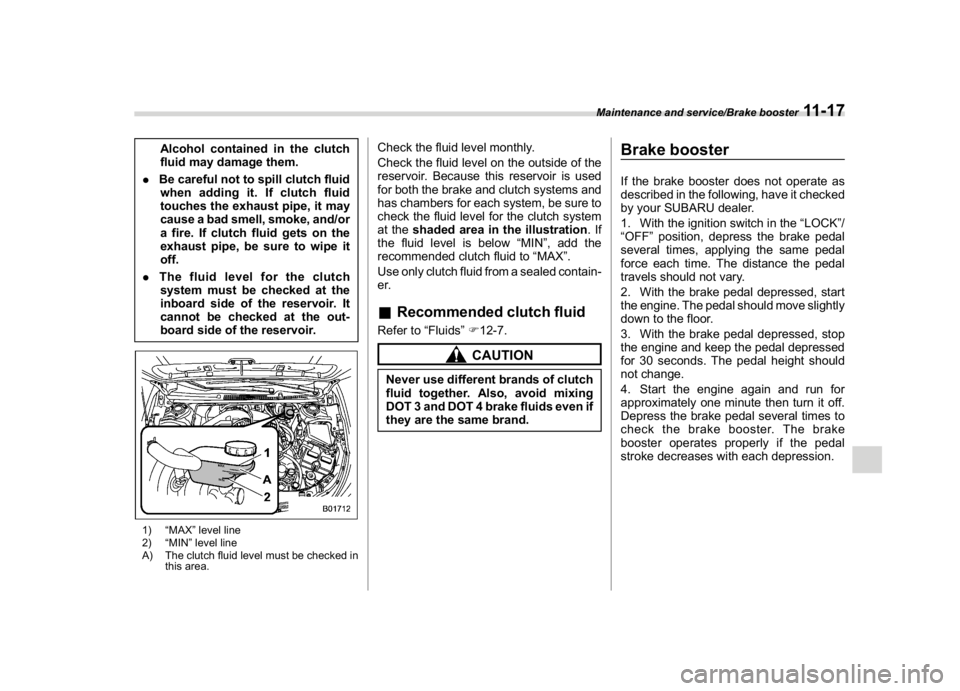
1)“MAX”level line
2)“MIN”level line
A) The clutch fluid level must be checked in
this area.
Check the fluid level monthly.
Check the fluid level on the outside of the
reservoir. Because this reservoir is used
for both the brake and clutch systems and
has chambers for each system, be sure to
check the fluid level for the clutch system
at theshaded area in the illustration.If
the fluid level is below“MIN”, add the
recommended clutch fluid to“MAX”.
Use only clutch fluid from a sealed contain-
er.&Recommended clutch fluidRefer to“Fluids”F12-7.
CAUTION
Never use different brands of clutch
fluid together. Also, avoid mixing
DOT 3 and DOT 4 brake fluids even if
they are the same brand.
Brake boosterIf the brake booster does not operate as
described in the following, have it checked
by your SUBARU dealer.
1. With the ignition switch in the“LOCK”/
“OFF”position, depress the brake pedal
several times, applying the same pedal
force each time. The distance the pedal
travels should not vary.
2. With the brake pedal depressed, start
the engine. The pedal should move slightly
down to the floor.
3. With the brake pedal depressed, stop
the engine and keep the pedal depressed
for 30 seconds. The pedal height should
not change.
4. Start the engine again and run for
approximately one minute then turn it off.
Depress the brake pedal several times to
check the brake booster. The brake
booster operates properly if the pedal
stroke decreases with each depression.
Maintenance and service/Brake booster
11-17
11
Page 399 of 474
(412,1)
北米Model "A1320BE-C" EDITED: 2017/ 10/ 10
Brake pedalCheck the brake pedal free play and
reserve distance according to the main-
tenance schedule in the“Warranty and
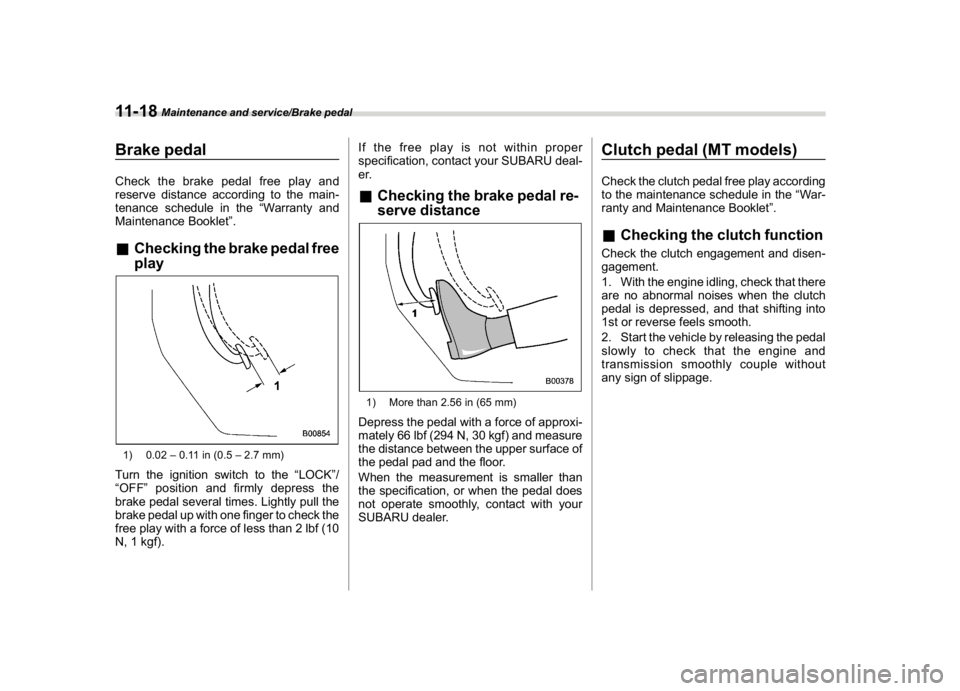
Maintenance Booklet”.&Checking the brake pedal free
play1) 0.02–0.11 in (0.5–2.7 mm)Turn the ignition switch to the“LOCK”/
“OFF”position and firmly depress the
brake pedal several times. Lightly pull the
brake pedal up with one finger to check the
free play with a force of less than 2 lbf (10
N, 1 kgf).If the free play is not within proper
specification, contact your SUBARU deal-
er.
&Checking the brake pedal re-
serve distance1) More than 2.56 in (65 mm)Depress the pedal with a force of approxi-
mately 66 lbf (294 N, 30 kgf) and measure
the distance between the upper surface of
the pedal pad and the floor.
When the measurement is smaller than
the specification, or when the pedal does
not operate smoothly, contact with your
SUBARU dealer.
Clutch pedal (MT models)Check the clutch pedal free play according
to the maintenance schedule in the“War-
ranty and Maintenance Booklet”.&Checking the clutch functionCheck the clutch engagement and disen-
gagement.
1. With the engine idling, check that there
are no abnormal noises when the clutch
pedal is depressed, and that shifting into
1st or reverse feels smooth.
2. Start the vehicle by releasing the pedal
slowly to check that the engine and
transmission smoothly couple without
any sign of slippage.
Maintenance and service/Brake pedal
11-18
Page 401 of 474
(414,1)
北米Model "A1320BE-C" EDITED: 2017/ 10/ 10
result in the need for costly brake
rotor repair or replacement.&Breaking-in of new brake
pads and liningsWhen replacing the brake pad or lining,
use only genuine SUBARU parts. After
replacement, the new parts must be
broken in as follows.
!Brake pad and lining
While maintaining a speed of 30 to 40 mph
(50 to 65 km/h), step on the brake pedal
lightly. Repeat this five or more times.
!Parking brake lining
1. Drive the vehicle at a speed of approxi-
mately 22 mph (35 km/h).
2. With the parking brake release button
pushed in, pull the parking brake lever
SLOWLY and GENTLY (pulling with a
force of approximately 33.7 lbf [150 N,
15.3 kgf]).
3. Drive the vehicle for approximately 220
yards (200 meters) in this condition.
4. Wait 5 to 10 minutes for the parking
brake to cool down. Repeat this proce-
dure.
5. Check the parking brake stroke. If the
parking brake stroke is out of the specified
range, adjust it by turning the adjusting nutlocated on the parking brake lever.
Parking brake stroke:
7–8 notches / 45 lbf (200 N, 20.4 kgf)
WARNING
A safe location and situation should
be selected for break-in driving.
CAUTION
Pulling the parking brake lever too
forcefully may cause the rear wheels
to lock. To avoid this, be certain to
pull the lever up slowly and gently.
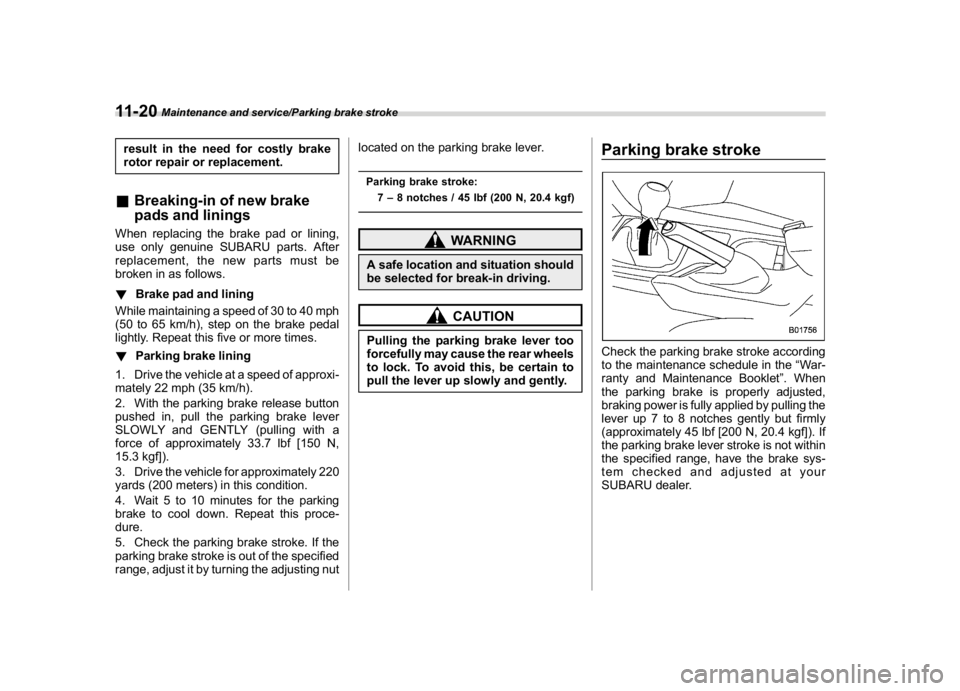
Parking brake strokeCheck the parking brake stroke according
to the maintenance schedule in the“War-
ranty and Maintenance Booklet”. When
the parking brake is properly adjusted,
braking power is fully applied by pulling the
lever up 7 to 8 notches gently but firmly
(approximately 45 lbf [200 N, 20.4 kgf]). If
the parking brake lever stroke is not within
the specified range, have the brake sys-
tem checked and adjusted at your
SUBARU dealer.
Maintenance and service/Parking brake stroke
11-20
Page 409 of 474
(422,1)
北米Model "A1320BE-C" EDITED: 2017/ 10/ 10
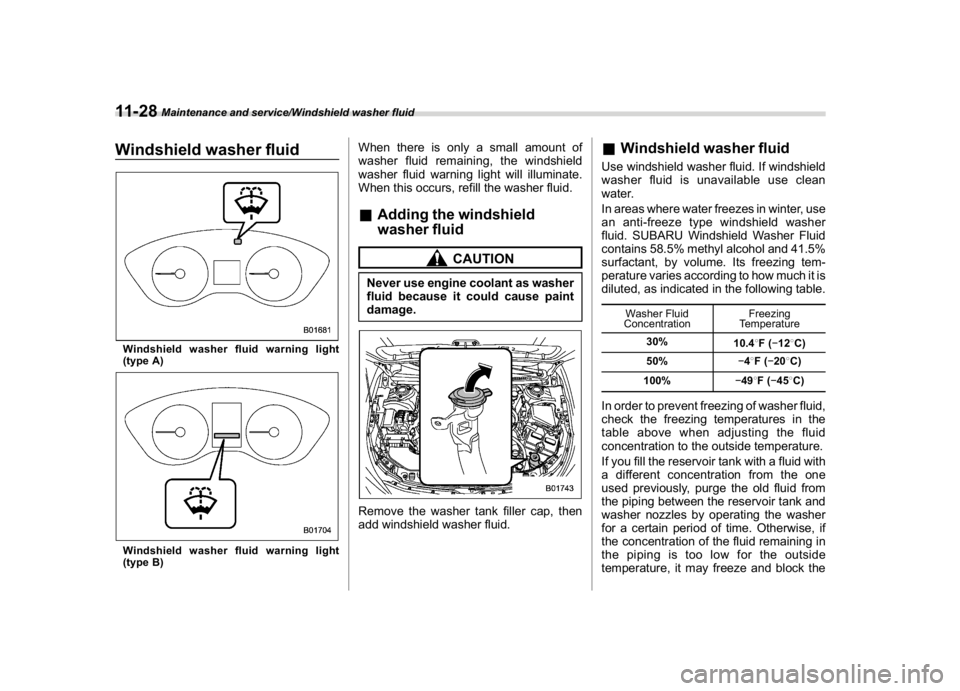
Windshield washer fluidWindshield washer fluid warning light
(type A)Windshield washer fluid warning light
(type B)
When there is only a small amount of
washer fluid remaining, the windshield
washer fluid warning light will illuminate.
When this occurs, refill the washer fluid.&Adding the windshield
washer fluid
CAUTION
Never use engine coolant as washer
fluid because it could cause paint
damage.Remove the washer tank filler cap, then
add windshield washer fluid.
&Windshield washer fluidUse windshield washer fluid. If windshield
washer fluid is unavailable use clean
water.
In areas where water freezes in winter, use
an anti-freeze type windshield washer
fluid. SUBARU Windshield Washer Fluid
contains 58.5% methyl alcohol and 41.5%
surfactant, by volume. Its freezing tem-
perature varies according to how much it is
diluted, as indicated in the following table.
Washer Fluid
ConcentrationFreezing
Temperature
30%
10.48F(128C)
50%48F(208C)
100%498F(458C)
In order to prevent freezing of washer fluid,
check the freezing temperatures in the
table above when adjusting the fluid
concentration to the outside temperature.
If you fill the reservoir tank with a fluid with
a different concentration from the one
used previously, purge the old fluid from
the piping between the reservoir tank and
washer nozzles by operating the washer
for a certain period of time. Otherwise, if
the concentration of the fluid remaining in
the piping is too low for the outside
temperature, it may freeze and block the
Maintenance and service/Windshield washer fluid
11-28
Page 411 of 474
(424,1)
北米Model "A1320BE-C" EDITED: 2017/ 10/ 10
CAUTION
Hold the wiper arm when replacing
the wiper blade. Holding the wiper
blade, may result in blade deforma-
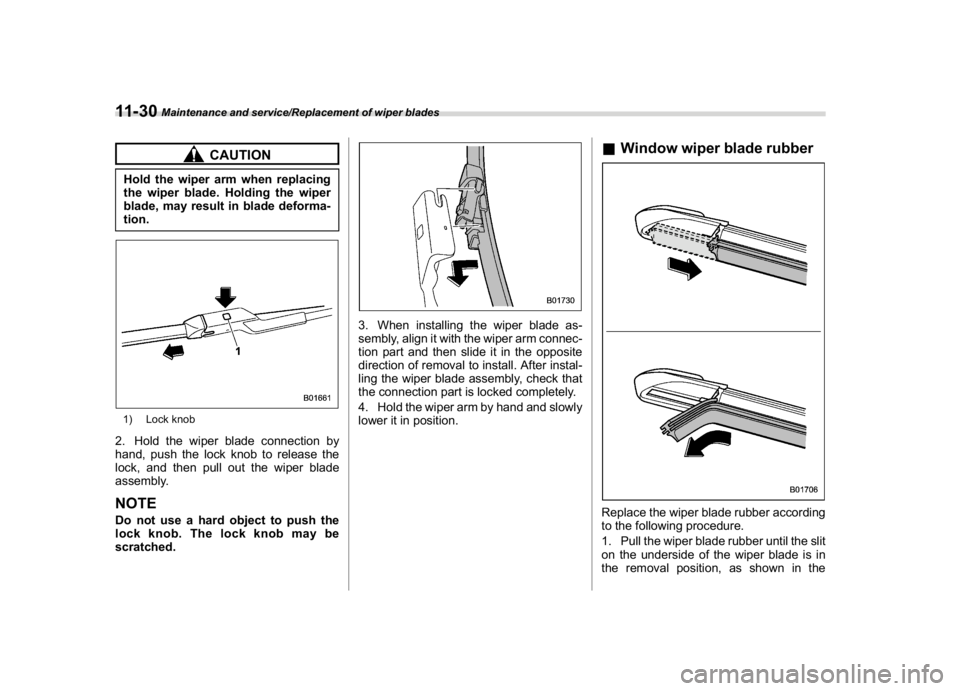
tion.1) Lock knob2. Hold the wiper blade connection by
hand, push the lock knob to release the
lock, and then pull out the wiper blade
assembly.NOTEDo not use a hard object to push the
lock knob. The lock knob may be
scratched.
3. When installing the wiper blade as-
sembly, align it with the wiper arm connec-
tion part and then slide it in the opposite
direction of removal to install. After instal-
ling the wiper blade assembly, check that
the connection part is locked completely.
4. Hold the wiper arm by hand and slowly
lower it in position.
&Window wiper blade rubberReplace the wiper blade rubber according
to the following procedure.
1. Pull the wiper blade rubber until the slit
on the underside of the wiper blade is in
the removal position, as shown in the
Maintenance and service/Replacement of wiper blades
11-30
Page 412 of 474

(425,1)
北米Model "A1320BE-C" EDITED: 2017/ 10/ 10
illustration, so that it can be removed.
2. Pull the end of the wiper blade rubber
through the slit to remove it.
3. To install a new wiper blade rubber,
perform the removal procedure in the
reverse order. After installation, check that
the tip of the wiper rubber has reached the
end of the cap.NOTEIt may be difficult to perform the wiper
blade rubber replacement. We recom-
mend that you contact your SUBARU
dealer for wiper blade rubber replace-
ment if necessary.
&Rear window wiper blade as-
sembly1. Raise the wiper arm off the rear
window.2. Turn the wiper blade assembly coun-
terclockwise.
3. Pull the wiper blade assembly toward
you to remove it from the wiper arm.
4. Install the wiper blade assembly to the
wiper arm. Make sure that it locks in place.
5. Hold the wiper arm by hand and slowly
lower it in position.
–CONTINUED–
Maintenance and service/Replacement of wiper blades
11-31
11