Page 468 of 568
468 5-2. Steps to take in an emergency
BRZ_U (A4450BE-A)
WARNING
■When using the compact spare tire (vehicles with a compact spare
tire)
●Remember that your compact spare tire is specifically designed for
use with your vehicle. Do not use your compact spare tire on another
vehicle.
●Do not use two compact spare tires simultaneously.
●Replace the compact spare tire with a standard tire as soon as possi-
ble.
●Avoid sudden acceleration, abrupt steering, sudden braking and shift-
ing operations that cause sudden engine braking.
●Install the compact spare tire on a front wheel.
■When storing the compact spare tire (vehicles with a compact
spare tire)
Be careful not to catch fingers or other body parts between the compact
spare tire and the body of the vehicle.
■Speed limit when using the compact spare tire (vehicles with a
compact spare tire)
Do not drive at speeds in excess of 50 mph (80 km/h) when a compact
spare tire is installed on the vehicle.
The compact spare tire is not designed for driving at high speeds. Failing
to observe this precaution may lead to an accident causing death or seri-
ous injury.
Page 469 of 568
5
When trouble arises
469
5-2. Steps to take in an emergency
BRZ_U (A4450BE-A)
WARNING
■When the compact spare tire is attached (vehicles with a compact
spare tire)
The vehicle speed may not be correctly detected, and the following sys-
tems may not operate correctly:
●ABS & brake assist
●Vehicle stability control (VSC)
●TRAC
●Electric power steering
●Navigation system (if equipped)
●Cruise control
Page 470 of 568
470 5-2. Steps to take in an emergency
BRZ_U (A4450BE-A)
CAUTION
■Do not drive the vehicle with a flat tire.
Do not continue driving with a flat tire.
Driving even a short distance with a flat tire can damage the tire and the
wheel beyond repair.
■Be careful when driving over bumps with the compact spare tire
installed on the vehicle (vehicles with a compact spare tire).
The vehicle becomes lower when driving with the compact spare tire
compared to when driving with standard tires. Be careful when driving
over uneven road surfaces.
■Driving with tire chains and the compact spare tire (vehicles with a
compact spare tire)
Do not fit tire chains to the compact spare tire.
Tire chains may damage the vehicle body and adversely affect driving
performance.
■When replacing the tires (vehicles with a tire pressure monitoring
system)
When removing or fitting the wheels, tires or the tire pressure warning
valve and transmitter, contact your SUBARU dealer as the tire pressure
warning valve and transmitter may be damaged if not handled correctly.
■To avoid damage to the tire pressure warning valves and transmit-
ters (vehicles with a tire pressure monitoring system)
When a tire is repaired with liquid sealants, the tire pressure warning
valve and transmitter may not operate properly. If a liquid sealant is
used, contact your SUBARU dealer or other qualified service shop as
soon as possible. Make sure to replace the tire pressure warning valve
and transmitter when replacing the tire. (→P. 375)
■Stowing the jack
When stowing the jack in the jack holder, make sure that the part that the
jack handle attaches to is pointing towards the inside of the trunk. Failure
to do so may damage the vehicle body.
Page 483 of 568
5
When trouble arises
483
5-2. Steps to take in an emergency
BRZ_U (A4450BE-A)
WARNING
■
Avoiding battery fires or explosions
Observe the following precautions to prevent accidentally igniting the flam-
mable gas that may be emitted from the battery.
● Make sure the jumper cable is connected to the correct terminal and that it
is not unintentionally in contact with any part other than the intended termi-
nal.
● Do not allow the jumper cables to come into contact with the “+” and “-” ter-
minals.
● Do not allow open flame or use matches, cigarette lighters or smoke near
the battery.
■ Battery precautions
The battery contains poisonous and corrosive acidic electrolyte, while
related parts contain lead and lead compounds. Observe the following pre-
cautions when handling the battery.
● When working with the battery, always wear safety glasses and take care
not to allow any battery fluids (acid) to come into contact with skin, clothing
or the vehicle body.
● Do not lean over the battery.
● In the event that battery fluid comes into contact with the skin or eyes,
immediately wash the affected area with water and seek medical attention.
Place a wet sponge or cloth over the affected area until medical attention
can be received.
● Always wash your hands after handling the battery support, terminals, and
other battery-related parts.
● Do not allow children near the battery.
■ To prevent damage to the vehicle
Do not pull- or push-start the vehicle as the three-way catalytic converter
may overheat and become a fire hazard.
Page 485 of 568
5
When trouble arises
485
5-2. Steps to take in an emergency
BRZ_U (A4450BE-A)
If your vehicle overheats
Correction proceduresStop the vehicle in a safe place and turn off the air condition-
ing system, and then stop the engine.
If you see steam: Carefully lift the hood after the steam subsides.
If you do not see steam: Carefully lift the hood.
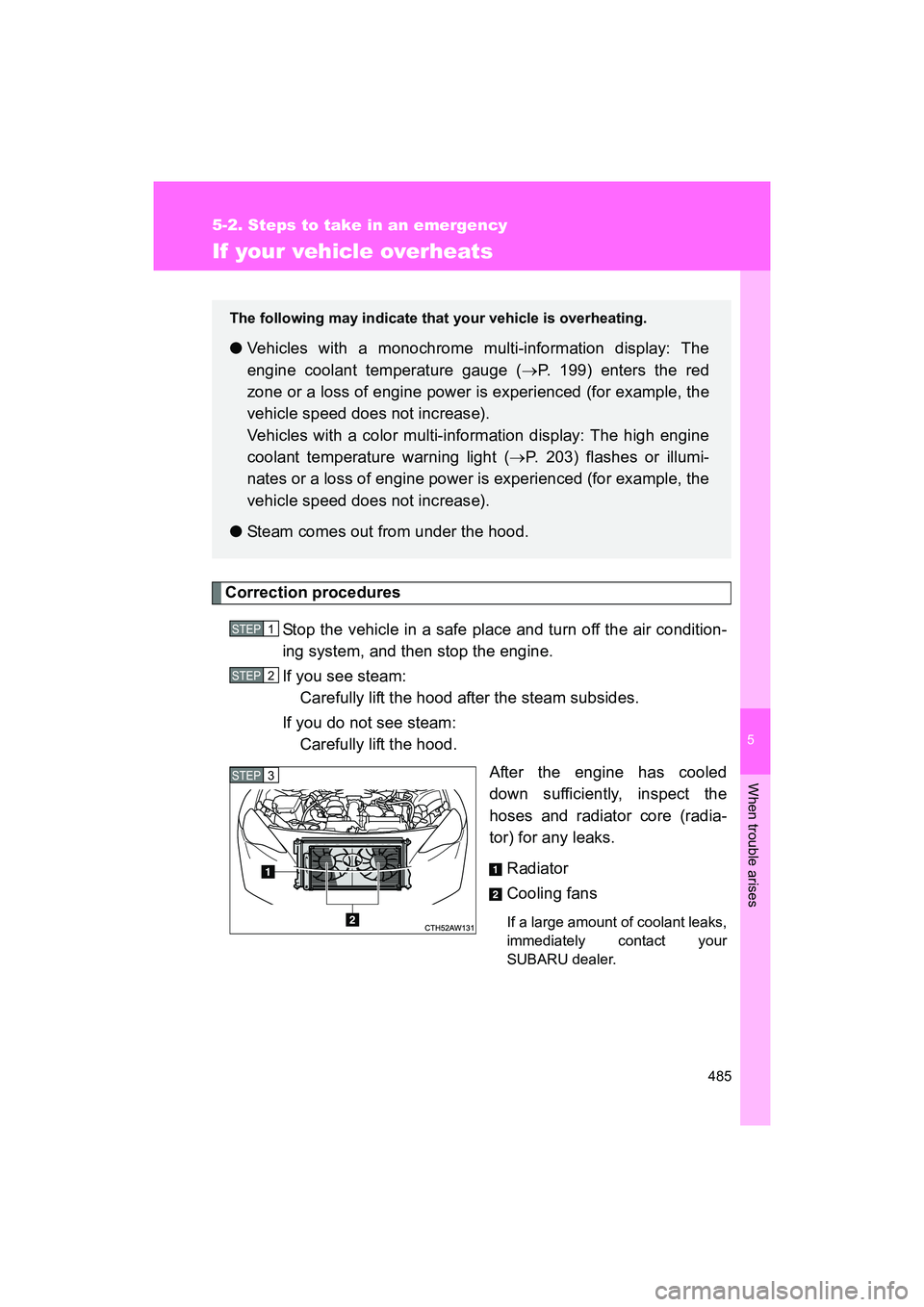
After the engine has cooled
down sufficiently, inspect the
hoses and radiator core (radia-
tor) for any leaks.
Radiator
Cooling fans
If a large amount of coolant leaks,
immediately contact your
SUBARU dealer.
The following may indicate that your vehicle is overheating.
●Vehicles with a monochrome multi-information display: The
engine coolant temperature gauge ( →P. 199) enters the red
zone or a loss of engine power is experienced (for example, the
vehicle speed does not increase).
Vehicles with a color multi-information display: The high engine
coolant temperature warning light ( →P. 203) flashes or illumi-
nates or a loss of engine power is experienced (for example, the
vehicle speed does not increase).
● Steam comes out from under the hood.
STEP 1
STEP 2
STEP 3
Page 487 of 568
5
When trouble arises
487
5-2. Steps to take in an emergency
BRZ_U (A4450BE-A)
WARNING
■
To prevent an accident or injury when inspecting under the hood of
your vehicle
● If steam is seen coming from under the hood, do not open the hood until
the steam has subsided. The engine compartment may be very hot, caus-
ing serious injuries such as burns.
● Keep hands and clothing (especially a tie, a scarf or a muffler) away from
the fans and belts. Failure to do so may cause the hands or clothing to be
caught, resulting in serious injury.
● Do not loosen the radiator cap and the coolant reservoir cap while the
engine and radiator are hot.
Serious injury, such as burns, may result from hot coolant and steam
released under pressure.
CAUTION
■When adding engine coolant
Wait until the engine has cooled down before adding engine coolant.
When adding coolant, do so slowly. Adding cool coolant to a hot engine too
quickly can cause damage to the engine.
■ To prevent damage to the cooling system
Observe the following precautions:
● Avoid contaminating the coolant with foreign matter (such as sand or dust
etc.).
● Do not use any coolant additives.
Page 489 of 568
5
When trouble arises
489
5-2. Steps to take in an emergency
BRZ_U (A4450BE-A)
WARNING
■
When attempting to free a stuck vehicle
If you choose to push the vehicle back and forth to free it, make sure the sur-
rounding area is clear to avoid striking other vehicles, objects or people. The
vehicle may also lunge forward or lunge back suddenly as it becomes free.
Use extreme caution.
■ When shifting the select lever
For vehicles with an automatic transmission, be careful not to shift the select
lever with the accelerator pedal depressed.
This may lead to unexpected rapid acceleration of the vehicle that may
cause an accident resulting in death or serious injury.
CAUTION
■To avoid damage to the transmission and other components
● Avoid spinning the rear wheels and depressing the accelerator pedal more
than necessary.
● If the vehicle remains stuck even after these procedures are performed,
the vehicle may require towing to be freed.
Page 514 of 568

514 6-1. Specifications
BRZ_U (A4450BE-A)■
Tre ad w ea r
The treadwear grade is a comparative rating based on the wear
rate of the tire when tested under controlled conditions on a speci-
fied government test course.
For example, a tire graded 150 would wear one and a half (1 - 1/2)
times as well on the government course as a tire graded 100.
The relative performance of tires depends upon the actual conditions
of their use. Performance may differ significantly from the norm due
to variations in driving habits, service practices and differences in
road characteristics and climate.
■Traction AA, A, B, C
The traction grades, from highest to lowest, are AA, A, B and C,
and they represent the tire’s ability to stop on wet pavement as
measured under controlled conditions on specified government
test surfaces of asphalt and concrete.
A tire marked C may have poor traction performance.
Warning: The traction grade assigned to this tire is based on braking
(straight ahead) traction tests and does not include cornering (turn-
ing) traction.
■Temperature A, B, C
The temperature grades are A (the highest), B, and C, represent-
ing the tire’s resistance to the generation of heat and its ability to
dissipate heat when tested under controlled conditions on a speci-
fied indoor laboratory test wheel.
Sustained high temperature can cause the material of the tire to
degenerate and reduce tire life, and excessive temperature can lead
to sudden tire failure.
Grade C corresponds to a level of performance which all passenger
car tires must meet under the Federal Motor Vehicle Safety Standard
No. 109.
Grades B and A represent higher levels of performance on the labo-
ratory test wheel than the minimum required by law.