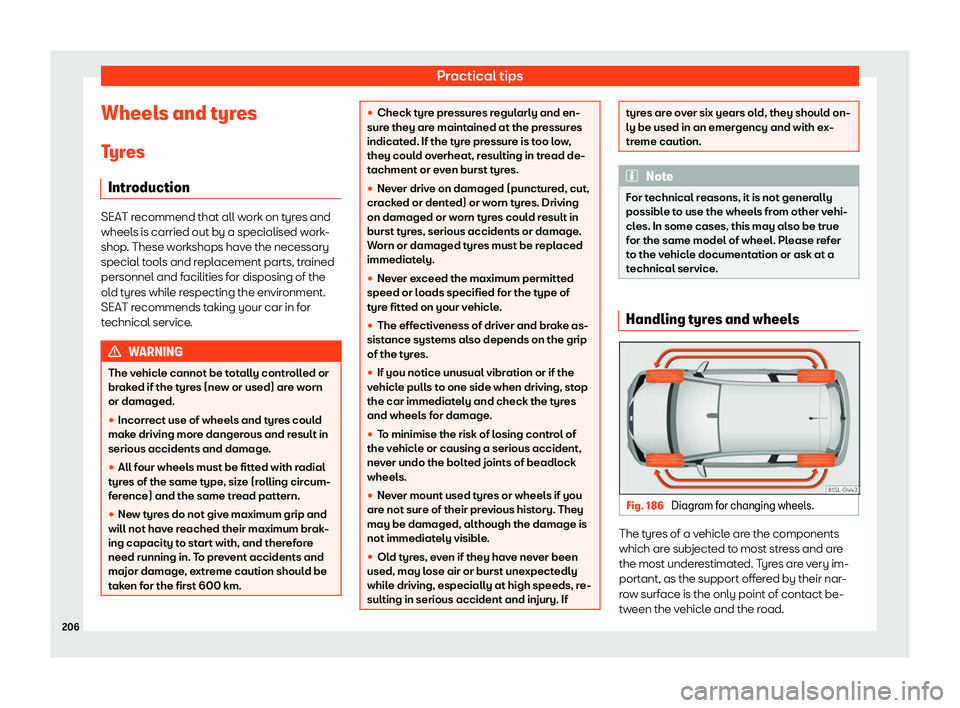
Page 74 of 256
Emergencies
case it is lost, another adapter can be or-
der ed using this number
. Not
e the anti-
theft bolt code for the wheels and keep it
in a place other than the vehicle.
Towline anchorage, removable.
Wire hook for pulling off the wheel cover,
integral hubcaps and the wheel bolt
caps.
Jack. Before storing the jack in the tool kit,
fold its hook. The crank must then be fol-
ded tight against the side of the jack in
order for it to be safely stored.
Wheel spanner.
Wheel bolt cap clips. Note
The jack does not generally require any
maintenance . If r
equired, it should be
greased using universal type grease. Changing a wheel
Intr oduction Read the additional information carefully
Page 84 of 256
Emergencies
Complete operations only in the se-
quence given:
6. R
epl
ace the faulty bulb with a new identical
bulb.
7. Insert the bulb hol
der in the headlight and t
urn
it clockwise as f
ar as the stop.
8. Plug the connector
1 into the bulb holder. The
connector must audibly click int o pl
ace.
9. Replace the wheel arch trim into its position.
10. Place the expansive rivet in the wheel arch trim
and bumper and press it compl
et
ely inwards
Page 109 of 256
Lights and visibility
Adjusting the headlights In those countries where vehicles drive on the
other side of the road t
o the home country,
the asymmetric dipped beam may dazzl
e
drivers of oncoming vehicles.
For this reason, stickers may be needed to
cover the headlights when driving abroad.
For further information, please refer to a spe-
cialised workshop. SEAT recommends visiting
a technical service. Note
The use of stickers to cover headlights is
only permitted o v
er a short period. To mod-
ify the direction of the headlamps more
permanently, please take the vehicle to a
specialised workshop. SEAT recommends
taking your car in for technical service. Headlight range control, lighting of
the instrument panel and contr
ol
s Fig. 112
Next to the steering wheel: Headlight
r ange contr ol Headlamp height adjustment
The headlight r
ange contr
ol
Page 159 of 256

Start and driving
the vehicle by braking individual wheels or by
r educing the engine t
or
que.
The ESC* has limits. It is important to realise
that ESC* is also subject to the laws of phys-
ics. ESC* will not be able to deal with all sit-
uations with which drivers may be faced. For
example, if the road surface changes sud-
denly then ESC* will not be useful in all ca-
ses. If the vehicle suddenly enters a section
covered by water, mud or snow then ESC*
will not provide assistance in the same way
as on dry ground. If the vehicle loses its grip
on the ground and moves on a film of water
(“aquaplaning”), the ESC* will not be able to
help the driver control the vehicle due to the
loss of adherence with the road surface pre-
venting braking and steering. If the vehicle is
driven through series of bends at high speed,
the ESC* will not always be as effective: ag-
gressive driving is not the same as slow driv-
ing.
Adjust your speed and driving style to suit vis-
ibility, and weather, road and traffic condi-
tions. ESC* cannot push the limits of the laws
of physics; improve the transmission available
or maintain the vehicle on the road if a lack of
driver attention creates an inevitable situa-
tion. Otherwise, ESC* assists in maintaining
vehicle control in extreme situations and uses
the movements of the steering made by the driver to maintain the vehicle moving in the
desired direction. If the v
ehicle is driven at
such a speed that it will leave the road before
ESC* can intervene then the system cannot
provide assistance.
The ABS, BAS, ASR and EDL systems are in-
corporated into the ESC*. The ESC* is al-
ways on 1)
.
Anti-lock system (ABS)
ABS can prevent the wheels from locking dur-
ing braking until just before the vehicle stops
thus helping the driver to steer the vehicle
and maintain control. This means that, even
during full braking, the risk of skidding is re-
duced: �
Page 160 of 256
Driving
Electronic differential lock (EDS)
EDL is av ail
abl
e when driving in straight lines
under normal conditions. When the EDL de-
tects wheelspin, it brakes the spinning wheel
and directs the power to the other one. To
prevent the disc brake of the braked wheel
from overheating, the EDL cuts out automati-
cally if subjected to excessive loads. The EDL
will switch on again automatically when the
brake has cooled down. WARNING
Driving at high speed on icy, slippery or wet
ground can r esult in l
oss of vehicle control
and serious injury to the driver and passen-
gers.
�
Page 208 of 256
Practical tips
Wheels and tyres
T yr
es
Intr
oduction SEAT recommend that all work on tyres and
wheels is carried out by a specialised w
ork
-
shop. These workshops have the necessary
special tools and replacement parts, trained
personnel and facilities for disposing of the
old tyres while respecting the environment.
SEAT recommends taking your car in for
technical service. WARNING
The vehicle cannot be totally controlled or
brak ed if the t
yres (new or used) are worn
or damaged.
�
Page 209 of 256
Wheels and tyres
The service life of tyres is dependent on tyre
pr essur
e
, driving style, the care they receive
and the correct fitting.
The tyres and wheel rims are an essential
part of the vehicle
Page 211 of 256
Wheels and tyres
Replacement of wheel rims and
ne w t
yr
es New tyres
�