2018 Seat Ateca fuel
[x] Cancel search: fuelPage 311 of 348

Wheels
WARNING
● Alw a
ys adapt the tyre pressure accordingly
when the vehicle load changes.
● A tyre with low air pressure has to flex a lot
more when the v
ehicle is heavily loaded or at
high speeds, therefore causing overheating
to occur. Under these conditions, the tyre
bead may be released or the tyre may burst.
Risk of accident! For the sake of the environment
Under-inflated tyres will increase fuel con-
sumption. Wear indicators
Fig. 243
Tyre tread: tread wear indicators Tread wear indicators indicate if a tyre is
w
orn. The origin
al
tyres on your vehicle have
1.6 mm high “trea
d wear indicators” running
across the tread. Depending on the manufac-
turer, there will be 6 to 8 of them spaced at
equal distances around the tyre. Markings on
the tyre sidewall (for instance the letters
“TWI” or a triangle) indicate the positions of
the tread wear indicators.
The minimum tread depth required by law is
1.6 mm (measured in the tread grooves next
to the tread wear indicators). (Different fig-
ures may apply in other countries.) WARNING
The tyres must be replaced at the latest when
the tre a
d is worn down to the tread wear indi-
cators. Failure to follow this instruction could
result in an accident.
● Especially in difficult driving conditions
such a
s wet or icy roads. It is important that
the tyre tread be as deep as possible and be
approximately the same on the tyres of both
the front and the rear axles.
● The scant driving safety due to insufficient
trea
d depth is particularly evident in vehicle
handling, when there is a risk of “aquaplan-
ing” in deep puddles of water and when driv-
ing through corners, and braking is also ad-
versely affected.
● The speed has to be adapted accordingly,
otherwi
se there is a risk of losing control over
the vehicle. Interchanging tyres
Fig. 244
Interchanging tyres. To ensure that the wear is equal on all tyres
the wheel
s
shou
ld be changed round from
time to time according to the system
››› Fig. 244. The useful life of all the tyres will
then be about the same time.
New tyres or new wheels –
All four wheels must be fitted with tyres of
the s ame type, s
iz
e (rolling circumference)
and preferably the same tread pattern.
– Tyres should be replaced at least in pairs
and not individual
ly (i.e. both front tyres or
both rear tyres together).
– Do not use tyres whose effective size ex-
ceeds
the dimensions of the factory-ap-
proved makes of tyre. »
309
Technical data
Advice
Operation
Emergencies
Safety
Page 313 of 348

Wheels
●
Av oid ru
nning the vehicle on tyres that are
more than 6 years old. If you have no alterna-
tive, you should drive slowly and with extra
care at all times.
● If wheel trims are fitted after the car is pur-
cha
sed, ensure that there is an adequate flow
of air for cooling the brake system. For the sake of the environment
Old tyres must be disposed of according to
the l aw
s in the country concerned. Note
● A S EA
T Service Centre should be consulted
to find out whether wheels or tyres of differ-
ent sizes to those originally fitted by SEAT
can be fitted, and to find out about the com-
binations allowed between the front axle
(axle 1) and the rear axle (axle 2).
● Never mount used tyres if you are not sure
of their “pr
evious history”.
● For technical reasons, it is not generally
poss
ible to use the wheels from other vehi-
cles. In some cases, this may also be true for
the same model of wheel. Wheel bolts
The wheel
bolts
ar
e m
atched to the rims.
When installing different wheels (for instance
alloy wheels or wheels with winter tyres) it is
important to use the correct wheel bolts with the right length and correctly shaped bolt
head
s. This ensures that wheels are fitted se-
curely and that the brake system functions
correctly.
The wheel bolts must be clean and turn easi-
ly.
A special adapter is required to turn the anti-
theft wheel bolts* ›››
page 65.
Tyre monitoring systems Introduction WARNING
Unsuitable handling of the wheels and tyres
ma y
lead to sudden tyre pressure losses, to
tread separation or even to a blow-out.
● Check tyre pressures regularly and ensure
they are m
aintained at the pressures indica-
ted. Tyre pressure that is too low could cause
overheating, resulting in tread detachment or
even burst tyres.
● Tyre pressure should be that indicated on
the label when the ty
res are cold at all times
››› page 319.
● Regularly check the cold inflation pressure
of the tyr
es. If necessary, change the tyre
pressure of the vehicle tyres while they are
cold. ●
Re gu
larly check your tyres for damage and
wear.
● Never exceed the maximum permitted
speed or loa
ds specified for the type of tyre
fitted on your vehicle. For the sake of the environment
Under-inflated tyres lead to increased fuel
c on s
umption and tyre wear. Note
● Driv ing f
or the first time with new tyres at a
high speed can cause them to slightly ex-
pand, which could then produce an air pres-
sure warning.
● Only replace used tyres with those author-
ised by
SEAT for the corresponding type vehi-
cle.
● Do not only rely on the tyre monitoring sys-
tem. Re
gularly check your tyres to ensure
that the tyre pressure is correct and that the
tyres are not damaged due to puncture, cuts,
tears and impacts/dents. Remove objects
from the tyres only when they have not
pierced the tyres. 311
Technical data
Advice
Operation
Emergencies
Safety
Page 318 of 348

Advice
and specialised workshop. Please note the
r e
gu
lations to this effect in your country.
“All-weather” tyres can also be used instead
of winter tyres.
Using winter tyres with V-rating
Please note that the generally applicable
240 km/h (149 mph) speed for winter tyres
with the letter V is subject to technical re-
strictions; the maximum permissible speed
for your vehicle may be significantly lower .
The maximum speed limit for these tyres de-
pends directly on the maximum axle weights
for your car and on the listed weight rating of
the tyres being used.
It is best to contact a SEAT Official Service to
check the maximum speed which is permissi-
ble for the V-rated tyres fitted on your car on
the basis of this information. WARNING
Exceeding the maximum speed permitted for
the wint er ty
res fitted on your car can cause
tyre failure, resulting in a loss of control of
the vehicle – risk of accident. For the sake of the environment
Summer tyres should be fitted again as soon
as po
ssible after the winter period; they give
better handling on roads which are free of
snow and ice. Summer tyres perform with
less rolling noise, tyre wear and – most im-
portant – reduce fuel consumption. 316
Page 320 of 348

Technical data
Vehicle data sticker
The v
ehic
le data sticker is under the carpet
trim in the luggage compartment, in the
spare wheel well. A sticker with the vehicle
data is attached to the inside cover of the
Maintenance Programme.
The following information is provided on the
vehicle data sticker: ››› Fig. 248
Vehicle identification number (chassis
number)
Vehicle type, model, capacity, engine
type, finish, engine power and gearbox
type
Engine code, gearbox code, external
paint code and internal equipment code
Optional extras and PR numbers
Identifying letters
The identifying letters of the engine can be
viewed on the instrument panel when the en-
gine is switched off and the ignition is on.
● Hold down the button 0.0/SET on the dash
p anel
f
or more than 15 seconds.
1 2
3
4 Information on fuel consump-
tion
Fuel
c
onsumption Approved consumption values are derived
from me
a
surements performed or supervised
by certified EU laboratories, according to the
legislation in force at the time (for more infor-
mation, see the Publications Office of the Eu-
ropean Union on the EUR-Lex website: © Eu-
ropean Union, http://eur-lex.europa.eu/) and
apply to the specified vehicle characteristics.
The values relating to fuel consumption and
CO 2 emissions can be found in the documen-
tation provided to the purchaser of the vehi-
cle at the time of purchase.
Fuel consumption and CO 2 emissions depend
on the equipment/features of each individual
vehicle, as well as on the driving style, road
conditions, traffic conditions, environmental
conditions, load or number of passengers. Note
In practice, and considering all the factors
mentioned here, c on
sumption values can dif-
fer from those calculated in the current Euro-
pean regulations. Weights
Kerb weight refers to the basic model with a
fuel
t
ank filled to 90% capacity and without
optional extras. The figure quoted includes
75 kg to allow for the weight of the driver.
Special versions, optional equipment fittings
or retro-fitting accessories will increase the
weight of the vehicle ››› .
WARNING
● Ple a
se note that the centre of gravity may
shift when transporting heavy objects; this
may affect vehicle handling and lead to an ac-
cident. Always adjust your speed and driving
style to suit road conditions and require-
ments.
● Never exceed the gross axle weight rating
or the gros
s vehicle weight rating. If the per-
missible axle load or the permissible total
weight is exceeded, the driving characteris-
tics of the vehicle may change, which could
lead to accidents, injuries and damage to the
vehicle. 318
Page 322 of 348

Technical data
Engine data P etr
o
l engine 1.0 85 kW (115 PS)
Power output in kW (PS) at rpmMaximum torque (Nm at rpm)No. of cylinders/displacement (cm 3
)Fuel
85 (115)/5,000-5,500200/2,000-3,5003/999Super 95 RON/Normal 91 RON a)
a)
Slight power loss.
Outputs and weights
Top speed (km/h)183 (5)
Acceleration from 0-80 km/h (seconds)7.2
Acceleration from 0-100 km/h (seconds)11.0
Maximum authorised weight (kg)1,830
Weight in running order (with driver) (kg)1,280
Maximum authorised weight on front axle (kg)940
Maximum authorised weight on rear axle (kg)940
Permitted roof load (kg)75
Maximum trailer weight without brakes (kg)640
Weight of trailer with brakes on gradients up to 8% (kg)1,500
Weight of trailer with brakes on gradients up to 12% (kg)1,300 320
Page 323 of 348
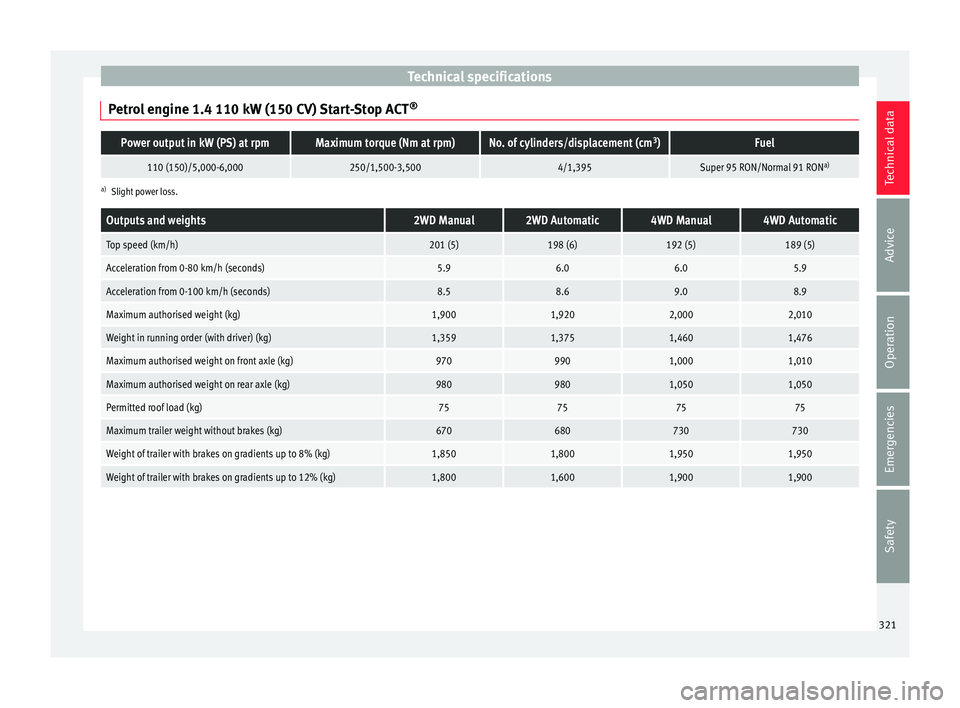
Technical specifications
Petrol engine 1.4 110 kW (150 CV) Start-Stop ACT ®Power output in kW (PS) at rpmMaximum torque (Nm at rpm)No. of cylinders/displacement (cm
3
)Fuel
110 (150)/5,000-6,000250/1,500-3,5004/1,395Super 95 RON/Normal 91 RON a)
a)
Slight power loss.
Outputs and weights2WD Manual2WD Automatic4WD Manual4WD Automatic
Top speed (km/h)201 (5)198 (6)192 (5)189 (5)
Acceleration from 0-80 km/h (seconds)5.96.06.05.9
Acceleration from 0-100 km/h (seconds)8.58.69.08.9
Maximum authorised weight (kg)1,9001,9202,0002,010
Weight in running order (with driver) (kg)1,3591,3751,4601,476
Maximum authorised weight on front axle (kg)9709901,0001,010
Maximum authorised weight on rear axle (kg)9809801,0501,050
Permitted roof load (kg)75757575
Maximum trailer weight without brakes (kg)670680730730
Weight of trailer with brakes on gradients up to 8% (kg)1,8501,8001,9501,950
Weight of trailer with brakes on gradients up to 12% (kg)1,8001,6001,9001,900 321
Technical data
Advice
Operation
Emergencies
Safety
Page 324 of 348

Technical data
Petrol engine 2.0 140 kW (190 PS) Start-StopPower output in kW (PS) at rpmMaximum torque (Nm at rpm)No. of cylinders/displacement (cm 3
)Fuel
140 (190)/4,200-6,000320/1,450-4,2004/1,984Super 95 RON/Normal 91 RON a)
a)
Slight power loss.
Outputs and weights4WD
Top speed (km/h)212(5)
Acceleration from 0-80 km/h (seconds)5.2
Acceleration from 0-100 km/h (seconds)7.9
Maximum authorised weight (kg)2,080
Weight in running order (with driver) (kg)1,536
Maximum authorised weight on front axle (kg)1,070
Maximum authorised weight on rear axle (kg)1,060
Permitted roof load (kg)75
Maximum trailer weight without brakes (kg)750
Weight of trailer with brakes on gradients up to 8% (kg)2,000
Weight of trailer with brakes on gradients up to 12% (kg)1,900 322
Page 325 of 348

Technical specifications
Diesel engine 1.6 85 kW (115 PS)Power output in kW (PS) at rpmMaximum torque (Nm at rpm)No. of cylinders/displacement (cm 3
)Fuel
85 (115)/3,250-4,000250/1,500-3,2504/1,598Diesel according to standard EN 590, min.
51 CZ
Outputs and weights
Top speed (km/h)184 (6)
Acceleration from 0-80 km/h (seconds)8.2
Acceleration from 0-100 km/h (seconds)11.5
Maximum authorised weight (kg)1,910
Weight in running order (with driver) (kg)1,375
Maximum authorised weight on front axle (kg)1,030
Maximum authorised weight on rear axle (kg)930
Permitted roof load (kg)75
Maximum trailer weight without brakes (kg)680
Weight of trailer with brakes on gradients up to 8% (kg)1,700
Weight of trailer with brakes on gradients up to 12% (kg)1,500 323
Technical data
Advice
Operation
Emergencies
Safety