2018 RENAULT TWIZY ESP
[x] Cancel search: ESPPage 3 of 118

0.1
Translated from French. Copying or translation, in part or in full, is fo\
rbidden unless prior written permission has been obtained from the vehicle manu-facturer.
This driver’s handbook contains the information necessary:
– for you to familiarise yourself with your vehicle, to use it to its best\
advantage and to benefit fully from the all the func tions and
the technical developments it incorporates.
– to ensure that it always gives the best performance by following the sim\
ple, but comprehensive advice concerning regular main -
tenance.
– to enable you to deal quickly with minor faults not requiring specialist\
attention.
It is well worth taking a few minutes to read this handbook to familiari\
se yourself with the information and guidelines it cont ains
about the vehicle and its functions and new features. If certain points \
are still unclear, our Network technicians will be only too
pleased to provide you with any additional information.
To help you, you will find the following symbols:
and visible in the vehicle, indicate that you should consult the manual for\
detailed information and/or limits on opera-
tions with respect to your vehicle’s equipment.
Welcome to your new electric vehicle
The descriptions of the models given in this handbook are based on the t\
echnical specifications at the time of writing. This hand-
book covers all items of equipment (both standard and optional) available for these models but whether or not these are
fitted to the vehicle depends on the version, options selected and the c\
ountry where the vehicle is sold.
This handbook may also contain information about items of equipment to b\
e introduced later in the model year.
Throughout the manual, the “approved Dealer” is your RENAULT Dealer. anywhere in the manual indicates a hazard, danger or a safety recommenda\
tion.
Enjoy driving your new vehicle.
Page 10 of 118

1.4
The vehicle drive system
in an electric vehicle uses
a direct voltage of ap-
proximately 58 volts. This
system can get hot during and after
switching off the ignition.
All interventions or modifications to
the vehicle’s electrical system (com-
ponents, cables, connectors, trac-
tion battery) are strictly prohibited
due to the risks they present to your
safety. Please contact an authorised
dealer.
Risk of fire, burns or electric
shocks which may lead to seri-
ous injury.
A
ELECTRIC VEHICLE: introduction (3/5)
The A symbol denotes the electrical
elements of your vehicle which may
present health risks.
“58 volt” electrical circuit
The electrical circuit can be recognised
by the orange cables and by the ele-
ments signalled using the
ṑ symbol.
Noise
Electric vehicles are particularly quiet.
You will not yet necessarily be used to
it, and neither will other road users. It
is difficult for them to hear the vehicle
when it is moving.
We would therefore recommend that
you are aware of the horn and make
use of it, especially when driving in a
built-up area or when manoeuvring
(please see the information under
“Horn” in Section 1).
As the motor is silent, you will hear
noises that you are not used to hearing
(aerodynamic noises, tyre noise, etc.).
When charging, the vehicle may emit
noises (fan, relays, etc).
Your electric vehicle is
silent, so when you get
out, always check that the
handbrake is engaged and
switch off the ignition.
Risk of serious injury.
Page 11 of 118

1.5
ELECTRIC VEHICLE: introduction (4/5)
For safety reasons, adapt
your driving to driving condi-
tions and avoid any sudden
turning of the steering
wheel, especially on steep slopes or
slippery surfaces.
Failure to respect these recommen-
dations may lead to a loss of control
of the vehicle.
Risk of accident and serious injury.
Obstructions to the driver
On the driver’s side, only
use mats suitable for the
vehicle, attached with the
pre-fitted components, and check
the fitting regularly. Do not lay one
mat on top of another.
There is a risk of wedging the
pedals.
Having a passenger effects
vehicle balance, road hold-
ing and increases the vehi-
cle braking distance.
Adapt your driving to the driving
conditions and avoid any sudden
manoeuvre which could lead to a
loss of control over the vehicle. Risk
of accident and serious injury.
Driving
When you lift your foot off the accelera-
tor pedal, the motor generates electri-
cal current during deceleration, and this
energy is used to recharge the traction
battery. Please refer to the information
on the “Charge meter” in Section 2.
An electric motor generates a greater
engine brake than in a petrol or diesel
engine vehicle.
Page 15 of 118
1.9
ELECTRIC VEHICLE: charging (2/5)
Important recommendations for charging your vehiclePlease read these instructions carefully. Failure to follow these instructions may lead to a risk of fire, burns or elec-
tric shock and serious injury.
Installations on domestic sockets
Have a qualified professional check that each socket you intend to use w\
ith the charging cord complies with the standards and
regulations in force in your country, and especially that they have:
– a Type A 30 mA residual current differential device;
– a device to protect against overvoltage (16A fuse or circuit breaker for the socket used);
– protection against overvoltage relating to lightning in exposed areas.
You are recommended to test the residual differential current device every month.
You are recommended to regularly check the domestic plug socket or wall-m\
ounted socket. In the event of any damage (cor-
rosion, discolouration, etc.), do not use it.
Charging
Never wash the vehicle while it is charging.
Never wash the vehicle or the traction battery with a high-pressure jet.\
Always check that the socket is clean, dry and shows no signs of rust be\
fore plugging in. Risk of serious injury and/or electri c
shock which may endanger life.
In the event of the presence of water, signs of corrosion or foreign bodies in the charging cord socket, do n\
ot charge the ve-
hicle. Fire hazard.
Do not attempt to introduce objects into the socket of the charging cord\
.
Never plug the charging cord into a multiple socket or an extension lead\
.
Do not remove or modify the charging cord. Fire hazard.
Take care of the cord: do not stand on it, do not get it wet, only pull i\
t gently, do not drive over it, do not allow anything to hit it
and keep it away from heat sources.
If the blue (or orange) protective sleeve, depending on the vehicle, i\
s damaged, do not use it. Please see an authorised dealer
to replace them.
Page 16 of 118
1.10
ELECTRIC VEHICLE: charging (3/5)
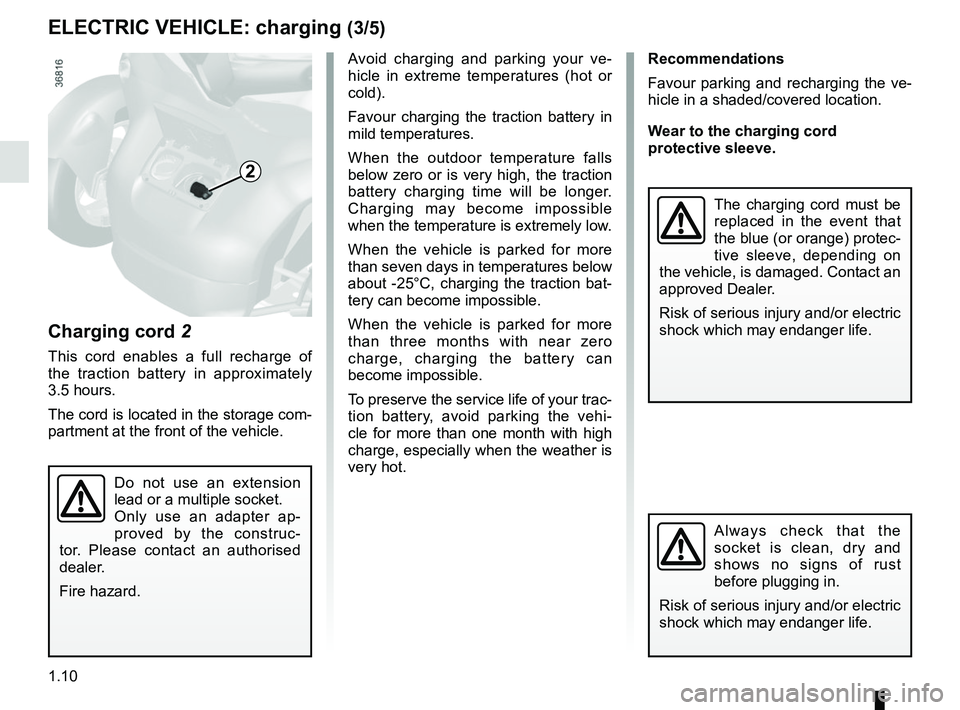
Charging cord 2
This cord enables a full recharge of
the traction battery in approximately
3.5 hours.
The cord is located in the storage com-
partment at the front of the vehicle.
Do not use an extension
lead or a multiple socket.
Only use an adapter ap-
proved by the construc-
tor. Please contact an authorised
dealer.
Fire hazard.
2
Avoid charging and parking your ve-
hicle in extreme temperatures (hot or
cold).
Favour charging the traction battery in
mild temperatures.
When the outdoor temperature falls
below zero or is very high, the traction
battery charging time will be longer.
Charging may become impossible
when the temperature is extremely low.
When the vehicle is parked for more
than seven days in temperatures below
about -25°C, charging the traction bat-
tery can become impossible.
When the vehicle is parked for more
than three months with near zero
charge, charging the battery can
become impossible.
To preserve the service life of your trac-
tion battery, avoid parking the vehi-
cle for more than one month with high
charge, especially when the weather is
very hot. Recommendations
Favour parking and recharging the ve-
hicle in a shaded/covered location.
Wear to the charging cord
protective sleeve.
The charging cord must be
replaced in the event that
the blue (or orange) protec-
tive sleeve, depending on
the vehicle, is damaged. Contact an
approved Dealer.
Risk of serious injury and/or electric
shock which may endanger life.
Always check that the
socket is clean, dry and
shows no signs of rust
before plugging in.
Risk of serious injury and/or electric
shock which may endanger life.
Page 19 of 118

1.13
KEY
Key
A Coded ignition-starter key, locking/
unlocking storage compartments.
The key must not be used for any
function other than those described
in the handbook (removing the cap
from a bottle, etc.).
Replacement, requirements for
additional keys
If you lose your key or require an-
other, you can obtain one exclu-
sively from an authorised dealer.
A
Driver’s responsibility
when parking or stopping
the vehicle
Never leave an animal,
child or adult who is not self-suffi-
cient alone on your vehicle, even for
a short time.
They may pose a risk of injury, such
as by starting the engine or activat-
ing equipment.
Risk of serious injury.
Page 20 of 118

1.14
OPENING AND CLOSING THE DOORS
Opening from inside or
outside
Lift handle 1 and pull upwards.
Closing
Lower the door until it locks into place.
1
As a safety precaution,
the doors should only be
opened or closed when the
vehicle is stationary.
For safety reasons:
– Do not press on the door
while it is open when there
is another occupant of the
vehicle;
– make sure that no people or pets prevent the doors from closing;
– hold the door when opening when parked on a steep slope.
Risk of serious injury.
Do not drive with the door open.
Risk of unwanted closure.Driver’s responsibility
when parking or stopping
the vehicle
Never leave an animal,
child or adult who is not self-suffi-
cient alone on your vehicle, even for
a short time.
They may pose a risk of injury, such
as by starting the engine or activat-
ing equipment.
Risk of serious injury.
Page 30 of 118

1.24
CHILD SAFETY: General information (1/2)
Carrying children
Children, and adults, must be correctly
seated and strapped in for all journeys.
The children being carried in your vehi-
cle are your responsibility.
A child is not a miniature adult. Children
are at risk of specific injuries as their
muscles and bones have not yet fin-
ished growing. The seat belt alone
would not provide suitable protection.
Use a booster seat and ensure you use
it correctly.
A collision at 30 mph
(50 km/h) is the same as fall-
ing a distance of 10 metres.
Transporting a child without
a restraint is the equivalent of allow-
ing him or her to play on a fourth-
floor balcony without railings.
Never travel with a child held in your
arms. In the event of an accident,
you will not be able to keep hold of
the child, even if you yourself are
wearing a seat belt.
If your vehicle has been involved
in a road accident, replace the
booster seat and have the seat belts
checked.Driver’s responsibility
when parking or stopping
the vehicle
Never leave an animal,
child or adult who is not self-suffi-
cient alone on your vehicle, even for
a short time.
They may pose a risk of injury, such
as by starting the engine or activat-
ing equipment.
Risk of serious injury.
Driver’s responsibility
Never use the storage
space as a booster seat for
a child or a pet. Otherwise,
this could place your child or pet in
danger, or endanger the driver, in
the event of hard braking or impact.
Risk of death or serious injuries.