Page 307 of 364
5.15
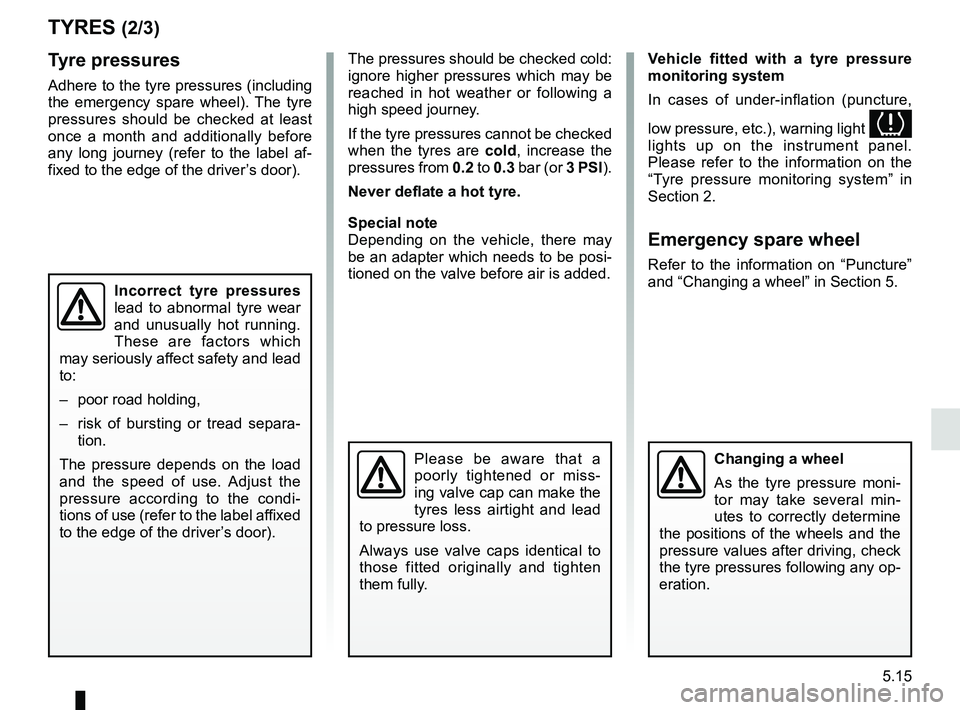
TYRES (2/3)
Tyre pressures
Adhere to the tyre pressures (including
the emergency spare wheel). The tyre
pressures should be checked at least
once a month and additionally before
any long journey (refer to the label af-
fixed to the edge of the driver’s door).The pressures should be checked cold:
ignore higher pressures which may be
reached in hot weather or following a
high speed journey.
If the tyre pressures cannot be checked
when the tyres are
cold, increase the
pressures from 0.2 to 0.3 bar (or 3 PSI).
Never deflate a hot tyre.
Special note
Depending on the vehicle, there may
be an adapter which needs to be posi-
tioned on the valve before air is added. Vehicle fitted with a tyre pressure
monitoring system
In cases of under-inflation (puncture,
low pressure, etc.), warning light
lights up on the instrument panel.
Please refer to the information on the
“Tyre pressure monitoring system” in
Section 2.
Emergency spare wheel
Refer to the information on “Puncture”
and “Changing a wheel” in Section 5.
Incorrect tyre pressures
lead to abnormal tyre wear
and unusually hot running.
These are factors which
may seriously affect safety and lead
to:
– poor road holding,
– risk of bursting or tread separa- tion.
The pressure depends on the load
and the speed of use. Adjust the
pressure according to the condi-
tions of use (refer to the label affixed
to the edge of the driver’s door).
Please be aware that a
poorly tightened or miss-
ing valve cap can make the
tyres less airtight and lead
to pressure loss.
Always use valve caps identical to
those fitted originally and tighten
them fully.Changing a wheel
As the tyre pressure moni-
tor may take several min-
utes to correctly determine
the positions of the wheels and the
pressure values after driving, check
the tyre pressures following any op-
eration.
Page 333 of 364
5.41
OPERATING FAULTS (4/7)
On the roadPOSSIBLE CAUSESWHAT TO DO
Vibrations. Tyres not inflated to correct pres-
sures, incorrectly balanced or dam-
aged. Check the tyre pressures: if this is not the
problem, have them checked by an ap-
proved Dealer.
White smoke from the exhaust. In the diesel version, this is not neces-
sarily a fault. Smoke may be caused
by particle filter regeneration. Refer to the information on “Special fea-
tures of diesel versions” in Section 2.
Smoke under the bonnet. Short-circuit or cooling system leak. Stop, switch off the ignition, stand away
from the vehicle and contact an approved
dealer.
The oil pressure warning light comes
on: while cornering or braking The level is too low. Top up the engine oil level (refer to the in-
formation on “Engine oil level: topping up/
filling” in Section 4).
is slow to go out or remains lit
under acceleration Loss of oil pressure.
Stop the vehicle and contact an approved
Dealer.
Page 343 of 364

The weights indicated are for a basic vehicle without options: they may \
vary depending on your vehicle’s equipment.
Consult an approved Dealer.
Maximum Permissible All-Up Weig")
6.7
WEIGHTS (in kg)
The weights indicated are for a basic vehicle without options: they may \
vary depending on your vehicle’s equipment.
Consult an approved Dealer.
Maximum Permissible All-Up Weight (MMAC)
Gross Train Weight (MTR)
Maximum permissible all-up weight (MMTA)Weights are indicated on the vehicle identification plate (refer
to the information on “Vehicle identification plates” in Section 6)
Braked Trailer Weight* found by calculating: MTR - MMAC
Unbraked Trailer Weight* 740
Permissible nose weight* 75
Permissible load on the roof with the carrying device 80 (including the carrying device)
* Towing weight (Towing a caravan, boat, etc.)
Towing is prohibited when the MTR - MMAC calculation is equal to zero, or\
when the MTR is equal to zero (or is not listed) on t he
identification plate.
– It is important to comply with the towing weights, governed by local leg\
islation in each country and, in particular, laid down in the Road Traffic Regulations. Contact an approved Dealer about any towing equipment.
– For vehicles fitted with a trailer, the total train weight (vehicle + trailer) must never be exceeded. However, for vehicles with
a long chassis, the following conditions are permitted:
– rear axle MMTA exceeded by no more than 15%,
– maximum MMAC exceeded by no more than 10% or 100 kg (whichever is reach\
ed first).
In either case, the maximum speed of the vehicle and trailer must not ex\
ceed 60 mph (100 km/h) and the tyre pressures must be increased by 0.2 bar (3 PSI).
– The engine output and climbing capability are reduced with altitude. You need to reduce the total train weight by 10% at an a l-
titude of 1,000 metres and by an additional 10% for each 1,000 metres th\
ereafter.
Weight transfer
If the Maximum Authorised Mass of the vehicle has not been reached, up to 350 kg can be\
transferred to the braked trailer, with in
the limits of the Gross Train Weight.
Page 362 of 364

7.6
ALPHABETICAL INDEX (6/6)
towing hitch............................................................. 5.36 – 5.37
towing rings .............................................................. 3.51, 3.54
towing weights ..................................................................... 6.7
traction control .......................................................2.35 → 2.39
transporting children ..........................1.39 – 1.40, 1.42 → 1.58
transporting objects in the luggage compartment ........................................ 3.51
luggage net ......................................................3.53 → 3.55
trims ..................................................................\
................. 5.10
trip computer and warning system... 1.66 → 1.71, 1.78 → 1.87
tyre inflation kit...........................................................5.5 → 5.8
tyre pressure.............................2.32 → 2.34, 4.13 – 4.14, 5.15
tyre pressure monitor.............................................2.32 → 2.34
tyre pressures ...........................2.32 → 2.34, 4.13 – 4.14, 4.14
tyres .................... 2.29, 2.32 → 2.34, 4.13 – 4.14, 5.14 → 5.16
U
unlocking the doors ...............................................1.13 → 1.15
V
vehicle detection ....................................................2.40 → 2.46
V
vehicle identification plates .................................................. 6.3
ventilation ............................................3.6 → 3.13, 3.19 – 3.20
W
warning buzzer ................................................ 1.16, 1.94, 1.98
warning lights................................... 1.66 → 1.71, 1.78 → 1.87
washing ................................................................\
.4.15 → 4.17
weights ................................................................\
................ 6.7
wheelbrace .............................................................\
. 5.9 → 5.11
wheels (safety) ......................................................5.14 → 5.16
windscreen de-icing/demisting .......................................... 3.13
windscreen washer .................................... 1.109 – 1.110, 4.10
wiper blades ........................................................... 5.34 – 5.35 wipers
blades ............................................................... 5.34 – 5.35
Page:
< prev 1-8 9-16 17-24
