2018 RENAULT MASTER radio
[x] Cancel search: radioPage 8 of 290

1.2
KEY, RADIO FREQUENCY REMOTE CONTROL: general information (1/3)
Radio frequency remote
control B
1 Locking all the opening elements.
2 Unlocking all the opening elements.
3 Key for ignition switch, doors and
fuel filler cap.
4 Locking/unlocking the luggage com- partment and, depending on the ve-
hicle, the sliding side doors.
Radio frequency remote
control A
1 Locking all the opening elements.
2 Unlocking all the opening elements.
3 Key for ignition switch, doors and
fuel filler cap.
1
2
3
The key must not be used for any
function other than those described
in the handbook (removing the cap
from a bottle, etc.).Advice
Avoid leaving the remote control in
hot, cold or humid areas.
A
1
2
3
4
B
Driver’s responsibility
when parking or stopping
the vehicle
Never leave an animal,
child or adult who is not self-suffi-
cient alone on your vehicle, even for
a short time.
They may pose a risk to themselves
or to others by starting the engine,
activating equipment such as the
electric windows or locking the
doors.
Also, in hot and/or sunny weather,
please remember that the tempera-
ture inside the passenger compart-
ment increases very quickly.
RISK OF DEATH OR SERIOUS
INJURY.
Page 9 of 290
1.3
Radio frequency remote
control operating range
This varies according to the environ-
ment: take care not to lock or unlock
the doors by inadvertently pressing the
buttons on the remote control.
Note: on certain vehicles, if a door is
not opened within approximately 2 min-
utes of the door being unlocked by
remote control, the doors will lock again
automatically.
Interference
Interference by factors in the imme-
diate vicinity (external installations or
the use of equipment operating on the
same frequency as the remote control)
may affect the operation of the remote
control.
KEY, RADIO FREQUENCY REMOTE CONTROL: general information (2/3)
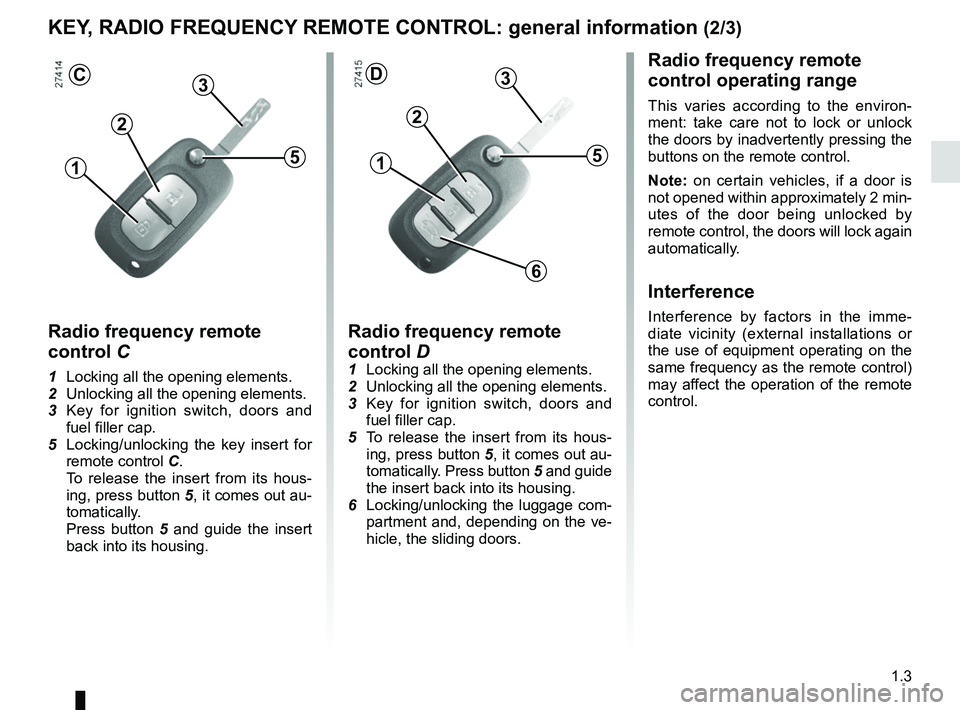
Radio frequency remote
control D
1 Locking all the opening elements.
2 Unlocking all the opening elements.
3 Key for ignition switch, doors and
fuel filler cap.
5 To release the insert from its hous- ing, press button 5, it comes out au-
tomatically. Press button 5 and guide
the insert back into its housing.
6 Locking/unlocking the luggage com- partment and, depending on the ve-
hicle, the sliding doors.
D
1
2
3
5
6
Radio frequency remote
control C
1 Locking all the opening elements.
2 Unlocking all the opening elements.
3 Key for ignition switch, doors and
fuel filler cap.
5 Locking/unlocking the key insert for remote control C.
To release the insert from its hous- ing, press button 5, it comes out au-
tomatically.
Press button 5 and guide the insert
back into its housing.
1
2
C
5
3
Page 10 of 290

1.4
Replacement, additional remote
control or transmitter/receiver
You must only contact an approved
Dealer.
– To replace a remote control, the vehicle must be taken to an ap-
proved Dealer as both the vehi-
cle and the remote control are
needed to initialise the system.
– Depending on the vehicle, you may use up to four remote con-
trols or two transmitter/receivers.
Remote control unit failure
Make sure that the correct battery
type is being used, and that the
battery is in good condition and in-
serted correctly. These batteries
have a service life of approximately
two years.
Refer to the information on the “Key,
radio frequency remote control: bat-
teries” in Section 5 for the battery
changing procedure.
Hands-free access
transmitter/receiver E
This enables the vehicle doors to be
locked/unlocked without using the
remote control unit. Refer to the infor-
mation on “Hands-free access transmit-
ter/receiver: use” in section 1.
EDriver’s responsibility
when parking or stopping
the vehicle
Never leave an animal,
child or adult who is not self-suffi-
cient alone on your vehicle, even for
a short time.
They may pose a risk to themselves
or to others by starting the engine,
activating equipment such as the
electric windows or locking the
doors.
Also, in hot and/or sunny weather,
please remember that the tempera-
ture inside the passenger compart-
ment increases very quickly.
RISK OF DEATH OR SERIOUS
INJURY.
KEY, RADIO FREQUENCY REMOTE CONTROL: general information (3/3)
Page 11 of 290
1.5
KEY, RADIO FREQUENCY REMOTE CONTROL: use (1/2)
1
A
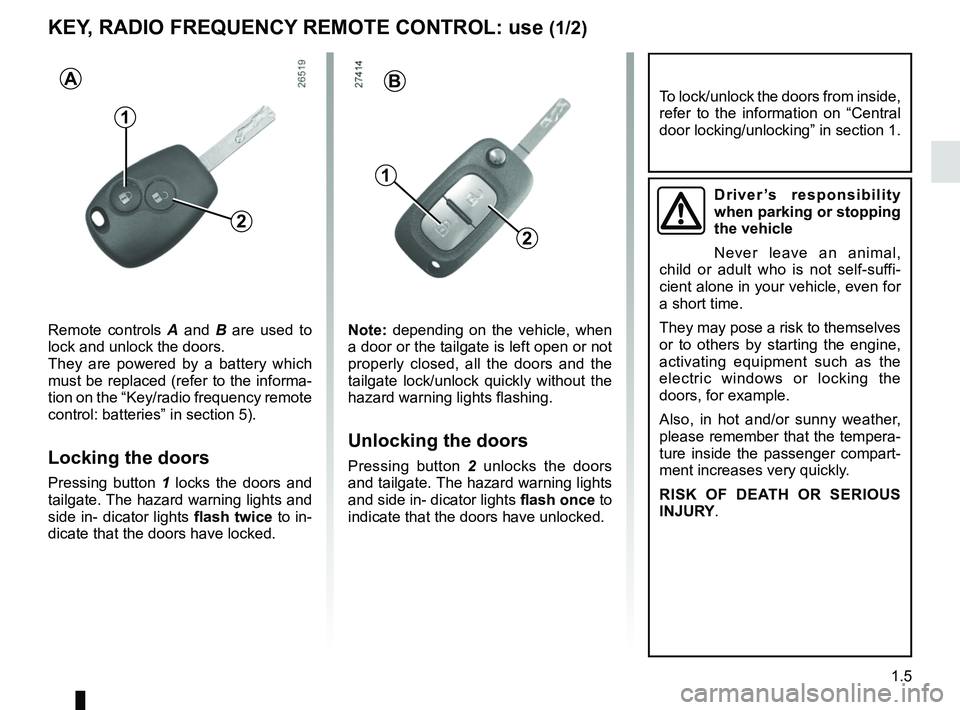
Remote controls A and B are used to
lock and unlock the doors.
They are powered by a battery which
must be replaced (refer to the informa-
tion on the “Key/radio frequency remote
control: batteries” in section 5).
Locking the doors
Pressing button 1 locks the doors and
tailgate. The hazard warning lights and
side in- dicator lights flash twice to in-
dicate that the doors have locked. Note: depending on the vehicle, when
a door or the tailgate is left open or not
properly closed, all the doors and the
tailgate lock/unlock quickly without the
hazard warning lights flashing.
Unlocking the doors
Pressing button 2
unlocks the doors
and tailgate. The hazard warning lights
and side in- dicator lights flash once to
indicate that the doors have unlocked.
2
B
1
2
Driver’s responsibility
when parking or stopping
the vehicle
Never leave an animal,
child or adult who is not self-suffi-
cient alone in your vehicle, even for
a short time.
They may pose a risk to themselves
or to others by starting the engine,
activating equipment such as the
electric windows or locking the
doors, for example.
Also, in hot and/or sunny weather,
please remember that the tempera-
ture inside the passenger compart-
ment increases very quickly.
RISK OF DEATH OR SERIOUS
INJURY.
To lock/unlock the doors from inside,
refer to the information on “Central
door locking/unlocking” in section 1.
Page 12 of 290
1.6
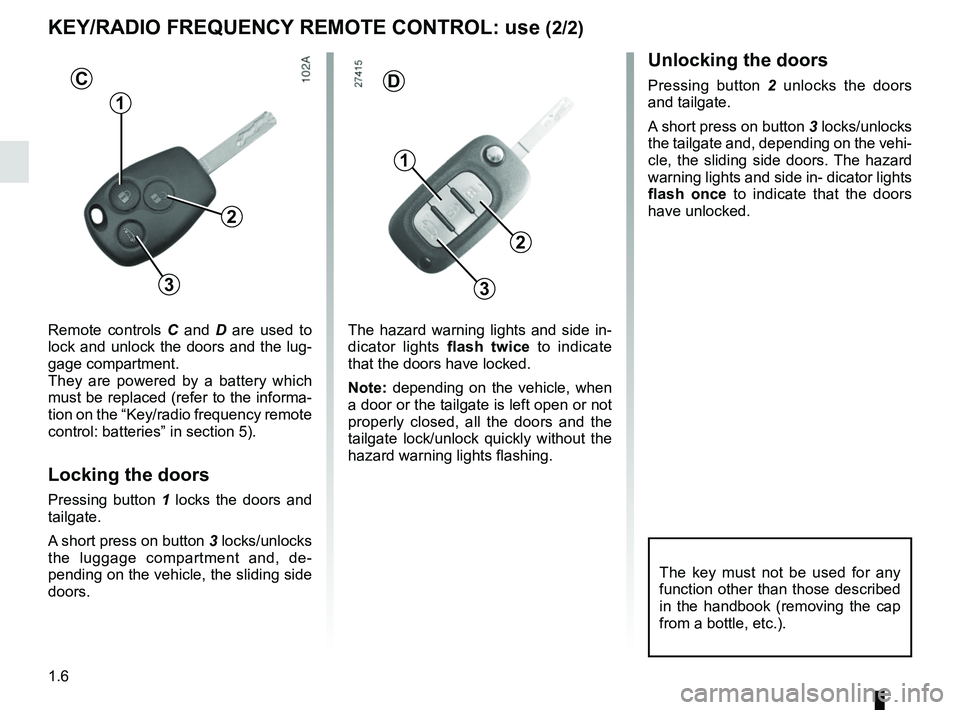
Remote controls C and D are used to
lock and unlock the doors and the lug-
gage compartment.
They are powered by a battery which
must be replaced (refer to the informa-
tion on the “Key/radio frequency remote
control: batteries” in section 5).
Locking the doors
Pressing button 1 locks the doors and
tailgate.
A short press on button 3 locks/unlocks
the luggage compartment and, de-
pending on the vehicle, the sliding side
doors.
KEY/RADIO FREQUENCY REMOTE CONTROL: use (2/2)
D
The hazard warning lights and side in-
dicator lights flash twice to indicate
that the doors have locked.
Note: depending on the vehicle, when
a door or the tailgate is left open or not
properly closed, all the doors and the
tailgate lock/unlock quickly without the
hazard warning lights flashing.
1
2
3
C
1
2
3
The key must not be used for any
function other than those described
in the handbook (removing the cap
from a bottle, etc.).
Unlocking the doors
Pressing button 2 unlocks the doors
and tailgate.
A short press on button 3 locks/unlocks
the tailgate and, depending on the vehi-
cle, the sliding side doors. The hazard
warning lights and side in- dicator lights
flash once to indicate that the doors
have unlocked.
Page 81 of 290

1.75
DRIVER’S POSITION: LEFT-HAND DRIVE (2/2)
The equipment fitted, described below, DEPENDS ON THE VERSION AND COUNTRY.
1 Side window demister outlet.
2 Side air vent.
3 Stalk for:
– direction indicator lights;
– exterior lights;
– front fog lights;
– rear fog lights.
4 Instrument panel.
5 Location for driver’s air bag.
6 – Windscreen wiper/washer stalk.
– Information readout control.
7 Accessories socket.
8 Centre air vent.
9 Location for:
– radio;
– storage compartment.
10 Heating and ventilation controls.
11 Centre air vent.
12 Passenger airbag location.
13 Side air vent.
14 Side window demister.
15 Storage compartments.
16 Location for:
– storage compartment;
– audio connection socket;
– front passenger air bag deacti-vation warning light.
17 Cigar lighter or accessories socket.
18 Switches:
– cruise control/speed limiter;
– activation/deactivation of the Stop and Start function;
– activation/deactivation of ECO mode;
– fast idle speed;
– power take-off.
19 Steering wheel height adjustment
control.
20 Bonnet release.
21 Fuse box.
22 Controls for:
– electric beam height adjust-ment;
– activation/deactivation of the parking distance control;
– activating/deactivating the load position;
– activation/deactivation of the traction control.
Page 83 of 290

1.77
DRIVER’S POSITION, RIGHT-HAND DRIVE (2/2)
The equipment fitted, described below, DEPENDS ON THE VERSION AND COUNTRY.
1 Side window demister outlet.
2 Side air vent.
3 Location for passenger air bag.
4 Centre air vent.
5 Heating and ventilation controls.
6 Location for:
– radio;
– storage compartment.
7 Centre air vent.
8 Accessories socket.
9 Stalk for:
– direction indicator lights;
– exterior lights;
– front fog lights;
– rear fog lights.
10 Instrument panel.
11 Driver airbag location.
12 – Windscreen wiper/washer stalk;
– Information readout control.
13 Side air vent.
14 Side window demister.
15 Controls for:
– electric beam height adjust-ment;
– activation/deactivation of the parking distance control;
– activating/deactivating the load position;
– activation/deactivation of the traction control.
16 Steering wheel height adjustment
control.
17 Switches:
– cruise control/speed limiter;
– activation/deactivation of the Stop and Start function;
– activation/deactivation of ECO mode;
– fast idle speed;
– power take-off.
18 Cigar lighter or accessories socket.
19 Location for:
– storage compartment;
– audio connection socket;
– front passenger air bag deacti-vation warning light.
20 Storage compartment.
21 Bonnet release.
22 Fuse box.
Page 118 of 290

2.2
RUNNING IN, IGNITION SWITCH
Start position D
If the engine fails to start at the first at-
tempt, turn the key back before activat-
ing the starter again. Release the key
as soon as the engine starts.
Note: several seconds may pass be-
tween turning the key and the engine
starting to allow for engine preheating.
Special note on vehicles with a se-
quential gearbox
Depress the brake pedal with the lever
in the N position.
Note: If a gear other than neutral is dis-
played, it flashes; starting is not pos-
sible unless you depress the brake
pedal, while holding the key in the start-
ing position.
Ignition switch
Stop and steering lock position St
To lock: remove the key and turn the
steering wheel until the steering column
locks.
To unlock: turn the key and the steering
wheel slightly.
Accessories position A
When the ignition is switched off, any
accessories (radio, etc.) will continue to
function.
Ignition on position M
With the ignition on, the engine will be
preheating.
In the “Accessories” or “On” posi-
tion, a system may automatically
switch off your vehicle’s accessories
depending on the battery charge, to
prevent it from discharging com-
pletely.
Up to 900 miles (1,500 km), do not exceed 2,500 rpm or approximately
54 mph (90 km/h) in the highest gear.
After completing this mileage you may
drive faster, although you may only
expect top performance after approxi-
mately 3,600 miles (6,000 km).
During the running in period, do not ac-
celerate hard while the engine is still
cold and do not let the engine over-rev.
Service intervals: refer to the
Maintenance Document for the vehicle.