Page 223 of 290
5.9
TYRE INFLATION KIT (5/6)
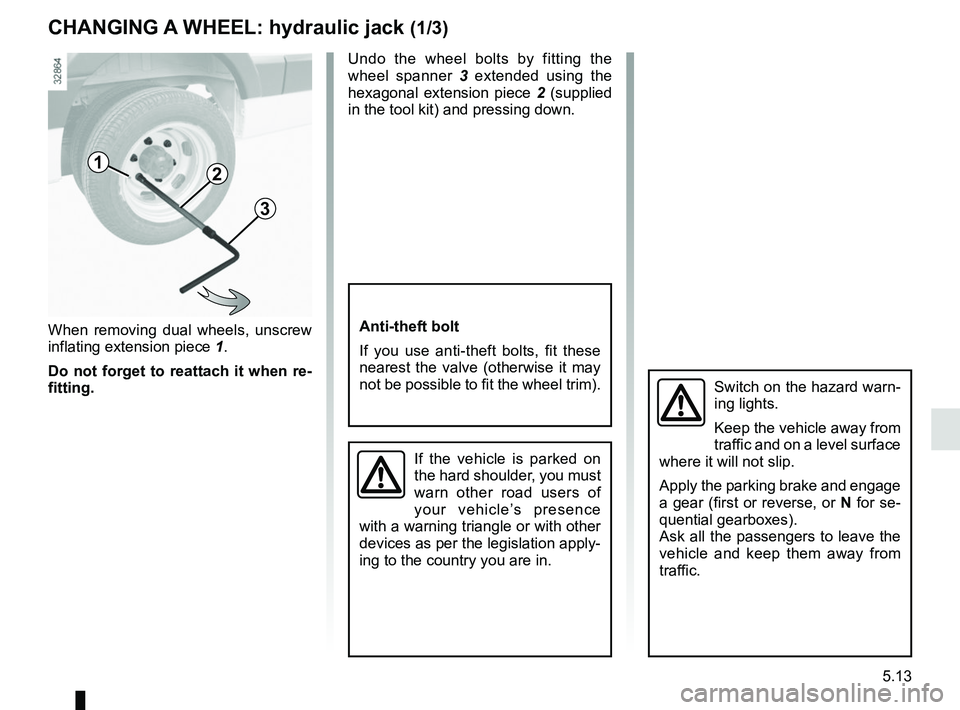
Inflation kit E
Depending on the vehicle, in the event
of a puncture, use the inflation kit lo-
cated underneath the driver’s seat.
Before using this kit, park
the vehicle at a sufficient
distance from traffic, switch
on the hazard warning
lights, apply the handbrake, ask all
passengers to leave the vehicle and
keep them away from traffic.
If the vehicle is parked on
the hard shoulder, you must
warn other road users of
your vehicle’s presence
with a warning triangle or with other
devices as per the legislation apply-
ing to the country you are in.
With the engine running and the
parking brake applied,
– unroll the hose from the container;
– connect the compressor hose 14 to the container’s inlet 19;
– depending on the vehicle, connect the container 19 to the compressor
from the container recess 18;
– unscrew the valve cap on the rel- evant wheel and screw on the con-
tainer’s inflation adapter 12;
– disconnect any accessories previ- ously connected to the vehicle’s ac-
cessories sockets;
– adapter 13 must be connected to
the vehicle accessories socket;
– press switch 15 to inflate the tyre to
the recommended pressure (please
refer to the information in the section
on “Tyre pressure”);
1516
1219
– after a maximum of 15 minutes, stop inflating and read the pressure (on
pressure gauge 16).
Note: while the bottle is empty-
ing (approximately 30 seconds),
the pressure gauge 16 will indicate
briefly a pressure of up to 6 bars,
then the pressure drops.
– adjust the pressure: to increase it, continue inflation with the kit; to
reduce it, press button 17.
If a minimum pressure of 1.8 bar is
not reached after 15 minutes, repair
is not possible; do not drive the ve-
hicle but contact an approved dealer.
13
14
18
17
E
Page 227 of 290
5.13
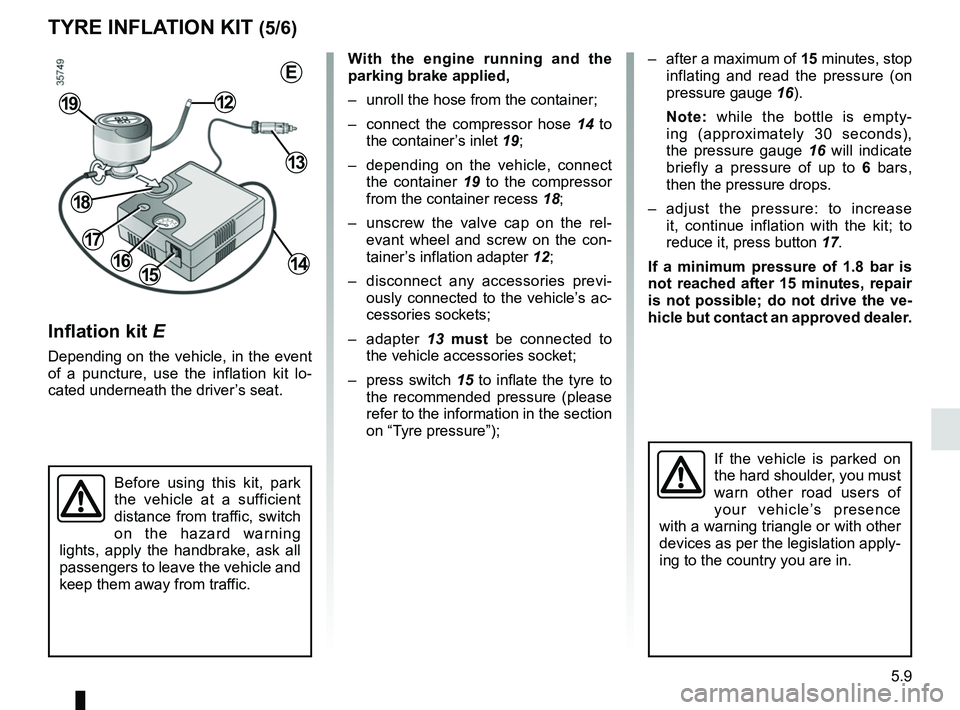
When removing dual wheels, unscrew
inflating extension piece 1.
Do not forget to reattach it when re-
fitting. Undo the wheel bolts by fitting the
wheel spanner
3 extended using the
hexagonal extension piece 2 (supplied
in the tool kit) and pressing down.
1
CHANGING A WHEEL: hydraulic jack (1/3)
Switch on the hazard warn-
ing lights.
Keep the vehicle away from
traffic and on a level surface
where it will not slip.
Apply the parking brake and engage
a gear (first or reverse, or N for se-
quential gearboxes).
Ask all the passengers to leave the
vehicle and keep them away from
traffic.
If the vehicle is parked on
the hard shoulder, you must
warn other road users of
your vehicle’s presence
with a warning triangle or with other
devices as per the legislation apply-
ing to the country you are in.
Anti-theft bolt
If you use anti-theft bolts, fit these
nearest the valve (otherwise it may
not be possible to fit the wheel trim).
2
3
Page 230 of 290
5.16
CHANGING A WHEEL: jack (1/2)
2
If the vehicle is parked on
the hard shoulder, you must
warn other road users of
your vehicle’s presence
with a warning triangle or with other
devices as per the legislation ap-
plying to the country you are in.
Switch on the hazard war-
ning lights.
Keep the vehicle away from
traffic and on a level surface
where it will not slip.
Apply the parking brake and engage
a gear (first or reverse, or N for se-
quential gearboxes).
Ask all the passengers to leave the
vehicle and keep them away from
traffic.
To prevent any risk of injury
or damage to the vehi-
cle, raise the jack until the
wheel you are replacing is
a maximum of 3 centimetres off the
ground.
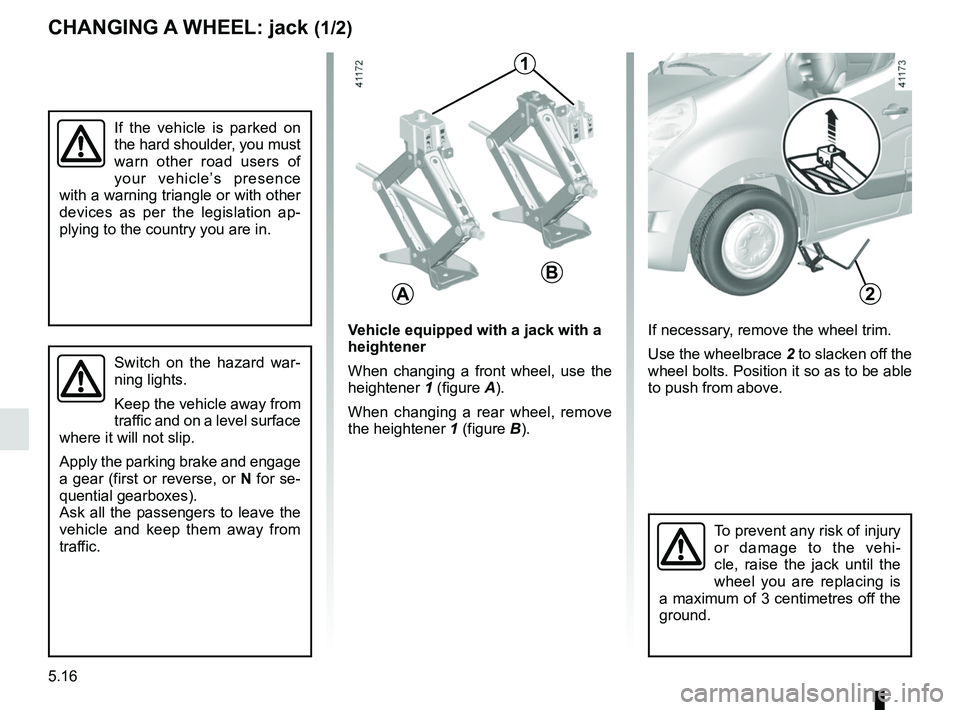
If necessary, remove the wheel trim.
Use the wheelbrace 2 to slacken off the
wheel bolts. Position it so as to be able
to push from above.Vehicle equipped with a jack with a
heightener
When changing a front wheel, use the
heightener 1 (figure A).
When changing a rear wheel, remove
the heightener 1 (figure B).
A
B
1
Page 233 of 290
5.19
TYRES (2/3)
Tyre pressures
Adhere to the tyre pressures (including
the emergency spare wheel). The tyre
pressures should be checked at least
once a month and additionally before
any long journey (refer to the label af-
fixed to the edge of the driver’s door).
Incorrect tyre pressures
lead to abnormal tyre wear
and unusually hot running.
These are factors which
may seriously affect safety and lead
to:
– poor road holding,
– risk of bursting or tread separa- tion.
The pressure depends on the load
and the speed of use. Adjust the
pressure according to the condi-
tions of use (refer to the label affixed
to the edge of the driver’s door).
Please be aware that a
poorly tightened or miss-
ing valve cap can make the
tyres less airtight and lead
to pressure loss.
Always use valve caps identical to
those fitted originally and tighten
them fully.
Pressures should be checked when the
tyres are cold; ignore higher pressures
which may be reached in hot weather
or following a fast journey.
If tyre pressures cannot be checked
when the tyres are cold, the normal
pressures must be increased by 0.2 to
0.3 bar (or 3 PSI).
Never deflate a hot tyre.
Dual wheel versions
To inflate the outer wheel, it is recom-
mended that the inflation tube is passed
between the two wheels. Vehicle fitted with a tyre pressure
loss warning system
If underinflated (puncture, low pres-
sure, etc.), the warning light
on
the instrument panel comes on, see
“Tyre pressure loss warning system” in
Section 2.
Changing wheels around
This practice is not recommended.
Emergency spare wheel
Refer to the information on the
“Emergency spare wheel” and
“Changing a wheel” in Section 5.
Page 235 of 290

5.21
Direction indicators
Remove cover A and turn bulb holder 1
a quarter turn.
To refit the bulb holder, position it cor-
rectly, as determined by the foolproof-
ing device.
Bulb type: PY21W.
Note: once the bulb has been replaced,
ensure the cover is refitted correctly.
HEADLIGHTS: changing bulbs (1/2)
Front side lights
Remove cover B and pull bulb holder 2.
Bulb type: W5W.
Note: once the bulb has been replaced,
ensure the cover is refitted correctly.The bulbs are under pres-
sure and can break when
replaced.
Risk of injury.
To comply with current legislation,
or as a precaution, you can obtain
an emergency kit from an approved
dealer containing a set of spare
bulbs and fuses.
B
A
2
1
Please note when work-
ing close to the engine that
it may be hot. In addition,
the engine cooling fan may
start at any moment. The
warning light in the engine compart-
ment reminds you of this.
Risk of injury.Before performing any
action in the engine com-
partment, the ignition must
be switched off (please see
the information on “Starting, stop-
ping the engine” in Section 2).
Page 236 of 290

5.22
Cornering lights(depending on the vehicle)
Remove cover D and turn bulb holder 5
a quarter turn.
Bulb type: H7.
Note: once the bulb has been replaced,
ensure the cover is refitted correctly.Dipped beam headlights
Remove cover E and turn bulb holder 6
a quarter turn.
Bulb type: H7LL.
Do not touch the bulb glass. Hold it
by its base.
Note: once the bulb has been replaced,
ensure the cover is refitted correctly.
Main beam headlights
Remove cover C.
Unclip the springs 4 and remove the
bulb holder 3.
Bulb type: H1.
Note: once the bulb has been replaced,
ensure the cover is refitted correctly.
The bulbs are under pres-
sure and can break when
replaced.
Risk of injury.
To comply with current legislation,
or as a precaution, you can obtain
an emergency kit from an approved
dealer containing a set of spare
bulbs and fuses.
HEADLIGHTS: changing bulbs (2/2)
C
D
E
3
5
6
4
Please note when work-
ing close to the engine that
it may be hot. In addition,
the engine cooling fan may
start at any moment. The
warning light in the engine compart-
ment reminds you of this.
Risk of injury.Before performing any
action in the engine com-
partment, the ignition must
be switched off (please see
the information on “Starting, stop-
ping the engine” in Section 2).
Page 244 of 290
5.30
Fuses in the engine
compartment
Removing fuse box C
Remove screw 2 and remove coolant
reservoir 3. Unscrew the four screws
4.Turn unit 5 over to access the fuses in
the engine compartment.
To identify the fuses, refer to the fuse
allocation label (see the next page for
details), located on unit 5.
FUSES (3/5)
2
3
C4
4
5
No operations should be
carried out on the cooling
circuit when the engine is
hot.
Risk of burns.
Check that no water or dust enters
unit 5 when it is being removed/re-
fitted.
Deactivate the Stop and
Start function for any opera-
tion performed in the engine
compartment.
Please note when work-
ing close to the engine that
it may be hot. The engine
cooling fan may also start
at any moment. The
warning
light in the engine compartment re-
minds you of this.
Risk of injury.
Page 247 of 290

5.33
Connecting a battery charger
The battery charger must be com-
patible with a battery with nominal
voltage of 12 volts.
Do not disconnect the battery when the
engine is running. Follow the instruc-
tions given by the manufacturer of
the battery charger you are using.
When many accessories are fitted to
the vehicle, have them connected to
the + after ignition feed .
BATTERY: troubleshooting (1/2)
To avoid all risk of sparks:
– Ensure that any consumers (cour-
tesy lights, etc.) are switched off
before disconnecting or reconnect-
ing the battery;
– when charging, stop the charger before connecting or disconnecting
the battery;
– to avoid creating a short circuit be- tween the terminals, do not place
metal objects on the battery;
– always wait at least one minute after the engine has been switched off
before disconnecting a battery;
– make sure that you reconnect the battery terminals after refitting.
Special procedures may be
required to charge some
batteries. Contact your ap-
proved dealer.
Avoid all risk of sparks which may
cause an immediate explosion, and
charge the battery in a well venti-
lated area. Risk of serious injury.
Handle the battery with care
as it contains sulphuric acid,
which must not come into
contact with eyes or skin. If
it does, wash the affected area with
plenty of cold water. If necessary,
consult a doctor.
Ensure that naked flames, red hot
objects and sparks do not come into
contact with the battery as there is a
risk of explosion.
Please note when working close to
the engine that it may be hot. In ad-
dition, the engine cooling fan may
start at any moment. The
warning light in the engine compart-
ment reminds you of this.
Risk of injury.