2018 RENAULT MASTER brake
[x] Cancel search: brakePage 239 of 290
5.25
REAR LIGHTS: changing bulbs (1/2)
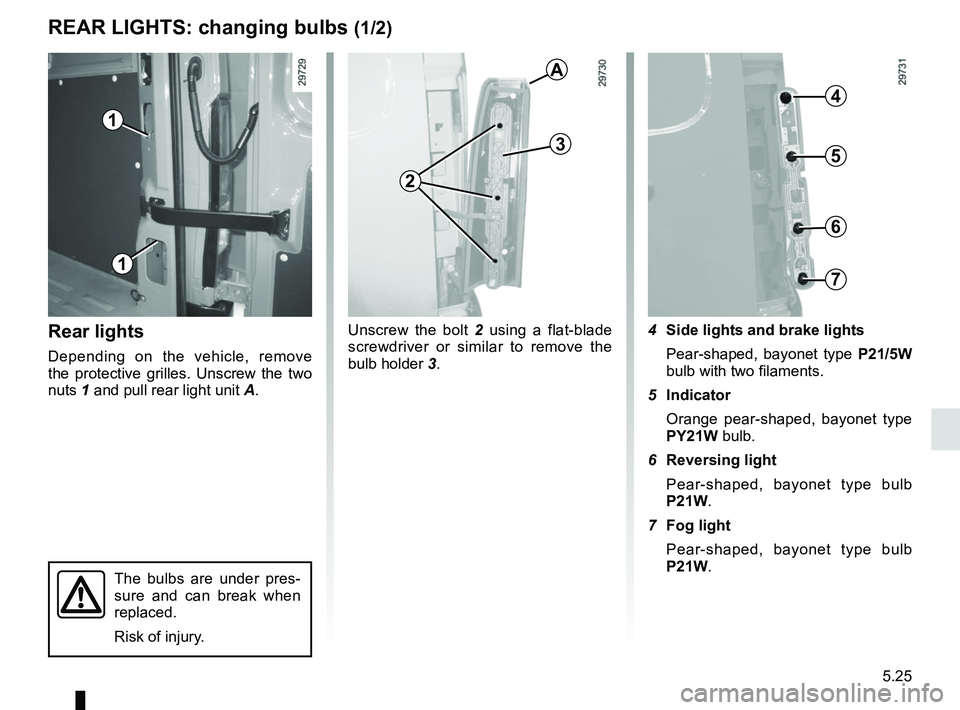
Rear lights
Depending on the vehicle, remove
the protective grilles. Unscrew the two
nuts 1 and pull rear light unit A.Unscrew the bolt
2 using a flat-blade
screwdriver or similar to remove the
bulb holder 3. 4 Side lights and brake lights
Pear-shaped, bayonet type P21/5W
bulb with two filaments.
5 Indicator Orange pear-shaped, bayonet type
PY21W bulb.
6 Reversing light
Pear-shaped, bayonet type bulb
P21W.
7 Fog light Pear-shaped, bayonet type bulb
P21W.
The bulbs are under pres-
sure and can break when
replaced.
Risk of injury.
1
1
A
2
3
4
5
6
7
Page 240 of 290
5.26
REAR LIGHTS: changing bulbs (2/2)
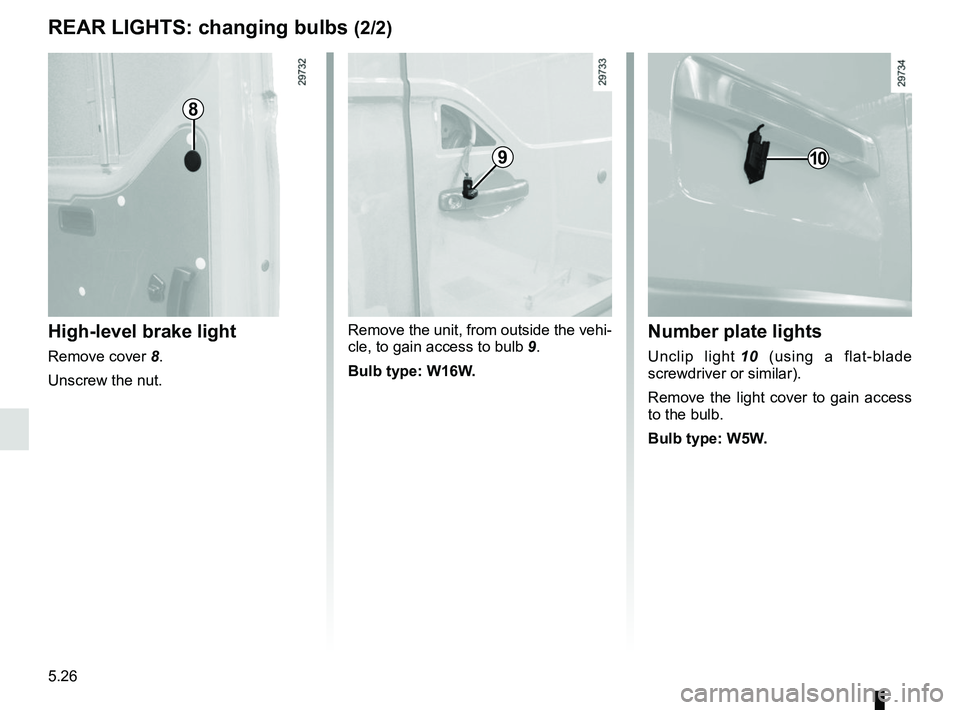
High-level brake light
Remove cover 8.
Unscrew the nut. Remove the unit, from outside the vehi-
cle, to gain access to bulb
9.
Bulb type: W16W.
Number plate lights
Unclip light 10 (using a flat-blade
screwdriver or similar).
Remove the light cover to gain access
to the bulb.
Bulb type: W5W.
8
910
Page 243 of 290
5.29
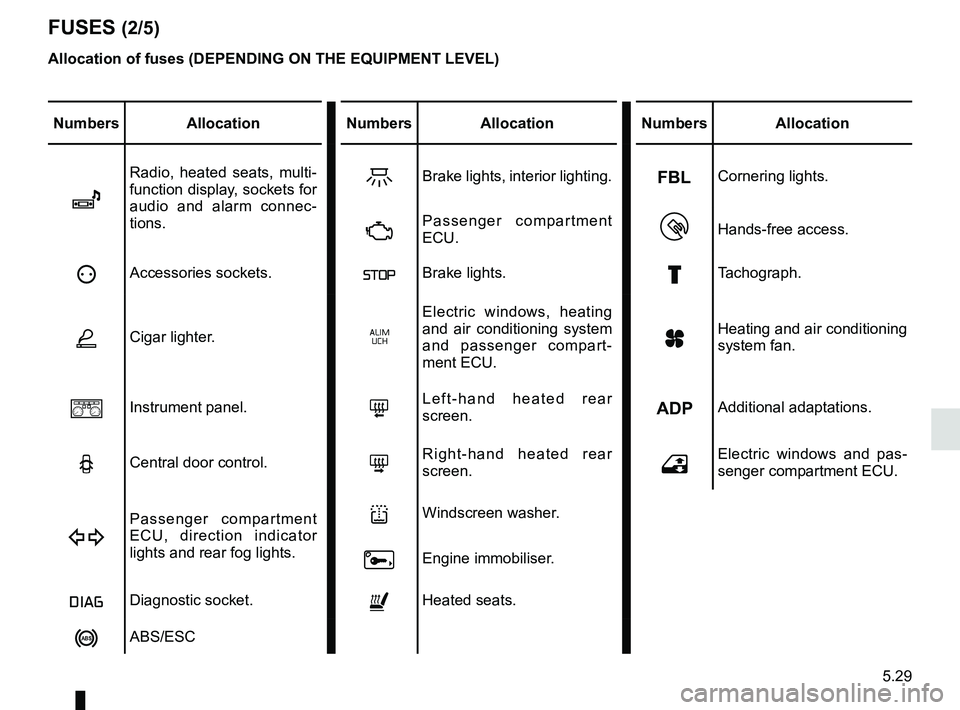
FUSES (2/5)
Allocation of fuses (DEPENDING ON THE EQUIPMENT LEVEL)
Numbers AllocationNumbers Allocation Numbers Allocation
î
Radio, heated seats, multi-
function display, sockets for
audio and alarm connec-
tions.ZBrake lights, interior lighting.Cornering lights.
ÄPassenger compartment
ECU.Hands-free access.
ëAccessories sockets.ßBrake lights.£Tachograph.
ÆCigar lighter.‚
Electric windows, heating
and air conditioning system
and passenger compart-
ment ECU.
yHeating and air conditioning
system fan.
aInstrument panel.8Left-hand heated rear
screen.Additional adaptations.
NCentral door control.7Right-hand heated rear
screen.hElectric windows and pas-
senger compartment ECU.
D
Passenger compartment
ECU, direction indicator
lights and rear fog lights.lWindscreen washer.
0Engine immobiliser.
ÎDiagnostic socket.ñHeated seats.
nABS/ESC
Page 252 of 290

5.38
TOWING: breakdown (1/2)
The steering wheel must be un-
locked and the ignition key must be
in position M (ignition on) to provide
brake lights and hazard warning
lights on the towed vehicle. At night
the vehicle must have its lights on.
Unhitch the trailer, etc., if one is
being towed.
You must observe the towing regu-
lations which apply in the country in
which you are driving: do not exceed
the towing weight for your vehicle.
Contact an approved dealer.
– Use a rigid towing bar.
If a rope or cable is used
(where the law allows this),
the vehicle being towed
must be able to brake.
– A vehicle must not be towed if it is not fit to be driven.
– Avoid accelerating or braking suddenly when towing, as this
may result in damage being
caused to the vehicle.
– When towing a vehicle, it is ad- visable not to exceed 15 mph
(25 km/h).
When the engine is
stopped, steering and brak-
ing assistance are not op-
erational.
Do not remove the key from
the ignition when the vehi-
cle is being towed.
Towing a vehicle with a
sequential gearbox
If the gearbox is stuck in a gear:
– switch on the ignition;
– select neutral with the brake pedal depressed;
– check that the gearbox is in neutral (by pushing the vehicle for example).
If you cannot find neutral you must tow
the vehicle with the front wheels raised.
The vehicle should always be towed
with the ignition switched off.
Page 255 of 290

5.41
ACCESSORIES
Electrical and electronic accessories
Before installing this type of accessory (particularly for transmitters\
/receivers: frequency bandwidth, power level, po-
sition of the aerial, etc.), make sure it is compatible with your vehic\
le. You can get advice from an authorised dealer.
Connect accessories with a maximum power of 120 Watts only. Fire hazard. When several accessory sockets are
used at the same time, the total power of the connected accessories must\
not exceed 180 watts.
No work may be carried out on the vehicle’s electrical or radio circuits, except by authorised dealers: an incorre\
ctly connecte d
system may result in damage being caused to the electrical equipment and\
/or the components connected to it.
If the vehicle is fitted with any aftermarket electrical equipment, make\
sure that the installation is correctly protected by a fuse.
Establish the rating and position of this fuse.
Using the diagnostic socket
The use of electronic accessories on the diagnostic socket may cause ser\
ious disturbance to the vehicle’s electronic systems.
For your safety we recommend that you use only electronic accessories ap\
proved by the manufacturer, consult an Approved
Dealer. Serious accident risk.
Use of transmitting/receiving devices (telephones, CB equipment etc.).\
Telephones and CB equipment with integrated aerials may cause interferenc\
e to the electronic systems originally fitted to the
vehicle: it is advisable only to use equipment with an external aerial. \
Furthermore, we remind you of the need to conform
to the legislation in force concerning the use of such equipment.
Fitting aftermarket accessories
If you wish to install accessories on the vehicle: please contact an aut\
horised dealer. Also, to ensure the correct operation o f
your vehicle, and to avoid any risk to your safety, we recommend that you use only accessories specifically designed for y\
our
vehicle, which are the only accessories for which the manufacturer will \
provide a warranty.
If you are using an anti-theft device, only attach it to the brake pedal\
.
Obstructions to the driver
On the driver’s side, only use mats suitable for the vehicle, attached with the pre-fi\
tted components, and check the fitting re gu-
larly. Do not lay one mat on top of another. There is a risk of wedging the pedals.
Page 268 of 290
6.8
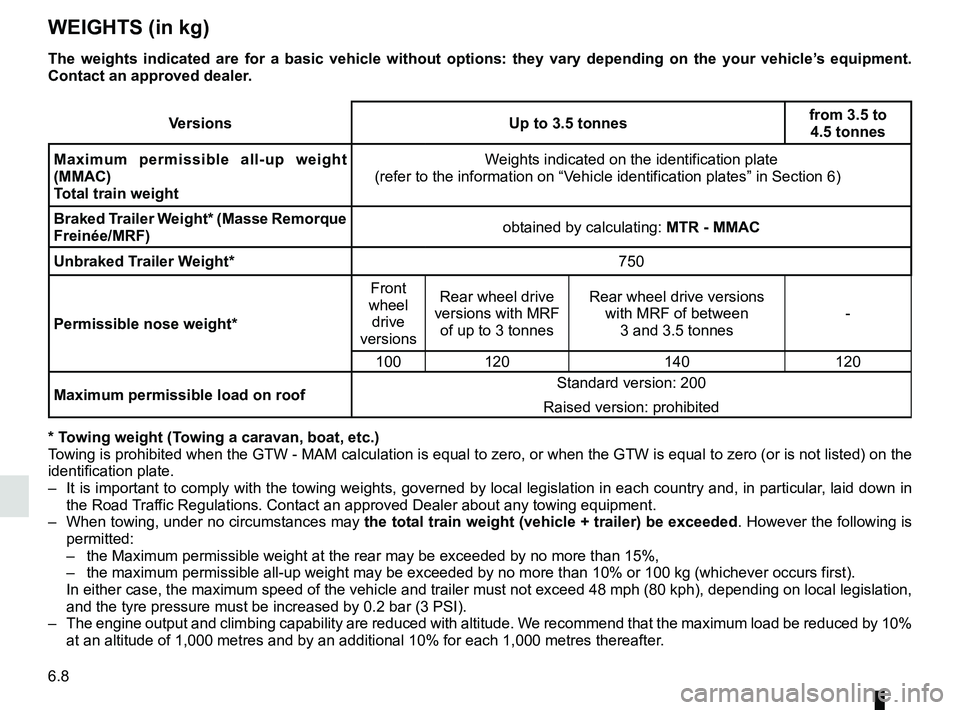
WEIGHTS (in kg)
VersionsUp to 3.5 tonnesfrom 3.5 to
4.5 tonnes
Maximum permissible all-up weight
(MMAC)
Total train weight Weights indicated on the identification plate
(refer to the information on “Vehicle identification plates” in Section 6)
Braked Trailer Weight* (Masse Remorque
Freinée/MRF) obtained by calculating:
MTR - MMAC
Unbraked Trailer Weight* 750
Permissible nose weight* Front
wheel drive
versions Rear wheel drive
versions with MRF of up to 3 tonnes Rear wheel drive versions
with MRF of between 3 and 3.5 tonnes -
100 120 140120
Maximum permissible load on roof Standard version: 200
Raised version: prohibited
* Towing weight (Towing a caravan, boat, etc.)
Towing is prohibited when the GTW - MAM calculation is equal to zero, or \
when the GTW is equal to zero (or is not listed) on th e
identification plate.
– It is important to comply with the towing weights, governed by local leg\
islation in each country and, in particular, laid down in the Road Traffic Regulations. Contact an approved Dealer about any towing equipment.
– When towing, under no circumstances may the total train weight (vehicle + trailer) be exceeded . However the following is
permitted:
– the Maximum permissible weight at the rear may be exceeded by no more th\
an 15%,
– the maximum permissible all-up weight may be exceeded by no more than 10\
% or 100 kg (whichever occurs first).
In either case, the maximum speed of the vehicle and trailer must not ex\
ceed 48 mph (80 kph), depending on local legislation, and the tyre pressure must be increased by 0.2 bar (3 PSI).
– The engine output and climbing capability are reduced with altitude. We recommend that the maximum load be reduced by 10% at an altitude of 1,000 metres and by an additional 10% for each 1,000 m\
etres thereafter.
The weights indicated are for a basic vehicle without options: they vary\
depending on the your vehicle’s equipment.
Contact an approved dealer.
Page 283 of 290

A
ABS ....................................................................\
...2.16 → 2.23
accessories...................................................................")
7.1
ALPHABETICAL INDEX (1/4)
A
ABS ....................................................................\
...2.16 → 2.23
accessories........................................................................\
5.41
accessories socket ............................................................ 3.19
AdBlue ...............................................................1.104 → 1.109
AdBlue additive..................................................1.104 → 1.109
additional systems to the seat belts................................... 1.31
additive (tank) ....................................................1.104 → 1.109
additive tank ......................................................1.104 → 1.109
adjusting the seats............................................................. 1.24
adjusting your driving position ........................................... 1.24
advice on antipollution ....................................................... 2.12
air bag....................................................................1.28 → 1.31
activating the front passenger air bags ............1.70 → 1.72
deactivating the front passenger air bags ........1.70 → 1.72
air conditioning ........................................................3.2 → 3.14
air vents ...................................................................... 3.2 – 3.3
anti-corrosion check ..............................................6.16 → 6.21
anti-corrosion protection .................................................... 4.14
anti-lock braking system: ABS ...............................2.16 → 2.23
antipollution advice .................................................................\
......... 2.12
ashtrays ...............................................................\
.............. 3.19
audible and visual signals................................................ 1.101
automatic gearbox selector lever...........................2.45 → 2.49
B
battery........................................................................\
........ 4.13 troubleshooting ................................................. 5.33 – 5.34
bonnet........................................................................\
.......... 4.2
brake fluid ........................................................................\
.... 4.8
bulbs changing ......................................5.21 – 5.22, 5.25 → 5.27
C
capacity of mechanical components........................4.8 → 4.10central door locking ........................... 1.2
→ 1.12, 1.15 → 1.18
changing a bulb .................................5.21 – 5.22, 5.25 → 5.27
changing a wheel........................ 5.2 → 5.4, 5.11 → 5.15, 5.17
changing gear .................................................................... 2.14
child restraint/seat 1.30, 1.33 – 1.34, 1.38 → 1.57, 1.70 → 1.72
child safety................... 1.33 – 1.34, 1.38 → 1.57, 1.70 → 1.72
child seats..........................................1.33 – 1.34, 1.38 → 1.57
children ................................................................... 1.33 – 1.34
cigar lighter ........................................................................\
3.19
cleaning: inside the vehicle .............................................. 4.17 – 4.18
clock ..................................................................\
................ 1.93
control instruments ................................................1.78 → 1.85
coolant ................................................................\
............... 1.83
courtesy light ............................................................ 3.17, 5.27
cruise control .........................................................2.33 → 2.36
cruise control-speed limiter....................................2.30 → 2.36
D
deadlocking the doors ......................................................... 1.7
demisting windscreen ..................................................3.4, 3.7 → 3.12
dimensions ................................................................. 6.6 – 6.7
dipstick................................................................\
........ 4.4 – 4.5
display .................................................................... 1.84 – 1.85
doors................................................... 1.13 – 1.14, 1.17 – 1.18
driver’s position .....................................................1.74 → 1.77
driving ...........................................2.2, 2.10, 2.16 → 2.26, 2.37
driving recommendations ........................................ 2.8 → 2.11
E
ECO driving .............................................................
2.8 → 2.11
ECO mode ........................................................................\
... 2.9
electric beam height adjustment ...................................... 1.100
electric windows ..................................................... 3.15 – 3.16
electronic stability control: ESC .............................2.16 → 2.23
Page 284 of 290

7.2
ALPHABETICAL INDEX (2/4)
emergency active braking......................................2.16 → 2.23
emergency brake assist.........................................2.16 → 2.23
emergency braking ................................................2.16 → 2.23
emergency spare wheel ............................................. 5.2 – 5.3
engine technical specifications .................................................. 6.5
engine coolant ..................................................................... 4.9
engine oil ...................................................................4.4 → 4.7
engine oil level ..................................................1.83, 4.4 → 4.7
engine specifications ........................................................... 6.5
environment ............................................................\
........... 2.13
ESC: electronic stability control .............................2.16 → 2.23
external lights and signals ...................................1.96 → 1.100
external temperature ......................................................... 1.93
F
filter .................................................................\
................... 4.10
fitting a radio ...................................................................... 5.40
foot panel ........................................................................\
... 5.37
front passenger air bag deactivation .....................1.70 → 1.72
front seat adjustment ......................................................... 1.21
front seats ........................................................................\
.. 1.21
fuel advice on fuel economy ..................................... 2.8 → 2.11
consumption ...................................................... 2.8 → 2.11
filling .............................................................. 1.102 – 1.103
grade ..................................................................\
........ 1.102
fuel consumption ..................................................... 2.8 → 2.11
fuel filler cap ....................................................... 1.102 – 1.103
fuel grade........................................................................\
. 1.103
fuel level ........................................................................\
.... 1.83
fuel repriming ...................................................... 1.102 – 1.103
fuel tank .............................................................. 1.102 – 1.103
fuel tank capacity ............................................................. 1.102
fuses ..................................................................\
....5.28 → 5.32G
gear lever......................................................2.14, 2.45
→ 2.49
grab handle........................................................................\
3.18
grip control ........................................................................\
. 2.22
ground clearance ........................................................ 6.6 – 6.7
H
handbrake........................................................................\
.. 2.15
handsfree.................................................................... 1.8 – 1.9
hazard warning lights signal ............................................ 1.101
headrest........................................................................\
..... 1.20
heated seats ...................................................................... 1.21
heating and air conditioning system ........3.2 – 3.3, 3.7 → 3.13
heating system ......................................3.2 → 3.6, 3.13 – 3.14
Hill Start Assist.......................................................2.16 → 2.23
HSA: Hill Start Assistance ................................................ 2.23
hubcap tool ...................................................... 5.4, 5.11 – 5.12
I
idle speed ........................................................................\
.. 2.43
indicators .............................................................\
............ 1.101
indicators: direction indicators ..................................................... 1.101
instrument panel ..............................................1.78 → 1.83
instrument panel ....................................................1.78 → 1.85
interior lighting: changing bulbs ............................................................. 5.27
interior trim maintenance ..................................................... 4.17 – 4.18
J
jack ...................................................................\
................... 5.4
K
keys ...................................................................\
........1.2 → 1.6