Page 23 of 290
1.17
Lower lever 4 to open the door.
If the vehicle is parked on
the hard shoulder with tail-
gate open, the rear lights
may be obscured. You
should make other road users aware
of your vehicle by using a warning
triangle or other equipment speci-
fied by the road traffic regulations of
the country you are driving in.
REAR DOORS (1/2)
Opening the doors from the
outside
Unlock lock 1 using the key or, on
equipped vehicles, use the remote con-
trol or the hands-free access remote
control by pressing button 3. Pull
handle 2 towards you and open the
door.
Opening the doors to 180°
Open the door, but not fully.
Remove tie rod 7 from its housing 5.
Lock the tie rod on the hook 6.
Open the door as far as possible.
1
24
1
Do not leave the hinged
rear doors open in case of
strong winds. Risk of injury.For your safety, check that
all the vehicle’s doors are
properly closed before
starting the engine.
3
5
6
7
Page 24 of 290
1.18
REAR DOORS (2/2)
Opening the doors to 270°
Remove the check-strap from its hous-
ing as when opening to 180°. Open
the door fully until the magnets 6 make
contact.
Closing from the outside
Partially close the left-hand door, then
slam it shut.
Then repeat this with the right-hand
door.
Lock.
Opening from the inside
Lower lever 7 and push door A.
Pull lever 8 and open door B.
Closing from the inside
Partially close door B, then slam it shut.
Do the same with door A using
handle 9.
Locking/unlocking
Turn button 10.
9
78106
For your safety, check that
all the vehicle’s doors are
properly closed before
starting the engine.
ABAB
Page 25 of 290
1.19
STEERING WHEEL/POWER-ASSISTED STEERING
Power-assisted steering
With the engine running, do not leave
the steering wheel at full lock while sta-
tionary as this may damage the power-
assisted steering pump.
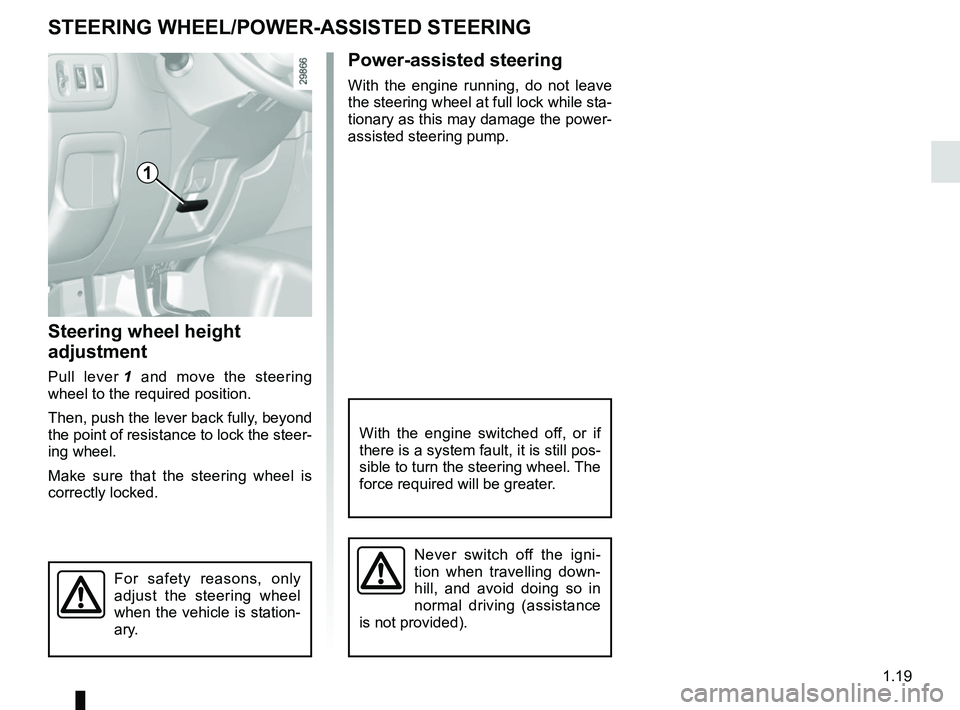
Steering wheel height
adjustment
Pull lever 1 and move the steering
wheel to the required position.
Then, push the lever back fully, beyond
the point of resistance to lock the steer-
ing wheel.
Make sure that the steering wheel is
correctly locked.
For safety reasons, only
adjust the steering wheel
when the vehicle is station-
ary.
Never switch off the igni-
tion when travelling down-
hill, and avoid doing so in
normal driving (assistance
is not provided).
With the engine switched off, or if
there is a system fault, it is still pos-
sible to turn the steering wheel. The
force required will be greater.
1
Page 27 of 290
1.21
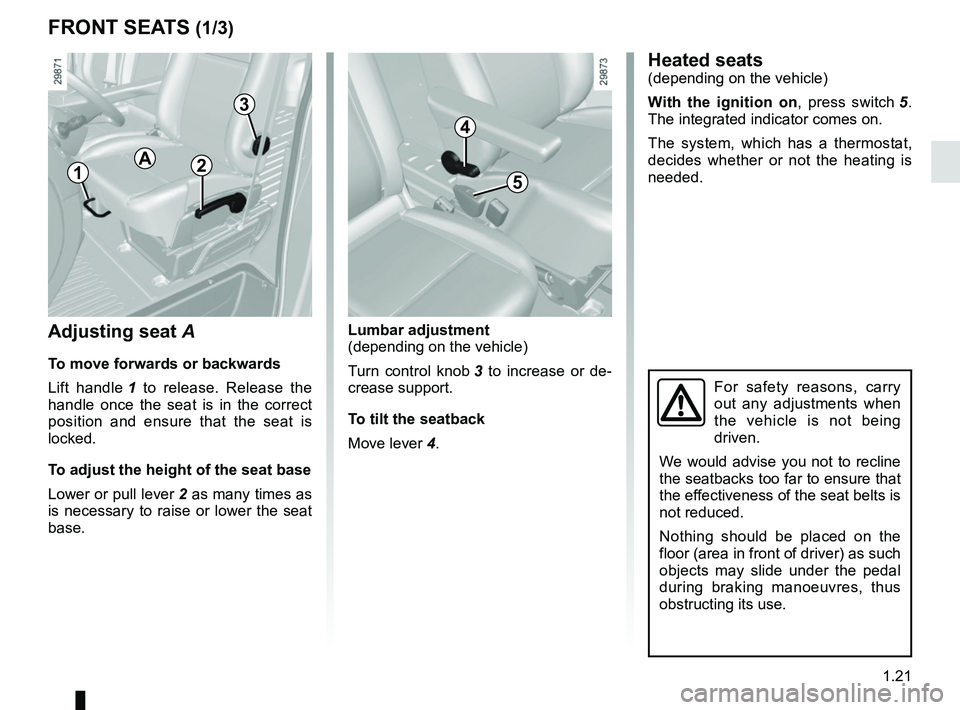
Lumbar adjustment
(depending on the vehicle)
Turn control knob 3 to increase or de-
crease support.
To tilt the seatback
Move lever 4.
FRONT SEATS (1/3)
Adjusting seat A
To move forwards or backwards
Lift handle 1 to release. Release the
handle once the seat is in the correct
position and ensure that the seat is
locked.
To adjust the height of the seat base
Lower or pull lever 2 as many times as
is necessary to raise or lower the seat
base.
12
3
4
For safety reasons, carry
out any adjustments when
the vehicle is not being
driven.
We would advise you not to recline
the seatbacks too far to ensure that
the effectiveness of the seat belts is
not reduced.
Nothing should be placed on the
floor (area in front of driver) as such
objects may slide under the pedal
during braking manoeuvres, thus
obstructing its use.
Heated seats(depending on the vehicle)
With the ignition on , press switch 5.
The integrated indicator comes on.
The system, which has a thermostat,
decides whether or not the heating is
needed.
5
A
Page 28 of 290
1.22
FRONT SEATS (2/3)
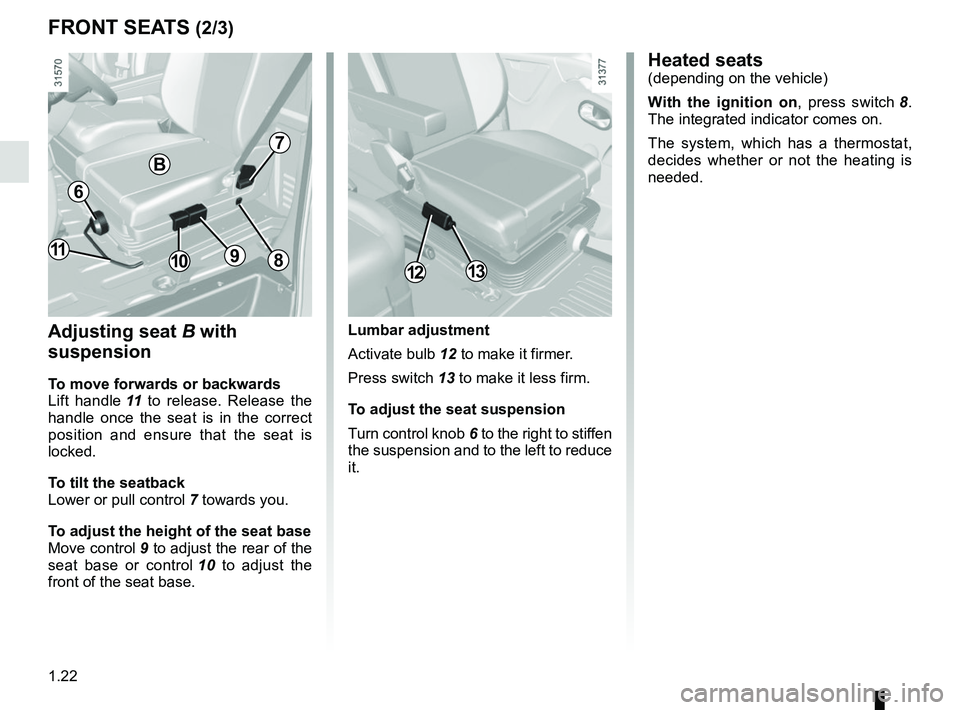
Adjusting seat B with
suspension
To move forwards or backwards
Lift handle 11 to release. Release the
handle once the seat is in the correct
position and ensure that the seat is
locked.
To tilt the seatback
Lower or pull control 7 towards you.
To adjust the height of the seat base
Move control 9 to adjust the rear of the
seat base or control 10 to adjust the
front of the seat base.
6
7
910118
Lumbar adjustment
Activate bulb 12 to make it firmer.
Press switch 13 to make it less firm.
To adjust the seat suspension
Turn control knob 6 to the right to stiffen
the suspension and to the left to reduce
it.
1312
Heated seats(depending on the vehicle)
With the ignition on , press switch 8.
The integrated indicator comes on.
The system, which has a thermostat,
decides whether or not the heating is
needed.
B
Page 29 of 290
1.23
FRONT SEATS (3/3)
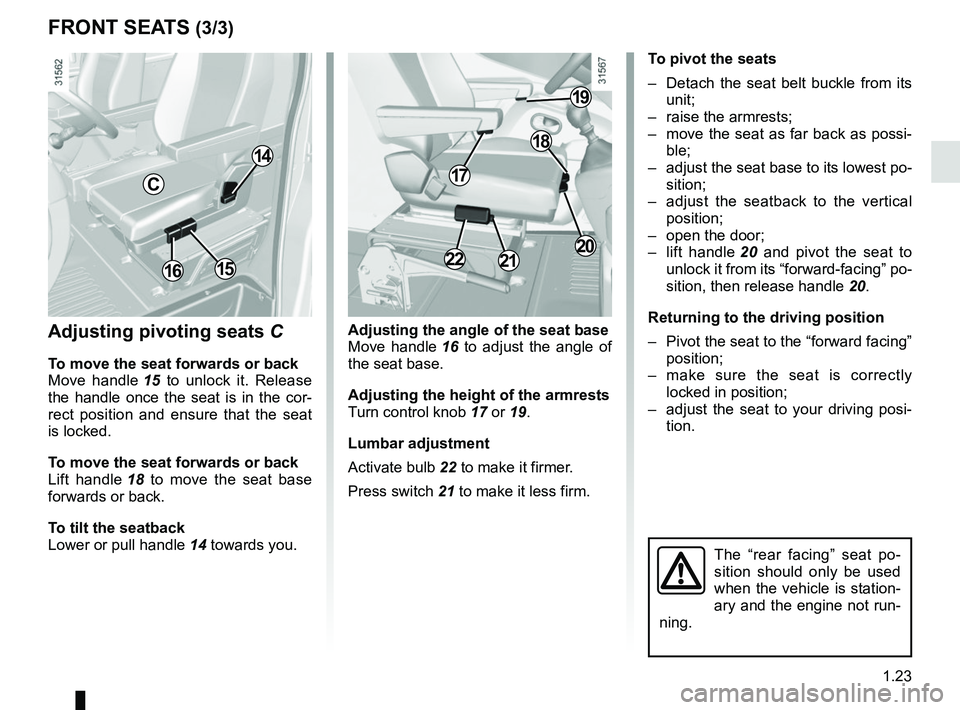
Adjusting pivoting seats C
To move the seat forwards or back
Move handle 15 to unlock it. Release
the handle once the seat is in the cor-
rect position and ensure that the seat
is locked.
To move the seat forwards or back
Lift handle 18 to move the seat base
forwards or back.
To tilt the seatback
Lower or pull handle 14 towards you.
The “rear facing” seat po-
sition should only be used
when the vehicle is station-
ary and the engine not run-
ning.
Adjusting the angle of the seat base
Move handle 16 to adjust the angle of
the seat base.
Adjusting the height of the armrests
Turn control knob 17 or 19.
Lumbar adjustment
Activate bulb 22 to make it firmer.
Press switch 21 to make it less firm.
To pivot the seats
– Detach the seat belt buckle from its unit;
– raise the armrests;
– move the seat as far back as possi- ble;
– adjust the seat base to its lowest po- sition;
– adjust the seatback to the vertical position;
– open the door;
– lift handle 20 and pivot the seat to
unlock it from its “forward-facing” po-
sition, then release handle 20.
Returning to the driving position
– Pivot the seat to the “forward facing” position;
– make sure the seat is correctly locked in position;
– adjust the seat to your driving posi- tion.
14
15162122
18
17
19
20
C
Page 31 of 290
1.25
SEAT BELTS (2/3)
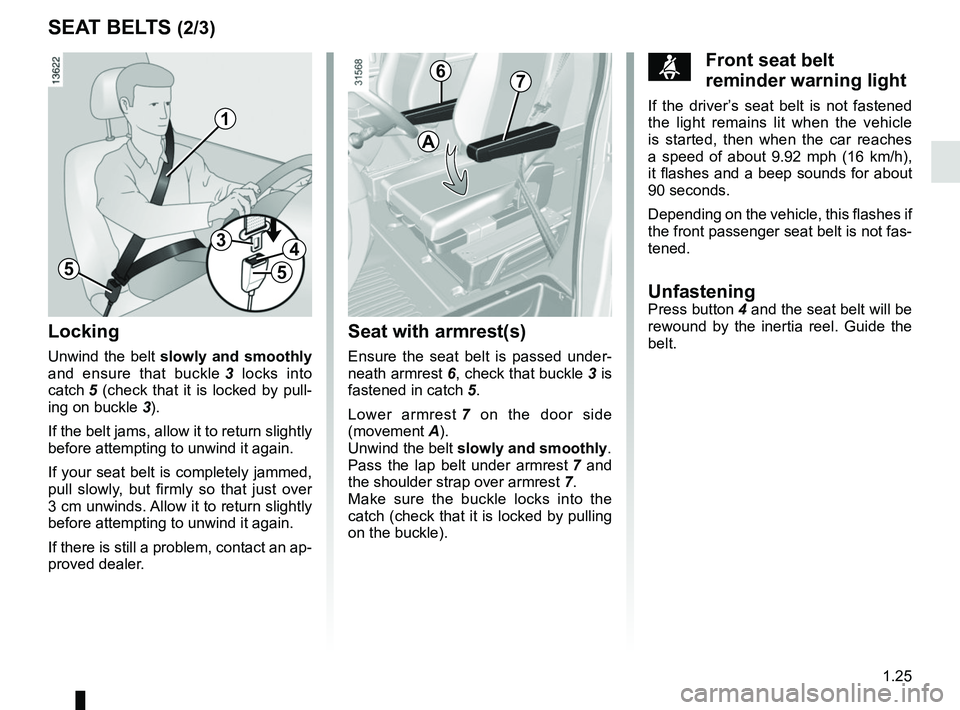
5
34
5
1
Locking
Unwind the belt slowly and smoothly
and ensure that buckle 3 locks into
catch 5 (check that it is locked by pull- ing on buckle 3).
If the belt jams, allow it to return slightly
before attempting to unwind it again.
If your seat belt is completely jammed,
pull slowly, but firmly so that just over
3 cm unwinds. Allow it to return slightly
before attempting to unwind it again.
If there is still a problem, contact an ap-
proved dealer.
Seat with armrest(s)
Ensure the seat belt is passed under-
neath armrest 6, check that buckle 3 is
fastened in catch 5.
Lower armrest 7 on the door side
(movement A).
Unwind the belt slowly and smoothly .
Pass the lap belt under armrest 7 and
the shoulder strap over armrest 7.
Make sure the buckle locks into the
catch (check that it is locked by pulling
on the buckle).
ßFront seat belt
reminder warning light
If the driver’s seat belt is not fastened
the light remains lit when the vehicle
is started, then when the car reaches
a speed of about 9.92 mph (16 km/h),
it flashes and a beep sounds for about
90 seconds.
Depending on the vehicle, this flashes if
the front passenger seat belt is not fas-
tened.
UnfasteningPress button 4 and the seat belt will be
rewound by the inertia reel. Guide the
belt.
A
76
Page 32 of 290
1.26
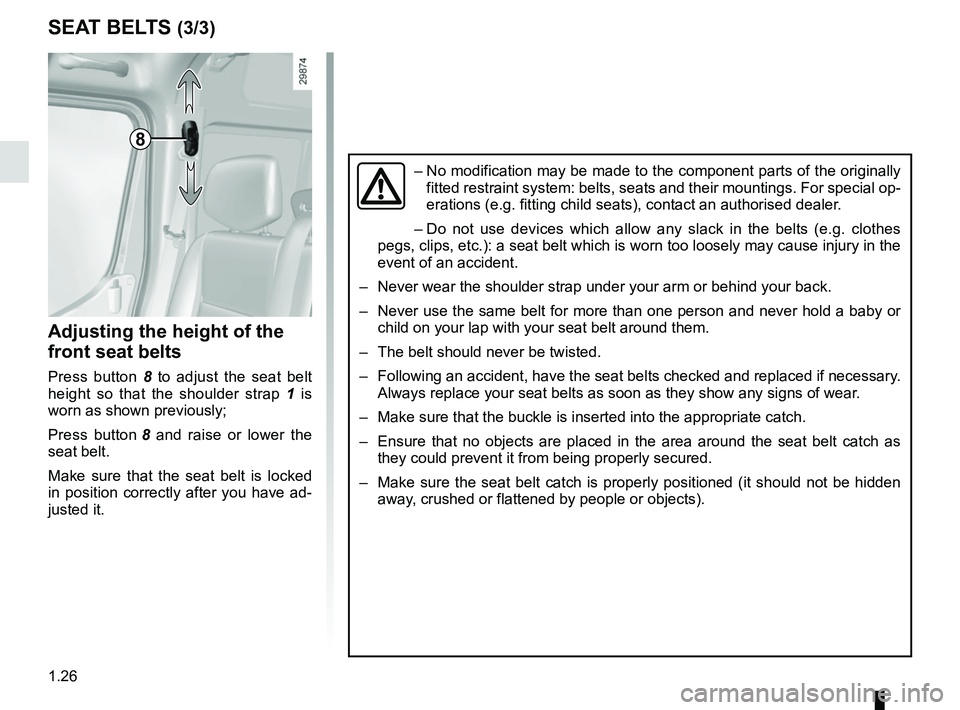
8
Adjusting the height of the
front seat belts
Press button 8 to adjust the seat belt
height so that the shoulder strap 1 is
worn as shown previously;
Press button 8 and raise or lower the
seat belt.
Make sure that the seat belt is locked
in position correctly after you have ad-
justed it.
SEAT BELTS (3/3)
– No modification may be made to the component parts of the originally
fitted restraint system: belts, seats and their mountings. For special o\
p-
erations (e.g. fitting child seats), contact an authorised dealer.
– Do not use devices which allow any slack in the belts (e.g. clothes
pegs, clips, etc.): a seat belt which is worn too loosely may cause inj\
ury in the
event of an accident.
– Never wear the shoulder strap under your arm or behind your back.
– Never use the same belt for more than one person and never hold a baby o\
r child on your lap with your seat belt around them.
– The belt should never be twisted.
– Following an accident, have the seat belts checked and replaced if neces\
sary. Always replace your seat belts as soon as they show any signs of wear.
– Make sure that the buckle is inserted into the appropriate catch.
– Ensure that no objects are placed in the area around the seat belt catch\
as they could prevent it from being properly secured.
– Make sure the seat belt catch is properly positioned (it should not be \
hidden away, crushed or flattened by people or objects).