Page 62 of 290
1.56
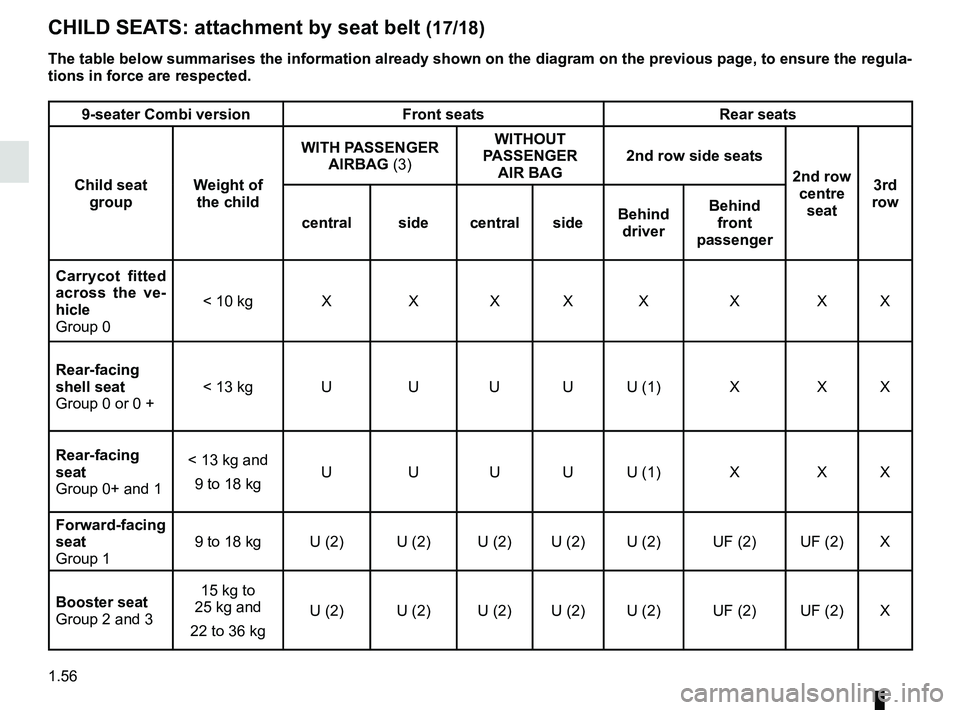
CHILD SEATS: attachment by seat belt (17/18)
9-seater Combi versionFront seatsRear seats
Child seat group Weight of
the child WITH PASSENGER
AIRBAG (3) WITHOUT
PASSENGER AIR BAG 2nd row side seats
2nd row centre seat 3rd
row
central side central side Behind
driver Behind
front
passenger
Carrycot fitted
across the ve-
hicle
Group 0 < 10 kg X X X X X X X X
Rear-facing
shell seat
Group 0 or 0 + < 13 kg U U U U U (1) X X X
Rear-facing
seat
Group 0+ and 1 < 13 kg and
9 to 18 kg U U U U U (1) X X X
Forward-facing
seat
Group 1 9 to 18 kg U (2) U (2) U (2) U (2) U (2) UF (2) UF (2) X
Booster seat
Group 2 and 3 15 kg to
25 kg and
22 to 36 kg U (2) U (2) U (2) U (2) U (2) UF (2) UF (2) X
The table below summarises the information already shown on the diagram \
on the previous page, to ensure the regula-
tions in force are respected.
Page 63 of 290

(3) RISK OF DEATH OR SERIOUS INJURY: before installing a child seat on the front passenger seat, check that \
the
airbag has been deactivated (refer")
1.57
CHILD SEATS: attachment by seat belt (18/18)
(3) RISK OF DEATH OR SERIOUS INJURY: before installing a child seat on the front passenger seat, check that \
the
airbag has been deactivated (refer to “Child safety: front passenger\
airbag deactivation, activation” Section 1).
X = Seat not suitable for fitting child seats.
U = Seat which allows a child seat with “Universal” approval to be ins\
talled using a seat belt; check that it can be fitted.
UF = Seat which only allows a forward-facing seat with “Universal” appr\
oval to be attached with a seat belt; check that it can be
fitted.
(1) Move the front seat as far forward as possible to install a rear-facing \
child seat, then move back the seat in front as far as it will
go, although without allowing it to come into contact with the child sea\
t.
(2) Forward-facing child seat; position the seatback of the child seat in co\
ntact with the seatback of the vehicle seat. Adjust the
height of the headrest or remove it if necessary; do not push the seat i\
n front of the child more than halfway back on its runn ers
and do not recline the seatback more than 25°.
Page 76 of 290

1.70
Deactivating the front
passenger air bag
(depending on the vehicle)
Yo u must deactivate the passenger
airbag before fitting a child seat on the
front passenger seat.
To deactivate the air bag: with the
vehicle stopped and the ignition off,
press and turn lock 2 to the OFF posi-
tion. With the ignition on, you
must check
that the warning light 1 ¹ is lit on
the dashboard and, depending on the
vehicle, that the message “Passenger
airbag off” is displayed.
This light remains permanently lit to
let you know that you can fit a child
seat.
CHILD SAFETY: deactivating, activating the front passenger air bag (1/3)
1
2
The front passenger airbag
must also be deactivated
when a forward-facing child
seat is installed in the front
passenger seat.
The passenger air bag must
only be deactivated or acti-
vated with the ignition off.
If it is interfered with when
the vehicle is being driven, indicator
lights
å and © will come
on.
Switch the ignition off then on again
to reset the air bag in accordance
with the lock.
1
Page 77 of 290
1.71
3
A
A
CHILD SAFETY: deactivating, activating the front passenger air bag (2/3)
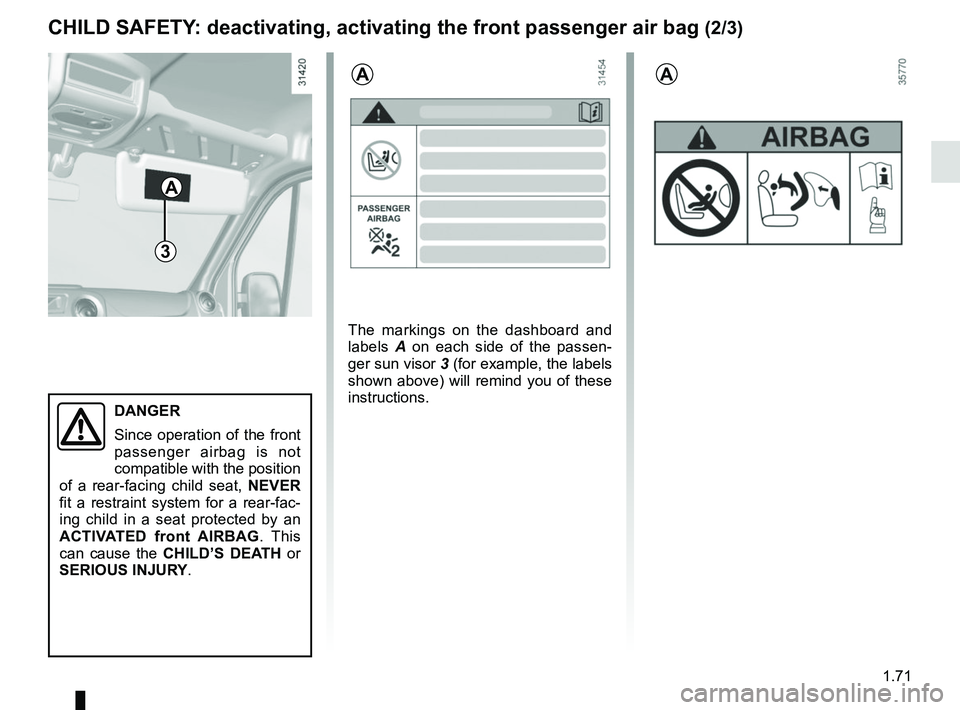
The markings on the dashboard and
labels A on each side of the passen-
ger sun visor 3 (for example, the labels
shown above) will remind you of these
instructions.
A
DANGER
Since operation of the front
passenger airbag is not
compatible with the position
of a rear-facing child seat, NEVER
fit a restraint system for a rear-fac-
ing child in a seat protected by an
ACTIVATED front AIRBAG . This
can cause the CHILD’S DEATH or
SERIOUS INJURY.
Page 78 of 290

1.72
Operating faultsIn the event that the front passenger air
bag activation/deactivation system is
faulty, child seats must not be fitted to
the front seat.
Allowing any other passenger to sit in
that seat is not recommended.
Contact your approved Dealer as soon
as possible.Activation of the front
passenger air bag
You should reactivate the air bag as
soon as you remove the child seat from
the front passenger seat to ensure the
protection of the front passenger in the
event of an impact.
To reactivate the air bag: with the
vehicle stopped and the ignition off,
press and turn lock 2 to the ON posi-
tion.
With the ignition on, you must check
that the warning light 1
¹ is not lit
up on the dashboard.
CHILD SAFETY: deactivating, activating the front passenger air bag (3/3)
1
2
The passenger air bag must
only be deactivated or acti-
vated when the vehicle
is stationary. If it is inter-
fered with when the vehicle is being
driven, indicator lights
å and
© will come on. Switch the ig-
nition off then on again to reset the
air bag in accordance with the lock
position.
1DANGER
Since operation of the front
passenger airbag is not
compatible with the position
of a rear-facing child seat, NEVER
fit a restraint system for a rear-fac-
ing child in a seat protected by an
ACTIVATED front AIRBAG . This
can cause the CHILD’S DEATH or
SERIOUS INJURY.
Page 81 of 290

1.75
DRIVER’S POSITION: LEFT-HAND DRIVE (2/2)
The equipment fitted, described below, DEPENDS ON THE VERSION AND COUNTRY.
1 Side window demister outlet.
2 Side air vent.
3 Stalk for:
– direction indicator lights;
– exterior lights;
– front fog lights;
– rear fog lights.
4 Instrument panel.
5 Location for driver’s air bag.
6 – Windscreen wiper/washer stalk.
– Information readout control.
7 Accessories socket.
8 Centre air vent.
9 Location for:
– radio;
– storage compartment.
10 Heating and ventilation controls.
11 Centre air vent.
12 Passenger airbag location.
13 Side air vent.
14 Side window demister.
15 Storage compartments.
16 Location for:
– storage compartment;
– audio connection socket;
– front passenger air bag deacti-vation warning light.
17 Cigar lighter or accessories socket.
18 Switches:
– cruise control/speed limiter;
– activation/deactivation of the Stop and Start function;
– activation/deactivation of ECO mode;
– fast idle speed;
– power take-off.
19 Steering wheel height adjustment
control.
20 Bonnet release.
21 Fuse box.
22 Controls for:
– electric beam height adjust-ment;
– activation/deactivation of the parking distance control;
– activating/deactivating the load position;
– activation/deactivation of the traction control.
Page 83 of 290

1.77
DRIVER’S POSITION, RIGHT-HAND DRIVE (2/2)
The equipment fitted, described below, DEPENDS ON THE VERSION AND COUNTRY.
1 Side window demister outlet.
2 Side air vent.
3 Location for passenger air bag.
4 Centre air vent.
5 Heating and ventilation controls.
6 Location for:
– radio;
– storage compartment.
7 Centre air vent.
8 Accessories socket.
9 Stalk for:
– direction indicator lights;
– exterior lights;
– front fog lights;
– rear fog lights.
10 Instrument panel.
11 Driver airbag location.
12 – Windscreen wiper/washer stalk;
– Information readout control.
13 Side air vent.
14 Side window demister.
15 Controls for:
– electric beam height adjust-ment;
– activation/deactivation of the parking distance control;
– activating/deactivating the load position;
– activation/deactivation of the traction control.
16 Steering wheel height adjustment
control.
17 Switches:
– cruise control/speed limiter;
– activation/deactivation of the Stop and Start function;
– activation/deactivation of ECO mode;
– fast idle speed;
– power take-off.
18 Cigar lighter or accessories socket.
19 Location for:
– storage compartment;
– audio connection socket;
– front passenger air bag deacti-vation warning light.
20 Storage compartment.
21 Bonnet release.
22 Fuse box.
Page 85 of 290

The presence and operation of the warning lights DEPEND ON THE EQUIPMENT\
AND COUNTRY.
DHandbrake on and brake cir-
cuit incident warning light
This comes on when the igniti")
1.79
WARNING LIGHTS (2/4)
The presence and operation of the warning lights DEPEND ON THE EQUIPMENT\
AND COUNTRY.
DHandbrake on and brake cir-
cuit incident warning light
This comes on when the ignition is
switched on and goes out as soon as
the handbrake is released. If it comes
on during braking or when the vehicle
is being driven, accompanied by the
® indicator light, it means that one
of the circuit levels is too low; it may be
dangerous to continue driving. Consult
an approved dealer.
\bTyre pressure loss warning
Please refer to the information
on the “Tyre pressure loss warning” in
Section 2.
©Warning light
This comes on when the igni-
tion is switched on and goes out after
about 3 seconds. If it comes on, pos-
sibly accompanied by other warning
lights, you should visit an approved
dealer as soon as possible. Depending
on the vehicle, this warning light is ac-
companied by a message on the instru-
ment panel.
ÄToxic fume filter system
warning light
On equipped vehicles, the light comes
on when the ignition is switched on then
goes out.
– If it lights up continuously accom- panied by the
© warning light,
please consult an authorised dealer
as soon as possible;
– if it flashes, reduce the engine speed until the light stops flashing. Contact
an approved dealer as soon as pos-
sible.
Please refer to the information on
«Maintenance and anti-pollution
advice» in Section 2.
åIndicator light Airbag
This light comes on when the
ignition is switched on and goes out
within about 3 seconds. If it comes on,
there is a fault in the system. Contact
an approved dealer as soon as possi-
ble.
2
Door status warning light
If it lights up when the ignition
is switched on, it indicates that
a door is not properly closed.
ÜNot used
®STOP light
This comes on when the igni-
tion is switched on and goes out after
about 3 seconds.
If it comes on, possibly accompanied
by other warning lights, stop soon as
traffic conditions allow. Contact an ap-
proved dealer as soon as possible.
Depending on the vehicle, this warning
light is accompanied by a message on
the instrument panel.
ÔCoolant temperature warn-
ing light
If this remains lit while driving accom-
panied by the
® indicator light, it
indicates engine overheating. Stop and
allow the engine to run at idle speed for
about a minute or two. The tempera-
ture should drop. Otherwise, stop the
engine. Let the engine cool down, then
check the coolant level. Contact an ap-
proved Dealer if necessary.