2018 RENAULT KOLEOS temperature
[x] Cancel search: temperaturePage 223 of 332
3.27
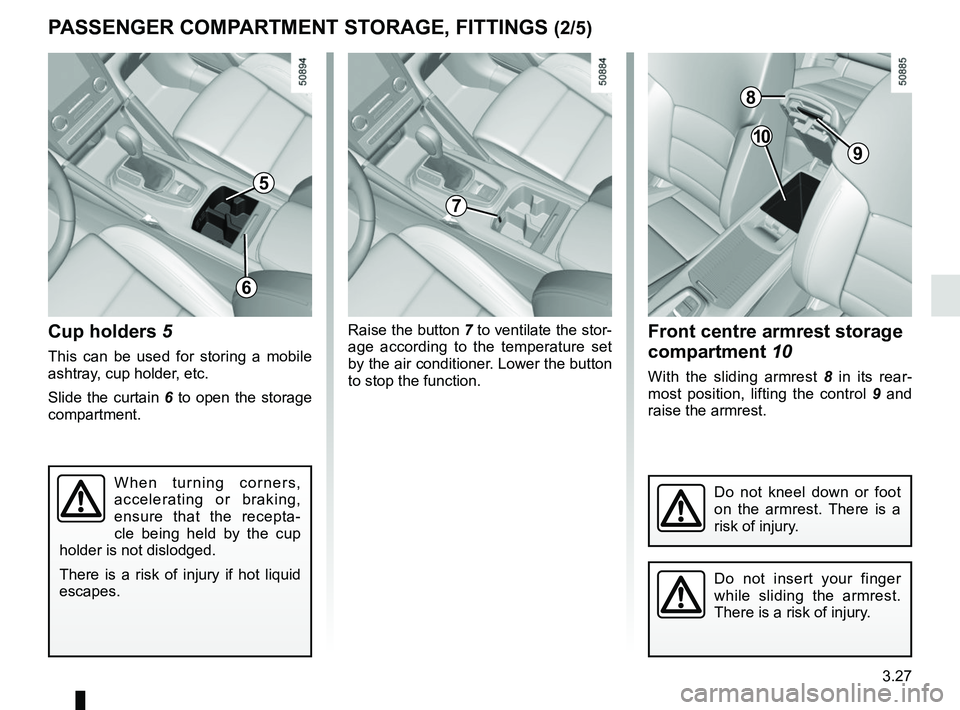
Front centre armrest storage
compartment 10
With the sliding armrest 8 in its rear-
most position, lifting the control 9 and
raise the armrest.
Cup holders 5
This can be used for storing a mobile
ashtray, cup holder, etc.
Slide the curtain 6 to open the storage
compartment.
When turning corners,
accelerating or braking,
ensure that the recepta-
cle being held by the cup
holder is not dislodged.
There is a risk of injury if hot liquid
escapes.
PASSENGER COMPARTMENT STORAGE, FITTINGS (2/5)
5
Raise the button 7 to ventilate the stor-
age according to the temperature set
by the air conditioner. Lower the button
to stop the function.
8
9
10
7
6
Do not kneel down or foot
on the armrest. There is a
risk of injury.
Do not insert your finger
while sliding the armrest.
There is a risk of injury.
Page 259 of 332

4.13
BATTERY (1/2)
1
Battery 1 does not require any mainte-
nance. You should not open it or add
any fluid.
Handle the battery with care
as it contains sulphuric acid
which must not come into
contact with the eyes or
skin. If it does, wash the affected
area with plenty of cold water. If
necessary, consult a doctor.
Ensure that naked flames, red hot
objects and sparks do not come into
contact with the battery as there is a
risk of explosion.
Depending on the vehicle, a system
continuously checks the battery charge
status. If this decreases, the message
“Battery low start engine” is displayed
on the instrument panel. In this case,
start the engine. The message will go
off.
The charge status of your battery can
decrease especially if you use your ve-
hicle:
– for short journeys;
– for driving in town;
– when the temperature drops;
– after extended use of energy-con- suming devices (radio, etc.) with the
engine switched off.
The engine may be hot
during operations in close
proximity. In addition, the
engine cooling fan may
start at any moment.
Risk of injury.
Before performing any
action in the engine com-
partment, the ignition must
be switched off by pressing
the engine stop button (please see
the information on “Starting, stop-
ping the engine” in Section 2).
Page 261 of 332
4.15
BODYWORK MAINTENANCE (1/2)
You should
Wash your car frequently, with the
engine off, with cleaning products rec-
ommended by the manufacturer (never
use abrasive products). Rinse thor-
oughly beforehand with a jet:
– spots of tree resin and industrial
grime;
– mud in the wheel arches and under-
neath the body which forms damp
patches;
– bird droppings , which cause a
chemical reaction with the paint that
rapidly discolours paintwork and
may even cause the paint to peel
off;
wash the vehicle immediately to
remove these marks since it is im-
possible to remove them by polish-
ing;
– salt, particularly in the wheel arches
and underneath the body after driv-
ing in areas where the roads have
been gritted.
Remove any plant matter (resin, leaves,
etc.) from the vehicle regularly.
What you should not doDo not degrease or clean mechani-
cal components (e.g. the engine com-
partment), underneath the body, parts
with hinges (e.g. inside the doors) and
painted plastic external fittings (e.g.
bumpers) using high-pressure clean-
ing equipment or by spraying on prod-
ucts not approved by our Technical
Department. Doing this could give rise
to corrosion or operational faults.
Wash the vehicle in bright sunlight or
freezing temperatures.
Do not scrape off mud or dirt without
pre-wetting.
Allow dirt to accumulate on the exterior.
Allow rust to form following minor im-
pacts.
Do not use solvents not approved by
our Technical Department to remove
stains as this could damage the paint-
work.
Do not drive in snow or muddy condi-
tions without washing the vehicle, par-
ticularly under the wheel arches and
body.
A well-maintained vehicle will last
longer. It is therefore recommended to
maintain the exterior of the vehicle reg-
ularly.
Your vehicle has been treated with very
effective anti-corrosion products. It is
nevertheless subject to various outside
influences.
Corrosive agents in the atmosphere
–
atmospheric pollution (built-up and
industrial areas),
– saline atmospheres (near the sea,
particularly in hot weather),
– seasonal and damp weather condi-
tions (e.g. road salt in winter, water
from road cleaners, etc.).
Minor impacts
Abrasive action
Dust and sand in the air, mud, road grit
thrown up by other vehicles, etc.
You should take a number of minor pre-
cautions in order to safeguard your ve-
hicle against such risks.
Page 263 of 332

4.17
Glass instrument panel(e.g.: instrument panel, clock, exterior
temperature display, radio display, mul-
timedia or multifunction display etc.)
Use a soft cloth (or cotton wool).
If this does not clean them properly,
use a soft cloth (or cotton wool) slightly
moistened with soapy water and then
wipe clean with another soft damp cloth
or cotton wool.
Finally, carefully dry off with a soft dry
cloth.
Do not use products containing alco-
hol and/or spray fluids on the area.
Seat belts
These must be kept clean.
Use products selected by our Technical
Department (Approved outlets) or
warm, soapy water and a sponge and
wipe with a dry cloth.
Detergents or dyes must not be used
under any circumstances.
INTERIOR TRIM MAINTENANCE (1/2)
Textiles (seats, door trim, etc)
Vacuum-clean the textiles regularly.
Liquid stain
Use soapy water.
Dab lightly (never rub) with a soft cloth,
rinse and remove the excess.
Solid or pasty stain
Carefully remove the excess solid or
pasty material immediately with a
spatula (working from the edges to the
centre to avoid spreading the stain).
Clean as for a liquid stain.
Special instructions for sweets or
chewing gum
Put an ice cube on the stain to solidify
it, then proceed as for a solid stain.
A well-maintained vehicle will last
longer. It is therefore recommended to
maintain the interior of the vehicle regu-
larly.
A stain should always be dealt with
swiftly.
Whatever type of stain is on the trim,
use
cold (or warm) soapy water with
natural soap.
Detergents (washing-up liquid, pow-
dered products, alcohol-based prod-
ucts) should not be used.
Use a soft cloth.
Rinse and soak up the excess.
For further recommendations for
maintaining the interior, and/or for
any unsatisfactory results, please
see an authorised dealer.
Page 303 of 332

5.39
OPERATING FAULTS (5/7)
On the roadPOSSIBLE CAUSESWHAT TO DO
Steering becomes heavy. Assistance overheating.
Fault with the electric assistance
motor.
Fault in assistance system. Drive carefully at reduced speed, be aware
of the level of force in the steering wheel
needed to turn the wheels. Consult an ap-
proved dealer.
The engine is overheating. The cool-
ant temperature indicator is in the
warning zone and warning light
® comes on. Engine cooling fan not working. Stop the vehicle, switch off the engine and
contact an approved dealer.
Coolant leaks. Check the coolant reservoir: it should con- tain fluid. If there is no coolant, consult an
approved dealer as soon as possible.
Coolant boiling in the coolant reser-
voir. Mechanical fault: damaged cylinder
head gasket. Stop the engine.
Contact an approved dealer.
Radiator:
If there is a significant lack of coolant, remember that it must never b\
e topped up using cold coolant while
the engine is very warm. After any procedure on the vehicle which has involved even partial drain\
ing of the cooling
system, it must be refilled with a new mixture prepared in the correct p\
roportions. Reminder: only products approved
by our Technical Department may be used for this purpose.
Page 305 of 332

5.41
OPERATING FAULTS (7/7)
Electrical equipmentPOSSIBLE CAUSESWHAT TO DO
Traces of condensation in the head-
lights or rear lights Traces of condensation may be a nat-
ural phenomenon caused by varia-
tions in temperature and humidity.
In this case, the traces will disappear
slowly once the lights are switched
on.
The front seat belt reminder light
comes on when the seat belts are
fastened. An object is stuck between the floor
and the seat and is disrupting the op-
eration of the sensor. Remove all objects from underneath the
front seats.
Page 329 of 332

storage compartments ...........................................3.26 → 3.30
sun visor ........................................................................\
.... 3.26")
7.5
ALPHABETICAL INDEX (5/5)
storage compartments ...........................................3.26 → 3.30
sun visor ........................................................................\
.... 3.26
sunroof.................................................................... 3.21 – 3.22
switching on the vehicle ignition .........................2.3, 2.5 → 2.9
T
tailgate ...............................................3.36 → 3.41, 3.45 – 3.46
tanks and reservoirs brake fluid ...................................................................... 4.9
coolant ................................................................\
........... 4.8
tanks and reservoirs: windscreen washer ...................................................... 4.10
technical specifications ..............................................6.4 → 6.7
telephone ................................................................ 3.49 – 3.50
temperature regulation ............................................3.7 → 3.17
tool kit ........................................................................\
.......... 5.7
towing breakdown .......................................................5.31 → 5.34
towing equipment ......................................................... 3.47
towing a caravan ........................................................ 3.47, 6.6
towing equipment fitting ................................................................\
............ 3.47
towing hitch.....................................................5.7, 5.31 → 5.34
towing rings ....................................................................... 3.46
towing weights ..................................................................... 6.6
traction control: ASR ..............................................2.31 → 2.34
transporting children .................1.34 – 1.35, 1.37 → 1.43, 1.47
transporting objects in the luggage compartment ........................................ 3.46
on the roof ...................................................................... 6.6
trip computer and warning system... 1.54 → 1.59, 1.62 → 1.71
tyre inflation kit...........................................................5.4 → 5.6
tyre pressure............................. 2.28 → 2.30, 4.11 – 4.12, 5.11
tyre pressure loss warning.....................................2.28 → 2.30
tyre pressures ......................................................... 4.11 – 4.12
tyres .................... 2.24, 2.28 → 2.30, 4.11 – 4.12, 5.10 → 5.12 U
unlocking the doors ............................................... 1.11
→ 1.13
V
variable power-assisted steering ....................................... 1.74
vehicle identification plates .................................................. 6.3
ventilation .......................................................1.22, 3.2 → 3.17
W
warning lights.........................................................1.54 → 1.71
washing .................................................................. 4.15 – 4.16
weights ................................................................\
................ 6.6
wheelbrace .............................................................\
............. 5.7
wheels (safety) ......................................................5.10 → 5.12
windscreen de-icing/demisting ............................................ 3.9
windscreen washer ................................................1.87 → 1.94
wiper blades ........................................................... 5.29 – 5.30
wipers .................................................................\
...1.87 → 1.94
blades ............................................................... 5.29 – 5.30