Page 92 of 310
1.86
HEADLIGHT BEAM ADJUSTMENT (2/2)
Temporary adjustment for
vehicles fitted with halogen
headlights
Open the bonnet and identify the mark-
ing B next to one of the front headlight
projectors.
For each headlight, using a screw-
driver, turn the screw 1 by a quarter
turn towards the - symbol to lower the
beams.
Return to the original position once your
trip is over: turn the screw 1 a quarter of
a turn towards the + symbol to raise the
beams.
When driving on the left in a left-
hand drive vehicle (or vice versa),
you must adjust your lights tempo-
rarily during your stay.
1
B
Page 98 of 310
1.92
Note:
To ensure the headlight washers op-
erate correctly in winter, remove snow
from the jet trims and de-ice the jet
trims using an aerosol de-icer.
You are recommended to regularly
remove dirt encrusted on the headlight
glass.
When the minimum windscreen washer
fluid level is reached, the headlight
washer system may be deprimed.
Fill the windscreen washer fluid and
then activate the windscreen washer,
with the engine running, to reprime
the system.
1
A
B
C
DE
WINDSCREEN WASH, WIPE (6/6)
Headlight washers
Headlights on
On equipped vehicles, hold stalk 1
pulled towards you for about 2 seconds
- the headlight washers and winds-
creen washers will be activated at the
same time.
The headlight washers are also activa-
ted after three prolonged movements
on the front windscreen washer control.
When working in the engine
compartment, ensure that
the windscreen wiper stalk
is in position B (stop).
Risk of injury.
Page 103 of 310

1.97
FUEL TANK (3/3)
Persistent fuel odour
If you notice a persistent
fuel odour you should:
– stop the vehicle as soon as traf- fic conditions allow and switch off
the ignition;
– switch on the hazard warning lights and ask your passengers to
leave the vehicle and stay clear
of the traffic;
– contact an approved Dealer.
No modifications what-
soever are permitted on
any part of the fuel supply
system (electronic units,
wiring, fuel circuit, injectors, pro-
tective covers, etc.) as this may be
dangerous (unless undertaken by
qualified Network personnel).Running out of fuel on diesel
versions
Vehicles with key/remote control
– Put the ignition key in “On” posi- tion M (please see the information
on the “Ignition switch” in Section
2) and wait for a few minutes before
starting, to enable the fuel circuit to
be primed;
– turn the key to position D . If the
engine does not start, repeat the pro-
cedure.
– If the engine does not start after sev- eral attempts, please contact an au-
thorised dealer. Vehicles with RENAULT card
With the card RENAULT
in the pas-
senger compartment, press the start
button 4 without pressing any of the
pedals. Wait a few minutes before start-
ing. This will enable the fuel circuit to
be primed. If the engine does not start,
repeat the procedure.
If the engine does not start after several
attempts, please contact an authorised
dealer.
4
Page 105 of 310

1.99
In extreme cold weather conditions
Fill the reagent tank as soon as pos-
sible when the warning light
and the message “Top up AdBlue
before 1200 km” are displayed.
The reagent fluid freezes below about
-10°C.
In these conditions, do not attempt fill-
ing when the fluid is frozen. In the event
of needing to top up or fill the tank
with reagent (
on), park the ve-
hicle in a hotter location if possible so
that the reagent becomes liquid again.
Otherwise, have a qualified profes-
sional top up or fill up with reagent fluid.
Precautions for use
When filling, handle the reagent care-
fully.
They can damage clothes, shoes,
bodywork components etc.
If the reagent overflows, or contami-
nates any paintwork, clean the affected
area quickly with plenty of cold water
and a soft cloth.
Note: If the reagent crystallises, use a
soft sponge.
The reagent must not come
into contact with eyes or
skin. If it does, wash the af-
fected area with plenty of
cold water. If necessary, consult a
doctor.
REAGENT TANK (2/4)
No work whatsoever is
permitted on any part of
the system. To prevent
damage, only qualified per-
sonnel from our network may work
on the system.
After filling the reagent tank, check
that the cap and cover are closed,
start the engine and WAIT 10 sec-
onds with the vehicle stationary,
engine running before setting off
again.
If this operation is not carried out,
the filling of the tank will not be
taken into account automatically
until after several dozens of minutes
of driving.
The message “--- Top up AdBlue”
and/or the warning lights will con-
tinue to appear until the filling has
been registered by the system.
Page 106 of 310

Maintenance/Range
The information displayed on the instrument panel may be accompanied by \
a beep.
Indicator lights Message What to do?
– “AdBlue Level Correct” –
â€")
1.100
REAGENT TANK (3/4)
Maintenance/Range
The information displayed on the instrument panel may be accompanied by \
a beep.
Indicator lights Message What to do?
– “AdBlue Level Correct” –
– “Top Up AdBlue before 2400 km” When the message is displayed when the ignition is switched
on, you have less than 1,488 miles (2,400 km) range.
Fill or have an Approved Dealer
fill or top up the reagent in
the tank.
appears. “Top up AdBlue before 1200 km” When the message is displayed when the ignition is switched
on, you have
between 744 miles (1,200 km) and 496 miles
(800 km) range.
Fill or have an Approved Dealer fill or top up the reagent in
the tank.
appears. “XXX MILES (XXX KM) Failure Top up
AdBlue” The message is displayed when the ignition is switched on and
is repeated:
– Approximately every 62 miles (100 km), you have
between
about 496 miles (800 km) and 124 miles (200 km) range ;
– Approximately every 31 miles (50 km), you have less than
124 miles (200 km) range .
In any event, fill or have an Approved Dealer fill the reagent
tank as soon as possible.
appears. “0 MILES (0 KM) Failure Top up AdBlue” The engine will not start.
To restart, you must fill the reagent tank yourself.
Page 107 of 310
1.101
REAGENT TANK (4/4)
System fault
When the indicator lights light up, this may be accompanied by a beep.
Indicator lights Message Readings
and © come on.“Check anti-pollution system”
Indicates a fault in the system. Contact your approved
dealer as soon as possible.
and © come on.“XXX MILES (XXX KM) Failure antipollu-
tion” Indicates a system fault and that in
less than
496 miles (800 km) it will become impossible to
restart the vehicle .
These warnings are repeated:
– Every 62 miles (100 km) until there is around
124 miles (200 km) left before the vehicle cannot
be restarted;
– Every 31 miles (50 km) when there is less than 124 miles (200 km) left before the vehicle cannot
be restarted.
Contact your approved dealer as soon as possible.
and © come on. “0 KM Failure antipollution”
Indicates that after the ignition is switched off the ve-
hicle will not restart
. Call an approved Dealer.
Page 111 of 310
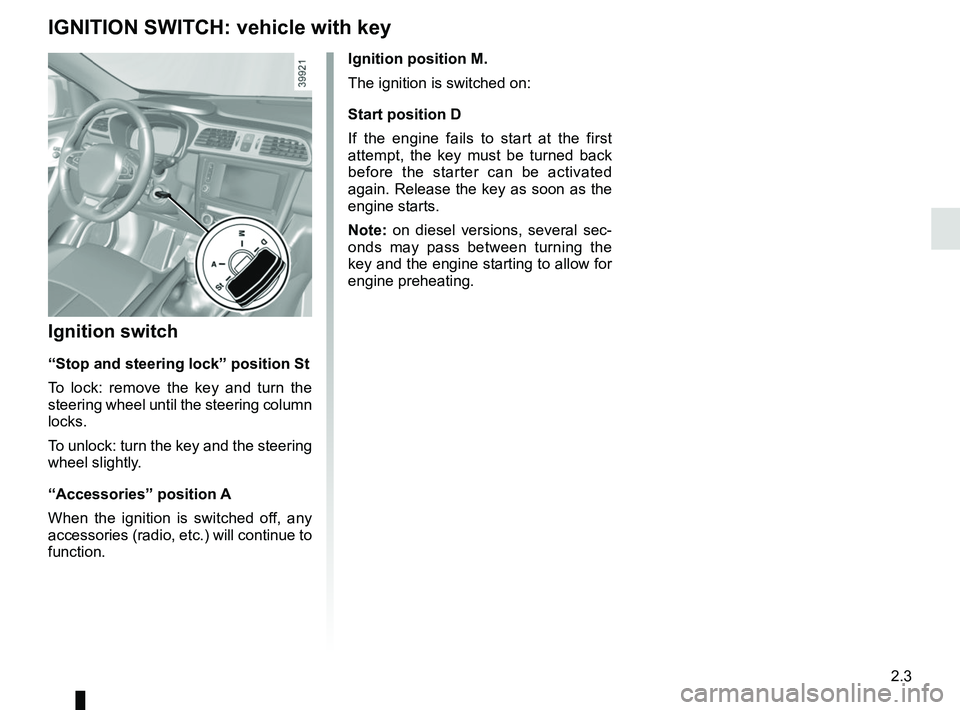
2.3
Ignition position M.
The ignition is switched on:
Start position D
If the engine fails to start at the first
attempt, the key must be turned back
before the starter can be activated
again. Release the key as soon as the
engine starts.
Note: on diesel versions, several sec-
onds may pass between turning the
key and the engine starting to allow for
engine preheating.
Ignition switch
“Stop and steering lock” position St
To lock: remove the key and turn the
steering wheel until the steering column
locks.
To unlock: turn the key and the steering
wheel slightly.
“Accessories” position A
When the ignition is switched off, any
accessories (radio, etc.) will continue to
function.
IGNITION SWITCH: vehicle with key
Page 112 of 310

2.4
STARTING, STOPPING THE ENGINE: vehicle with key
Starting the engine
Petrol versions– Activate the starter without ac-
celerating;
– release the key as soon as the
engine starts.
ÉDiesel versions
– Turn the ignition key to the
“Ignition on” position M, and hold
this position until the engine pre-
heating light goes off;
– turn the key to starter position D
without depressing the accel-
erator pedal;
– release the key as soon as the
engine starts.
Special note: if starting the engine
when the outdoor temperature is very
low (below - 10 ° C): hold down the
clutch pedal until the engine starts.
Never start your vehicle
while freewheeling on a
gradient. Risk of non-ac-
tivation of power-assisted
steering.
There is a risk of accidents.
Never switch off the igni-
tion before the vehicle has
stopped completely. Once
the engine has stopped, the
brake servo, power-assisted steer-
ing, etc. and the passive safety de-
vices such as air bags and preten-
sioners will no longer operate.
Driver’s responsibility
when parking or stopping
the vehicle
Never leave an animal,
child or adult who is not self-suffi-
cient alone in your vehicle, even for
a short time.
They may pose a risk to themselves
or to others by starting the engine,
activating equipment such as the
electric windows or locking the
doors, for example.
Also, in hot and/or sunny weather,
please remember that the tempera-
ture inside the passenger compart-
ment increases very quickly.
RISK OF DEATH OR SERIOUS
INJURY.
Stopping the engine
With the engine idling, turn the key to
the “Stop” position St.