2018 RENAULT CAPTUR brake light
[x] Cancel search: brake lightPage 176 of 258

4.8
Level 2
It is normal for the level to drop as the
brake shoes become worn, but it must
never drop lower than the “MINI" warn-
ing line.
If you wish to check the disc and drum
wear yourself, you should obtain the
document explaining the checking pro-
cedure from the manufacturer’s net-
work or web site.
Topping up
After any operation on the hydraulic cir-
cuit, a specialist must replace the brake
fluid.
Only use fluids approved by our
Technical Department (and taken from
a sealed container).
Replacement interval
Refer to the Maintenance Document for
your vehicle.
Brake fluid level
The level should be read with the engine
switched off and on level ground.
This should be checked frequently,
and immediately if you notice even the
slightest loss in braking efficiency.
LEVELS (2/3)
2
Please note when work-
ing close to the engine that
it may be hot. The engine
cooling fan may also start
at any moment. The
warning
light in the engine compartment re-
minds you of this.
Risk of injury.
Consult your approved dealer at
once if you notice an abnormal or
repeated drop in any of the fluid
levels.
Page 195 of 258

5.5
TYRE PRESSURE KIT (2/3)
Depending on the vehicle, in the event
of a puncture, use the kit located in the
boot or underneath the luggage com-
partment carpet.
Vehicle fitted with a tyre pressure
loss warning system
If under-inflated (puncture, low pres-
sure, etc.), the warning light
lights up on the instrument panel.
See “Tyre pressure loss warning” in
Section 2.
With the engine running and the
parking brake applied,
– Disconnect any accessories previ- ously connected to the vehicle’s ac-
cessories sockets;
– Refer to the information on the in- flation kit compressor located in the
vehicle’s luggage compartment and
follow the instructions;
– inflate the tyre to the recommended pressure (please refer to the infor-
mation in the section on “Tyre pres-
sures”);
– after a maximum of 15 minutes, stop inflating and read the pressure (on
the pressure gauge 1);
Note: while the bottle is emptying
(approximately 30 seconds), the
pressure gauge 1 will indicate briefly
a pressure of 6 bar, then the pres-
sure drops.
– Adjust the pressure: to increase it, continue inflation with the kit. To
reduce it, press the button 2.
1Before using this kit, park
the vehicle at a sufficient
distance from traffic, switch
on the hazard warning
lights, apply the handbrake, ask all
passengers to leave the vehicle and
keep them away from traffic.
If the vehicle is parked on
the hard shoulder, you must
warn other road users of
your vehicle’s presence
with a warning triangle or with other
devices as per the legislation apply-
ing to the country you are in.
2
Page 199 of 258

5.9
Continue to crank the jack so that the
baseplate is correctly positioned (it
should be underneath the vehicle and
aligned with the jack head).
Turn it a few times to lift the wheel off
the ground.
Switch on the hazard warn-
ing lights.
Keep the vehicle away from
traffic and on a level surface
where it will not slip.
Apply the parking brake and engage
a gear (first or reverse, or P for auto-
matic transmissions).
Ask all the passengers to leave the
vehicle and keep them away from
traffic.
CHANGING A WHEEL (1/2)
2
1
Vehicles equipped with a jack
and wheelbrace
If necessary, remove the wheel trim.
Use the wheelbrace 1 to slacken off the
wheel bolts. Position it so as to be able
to push from above.
Crank up jack 2 by hand to position the
jack head against the jacking point clos-
est to the relevant wheel and marked
by an arrow 3.
If the vehicle is not equipped with a
jack or wheelbrace, you can obtain
these from your approved dealer.
If the vehicle is parked on
the hard shoulder, you must
warn other road users of
your vehicle’s presence
with a warning triangle or with other
devices as per the legislation apply-
ing to the country you are in.
3
Page 207 of 258

5.17
REAR LIGHTS AND SIDE LIGHTS: replacing the bulbs (1/3)
Brake lights and direction indicator
lights
Open the boot lid and remove screws 1.Pull on the outside A
of the light and
remove the rear light unit.
Remove the bulb holder by releasing
clips 2, then clips 3.
Change the bulb.
Refit the bulb holder and push the unit
in fully until it locks in place.
Check that the light is properly locked
in position.
Tighten screws 1. 4
Direction indicator lights
Bulb type: PY21W.
5 Brake light
Bulb type: P21W.
The bulbs are under pres-
sure and can break when
replaced.
Risk of injury.
1
A
2
3
4
5
Page 208 of 258

5.18
Side lights 6
Consult an approved dealer
REAR LIGHTS AND SIDE LIGHTS: replacing the bulbs (2/3)
High level brake light 7
Consult an approved dealer
Fog lights 9 and reversing
lights 8
The front bumper needs to be removed;
consult an authorised dealer.
Note: depending on the vehicle, the re-
versing and fog lights are inverted.
Bulb type: P21W.
6
7
98
Page 217 of 258

5.27
Number Allocation
18 Brake lights
19 Exterior rear view mirrors
20 ABS, ESC,
Brake switch
21 Interior lighting,
electric windows,
air conditioning,
passenger compartment
temperature sensor
22 Vehicle Start/Stop button,
rain and light sensor,
steering wheel angle
sensor,
driving mode control
23 Radio,
diagnostic socket
24 Passenger compartment
ECU
25 Passenger compartment
ECU
FUSES (5/5)
Number Allocation
26 Direction indicator lights
27 Central locking of opening
elements
28 Hands-free access
29 Front row cigar lighter,
accessories socket,
passenger compartment
unit,
radio
30 Alarm,
lighting
31 Instrument panel
32 Cigarette lighter
33 Empty location
34 Front seat heatingNumber Allocation
35 Rear screen de-icing,
exterior rear view mirror
36 Towbar
37 Front windscreen wiper
38 Empty location
39 Not used
Page 224 of 258

5.34
TOWING: breakdown recovery (1/2)
Before towing, unlock the steering
column: with the clutch depressed,
engage first gear (lever in position N
or R for vehicles with automatic gear-
boxes), insert the RENAULT card in the
card reader, then press the engine start
button for two seconds.
Reposition the lever to neutral (posi-
tion N for vehicles fitted with an auto-
matic gearbox).
The column is unlocked, the acces-
sory functions are supplied: the vehi-
cle lights can be used (indicators, brake
lights etc.). At night the vehicle must
have its lights on.
Once you have finished towing, press
the engine start button twice (risk of
running down the battery). The speed specified by current legis-
lation for towing must always be ob-
served. If your vehicle is the towing
vehicle, do not exceed the maximum
towing weight for your vehicle (refer to
the information on “Weights” in Section
6).
Towing a vehicle with an
automatic gearbox
With the engine switched off, the trans-
mission is no longer lubricated. It is
preferable to tow this type of vehicle on
a trailer or tow it with the front wheels
off the ground.
Under
exceptional circumstances, you
may tow the vehicle with all four wheels
on the ground, only going forward, with
the gear lever in the neutral N position,
and for a distance not exceeding
30 miles (50 km).
Do not remove the
RENAULT card from the
reader when the vehicle is
being towed.
1
2
If the lever is stuck in P , even though
you are depressing the brake pedal, the
lever can be released manually. To do
this, unclip the base of the lever, then
insert a tool (with a hard rod to it) into
the slot 1 and press the button 2 at the
same time in order to unlock the lever.
Contact an authorised dealer as soon
as possible.
Page 251 of 258
7.1
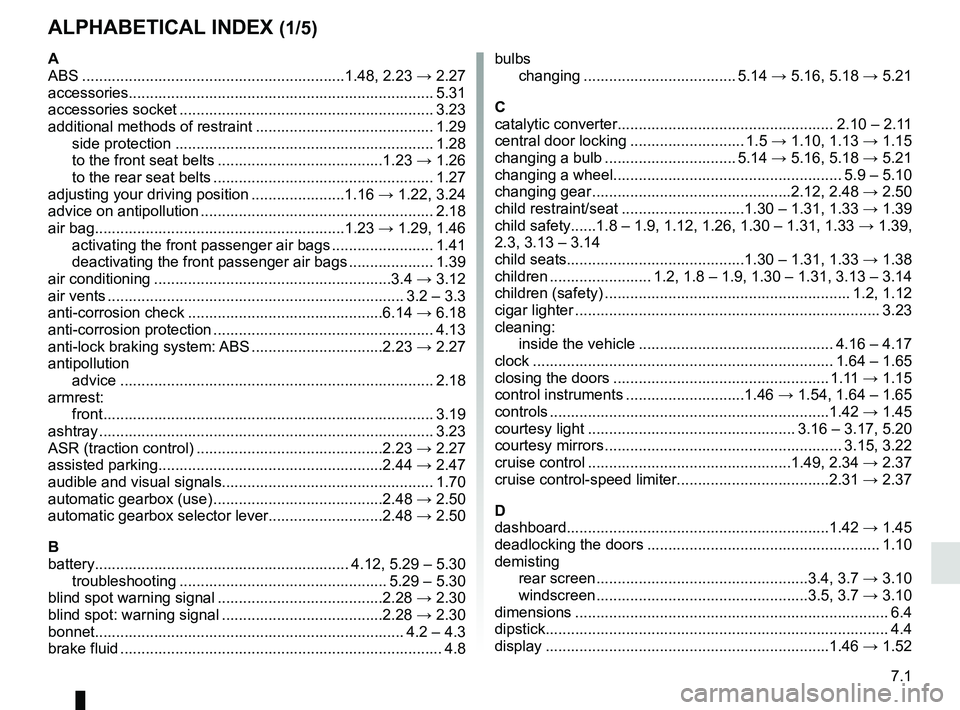
ALPHABETICAL INDEX (1/5)
A
ABS ..............................................................1.48, 2.23 → 2.27
accessories........................................................................\
5.31
accessories socket ............................................................ 3.23
additional methods of restraint .......................................... 1.29 side protection ............................................................. 1.28
to the front seat belts .......................................1.23 → 1.26
to the rear seat belts .................................................... 1.27
adjusting your driving position ......................1.16 → 1.22, 3.24
advice on antipollution ....................................................... 2.18
air bag...........................................................1.23 → 1.29, 1.46
activating the front passenger air bags ........................ 1.41
deactivating the front passenger air bags .................... 1.39
air conditioning ........................................................3.4 → 3.12
air vents ...................................................................... 3.2 – 3.3
anti-corrosion check ..............................................6.14 → 6.18
anti-corrosion protection .................................................... 4.13
anti-lock braking system: ABS ...............................2.23 → 2.27
antipollution advice .................................................................\
......... 2.18
armrest: front ..................................................................\
............ 3.19
ashtray ................................................................\
............... 3.23
ASR (traction control) ............................................2.23 → 2.27
assisted parking.....................................................2.44 → 2.47
audible and visual signals.................................................. 1.70
automatic gearbox (use) ........................................2.48 → 2.50
automatic gearbox selector lever...........................2.48 → 2.50
B
battery............................................................ 4.12, 5.29 – 5.30 troubleshooting ................................................. 5.29 – 5.30
blind spot warning signal .......................................2.28 → 2.30
blind spot: warning signal ......................................2.28 → 2.30
bonnet........................................................................\
. 4.2 – 4.3
brake fluid ........................................................................\
.... 4.8 bulbs
changing .................................... 5.14 → 5.16, 5.18 → 5.21
C
catalytic converter................................................... 2.10 – 2.11
central door locking ........................... 1.5 → 1.10, 1.13 → 1.15
changing a bulb ............................... 5.14 → 5.16, 5.18 → 5.21
changing a wheel...................................................... 5.9 – 5.10
changing gear ...............................................2.12, 2.48 → 2.50
child restraint/seat .............................1.30 – 1.31, 1.33 → 1.39
child safety......1.8 – 1.9, 1.12, 1.26, 1.30 – 1.31, 1.33 → 1.39,
2.3, 3.13 – 3.14
child seats..........................................1.30 – 1.31, 1.33 → 1.38
children ........................ 1.2, 1.8 – 1.9, 1.30 – 1.31, 3.13 – 3.14
children (safety) .......................................................... 1.2, 1.12
cigar lighter ........................................................................\
3.23
cleaning: inside the vehicle .............................................. 4.16 – 4.17
clock ....................................................................... 1.64 – 1.65
closing the doors ................................................... 1.11 → 1.15
control instruments ............................1.46 → 1.54, 1.64 – 1.65
controls ...............................................................\
...1.42 → 1.45
courtesy light ................................................. 3.16 – 3.17, 5.20
courtesy mirrors ........................................................ 3.15, 3.22
cruise control ................................................1.49, 2.34 → 2.37
cruise control-speed limiter....................................2.31 → 2.37
D
dashboard..............................................................1.42 →
1.45
deadlocking the doors ....................................................... 1.10
demisting rear screen
..................................................3.4, 3.7 → 3.10
windscreen ..................................................3.5, 3.7 → 3.10
dimensions .............................................................\
............. 6.4
dipstick................................................................\
................. 4.4
display ................................................................\
...1.46 → 1.52