4.4
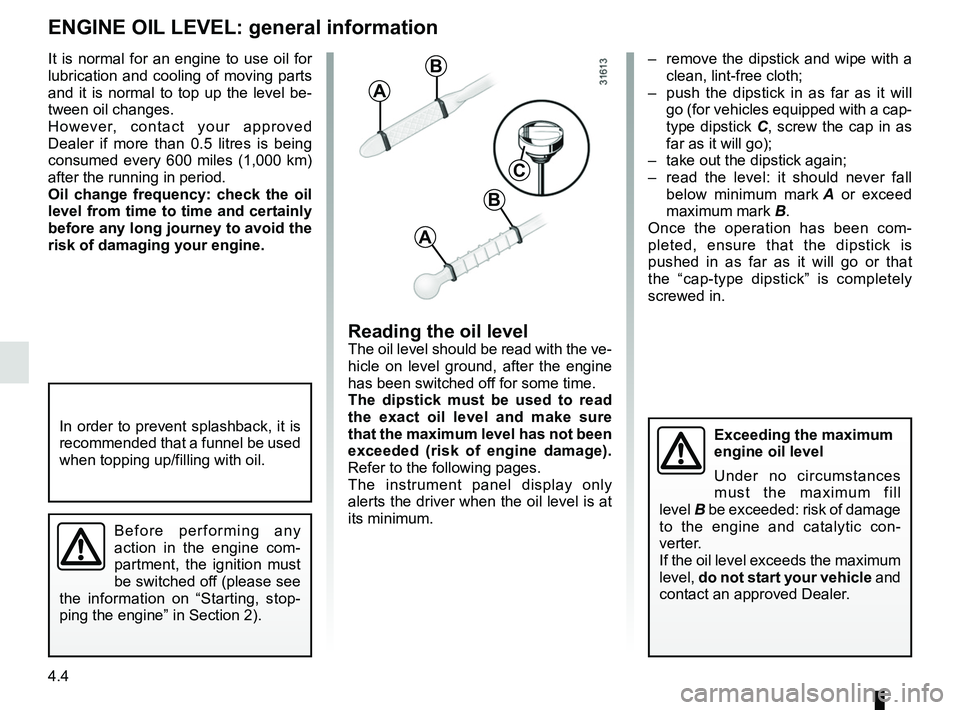
– remove the dipstick and wipe with a clean, lint-free cloth;
– push the dipstick in as far as it will go (for vehicles equipped with a cap-
type dipstick C, screw the cap in as
far as it will go);
– take out the dipstick again;
– read the level: it should never fall below minimum mark A or exceed
maximum mark B.
Once the operation has been com-
pleted, ensure that the dipstick is
pushed in as far as it will go or that
the “cap-type dipstick” is completely
screwed in.
Reading the oil levelThe oil level should be read with the ve-
hicle on level ground, after the engine
has been switched off for some time.
The dipstick must be used to read
the exact oil level and make sure
that the maximum level has not been
exceeded (risk of engine damage).
Refer to the following pages.
The instrument panel display only
alerts the driver when the oil level is at
its minimum.
It is normal for an engine to use oil for
lubrication and cooling of moving parts
and it is normal to top up the level be-
tween oil changes.
However, contact your approved
Dealer if more than 0.5 litres is being
consumed every 600 miles (1,000 km)
after the running in period.
Oil change frequency: check the oil
level from time to time and certainly
before any long journey to avoid the
risk of damaging your engine.
ENGINE OIL LEVEL: general information
A
B
A
B
C
In order to prevent splashback, it is
recommended that a funnel be used
when topping up/filling with oil.
Before performing any
action in the engine com-
partment, the ignition must
be switched off (please see
the information on “Starting, stop-
ping the engine” in Section 2).
Exceeding the maximum
engine oil level
Under no circumstances
must the maximum fill
level B be exceeded: risk of damage
to the engine and catalytic con-
verter.
If the oil level exceeds the maximum
level, do not start your vehicle and
contact an approved Dealer.
7.3
ALPHABETICAL INDEX (3/5)
heating system ........................................................3.4 → 3.12
Hill Start Assist.......................................................2.23 → 2.27
horn ...................................................................\
................ 1.70
horn: flash ..................................................................\
........... 1.70
hubcap tool ................................................................. 5.7 – 5.8
I
indicators ..................................1.70, 5.14 → 5.16, 5.18 – 5.19
indicators: direction indicators ....................................................... 1.70
instrument panel ..............................................1.46 → 1.54
instrument panel ....................................................1.46 → 1.62
instrument panel messages...................................1.53 → 1.62
interior trim maintenance ..................................................... 4.16 – 4.17
Isofix ....................................................................... 1.33 – 1.34
J
jack ...................................................................\
................... 5.7
L
levels .................................................................\
........4.7 → 4.9
levels: brake fluid ...................................................................... 4.8
coolant ................................................................\
........... 4.7
windscreen washer reservoir ......................................... 4.9
lifting the vehicle changing a wheel ................................................ 5.9 – 5.10
lighting: exterior .............................................................1.67 → 1.72
instrument panel .......................................................... 1.67
interior ........................................... 3.16 – 3.17, 5.20 – 5.21
lights adjustment ........................................................ 1.71 – 1.72
changing bulbs .................................................5.14 → 5.16front ..................................................................\
5.14
→ 5.16
lights: adjusting ........................................................... 1.71 – 1.72
brake lights ....................................................... 5.18 – 5.19
dipped beam headlights .................1.46, 1.67, 5.14 → 5.16
direction indicators ................1.46, 1.70, 5.14 → 5.16, 5.18
fog lights .................................................... 1.46, 1.69, 5.19
hazard warning ............................................................ 1.70
main beam headlights ................................ 1.46, 1.67, 5.14
reversing lights ............................................................. 5.19
side lights .......................................1.67, 5.14 → 5.16, 5.18
load permitted on the roof.................................................... 6.6
locking the doors .....................................................1.2 → 1.15
M
maintenance ............................................................\
.......... 2.18
maintenance: bodywork .........................................................4.13 → 4.15
interior trim ........................................................ 4.16 – 4.17
mechanical .........................................4.4, 4.12, 6.8 → 6.13
map reading lights .................................................. 3.16 – 3.17
methods of restraint in addition to the seat belts ...1.23 → 1.29
mobile floor ........................................................................\
3.29
multimedia equipment .............................................. 3.34, 5.22
N
navigation system .............................................................. 3.34
O
oil change ................................................................... 4.5 – 4.6
opening the doors .................................................. 1.11 → 1.14
operating faults ................................ 1.46 → 1.50, 5.36 → 5.41
P
paintwork maintenance ....................................................4.13 → 4.15