Page 352 of 529

5. Insert a screwdriver or similar tool into the access port(ringed circle) on the bottom of the steering column, and
push and hold the override release lever up.
6. Move the gear selector to the NEUTRAL position.
7. The vehicle may then be started in NEUTRAL.FREEING A STUCK VEHICLE
If your vehicle becomes stuck in mud, sand, or snow, it can
often be moved using a rocking motion. Turn the steering
wheel right and left to clear the area around the front
wheels. Next, shift back and forth between DRIVE and
REVERSE (with automatic transmission) or SECOND
GEAR and REVERSE (with manual transmission) while
gently pressing the accelerator. Use the least amount of
accelerator pedal pressure that will maintain the rocking
motion, without spinning the wheels or racing the engine.
NOTE: Push the �ESC Off� switch, to place the Electronic
Stability Control (ESC) system in �Partial Off�mode, before
rocking the vehicle. Refer to “Electronic Brake Control
System” in “Safety” for further information. Once the
vehicle has been freed, push the �ESC Off�switch again to
restore �ESC On� mode.
Gear Selector Override Access Port
350 IN CASE OF EMERGENCY
Page 353 of 529
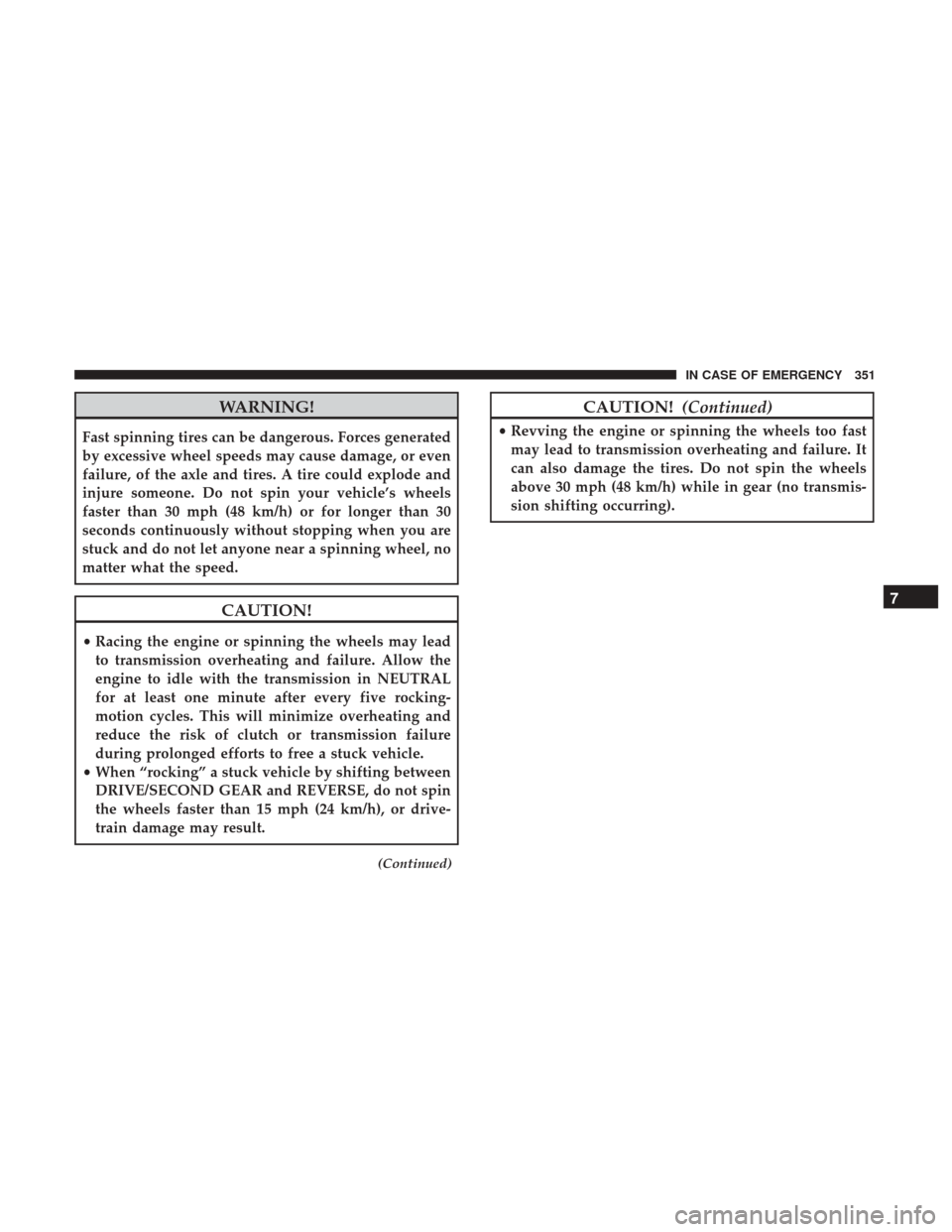
WARNING!
Fast spinning tires can be dangerous. Forces generated
by excessive wheel speeds may cause damage, or even
failure, of the axle and tires. A tire could explode and
injure someone. Do not spin your vehicle’s wheels
faster than 30 mph (48 km/h) or for longer than 30
seconds continuously without stopping when you are
stuck and do not let anyone near a spinning wheel, no
matter what the speed.
CAUTION!
•Racing the engine or spinning the wheels may lead
to transmission overheating and failure. Allow the
engine to idle with the transmission in NEUTRAL
for at least one minute after every five rocking-
motion cycles. This will minimize overheating and
reduce the risk of clutch or transmission failure
during prolonged efforts to free a stuck vehicle.
• When “rocking” a stuck vehicle by shifting between
DRIVE/SECOND GEAR and REVERSE, do not spin
the wheels faster than 15 mph (24 km/h), or drive-
train damage may result.
(Continued)
CAUTION! (Continued)
•Revving the engine or spinning the wheels too fast
may lead to transmission overheating and failure. It
can also damage the tires. Do not spin the wheels
above 30 mph (48 km/h) while in gear (no transmis-
sion shifting occurring).
7
IN CASE OF EMERGENCY 351
Page 354 of 529

TOWING A DISABLED VEHICLE
This section describes procedures for towing a disabled
vehicle using a commercial towing service. If the transmis-
sion and drivetrain are operable, disabled vehicles mayalso be towed as described under “Recreational Towing” in
the “Starting And Operating” section.
Towing
Condition Wheels
OFF The Ground 2WD Models 4WD Models
Flat Tow NONE If transmission is operable:
•Transmission in NEUTRAL
• 30 mph (48 km/h) max speed
• 15 miles (24 km) maxdistance See instructions in “Recreational Tow-
ing” under “Starting And Operating”
•
Auto Transmission in PARK
• Manual Transmission in gear ( NOT
NEUTRAL)
• Transfer Case in NEUTRAL
• To w i n forward direction
Wheel Lift Or Dolly To w Front
NOT ALLOWED
Rear OK NOT ALLOWED
Flatbed ALL BEST METHOD BEST METHOD
Proper towing or lifting equipment is required to prevent
damage to your vehicle. Use only tow bars and other
equipment designed for this purpose, following equipment
manufacturer ’s instructions. Use of safety chains is man-
datory. Attach a tow bar or other towing device to main structural members of the vehicle, not to bumpers or
associated brackets. State and local laws regarding vehicles
under tow must be observed.
352 IN CASE OF EMERGENCY
Page 355 of 529

If you must use the accessories (wipers, defrosters, etc.)
while being towed, the ignition must be in the ON/RUN
mode, not the ACC mode.
If the key fob is unavailable or the vehicle’s battery is
discharged, refer to “Gear Selector Override” in this section
for instructions on shifting the automatic transmission out
of PARK for towing.
CAUTION!
•Do not use sling type equipment when towing.
Vehicle damage may occur.
• When securing the vehicle to a flat bed truck, do not
attach to front or rear suspension components. Dam-
age to your vehicle may result from improper towing.
Two-Wheel Drive Models
The manufacturer recommends towing your vehicle with
all four wheels OFFthe ground using a flatbed.
If flatbed equipment is not available, and the transmission
is operable, the vehicle may be towed (with the rear wheels
on the ground) under the following conditions:
• The transmission must be in NEUTRAL. •
The towing speed must not exceed 30 mph (48 km/h).
• The towing distance must not exceed 15 miles (24 km).
If the transmission is not operable, or the vehicle must be
towed faster than 30 mph (48 km/h) or farther than 15
miles (24 km), tow with the rear wheels OFFthe ground.
Acceptable methods are to tow the vehicle on a flatbed, or
with the front wheels raised and the rear wheels on a
towing dolly, or (when using a suitable steering wheel
stabilizer to hold the front wheels in the straight position)
with rear wheels raised and the front wheels on the
ground.
CAUTION!
Towing this vehicle in violation of the above require-
ments can cause severe engine and/or transmission
damage. Damage from improper towing is not covered
under the New Vehicle Limited Warranty.
Four-Wheel Drive Models
The manufacturer recommends towing with all wheels
OFF the ground. Acceptable methods are to tow the vehicle
on a flatbed or with one end of vehicle raised and the
opposite end on a towing dolly.
7
IN CASE OF EMERGENCY 353
Page 356 of 529

If flatbed equipment is not available, and the transfer case
is operable, the vehicle may be towed (in the forward
direction, withALLwheels on the ground), IFthe transfer
case is in NEUTRAL and the transmission is in PARK (for
automatic transmissions) or in gear (NOT in NEUTRAL,
for manual transmissions). Refer to “Recreational Towing”
in “Starting And Operating” for further information and
detailed instructions.
CAUTION!
• Front or rear wheel lifts must not be used (if the
remaining wheels are on the ground). Internal dam-
age to the transmission or transfer case will occur if
a front or rear wheel lift is used when towing.
• Towing this vehicle in violation of the above require-
ments can cause severe transmission and/or transfer
case damage. Damage from improper towing is not
covered under the New Vehicle Limited Warranty.
Emergency Tow Hooks — If Equipped
Your vehicle may be equipped with emergency tow hooks.
NOTE: For off-road recovery, it is recommended to use
both of the front tow hooks to minimize the risk of damage
to the vehicle.
WARNING!
• Do not use a chain for freeing a stuck vehicle. Chains
may break, causing serious injury or death.
• Stand clear of vehicles when pulling with tow hooks.
Tow straps may become disengaged, causing serious
injury.
CAUTION!
Tow hooks are for emergency use only, to rescue a
vehicle stranded off road. Do not use tow hooks for
tow truck hookup or highway towing. You could
damage your vehicle.
354 IN CASE OF EMERGENCY
Page 359 of 529

SERVICING AND MAINTENANCE
CONTENTS
�SCHEDULED SERVICING .................359
▫ Maintenance Plan ..................... .360
▫ Heavy Duty Use Of The Vehicle ............363
� ENGINE COMPARTMENT .................364
▫ 6.4L Engine ......................... .364
▫ Checking Oil Level — Gas Engine ...........365
▫ Adding Washer Fluid ...................365
▫ Maintenance-Free Battery .................365
� DEALER SERVICE ...................... .366
▫ Engine Oil — Gas Engine .................367
▫ Engine Oil Filter ...................... .368
▫ Engine Air Cleaner Filter .................368
▫ Air Conditioner Maintenance ..............371▫
Front Driveshaft Lubrication — 2500/3500
(Four-Wheel Drive Models Only) ............377
▫ Accessory Drive Belt Inspection ............377
▫ Body Lubrication ..................... .379
▫ Windshield Wiper Blades .................379
▫ Exhaust System ....................... .382
▫ Cooling System ....................... .384
▫ Brake System ........................ .388
▫ Automatic Transmission ..................389
▫ Rear Axle And 4x4 Front Driving Axle Fluid
Level .............................. .392
▫ Transfer Case ........................ .393
� HOISTING ........................... .393
� TIRES ............................... .394
▫ T
ire Safety Information ..................394
8
Page 362 of 529
Maintenance Plan
Required Maintenance
Refer to the maintenance plan on the following pages for
required maintenance.
At Every Oil Change Interval As Indicated By OilChange Indicator System:
•Change oil and filter.
• Rotate the tires. Rotate at the first sign of irregular
wear, even if it occurs before the oil indicator
system turns on.
• Inspect engine cooling system protection and hoses.
• Inspect exhaust system.
• Inspect engine air cleaner if using in dusty or
off-road conditions.
• Inspect battery and clean and tighten terminals as
required.
• Inspect automatic transmission fluid if equipped
with dipstick.
• Inspect brake pads, shoes, rotors, drums, hoses and
park brake.
At Every Oil Change Interval As Indicated By Oil
Change Indicator System:
•Inspect front end, and lubricate — If equipped with
serviceable fittings.
• Lube the front drive shaft fitting (4X4 models only).
360 SERVICING AND MAINTENANCE
Page 364 of 529
Mileage or time passed (which-ever comes first)
20,000
30,000
40,000
50,000
60,000
70,000
80,000
90,000
100,000
110,000
120,000
130,000
140,000
150,000
Or Years: 2 3 4 5 6 7 8 9 10 11 12 13 14 15
Or Kilometers:
32,000
48,000
64,000
80,000
96,000
112,000
128,000
144,000
160,000
176,000
192,000
208,000
224,000
240,000
Change the automatic transmis-
sion fluid (AS66RC Transmission
Only). XX X
Change the automatic transmis-
sion fluid and sump filter (AS66RC
Transmission Only). XX
Change the automatic transmis-
sion fluid and filter(s) (66RFE
Transmission Only), if using your
vehicle for police, taxi, fleet, or fre-
quent trailer towing. XX
Change the automatic transmis-
sion fluid and filter(s) (66RFE
transmission). X
Inspect the transfer case fluid,
change for any of the following:
police, taxi, fleet, or frequent trailer
towing. XX X X X
Change the transfer case fluid. X
362 SERVICING AND MAINTENANCE

