2018 PEUGEOT EXPERT check engine
[x] Cancel search: check enginePage 34 of 416

32
With an LCD instrument panel, "NO START IN"
is displayed.
When driving, this message is displayed every
30 seconds until the AdBlue level has been
topped up.
It is essential to top up as soon as possible and
before the tank is completely empty; other wise
it will not be possible to restart the engine after
the next stop.
For more information on the AdBlue
®
(BlueHDi engines) , and in particular on
topping up, refer to the corresponding
section.
Breakdown related to a lack of AdBlue
®
When switching on the ignition, this
warning lamp flashes, associated
with an audible signal and the
display of the message "Top
up emissions additive: Starting
prevented". With an LCD instrument panel, "NO START IN"
is displayed.
The AdBlue
® tank is empty: the starting
inhibition system required by legislation
prevents starting of the engine.
To be able to restart the engine, it is
essential to add at least 4
litres of AdBlue
®
to its tank.
In the event of a fault with the
SCR emissions control system
An engine immobiliser is activated
automatically after you have driven a
further 685
miles (1,100 km) following
confirmation of a fault with the SCR
emissions control system. Have the
system checked by a PEUGEOT dealer or
a qualified workshop as soon as possible. In the event of the detection of a fault
These warning lamps come on, accompanied
by an audible signal and the display of the
message "Emissions fault".
The alert is triggered while driving as soon
as the fault is detected for the first time, then
when switching on the ignition for subsequent
journeys, while the fault persists.
If it is a temporary fault, the alert
disappears during the next journey,
after self-diagnostic checks of the SCR
emissions control system.
Instruments
Page 46 of 416

44
Anti-theft protection
Electronic engine immobiliser
The remote control contains an electronic chip
which has a secret code. When the ignition is
switched on, this code must be recognised in
order for starting to be possible.
A few seconds after switching off the ignition,
this system locks the engine control system,
therefore preventing the engine from being
started in the event of a break-in.In the event of a fault, you are
informed by illumination of this
warning lamp, an audible signal and
a message in the screen.
The vehicle will not start; contact a PEUGEOT
dealer as soon as possible.
B a c k- u p c o nt r o l (s)
Locking the driver's door
F Insert the key in the door lock, then turn it to the rear.
Unlocking
F Insert the key in the door lock, then turn it to the front. If your vehicle has an alarm, it will not be
deactivated/activated on unlocking/locking
the vehicle.
Opening a door will trigger the alarm,
which can be stopped by switching the
ignition on.
Locking the front
passenger door
F Open the door.
F
R
emove the cap on the edge of the door.
F
I
nsert the key into the latch aperture
(without forcing) and turn the assembly.
F
R
emove the key and refit the cap.
F
C
lose the door and check from the outside
that it has locked correctly.
For mechanically locking and unlocking the
doors in the event of a fault with the central
locking system or a battery failure.
Access
Page 73 of 416
71
Manual or electric sliding
side door(s)
General recommendations
The doors must only be operated when
the vehicle is stationary.
For your safety and for that of your
passengers, as well as for correct
operation of the doors, you are strongly
advised not to drive with a door open.
Always check that it is safe to operate the
door and in particular, be sure not to leave
children or animals near the door controls
without supervision.
The audible warning, illumination of
the "door open" warning lamp and the
message in the multifunction screen are
there to remind you. Contact a PEUGEOT
dealer or a qualified workshop to
deactivate these warnings.
Lock your vehicle when using an
automatic car wash.Before opening or closing or per forming
any movement of the doors, ensure that
no person, animal or object is in the door
frame or can block the desired movement,
inside or outside the vehicle.
If this advice is not followed, injuries or
damage may occur if a person or an
object is trapped or caught.
The doors cannot be opened electrically
above 2
mph (3 km/h):
-
B
ut if the doors remained open when
starting, the speed must fall below
19
mph (30 km/h) before they can be
closed.
-
A
ny attempt to open a door electrically
using the interior handle while driving
results in it only being possible to open
the door manually.
-
T
his situation is accompanied by the
audible warning, illumination of the
"door open" warning lamp and the
message in the multifunction screen.
To release the door and be able to
operate it again, it is necessary to stop
the vehicle. The electric controls are inhibited in the
event of an impact. Manual opening and
closing remain possible.
While starting the engine, the movement
of a door is interrupted and restored once
the engine is running.
Depending on the engine, in Stop
mode of Stop & Start, if the door
is closed and you initiate opening
of the door, the door opens
partially and stops. When the
engine changes automatically to
Start mode, the door continues its
movement.
2
Access
Page 80 of 416
78
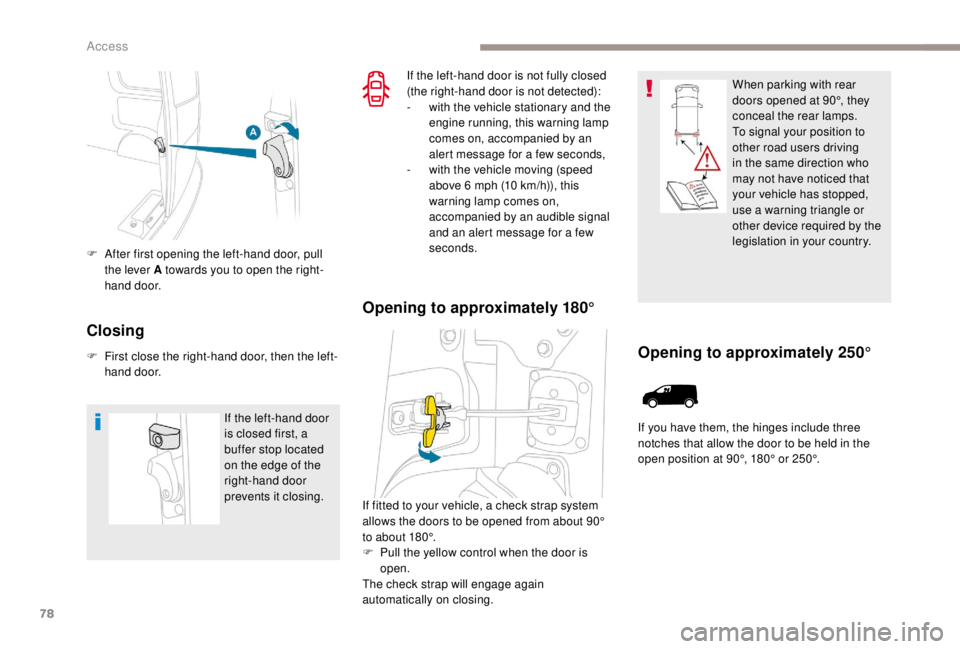
F After first opening the left-hand door, pull the lever A towards you to open the right-
hand door.
Closing
F First close the right-hand door, then the left-hand door.
If the left-hand door
is closed first, a
buffer stop located
on the edge of the
right-hand door
prevents it closing. If the left-hand door is not fully closed
(the right-hand door is not detected):
-
w
ith the vehicle stationary and the
engine running, this warning lamp
comes on, accompanied by an
alert message for a few seconds,
-
w
ith the vehicle moving (speed
above 6 mph (10 km/h)), this
warning lamp comes on,
accompanied by an audible signal
and an alert message for a few
seconds.
Opening to approximately 180°
If fitted to your vehicle, a check strap system
allows the doors to be opened from about 90°
to about 180°.
F
P
ull the yellow control when the door is
open.
The check strap will engage again
automatically on closing. When parking with rear
doors opened at 90°, they
conceal the rear lamps.
To signal your position to
other road users driving
in the same direction who
may not have noticed that
your vehicle has stopped,
use a warning triangle or
other device required by the
legislation in your country.
Opening to approximately 250°
If you have them, the hinges include three
notches that allow the door to be held in the
open position at 90°, 180° or 250°.
Access
Page 91 of 416
89
Table position for the
driver's and/or the front
passenger seat backrest
Check that there is no object that could
inter fere with the movement of a seat,
both above and below.
F
P
lace the head restraint in the low position,
and if fitted to your vehicle, raise the
armrest and fold the table on the back of the
seat.
Deactivation of the passenger front airbag
is recommended.
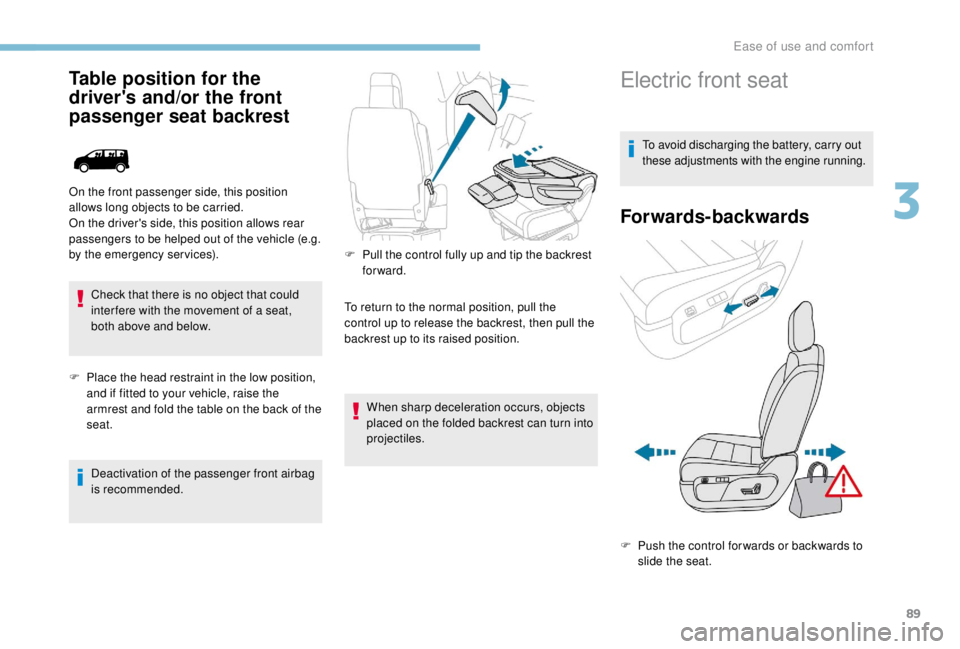
On the front passenger side, this position
allows long objects to be carried.
On the driver's side, this position allows rear
passengers to be helped out of the vehicle (e.g.
by the emergency services).
F
P
ull the control fully up and tip the backrest
forward.
To return to the normal position, pull the
control up to release the backrest, then pull the
backrest up to its raised position.
When sharp deceleration occurs, objects
placed on the folded backrest can turn into
projectiles.
Electric front seat
To avoid discharging the battery, carry out
these adjustments with the engine running.
Forwards-backwards
F Push the control for wards or backwards to slide the seat.
3
Ease of use and comfort
Page 125 of 416
123
Advice
In order for these systems to be fully effective,
follow the operation and maintenance
guidelines below:
F
T
o ensure that the air is distributed evenly,
keep the external air intake grilles at the
base of the windscreen, the nozzles, the
vents, the air outlets and the air extractor
located in the rear free from obstructions.
F
D
o not cover the sunshine sensor, located
at the top of the windscreen; this is used
for regulation of the air conditioning
system.
F
O
perate the air conditioning system for
at least 5
to 10 minutes, once or twice a
month to keep it in per fect working order.
F
T
o prevent misting or deteriorating air
quality inside the passenger compartment,
you should not deactivate the system for
too long and avoid extended operation of
the air recycling system when driving.
F
E
nsure that the passenger compartment
filter is in good condition and have the
filter elements replaced regularly. We recommend the use of a combined
passenger compartment filter. Thanks to
its special active additive, it contributes
to the purification of the air breathed by
the occupants and the cleanliness of the
passenger compartment (reduction of allergic
symptoms, bad odours and greasy deposits).
F
T
o ensure correct operation of the air
conditioning system, you are also advised
to have it checked in accordance with the
recommendations in the Warranty and
Maintenance Record.
F
I
f the system does not produce cold air,
switch it off and contact a PEUGEOT
dealer or a qualified workshop.
When towing the maximum load on a steep
gradient in high temperatures, switching off
the air conditioning increases the available
engine power and so improves the towing
ability. Vents
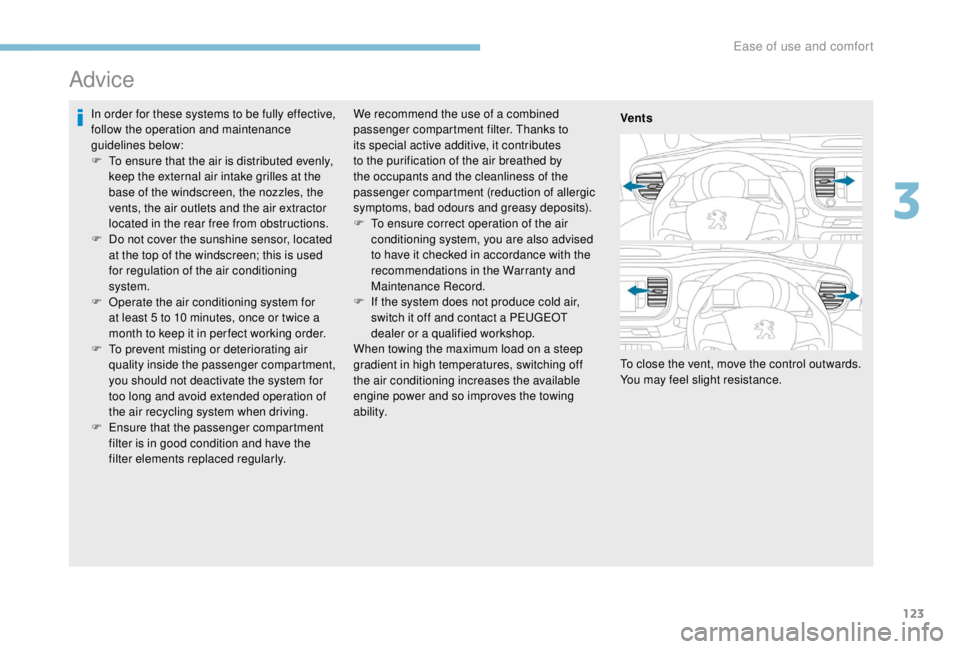
To close the vent, move the control outwards.
You may feel slight resistance.
3
Ease of use and comfort
Page 148 of 416
146
Emergency braking assistance
(EBA)
In an emergency, this system permits the
optimum braking pressure to be reached
more quickly, therefore reducing the stopping
distance.
It is triggered in relation to the speed at which
the brake pedal is pressed. The effect of this is
a reduction in the resistance of the pedal and
an increase in braking efficiency.
Anti-slip regulation (ASR)
The ASR system (also known as Traction
Control) optimises traction in order to limit
wheel slip by acting on the brakes of the driving
wheels and on the engine. It also improves
the directional stability of the vehicle on
acceleration.
Dynamic stability control (DSC)
If there is a difference between the path
followed by the vehicle and that required by
the driver, the DSC monitors each wheel and
automatically acts on the brake of one or more
wheels and on the engine to return the vehicle
to the required path, within the limits of the laws
of physics.
Intelligent traction control
If your vehicle has this system, it features a
system to help driving on snow: intelligent
traction control.
This system detects situations of difficult
sur face grip that could make it difficult to move
off or make progress on deep fresh snow or
compacted snow.
In these situations, the intelligent traction
control limits the amount of wheel spin to
provide the best traction and trajectory control
for your vehicle.
The use of snow tyres is strongly
recommended on sur faces offering low
levels of grip.
Anti-lock braking system
(ABS) and electronic brake
force distribution (EBFD)
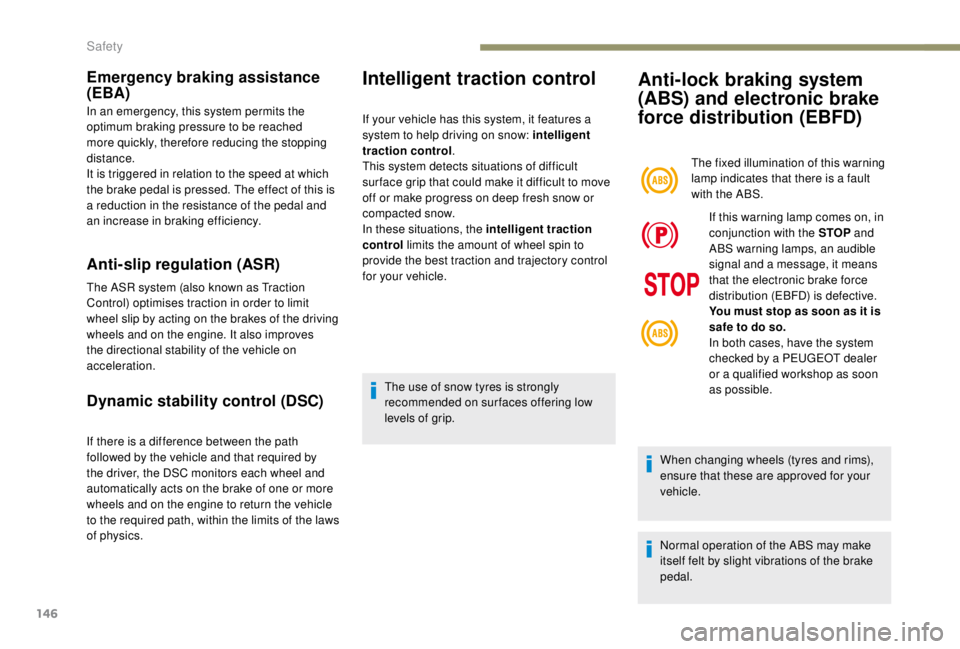
The fixed illumination of this warning
lamp indicates that there is a fault
with the ABS.If this warning lamp comes on, in
conjunction with the STOP and
ABS warning lamps, an audible
signal and a message, it means
that the electronic brake force
distribution (EBFD) is defective.
You must stop as soon as it is
safe to do so.
In both cases, have the system
checked by a PEUGEOT dealer
or a qualified workshop as soon
as possible.
When changing wheels (tyres and rims),
ensure that these are approved for your
vehicle.
Normal operation of the ABS may make
itself felt by slight vibrations of the brake
pedal.
Safety
Page 149 of 416
147
If you need to brake in an emergency,
press the brake pedal ver y firmly and
keep the pressure applied.
After an impact, have the system checked
by a PEUGEOT dealer or a qualified
workshop.
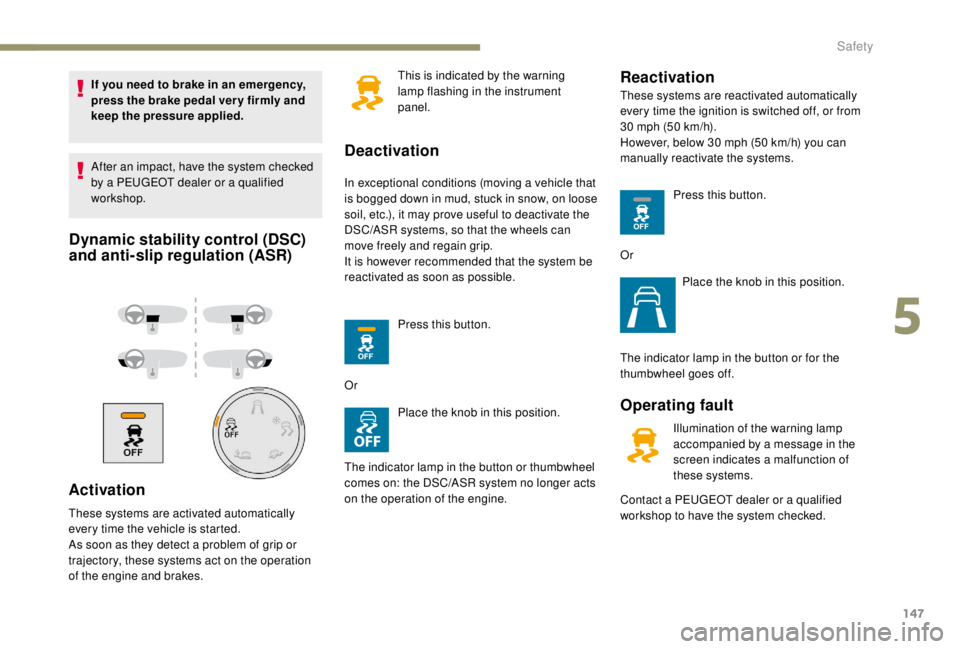
Dynamic stability control (DSC)
and anti-slip regulation (ASR)
Activation
These systems are activated automatically
every time the vehicle is started.
As soon as they detect a problem of grip or
trajectory, these systems act on the operation
of the engine and brakes. This is indicated by the warning
lamp flashing in the instrument
panel.
Deactivation
In exceptional conditions (moving a vehicle that
is bogged down in mud, stuck in snow, on loose
soil, etc.), it may prove useful to deactivate the
DSC/ASR systems, so that the wheels can
move freely and regain grip.
It is however recommended that the system be
reactivated as soon as possible.
Press this button.
Or Place the knob in this position.
The indicator lamp in the button or thumbwheel
comes on: the DSC/ASR system no longer acts
on the operation of the engine.
Reactivation
These systems are reactivated automatically
every time the ignition is switched off, or from
30 mph (50 km/h).
However, below 30
mph (50 km/h) you can
manually reactivate the systems.
Press this button.
Or Place the knob in this position.
The indicator lamp in the button or for the
thumbwheel goes off.
Operating fault
Illumination of the warning lamp
accompanied by a message in the
screen indicates a malfunction of
these systems.
Contact a PEUGEOT dealer or a qualified
workshop to have the system checked.
5
Safety