Page 13 of 702
1. Antenna (P. 4-48)
2. Rear window defroster switch
(P. 2-22)
3. Trunk lid release (P. 3-11)
4. Rearview camera (if so equipped)
(P. 4-2)
5. Replacing bulbs (P. 8-22)
6. Fuel-filler door (P. 3-13)
Fuel-filler cap (P. 3-13)
Fuel recommendation (P. 10-2)
7. Child safety rear door locks (P. 3-3)
Refer to the page number indicated in
parentheses for operating details.
LII2462
EXTERIOR REAR
0-4Illustrated table of contents
Page 24 of 702

∙ Properly secure all cargo with ropes or
straps to help prevent it from sliding
or shif ting. Do not place cargo higher
than the seatbacks. In a sudden stop
or collision, unsecured cargo could
cause personal injury.
∙ When returning the seatbacks to the
upright position, be certain they are
completely secured in the latched po-
sition. If they are not completely se-
cured, passengers may be injured in
an accident or sudden stop.
∙ Closely supervise children when they
are around the cars to prevent them
from playing and becoming locked in
the trunk where they could be seri-
ously injured. Keep the car locked,
with the rear seatback and trunk lid
securely latched when not in use, and
prevent children’s access to car keys.
ARMREST (if so equipped for
driver’s side only)
To use the armrest, pull it down to the rest-
ing position.
�AStowed position
�BResting position
WARNING
Head restraints/headrests supplement
the other vehicle safety systems. They
may provide additional protection
against injury in certain rear end colli-
sions. Adjustable head
restraints/headrests must be adjusted
properly, as specified in this section.
Check the adjustment af ter someone
else uses the seat. Do not attach any-
thing to the head restraint/headrest
stalks or remove the head
restraint/headrest. Do not use the seat
if the head restraint/headrest has been
removed. If the head restraint/headrest
was removed, reinstall and properly ad-
just the head restraint/headrest before
an occupant uses the seating position.
Failure to follow these instructions can
reduce the effectiveness of the head
restraints/headrests. This may in-
crease the risk of serious injury or death
in a collision.
LRS2454
HEAD RESTRAINTS/HEADRESTS
Safety—Seats, seat belts and supplemental restraint system1-5
Page 82 of 702

2 Instruments and controls
Instrument panel................................2-2
Meters and gauges..............................2-3
Speedometer and odometer.................2-5
Tachometer..................................2-8
Engine coolant temperature gauge
(if so equipped)...............................2-9
Fuel gauge...................................2-9
Trip computer...............................2-10
Warning lights, indicator lights and audible
reminders......................................2-12
Checking lights..............................2-13
Warning lights...............................2-13
Indicator lights..............................2-18
Audible reminders...........................2-20
Wiper and washer switch.......................2-21
Switch operation............................2-21
Rear window defroster switch..................2-22
Headlight and turn signal switch...............2-22
Headlight control switch.....................2-22Instrument brightness control...............2-24
Turn signal switch...........................2-24
Fog light switch (if so equipped).............2-25
Horn...........................................2-25
Vehicle Dynamic Control (VDC) OFF switch......2-26
Power outlets..................................2-26
Storage ........................................2-27
Front-door pockets..........................2-27
Seatback pocket (if so equipped)............2-28
Storagetray.................................2-28
Glovebox....................................2-29
Cup holders.................................2-29
Windows.......................................2-30
Power windows (if so equipped).............2-30
Manual windows (if so equipped)............2-32
Interior lights...................................2-32
Map light (if so equipped)....................2-33
Trunk light......................................2-34
Page 115 of 702

When the switch is in the DOOR position�2,
the map light will stay on for a period of
time when:
∙ The doors are unlocked by the key fob (if
so equipped), a key or the power door
lock switch while all doors are closed
and the ignition switch is placed in the
OFF position.
∙ The driver’s door is opened and then
closed while the key is removed from
the ignition switch.
∙ The key is removed from the ignition
switch while all doors are closed.
The light will turn off while the timer is acti-
vated when:
∙ The driver’s door is locked by the key fob
(if so equipped), a key, or the power door
lock switch.
∙ The ignition switch is placed in the ON
position.
When the switch is in the OFF position
�1,
the map light does not illuminate, regard-
less of door position.
The light will turn off automatically af ter a
period of time while doors are open to pre-
vent the battery from becoming dis-
charged.
CAUTION
Do not use for extended periods of time
with the engine stopped. This could re-
sult in a discharged battery.The light illuminates when the trunk lid is
opened. When the trunk lid is closed, the
light goes off. For additional information,
refer to “Exterior and interior lights” in the
“Do-it-yourself ” section of this manual.
TRUNK LIGHT
2-34Instruments and controls
Page 116 of 702

3 Pre-driving checks and adjustments
Keys.............................................3-2
Doors...........................................3-3
Locking with key..............................3-4
Locking with inside lock knob.................3-4
Locking with power door lock switch
(if so equipped)...............................3-5
Automatic door locks (if so equipped)........3-5
Child safety rear door lock....................3-6
Remote keyless entry system (if so equipped) . . . 3-6
How to use remote keyless entry
system....................................... 3-7
Hood...........................................3-10
Trunk lid.........................................3-11Key operation................................3-11
Opener operation (if so equipped)...........3-12
Interior trunk lid release.....................3-12
Fuel-filler door..................................3-13
Opener operation...........................3-13
Fuel-filler cap................................3-13
Steering wheel.................................3-16
Tilt operation................................3-16
Sun visors......................................3-16
Vanity mirror................................3-17
Mirrors.........................................3-17
Rearview mirror.............................3-17
Outside mirrors.............................3-17
Page 123 of 702

Unlocking doors
Press thebutton on the key fob once.
∙ Only the driver’s door unlocks.
∙ The hazard warning lights flash once if
all doors are completely closed with the
ignition switch in any position except
the ON position.
∙ The interior light turns on and the light
timer activates for 30 seconds when
the interior light switch is in the DOOR
position with the ignition switch in any
position except the ON position.Press the
button on the key fob again
within five seconds.
∙ All doors unlock.
∙ The hazard warning lights flash once if
all doors are completely closed.
The interior lights can be turned off without
waiting a period of time by inserting the key
into the ignition switch and placing the ig-
nition switch in the ON or START position,
locking the doors with the key fob, power
door lock switch or pushing the interior
light switch to the off position.
Auto relock
When thebutton on the key fob is
pressed, all doors will lock automatically
within 1 minute unless one of the following
operations is performed:
∙ Any door is opened.
∙ A key is inserted into the ignition switch
and the switch is cycled from OFF to ON.
∙ Press the
button.
Releasing the trunk lid
Press thebutton on the key fob for
longer than 0.5 seconds to open the trunk
lid. The trunk release button on the key fob
will not operate when the ignition switch is
placed in the ON position.
LPD2029LPD2030
3-8Pre-driving checks and adjustments
Page 126 of 702
WARNING
∙ Make sure the hood is completely
closed and latched before driving.
Failure to do so could cause the hood
to fly open and result in an accident.
∙ If you see steam or smoke coming
from the engine compartment, to
avoid injury do not open the hood.
WARNING
∙ Do not drive with the trunk lid open.
This could allow dangerous exhaust
gases to be drawn into the vehicle. For
additional information, refer to “Ex-
haust gas (carbon monoxide)” in the
“Starting and driving” section of this
manual.
∙ Closely supervise children when they
are around cars to prevent them from
playing and becoming locked in the
trunk where they could be seriously
injured. Keep the car locked, with the
rear seatback and trunk lid securely
latched when not in use, and prevent
children’s access to car keys.
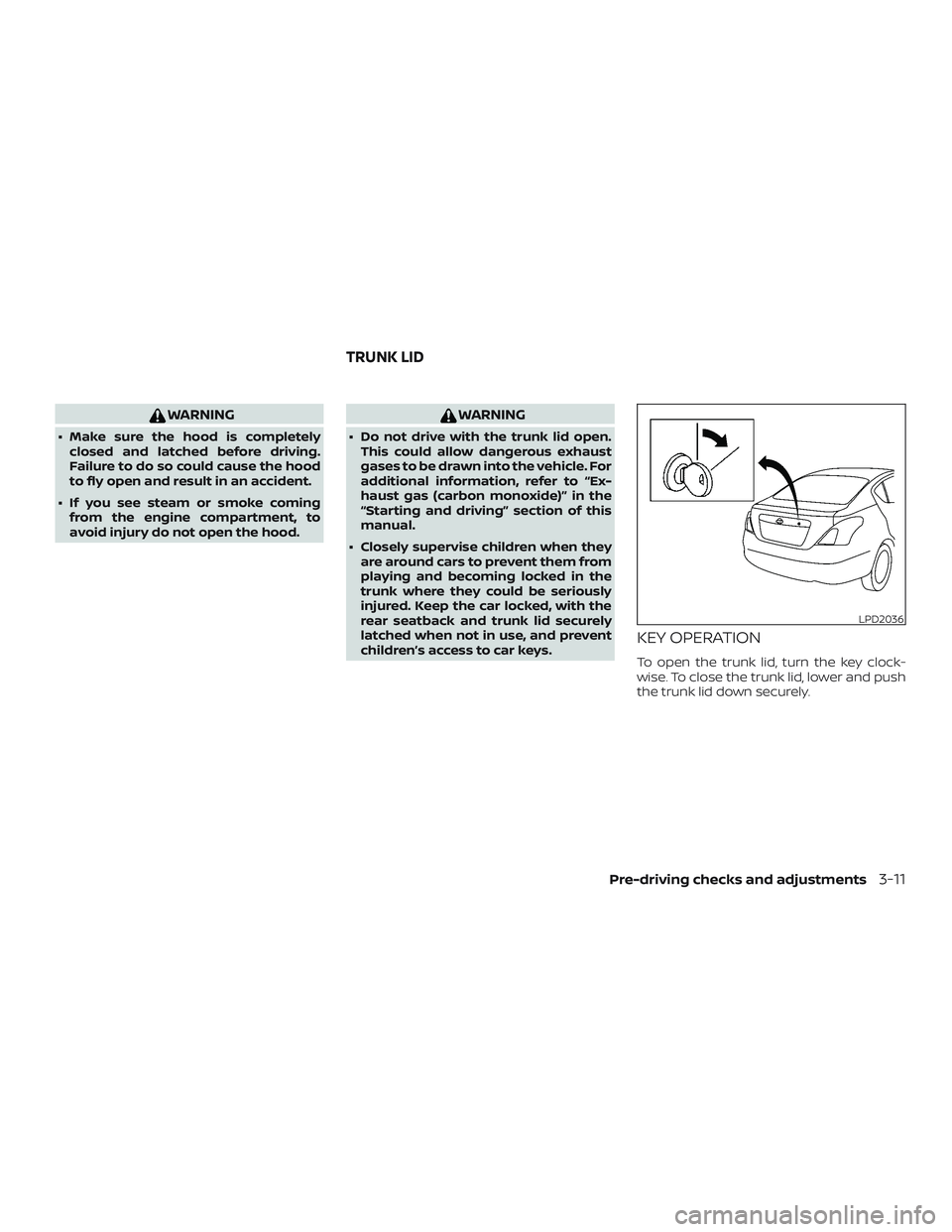
KEY OPERATION
To open the trunk lid, turn the key clock-
wise. To close the trunk lid, lower and push
the trunk lid down securely.
LPD2036
TRUNK LID
Pre-driving checks and adjustments3-11
Page 127 of 702

OPENER OPERATION (if so
equipped)
WARNING
∙ Do not drive with the trunk lid open.
This could allow dangerous exhaust
gases to be drawn into the vehicle. For
additional information, refer to “Ex-
haust gas (carbon monoxide)” in the
“Starting and driving” section of this
manual.∙ Closely supervise children when they
are around cars to prevent them from
playing and becoming locked in the
trunk where they could be seriously
injured. Keep the car locked, with the
rear seatback and trunk lid securely
latched when not in use, and prevent
children’s access to car keys.
The trunk lid release is located on the floor
to the lef t of the driver’s seat.
To open the trunk lid, pull the opener lever
up.
To close the trunk lid, lower and push the
trunk lid down securely.
INTERIOR TRUNK LID RELEASE
WARNING
Closely supervise children when they
are around cars to prevent them from
playing and becoming locked in the
trunk where they could be seriously in-
jured. Keep the car locked, with the rear
seatback and trunk lid securely latched
when not in use, and prevent children’s
access to car keys.
LPD2215LPD0396
3-12Pre-driving checks and adjustments